1. Background
Antibiotics transformed modern medicine by enabling the treatment of many bacterial infections that were once life-threatening. Among these agents, penicillin occupies a unique position as the first antibiotic to be widely used and remains an important drug in both human and veterinary medicine. Despite decades of clinical and industrial use, penicillin and its derivatives remain valuable because they are effective, relatively safe, and widely used to treat a broad range of infections. Accordingly, improving the efficiency and cost-effectiveness of penicillin production remains an important topic in biotechnology and industrial microbiology (1).
Penicillin is produced primarily by fungi of the genus Penicillium, particularly Penicillium chrysogenum (2). This filamentous fungus has long been used in industrial fermentation because it grows well on defined media and produces penicillin under suitable conditions (2, 3). Penicillin production is not a single-step process but comprises a sequence of interconnected stages. It begins with the preparation of a stable, active spore culture, continues with inoculum development and growth under controlled fermentation conditions, and ends with the extraction and purification of the antibiotic from the culture broth (1, 3). Within this process, the quality of the spore inoculum is critical because it influences the growth rate, fungal biomass formation, and the final antibiotic production level (4).
Spore formation, or sporulation, is particularly important in fungal biotechnology. Spores are the starting biological material for culture maintenance and inoculation; therefore, they must be produced in large numbers, remain viable during storage, and germinate rapidly and uniformly when transferred to production media (5). An appropriate sporulation substrate should support healthy fungal growth, promote abundant spore formation, and allow easy handling and transfer to the production process. If the substrate is suboptimal, the resulting spore culture may be weak, heterogeneous, or difficult to standardize, which can reduce fermentation performance and lower antibiotic yield (1). Therefore, the choice of carrier or substrate for sporulation is not a minor technical detail but a key factor in industrial penicillin production.
Traditionally, proso millet (Panicum miliaceum) has been used in many laboratories and production settings as a carrier for fungal sporulation (6, 7). It offers several advantages, including a surface structure that supports fungal colonization, suitable nutritional content, and favorable physical properties for spore formation and storage (8). However, it also has important limitations. In some regions, it is not readily available, its price may be relatively high, and its use may depend on importation or constrained supply chains. These constraints create a practical need to identify alternative local substrates that are less expensive, more accessible, and still effective for sporulation and subsequent penicillin production.
Rice (Oryza sativa) is widely available in many parts of the world and may serve as a practical alternative to proso millet as a carrier for fungal sporulation. As a solid substrate, rice can support fungal growth and spore development in a simple and cost-effective manner (9). Because it is often readily obtainable and widely available in many settings, it may provide a practical option for industrial fermentation, although its economic performance would require a separate formal analysis.
2. Objectives
Previous studies have shown that the choice of sporulation substrate can affect spore quality, fungal growth, and final antibiotic production (10, 11). Accordingly, this study investigated whether native rice can replace proso millet as a spore carrier for P. chrysogenum in penicillin fermentation. The primary objective was to compare the two substrates and determine whether rice can support efficient production without a loss of performance.
3. Methods
3.1. Fungal Strain
The strain used in this study was P. chrysogenum A5-1-1, obtained from Shafa Faramarz Co. (Iran).
3.2. Colony Selection and Maintenance
To obtain a clean, active fungal culture, the strain was first grown on a colony selection medium containing glycerol (7.5 g), brown sugar (10 g), sodium chloride (10 g), calcium sulfate (0.25 g), yeast extract (3 g), ammonium ferrous sulfate 1% solution (0.15 mL), magnesium sulfate 1% solution (0.5 mL), potassium dihydrogen phosphate 1% solution (0.6 mL), copper sulfate 1% solution (0.1 mL), agar (25 g), and distilled water to 1000 mL, with the pH adjusted to 6.9 to 7.0. The medium was sterilized at 121°C for 20 minutes.
A P. chrysogenum suspension was then added to the colony selection medium, and the plates were incubated at 25°C for 7 days. After incubation, the best colony was selected based on its white color, compact growth, and a colony diameter of 10 to 13 mm. The selected colony was transferred to a Roux bottle and incubated at 25°C and 35% to 40% humidity for 9 days. At the end of incubation, the grown mycelium was scraped from the surface using a 2 mL pipette, and 28 mL of sterile water was added to prepare the spore suspension for the next stage.
3.3. Preparation of the Sporulation Substrates
For sporulation medium preparation, 2 g corn steep liquor, 0.6 g sodium nitrate, 0.4 g sodium chloride, 0.05 g magnesium sulfate, 0.01 mL copper sulfate, 0.03 mL iron chloride, 0.6 g potassium dihydrogen phosphate, 2 g yeast extract, and 75 mL distilled water were mixed. The pH was set at 6.2. Proso millet grains (250 g) were soaked in the sporulation medium for 1 hour, cooked until soft, and allowed to cool. The grains were then packed into Roux bottles using sterile cotton plugs and wrapped with sterile material to protect the contents from contamination. The packed bottles were autoclaved at 121°C for 20 minutes and allowed to cool before inoculation. The same procedure was used for rice, with rice replacing millet and the remainder of the process unchanged.
3.4. Inoculation of Mycelial Suspension Into the Sporulation Medium
After the mycelial suspension was prepared from the selected colony (section 3.2), 5 mL of the suspension was transferred aseptically into each flask containing the sterile sporulation medium. The control flasks contained proso millet, and the treatment flasks contained rice as the solid carrier. In both cases, the inoculated flasks were mixed gently to distribute the suspension evenly over the substrate surface and then incubated for 7 days. This step was performed to initiate fungal growth on the 2 carriers and compare their performance under identical conditions.
3.5. Seed Culture Preparation
The seed medium was prepared with 100 mL distilled water, 6.7 g corn steep liquor, 2 g sugar, 0.5 g calcium carbonate, and 1 drop of corn oil. The pH was adjusted to 5.8 to 5.9 before sterilization at 121°C for 20 minutes. After cooling, 18 millet grains containing fungal spores were transferred aseptically into each Erlenmeyer flask containing the seed medium. The flasks were then incubated at 25°C and 240 rpm for 30 hours.
To select the best seed flask, cultures were compared in terms of contamination, visible fungal growth, and packed mycelial volume (PMV). The flask with the best fungal growth and cleanest culture and the highest PMV was selected as the most suitable seed culture for the next stage.
3.6. Packed Mycelial Volume and pH Measurement
Seed culture progress was monitored by measuring PMV and pH. For PMV, a culture broth sample was centrifuged, and the volume of the compact fungal pellet was recorded as PMV. In this study, a PMV of 13% to 18% was considered appropriate for the next stage, and cultures outside this range were not selected for further use. The pH of the culture broth was measured using a pH meter. At this stage, the desirable pH range was 5.8 to 5.9.
3.7. Production Fermentation
For penicillin production, 50 mL of production medium was prepared in 500 mL flasks. The medium contained 2.7 g corn steep liquor, 0.45 g ammonium sulfate, 13 g lactose, 0.4 g potassium dihydrogen phosphate, 1 g calcium carbonate, 100 mL distilled water, 4 drops of corn oil, and 1 drop of 13% phenylacetic acid solution. The pH was adjusted to 6.2 to 6.4. The flasks containing the medium were then sterilized at 121°C for 20 minutes. After cooling, each flask received 5 mL of seed culture and was incubated at 25°C and 240 rpm under 35% to 40% humidity for 8 days. Phenylacetic acid was also added daily until day 7.
3.8. Sampling and Penicillin Analysis
During fermentation, samples were collected on days 4, 6, 7, and 8 to monitor culture progress. At each sampling time, pH was measured with a calibrated pH meter, and PMV was determined as described in section 3.6.
Microscopic observations were performed to monitor fungal growth and morphological changes during fermentation. A Nikon light microscope was used at 100x magnification, and observations were conducted at a standardized time point on days 4, 6, 7, and 8 of fermentation. At least 15 fields per slide were examined, and representative images were selected from multiple observed fields. The assessment was qualitative and based on documented morphological changes between days 4 and 8. No quantitative morphometric scoring or blinded image analysis was performed.
At the end of fermentation, penicillin production was quantified by HPLC using a pharmacopeial penicillin reference standard. The culture broth was first clarified by centrifugation, and the supernatant was analyzed using a Smartline HPLC system (Knauer) equipped with a UV-visible detector and an Agilent reversed-phase C18 column. Separation was performed under isocratic conditions using a phosphate buffer/acetonitrile mobile phase at a flow rate of 1.0 mL/min, with detection at 214 nm and an injection volume of 20 µL. Quantification was based on a calibration curve prepared from penicillin standards in the range of 0.25 to 10 ppm. Each sample was injected in replicate, and penicillin identity was confirmed by retention-time matching with the standard. Penicillin concentration was then calculated from the calibration curve and reported as the final production level for each treatment.
3.9. Experimental Design, Replication, and Statistical Analysis
All fermentation experiments were performed during 2018 to 2019 in the Shafa Pharmed laboratory, Tehran, Iran. Each carrier condition was prepared in triplicate independent fermentation flasks (n = 3). The individual flask was considered the experimental unit for comparisons between rice and proso millet. pH and PMV were measured separately for each biological replicate at each sampling time. For penicillin analysis, clarified supernatants from each biological replicate were analyzed by HPLC.
Three independent fermentation flasks were prepared for each substrate condition (n = 3). The results are presented as mean ± standard deviation (SD). Statistical analyses were performed to evaluate the effects of substrate type and fermentation time on the measured variables. A 2-way analysis of variance was used, followed by the Tukey post hoc test for pairwise comparisons, as appropriate. For direct comparison of final penicillin production on day 8 between the 2 groups, an independent-samples t-test was applied. Differences were considered statistically significant at P < 0.05.
4. Results
In this study, we compared the performance of proso millet and native rice as spore carriers for P. chrysogenum during penicillin fermentation. The 2 systems were evaluated under identical culture conditions by assessing pH changes, PMV, penicillin production, and fungal morphology to determine whether rice could effectively replace millet in the production process.
4.1. pH Changes During Fermentation
During fermentation, the pH of both millet and rice cultures changed gradually, with similar overall patterns across the 2 substrates. In the millet culture, pH started at 6.2 ± 0.024, decreased to 5.75 ± 0.022 by day 4, then increased to 6.2 ± 0.022 on day 6 and reached 6.78 ± 0.022 by day 8. In the rice culture, the initial pH was 6.3 ± 0.016, which decreased to 5.85 ± 0.022 during the early phase of fermentation (day 4). Subsequently, pH increased and reached 6.78 ± 0.026 at the end of the process (day 8) (Table 1). These results indicate that both media supported a normal pH shift during fungal growth, with only minor differences between the 2 systems. The rice medium maintained a slightly more stable pH profile, whereas the millet medium showed a somewhat stronger rise toward the end; the differences were statistically significant on days 0, 4, 6, and 7 (Figure 1).
Table 1.
Raw Data, Mean, and Standard Deviation of pH, Packed Mycelial Volume, and Penicillin Activity During Fermentation in Millet-Based and Rice-Based Cultures
| Parameters and Repeat (n = 3) | Proso millet Day 0 | Proso millet Day 4 | Proso millet Day 6 | Proso millet Day 7 | Proso millet Day 8 | Rice Day 0 | Rice Day 4 | Rice Day 6 | Rice Day 7 | Rice Day 8 |
|---|---|---|---|---|---|---|---|---|---|---|
| pH | ||||||||||
| #1 | 6.2 | 5.73 | 6.23 | 6.46 | 6.76 | 6.3 | 5.84 | 6.45 | 6.67 | 6.76 |
| #2 | 6.23 | 5.74 | 6.18 | 6.47 | 6.77 | 6.32 | 5.88 | 6.38 | 6.65 | 6.77 |
| #3 | 6.17 | 5.78 | 6.19 | 6.49 | 6.81 | 6.28 | 5.83 | 6.4 | 6.74 | 6.82 |
| Average | 6.2 | 5.75 | 6.2 | 6.47 | 6.78 | 6.3 | 5.85 | 6.41 | 6.69 | 6.78 |
| SD | 0.024 | 0.022 | 0.022 | 0.012 | 0.022 | 0.016 | 0.022 | 0.029 | 0.039 | 0.026 |
| PMV (%) | ||||||||||
| #1 | 14 | 31 | 33 | 26 | 26 | 14 | 34 | 33 | 31 | 28 |
| #2 | 15 | 32 | 28 | 26 | 25 | 14 | 33 | 33 | 30 | 29 |
| #3 | 13 | 35 | 29 | 32 | 30 | 14 | 35 | 33 | 33 | 30 |
| Average | 14 | 33 | 30 | 28 | 27 | 14 | 34 | 33 | 31 | 29 |
| SD | 0.816 | 1.7 | 2.16 | 2.828 | 2.16 | 0 | 0.816 | 0 | 1.247 | 0.816 |
| Penicillin activity (IU/mL) | ||||||||||
| #1 | 0 | 2902 | 9466 | 10650 | 10702 | 0 | 3023 | 9999 | 11713 | 12010 |
| #2 | 0 | 2986 | 9816 | 10870 | 10952 | 0 | 3018 | 9954 | 12118 | 12120 |
| #3 | 0 | 3108 | 10016 | 11030 | 11052 | 0 | 3019 | 9658 | 11916 | 11900 |
| Average | 0 | 2998 | 9766 | 10850 | 10902 | 0 | 3020 | 9870 | 11915 | 12010 |
| SD | 0 | 84.575 | 227.303 | 155.778 | 147.196 | 0 | 2.16 | 151.262 | 165.341 | 89.815 |
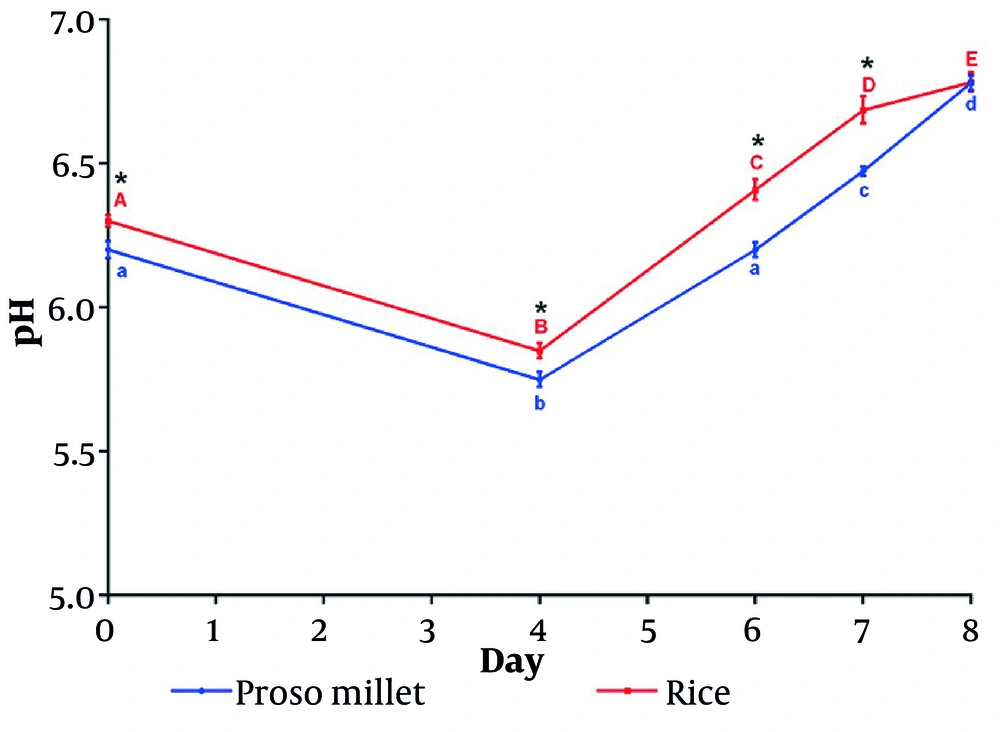
Figure 1.
Changes in pH during fermentation in cultures prepared with proso millet and rice as spore carriers. Data are shown as mean ± SD of three independent repeats (n = 3). Asterisks (*) indicate statistically significant differences between millet and rice at the same time point (P < 0.05). Differences between time points within the rice group are indicated by uppercase letters (A-E), and differences within the millet group are indicated by lowercase letters (a-d). Time points sharing at least 1 letter are not significantly different.
4.2. Packed Mycelial Volume
PMV increased in both cultures as fermentation progressed, indicating robust fungal biomass development on both carriers. In the millet system, PMV increased from 14 ± 0.816% to 33 ± 1.7% by day 4. Values then remained at approximately 27% to 30% during the later stages of growth. In the rice system, PMV similarly increased up to day 4, reaching 34 ± 0.816%, and then gradually decreased to 29 ± 0.816% at the end of the process (day 8) (Table 1). Although the day-to-day patterns differed slightly, the 2 carriers yielded very similar overall results. These findings suggest that rice supported fungal biomass formation as effectively as millet and did not reduce the growth capacity of P. chrysogenum (Figure 2).
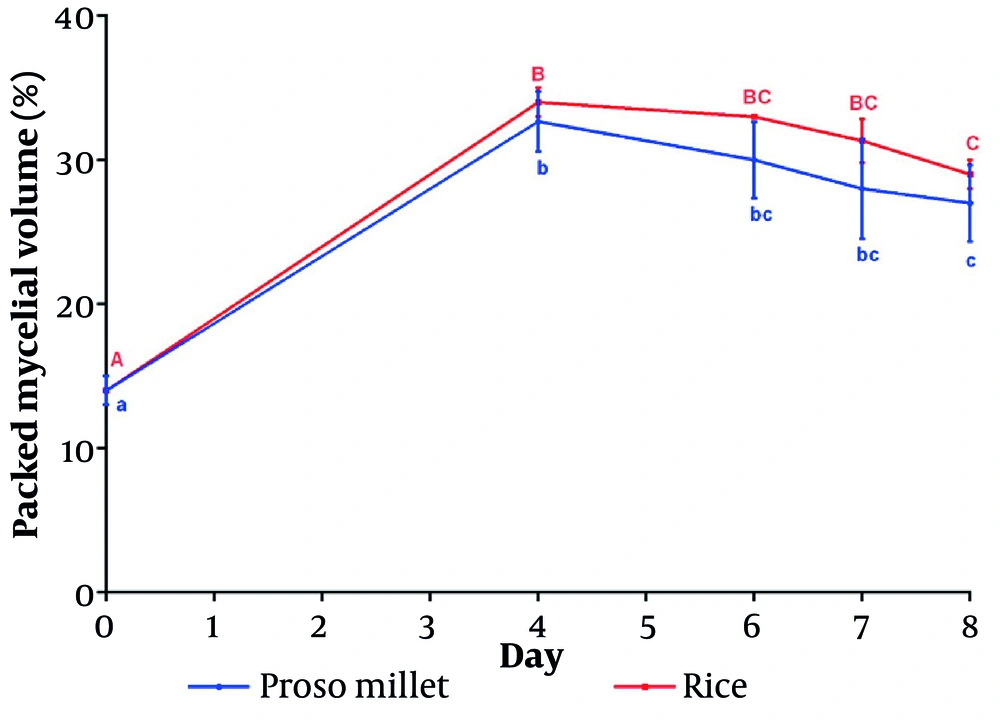
Figure 2.
Changes in packed mycelial volume (PMV) during fermentation in cultures prepared with proso millet and rice as spore carriers. Data are shown as mean ± SD of three independent repeats (n = 3). No statistically significant differences were observed between millet and rice at any time point. Differences between time points within the rice group are indicated by uppercase letters (A-C), and differences within the millet group are indicated by lowercase letters (a-c). Time points sharing at least 1 letter are not significantly different.
4.3. Penicillin Production
Penicillin production increased in both systems as fermentation progressed, but the rice culture produced a higher final yield. In the millet-based culture, penicillin activity increased during the later days of fermentation and reached 9766 ± 227.303 IU/mL on day 6, 10850 ± 155.778 IU/mL on day 7, and 10902 ± 147.196 IU/mL at the end of the process (day 8). In the rice-based culture, penicillin activity also increased steadily and reached 12010 ± 89.815 IU/mL on day 8 (end of the process) (Table 1). Thus, under identical culture conditions, the rice system produced more penicillin than the millet system. Rice yielded approximately 1.1-fold higher production than millet. These findings indicate that, under the tested conditions, rice achieved a significantly higher final penicillin yield than proso millet (Figure 3).
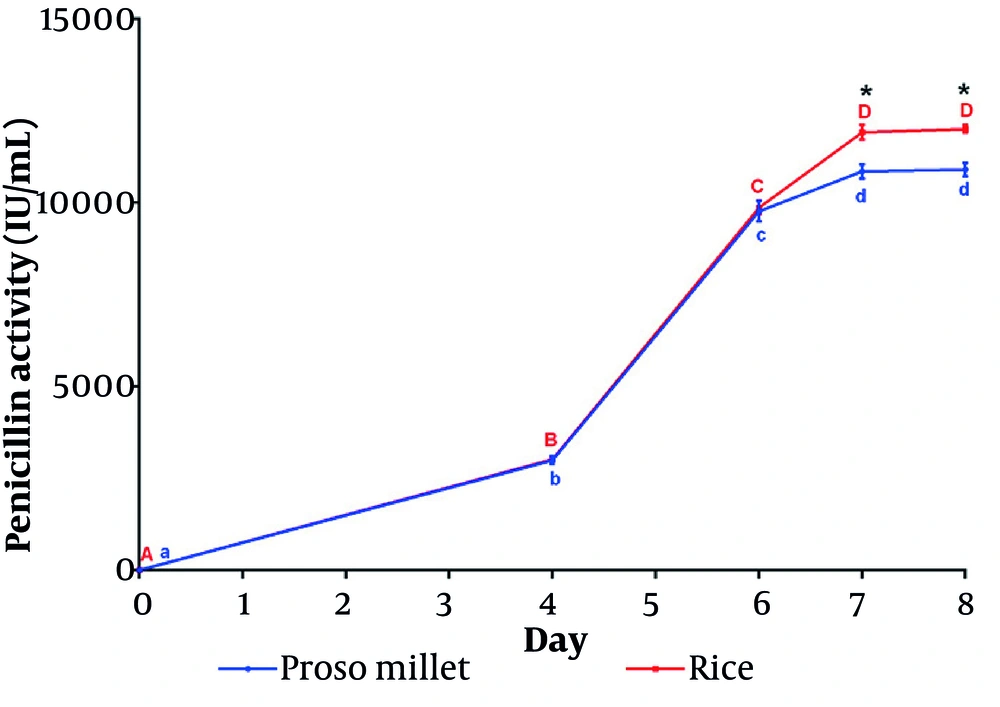
Figure 3.
Penicillin activity during fermentation in cultures prepared with proso millet and rice as spore carriers. Data are shown as mean ± SD of three independent repeats (n = 3). Asterisks (*) indicate statistically significant differences between millet and rice at the same time point (P < 0.05). Differences between time points within the rice group are indicated by uppercase letters (A-D), and differences within the millet group are indicated by lowercase letters (a-d). Time points sharing at least 1 letter are not significantly different.
4.4. Morphological Changes in P. chrysogenum
Microscopic observations revealed clear morphological changes during fermentation in both media. In both millet and rice cultures, the mycelium developed progressively and showed noticeable branching and fragmentation with increasing incubation time. By day 6, the hyphae were more extensive and covered a larger portion of the grain surface, whereas later observations showed a denser fungal network with visible mycelial accumulation (Figure 4).
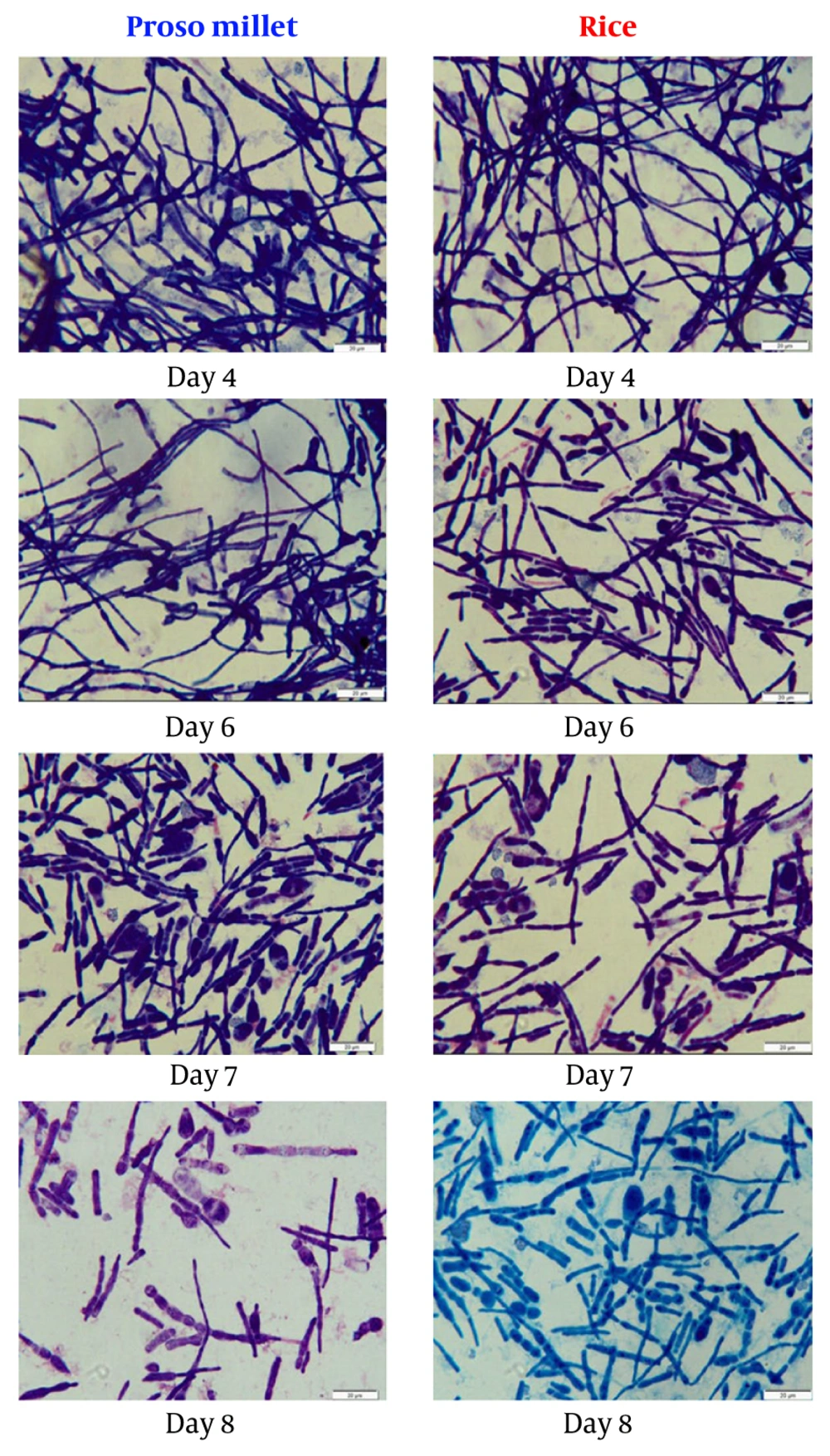
Figure 4.
Microscopic morphology of Penicillium chrysogenum during fermentation on proso millet and rice. Representative images were obtained using a Nikon light microscope at 100x magnification on days 4, 6, 7, and 8 of fermentation. At least 15 fields per slide were examined, and representative microscopic fields were selected to show general qualitative changes in branching, fragmentation, and mycelial organization.
5. Discussion
This work compared 2 practical inoculum carriers under identical fermentation conditions and showed that the choice of substrate can influence process outcomes. Although both carriers supported growth, the rice-based system provided better overall performance, particularly in terms of penicillin yield. This finding suggests that rice can serve as a reliable alternative to proso millet for P. chrysogenum, especially when a simpler, more accessible, and potentially less expensive solid carrier is needed for inoculum preparation and fermentation (1, 10). The results also support the concept that even small changes during early culture preparation can have a clear effect on final antibiotic production (12).
The need for such alternatives becomes more evident when the challenges of penicillin production are considered (1). Penicillin biosynthesis is not driven solely by the production medium. It also depends on the quality of the starting culture, the sporulation characteristics of the fungus, and the physical properties of the grain or solid substrate used for inoculum preparation. Previous work has shown that cereal-based carriers can influence fungal behavior in different ways. These studies have highlighted the importance of carrier surface properties, moisture level, and nutrient composition in shaping sporulation and downstream production (13). The present work follows the same logic by asking whether rice, which is widely available and often easier to obtain, can replace millet without compromising performance. The results indicate that rice performed at least as well as millet under the tested conditions and, in terms of final penicillin production, produced a statistically higher yield.
pH is one of the most informative parameters in fungal fermentation because it reflects the metabolic state of the culture (14). In penicillin production, pH is not merely a background measurement; it affects nutrient uptake, enzyme activity, precursor metabolism, and the balance between growth and secondary metabolism (15, 16). In this study, both carriers showed the expected pH shift during fermentation. The pH decreased during the early growth phase and then gradually increased during later stages. This pattern indicates active metabolism, nutrient consumption, and a transition toward the secondary metabolic phase. The millet culture showed a slightly greater increase toward the end, whereas the rice culture remained somewhat more stable. Although the final pH values were similar, rice maintained a more balanced profile. This may indicate that rice supported a smoother transition from growth to production. A stable pH profile is often considered favorable in penicillin fermentation because it allows continued antibiotic production without substantial metabolic stress (17).
PMV provides an indirect yet practical estimate of fungal biomass. Although it does not fully represent fungal growth, it remains useful for comparative evaluation of cultures grown under identical conditions (18). In this study, PMV increased in both systems, indicating that both rice and millet supported fungal growth. The increase was steady, and by the end of fermentation, the 2 systems reached very similar values. This result is important because it shows that rice did not reduce biomass formation. At the same time, the slightly more organized development observed in the rice system suggests that biomass formation may have been more uniform. This distinction is relevant because excessive or uneven biomass is not always beneficial in penicillin fermentation. Optimal antibiotic production typically results from balanced growth rather than maximal mycelial mass. Earlier reports also indicate that biomass quality and its distribution on the substrate can be more important than quantity alone (19). Accordingly, the PMV results support the view that rice can generate a strong inoculum while maintaining conditions suitable for secondary metabolite production. These results are consistent with previous reports (13).
Fungal morphology is closely linked to the physiological state in filamentous fungi (20). Branching, fragmentation, compactness, and the distribution of hyphae across the substrate can affect oxygen transfer, nutrient access, and metabolite release. In the millet culture, the fungus showed clear branching and fragmentation as fermentation progressed, and growth became denser later. The rice culture showed the same overall trend. These observations suggest that rice, similar to millet, provided a surface that allowed the fungus to colonize in a cleaner and more controlled manner. This pattern may help explain the improved penicillin yield, because a more regular mycelial structure can enhance mass transfer and reduce local overcrowding on the grain surface. Similar morphological differences have been reported in studies of solid-state sporulation, in which grain type influenced branching patterns, colony compactness, and the ability of the fungus to form a stable and productive inoculum (20-22).
The most important finding of this study was the higher penicillin production in the rice system. Although both carriers supported production, rice provided a higher final yield. The absolute difference was modest, but it was sufficient to indicate a real treatment effect. The final penicillin level from rice was approximately 1.1 times higher than that from millet. This increase is meaningful, particularly because it resulted from a simpler carrier rather than a major change in fermentation design. The findings suggest that the grain carrier itself has a substantive role in shaping culture productivity, consistent with a previous report on rice (13). One possible explanation is that rice provides a more favorable physical environment for sporulation and inoculum development. Another is that rice may promote the formation of a more consistent mycelial network, thereby improving access to oxygen and precursor molecules during the production phase.
One plausible explanation for the better performance of rice is its grain composition. Rice is mainly starch-rich, with approximately 78% starch and 6% to 7% protein, whereas proso millet contains approximately 70% to 74% carbohydrate, 9.4% to 9.9% protein, and 1.2% to 3.8% ash and fat, and millets are generally richer in fiber and minerals. In practical terms, rice provides a more starch-dominant and less complex matrix, whereas millet is nutritionally denser and structurally more complex (23, 24). This difference may influence water uptake, surface colonization, and mycelial spread across the grain, consistent with the more orderly morphology and higher penicillin yield observed in the rice system in this study.
The superiority of rice is also relevant from a process design perspective. Rice is widely available in many countries and is often easier to obtain in large quantities (25). In settings where millet is imported or available only in limited supply, this difference may improve practicality and supply reliability. However, the present study did not include a formal economic analysis; therefore, any cost advantage should be evaluated separately under local market conditions.
Another important consideration is the balance between growth and production. The results suggest that rice did not simply increase fungal growth; rather, it supported a better balance between biomass formation and secondary metabolism. This outcome is preferable to situations in which biomass increases but penicillin production remains unchanged or declines. In fungal biotechnology, increased growth is not necessarily beneficial. The producer strain must reach a physiological state that favors antibiotic synthesis, and the sporulation carrier can influence that state from the outset. In this study, rice appears to have guided the culture toward that favorable state more effectively than millet. This may explain the slightly more stable pH profile, the more organized mycelial structure, and the higher final antibiotic level.
5.1. Study Limitations and Conclusions
This study has limitations. Only 1 fungal strain was tested, and only 1 type of rice and 1 type of millet were compared under a single set of fermentation conditions. The work did not investigate different grain sizes, moisture levels, incubation times, or inoculum loads within a comprehensive optimization design. It also did not compare rice with other potential carriers, such as wheat, sorghum, or barley. Therefore, the present findings should be interpreted as a strong comparative result rather than a definitive conclusion for all fermentation systems. Future studies should test different rice cultivars, refine moisture and cooking conditions, and evaluate the process at a larger scale. It would also be useful to determine whether the same advantage of rice is observed with other Penicillium strains or in other solid-state inoculum systems.
In addition, a formal cost comparison was not performed in this study; therefore, any economic advantage of rice over proso millet should be evaluated in future work under defined local market conditions.
The present study showed that rice performed at least as well as proso millet in supporting fungal growth and performed better in final penicillin production. It provided a favorable pH profile, supported suitable biomass formation, and produced an orderly fungal morphology. Both carriers showed broadly similar fermentation behavior throughout the process, indicating that rice can maintain general performance comparable to millet. Overall, these results suggest that rice is a practical and effective alternative for penicillin fermentation. Most importantly, it led to a higher penicillin yield. If future studies confirm these results under optimized and scaled-up conditions, rice could become a practical carrier for penicillin fermentation in a broader industrial context.