
1. Background
Crackers are biscuits made from fermented hard dough, which confers a distinctive texture and taste. They have a crunchy texture, a slightly salty taste, and a flat, layered structure. Their low moisture content allows them to remain crisp for several weeks to months, and they may be consumed as an alternative to bread.
With increasing consumer awareness of functional and health-promoting foods, manufacturers have focused on developing such products, particularly widely consumed foods such as biscuits and crackers. Partial substitution of flour with bioactive compounds has been proposed as a strategy to improve the nutritional profile of these products.
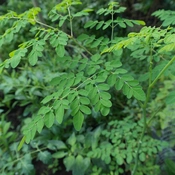
Malnutrition and micronutrient deficiencies remain major global concerns, particularly among children, and are associated with growth impairment and increased mortality (1). Moringa oleifera is a tropical plant that is readily cultivated, drought tolerant, and low maintenance. Among the 12 - 14 recognized species, M. oleifera is the most widely studied and used; it occurs in Africa, Arabia, Southeast Asia, the Pacific Islands, the Caribbean, and South America (2).
Various plant parts are nutrient-rich and are used in food and health-care applications. M. oleifera leaves are particularly rich in beta-carotene, vitamins A and C, protein, iron, calcium, potassium, antioxidants, and fiber. In some regions, the leaves are consumed as vegetables or dietary supplements to address malnutrition.
2. Objectives
This study aimed to produce crackers enriched with different levels of M. oleifera leaf powder and to evaluate their physicochemical properties, antioxidant activity, nutritional content, and sensory characteristics.
3. Methods
3.1. Preparation of Moringa Leaf Powder
Moringa oleifera leaves were obtained from the University of Sistan and Baluchestan, Zahedan, Iran. The leaves were washed with distilled water, dried, ground, and passed through a 100-mesh sieve to obtain a homogeneous powder.
3.2. Cracker Preparation
Crackers were prepared using four formulations in which M. oleifera leaf powder replaced wheat flour at 0.5%, 1%, 3%, and 5% (Table 1). Vegetable oil, invert syrup, salt, sodium bicarbonate, ammonium bicarbonate, and malt extract powder were mixed until creamy. Water and flour were added and mixed at low speed for 1 minute. The dough was laminated, reduced in thickness, cut into shapes, and baked at 180 °C for 20 minutes. After baking, the crackers were cooled to room temperature and stored in airtight containers (Figure 1).
Table 1.
Ingredients for Each Cracker Formulation a
| Ingredients | RS | AS (0.5%) | BS (1%) | CS (3%) | DS (5%) |
|---|---|---|---|---|---|
| Wheat flour | 60.39 | 59.89 | 59.39 | 57.39 | 55.39 |
| MOP | - | 0.5 | 1 | 3 | 5 |
| Vegetable oil | 9.42 | 9.42 | 9.42 | 9.42 | 9.42 |
| Invert syrup | 5.21 | 5.21 | 5.21 | 5.21 | 5.21 |
| Ammonium bicarbonate | 3.18 | 3.18 | 3.18 | 3.18 | 3.18 |
| Salt | 0.75 | 0.75 | 0.75 | 0.75 | 0.75 |
| Malt extract powder | 0.56 | 0.56 | 0.56 | 0.56 | 0.56 |
| Sodium bicarbonate | 20.3 | 0.19 | 0.19 | 0.19 | 0.19 |
| Water | 20.3 | 20.3 | 20.3 | 20.3 | 20.3 |
| Total | 100 | 100 | 100 | 100 | 100 |
a Abbreviations: MOP, Moringa oleifera powder; RS, reference sample; AS, 0.5% flour substitution with MOP; BS, 1% flour substitution with MOP; CS, 3% flour substitution with MOP; DS, 5% flour substitution with MOP.
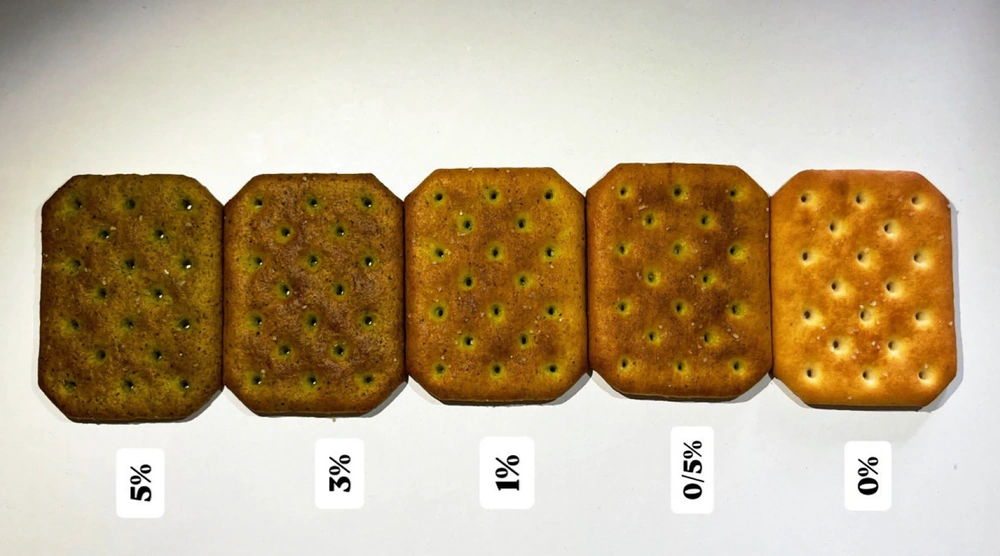
Figure 1.
Surface appearance of crackers formulated with different levels of MOP
3.3. Evaluation of Physicochemical Properties
3.4. Mineral Analysis
One gram of each sample was incinerated at 550 °C. The ash was dissolved in 0.1 M HCl and diluted to 100 mL. Magnesium, zinc, and iron were measured using atomic absorption spectroscopy (Perkin-Elmer 3300, USA) (5).
3.5. Antioxidant Activity and Total Phenolic Content
Phenolic extracts were obtained by refluxing 2 g of the sample with 20 mL of methanol containing 1% HCl at 60 ± 5 °C for 2 hours, followed by centrifugation (6). Total phenolic content (TPC) was determined using the Folin-Ciocalteu method (7). DPPH radical-scavenging activity was measured at 515 nm and expressed as percentage inhibition (8).
3.6. Sensory Evaluation
Sensory attributes (aroma, color, flavor, texture, and overall acceptability) were evaluated by 30 untrained panelists using a 5-point hedonic scale. Water was provided between samples.
3.7. Statistical Analysis
Data were analyzed using SPSS version 26. One-way analysis of variance and Duncan multiple-range test were applied at P < 0.05.
4. Results
4.1. Physicochemical Analysis of Crackers
4.1.1. Chemical Analysis
Table 2 presents the physicochemical properties of crackers formulated with different levels of leaf powder. Moisture content increased with greater leaf-powder incorporation; however, this increase was not statistically significant at the 3% and 5% levels (P > 0.05). This increase may be attributable to dietary fibers, such as cellulose and pectin, which enhance water retention and reduce evaporation during baking by modifying dough viscosity and matrix structure. Cabral et al. (9) reported increased moisture in biscuits containing mulberry leaf powder.
Table 2.
Chemical, Physical, and Mineral Characteristics of MOP-Supplemented Crackers a
| Characteristic | RS | AS | BS | CS | DS |
|---|---|---|---|---|---|
| Moisture (g/100 g) | 3.64 ± 0.05 C | 3.63 ± 0.1 C | 3.59 ± 0.02 B | 3.42 ± 0.02 A | 3.40 ± 0.01 A |
| NaCl | 1.41 ± 0.01 A | 1.39 ± 0.01 A | 1.40 ± 0.01 A | 1.41 ± 0.01 A | 1.41 ± 0.01 A |
| Peroxide value | 0.497 ± 0.00 D | 0.496 ± 0.005 C, D | 0.495 ± 0.005 C | 0.492 ± 0.001 B | 0.481 ± 0.001 A |
| Protein | 6.36 ± 0.17 D | 7.87 ± 0.06 C | 8.40 ± 0.36 C | 11.83 ± 1.23 B | 14.9 ± 0.65 A |
| Fat | 15.21 + 0.01 A | 15.24 + 0.01 B | 15.29 + 0.01 C | 15.32 + 0.00 D | 15.35 + 0.01 E |
| Ash | 0.021 ± 0.001 E | 1.023 ± 0.001 D | 1.024 ± 0.001 C | 3.025 ± 0.001 B | 4.027 ± 0.001 A |
| Acidity | 0.143 + 0.00 A | 0.143 + 0.001 A, B | 0.145 + 0.001 B | 0.145 + 0.001 B | 0.148 + 0.001 C |
| pH | 6.48 ± 0.028 A | 6.47 ± 0.026 B | 6.44 ± 0.11 B | 6.44 ± 0.11 B, C | 6.19 ± 0.17 C |
| Total sugar | 7.14 ± 0.01 D | 7.17 ± 0.01 C | 7.22 ± 0.02 B | 7.43 ± 0.01 A | 7.45 ± 0.0 A |
| Thickness (mm) | 34.1 ± 0.17 D | 34.3 ± 0.27 B, C | 35.33 ± 0.30 B, C | 35.47 ± 0.068 B | 38.56 ± 1.40 A |
| Width (mm) | 48.27 ± 0.25 C | 48.36 ± 0.32 A, B | 48.50 ± 0.35 A, B | 48.54 ± 0.29 A, B | 48.87 ± 0.06 A |
| Zinc (Zn) | 0.94 ± 0.9 D | 5.043 ± 1.3 C | 6.43 ± 0.37 B | 7.52 ± 0.02 A | 7.69 ± 0.04 A |
| Iron (Fe) | 0.82 ± 0.03 E | 3.35 ± 0.01 D | 4.18 ± 0.026 C | 4.34 ± 0.05 B | 5.31 ± 0.01 A |
| Magnesium (Mg) | 1 ± 0.02 E | 4.27 ± 0.02 D | 4.71 ± 0.03 C | 6.21 ± 0.02 B | 7.07 ± 0.025 A |
a Values are mean ± standard deviation of triplicate determinations. Values followed by the same superscripted capital letters within a row are not significantly different at P < 0.05. Abbreviations: MOP, Moringa oleifera powder; RS, reference sample; AS, 0.5% flour substitution with MOP; BS, 1% flour substitution with MOP; CS, 3% flour substitution with MOP; DS, 5% flour substitution with MOP.
Peroxide value increased with higher MOP levels; however, differences among RS, AS, and BS were not statistically significant (P > 0.05). This increase may be related to the fat content of Moringa leaves, which can promote lipid oxidation during baking or storage. Similar results were reported in bread enriched with M. oleifera leaf powder (11).
Salt content did not differ significantly among formulations, likely because of the low sodium content of Moringa leaves and the constant salt addition in all samples (12). Mereles et al. (13) reported that dried M. oleifera leaves contain relatively low sodium levels, suggesting that their incorporation into fortified-food formulations may not substantially influence the overall salt content of the final product.
Protein content increased significantly with MOP addition, from 6.36 ± 0.17% in the reference sample to 14.9 ± 0.65% in the 5% MOP sample. This enhancement reflects the high protein content of Moringa leaves (14). Similar increases were reported by Sultana (10) and El-Gammal et al. (15).
Fat content increased significantly (P < 0.05) with higher MOP levels (Table 2), attributable to the unsaturated fatty acids present in Moringa leaves. These findings are consistent with those reported by Sultana (10).
Ash content increased significantly (P < 0.05), from 0.021 ± 0.001% in the reference sample to 4.027 ± 0.001% in the 5% MOP sample, reflecting the higher mineral content of M. oleifera leaves than that of refined flour (16). Similar findings were reported by Dachana et al. (17). Acidity increased and pH decreased with higher MOP levels. Although differences between some adjacent formulations were not significant (P > 0.05), a significant difference (P < 0.05) was observed between CS and DS. This trend may be related to phenolic compounds and organic acids, such as ascorbic, gallic, and chlorogenic acids, in MOP, as well as reduced buffering capacity following partial flour substitution (16). Dachana et al. (17) reported similar results.
Total sugar content showed an increasing trend with MOP addition; however, differences between CS and DS were not statistically significant (P > 0.05). This may be attributable to naturally occurring sugars in M. oleifera leaves and the thermal degradation of polysaccharides during baking (2).
4.1.2. Physical Analysis
A slight increase in thickness and width was observed with higher leaf-powder incorporation, likely because of increased water absorption by dietary fiber. Dachana et al. (17) reported increased cookie thickness with Moringa addition. Leaf powders may weaken gluten-network development by competing for water and reducing gluten-protein concentration, thereby decreasing dough elasticity and strength (18, 19). However, thickness differences among the 0.5%, 1%, and 3% samples were not statistically significant, possibly because of uniform lamination before baking (Table 2). The greatest width was observed in the 5% MOP sample, whereas differences among the 0.5%, 1%, and 3% samples were not statistically significant.
4.2. Total Phenolic Content and Antioxidant Capacity
As shown in Figure 2, TPC increased significantly (P < 0.05) with increasing MOP levels. The reference sample had the lowest TPC (18.26 ± 0.9), whereas the 5% MOP sample had the highest value (47.4 ± 1.5), reflecting the rich polyphenol and flavonoid content of Moringa leaves (20). Similar increases in TPC were reported by Elhassaneen et al. (21) in enriched biscuits. Antioxidant activity, measured by DPPH, increased significantly (P < 0.05), ranging from 6.3% to 21.50% (Figure 2), confirming the functional contribution of MOP. Bobková et al. (22) also reported enhanced TPC and DPPH activity with leaf-powder incorporation.
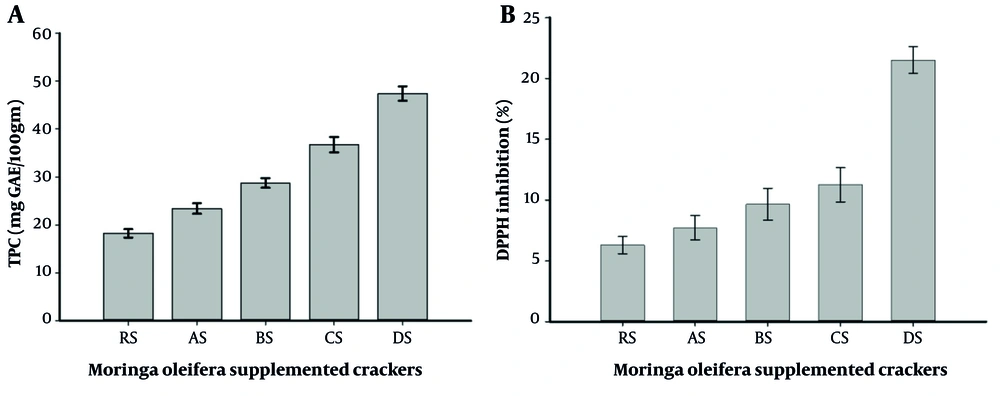
Figure 2.
Total phenolic content (A) and antioxidant properties (B) of cracker samples
4.3. Mineral Composition of Crackers
Table 2 shows significant increases (P < 0.05) in zinc, iron, and magnesium with higher MOP levels. Zinc increased from 0.94 to 7.69 mg/100 g, iron from 0.82 to 5.31 mg/100 g, and magnesium from 1 to 7.07 mg/100 g in the 5% MOP sample. Differences between the 3% and 5% samples were not significant. These increases reflect the naturally high mineral content of Moringa leaves, as supported by the ash results. Glover-Amengor et al. (25) and Blaško et al. (26) similarly reported high iron, manganese, and zinc levels in Moringa leaves.
4.4. Sensory Evaluation
As shown in Figure 3, the reference sample received the highest sensory scores. Flavor scores decreased slightly with increasing MOP because of the herbaceous taste; however, differences between AS and BS were not significant (P > 0.05). Texture scores showed a slight, nonsignificant decline (P > 0.05), possibly because of fiber–gluten interactions (27). Color acceptability decreased because of green pigmentation, but differences between the reference and 0.5%–1% samples were not significant. Overall acceptability declined with higher MOP levels; however, changes at 0.5% and 1% were not statistically significant. Yan et al. (12) similarly reported reduced acceptability at higher leaf-powder levels.
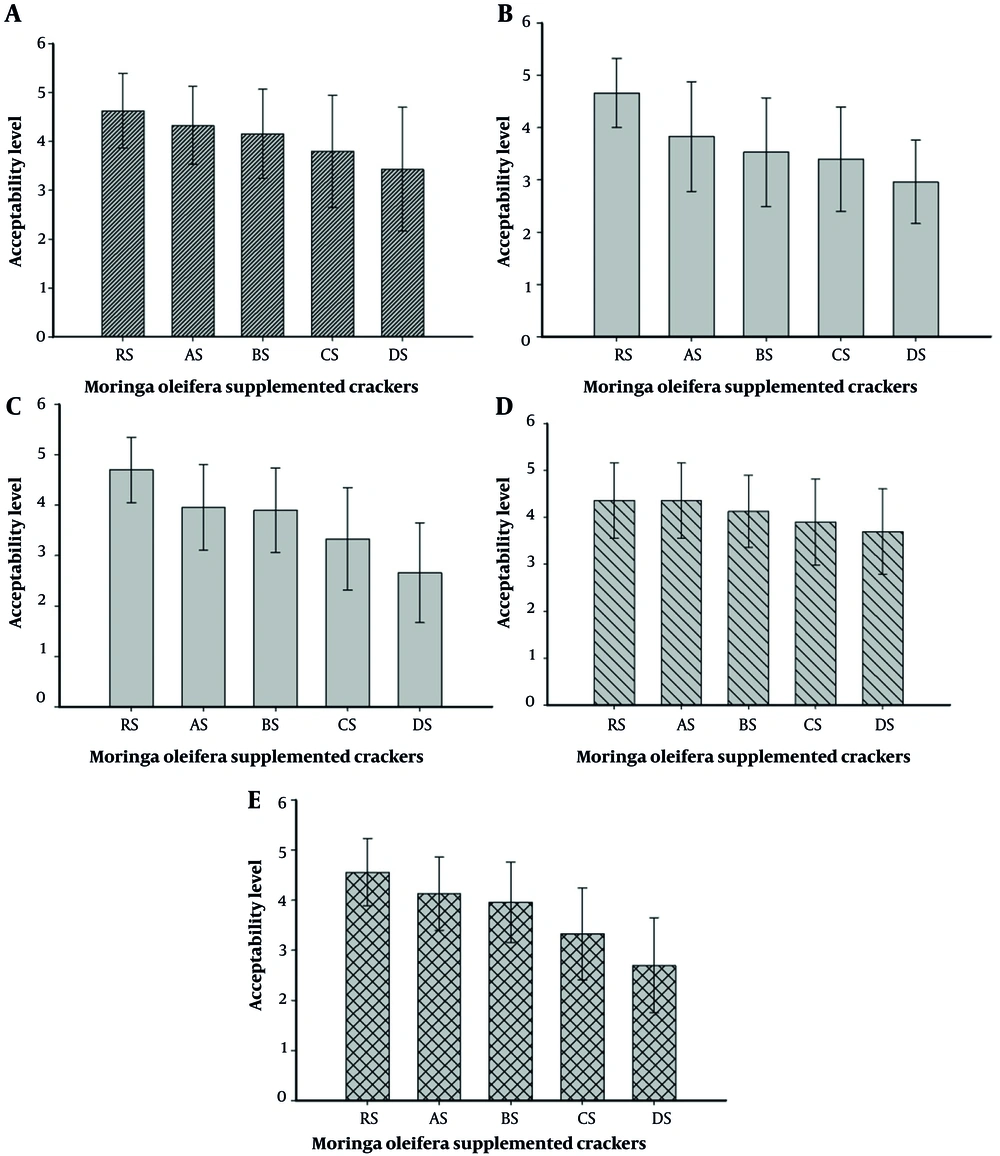
Figure 3.
Sensory evaluation of crackers
5. Discussion
5.1. Conclusions
Increasing M. oleifera leaf powder significantly enhanced mineral content, including iron, zinc, and magnesium, as well as antioxidant properties, including TPC and DPPH activity, indicating its potential as a functional fortifying ingredient. Although slight increases in thickness and width were observed, higher MOP levels adversely affected texture and color. Sensory evaluation showed reduced acceptability at higher concentrations, whereas the 0.5% and 1% levels did not result in significant differences. Overall, 3% Moringa leaf powder represents an optimal level, improving nutritional quality without significantly compromising sensory attributes, and can be recommended for cracker fortification.