
1. Background
Modern couples face socioeconomic pressures and psychological challenges that may disrupt the transition to parenthood (1). Declining fertility rates and delayed childbearing are particularly evident in urban populations, where young married couples often postpone starting a family (2). Psychological and relational factors may contribute to delayed childbearing (3). Addressing these psychological barriers is important because prolonged hesitation may affect individual well-being, marital satisfaction, family stability, and broader social structures (4).
Childbearing anxiety is a multifaceted psychological barrier that can discourage reproductive decision-making (5). Unlike generalized anxiety, it involves specific existential, medical, and physiological fears. These include fear of childbirth, particularly concerns about pain, medical interventions, and maternal complications (6), as well as concerns about having a child with physical or developmental disabilities. The responsibility of protecting an infant’s health can cause anticipatory distress in prospective parents. These anxieties may discourage childbearing and transform the anticipated joy of parenthood into psychological distress and avoidance (7).
Beyond physiological and neonatal concerns, childbearing anxiety encompasses relational and lifestyle concerns that may affect family relationships. Many couples fear that having a child will disrupt marital harmony, reduce intimacy, increase interpersonal conflict, and create role strain (8). Prospective mothers may also experience distress regarding mood fluctuations, postpartum depression, and the effects of these emotional changes on their child’s psychological development. Anticipated loss of personal autonomy, career disruption, and lifestyle changes may compound this distress (9). Collectively, these concerns may reduce couples’ sense of agency and hinder confident reproductive decision-making (10).
Psychological interventions addressing these fears should focus on the emotional foundations of the marital relationship as well as on individual symptoms. Emotionally focused training (EFT), developed by Sue Johnson, is an attachment-based intervention for couples facing stressful life transitions and developmental crises (11). Grounded in adult attachment theory, EFT promotes secure emotional bonds and helps partners process vulnerabilities and anxieties collaboratively (12). Previous studies have reported benefits in reducing psychological distress, improving marital satisfaction, and alleviating transition-related anxiety (13, 14). Establishing secure attachment through EFT may help couples co-regulate negative emotions, communicate fears without judgment, and manage shared stressors (15). Thus, EFT offers a promising framework for addressing the relational and emotional dimensions of childbearing anxiety.
Although the adverse effects of childbearing anxiety on family dynamics and birth rates are well documented, empirical research on relational treatments for this specific concern remains limited. Further research is needed on approaches that address reproductive hesitation as a shared relational challenge. With its focus on attachment bonds and emotional regulation, EFT provides a theoretical framework for addressing these fears. However, its clinical utility specifically for pregnancy-related anxiety has received limited attention.
2. Objectives
This study aimed to evaluate the effects of EFT on distinct dimensions of childbearing anxiety among couples and to support more adaptive reproductive decision-making.
3. Methods
3.1. Design and Participants
This study used a quasi-experimental pretest–posttest–follow-up design with a control group. Although the design was considered quasi-experimental because of convenience sampling, the 40 enrolled couples were randomly allocated to the intervention or control condition. The target population comprised married couples living in Isfahan, Iran, from 2024 to 2025. Recruitment, intervention, and follow-up took place in 2025. Forty couples were recruited from community family counseling centers through convenience sampling. They were randomly assigned to an intervention group (n = 20 couples) or a control group (n = 20 couples) using a computer-generated random sequence prepared by an independent researcher who was not involved in recruitment or assessment. Allocation was concealed using sequentially numbered, opaque, sealed envelopes that were opened only after baseline assessment.
Eligible participants were aged 20 - 45 years, had been married for at least 2 years, had no children younger than 1 year to standardize the childbearing decision-making stage, had relatively stable mental health, and had no history of psychotic disorders or current use of mood-altering medications. Both partners provided independent written informed consent and completed the outcome measures separately. Exclusion criteria included missing more than 2 intervention sessions, withdrawal from the study, incomplete questionnaire responses, or a severe family crisis, such as divorce or the death of a spouse or child.
No a priori sample-size calculation was performed because this was a preliminary investigation. However, a post hoc power analysis based on the observed large effect sizes (partial η2 > 0.75) indicated that 40 couples provided power > 0.90 (α = 0.05) to detect the group × time interactions reported below. A participant-flow diagram details the numbers of couples assessed for eligibility, excluded before allocation with reasons, allocated to each group, completing the intervention, providing posttest and 3-month follow-up data, and included in the final analyses. All 40 couples completed the pretest; attendance and completion rates are reported in the Results.
3.2. Measures
Childbearing anxiety was assessed using the Pregnancy-Related Anxiety Questionnaire (PRAQ), originally developed by Van den Bergh (16) and subsequently validated in Iranian populations (17). This 17-item instrument assesses 5 domains: 1) fear of childbirth; 2) fear of having a child with a physical or mental disability; 3) fear of adverse changes in marital relations; 4) fear of maternal mood fluctuations and their effects on the child; and 5) fear of disruptions to personal life and autonomy. Items are rated on a 7-point Likert scale from 1 (not true at all) to 7 (completely true). Total scores range from 17 to 119, with higher scores indicating greater childbearing anxiety. Subscale scores are calculated by summing the relevant items.
Both female and male partners independently completed the same questionnaire. For male participants, items referring to maternal experiences, such as the mother’s autonomy or postpartum mood, were administered with instructions to consider their anticipated effects on their partner and the couple’s life. Item wording was not changed. The instrument was originally developed for pregnant women and has shown acceptable psychometric properties in Iranian pregnant samples. Overall Cronbach’s α was 0.87 in the present study, and the reported test–retest correlation was r = 0.76. However, formal validation evidence for nonpregnant couples and male respondents remains limited.
3.3. Procedure
After obtaining ethical approval (IR.UI.REC.1404.256), the researchers informed all couples about the study aims. Participants provided written informed consent after receiving assurances of confidentiality and the right to withdraw at any time. The study was not prospectively registered in a clinical trial registry because it was conducted as a preliminary quasi-experimental investigation; the absence of registration is acknowledged as a limitation. All participants underwent baseline assessment before the intervention. The intervention group then participated in the EFT program, whereas the control group received no treatment and was placed on a waiting list. No co-interventions, including additional counseling or reproductive health services, were permitted during the study. At each assessment, participants were asked about concurrent psychological or medical support; none reported receiving such services. All participants completed the posttest after the final training session. Follow-up assessment was conducted 3 months later under the same conditions to assess whether treatment benefits were maintained. Missing data were handled using complete-case analysis. No participants were lost to follow-up, and all 80 individuals provided data at all 3 time points.
3.4. Intervention Program
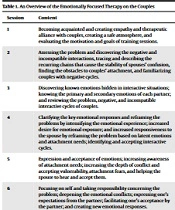
The intervention group participated in an eight-session EFT program based on Johnson’s framework (11) and structured around the brief learning and counseling model. Weekly sessions lasted 90 minutes and were delivered by a licensed clinical psychologist with a PhD in clinical psychology, formal EFT certification (Externship and Core Skills training completed), and more than 5 years of supervised experience working with couples. The facilitator was a member of the research team and received weekly clinical supervision from an independent EFT-certified supervisor. A detailed treatment manual based on Johnson’s protocol was followed. Treatment fidelity was assessed through supervisor review of randomly selected session recordings (20% of sessions) using a standardized EFT adherence checklist; mean adherence exceeded 90%. All intervention couples attended at least 6 of the 8 sessions, and 18 of 20 couples attended all 8 sessions. No protocol deviations or adverse events were reported. The intervention targeted emotional dysregulation and insecure attachment patterns to reduce childbearing anxiety. Table 1 outlines the intervention. The control group remained on a waiting list and received no active intervention or attention-matched contact during the study.
Table 1.
Emotionally Focused Training Sessions Based on Johnson’s Approach
| Session | Primary Objective | Education | Practice | Processing | Homework |
|---|---|---|---|---|---|
| 1 | Building therapeutic alliance & identifying negative cycles | Introducing concepts of attachment, emotion, and negative interactional cycles. | Identifying conflict situations and emotional patterns. | Reflecting on emotional experiences during conflicts. | Logging conflict situations and associated feelings. |
| 2 | Differentiating primary & secondary emotions | Psychoeducation on primary (vulnerable) vs. secondary (defensive) emotions. | Pinpointing hidden emotions underlying conflicts. | Analyzing the link between emotions and attachment needs. | Tracking deep-seated emotions in daily interactions. |
| 3 | Accessing vulnerable emotions | Highlighting the importance of expressing deep emotions for intimacy. | Expressing vulnerable emotions within the relationship. | Validating and reflecting emotional expressions. | Practicing the genuine expression of core emotions. |
| 4 | Restructuring emotional interactions | Understanding secure interactions and emotional responsiveness. | Engaging in guided dialogue between partners. | Analyzing shifts in interactional dynamics. | Practicing newly acquired interactional styles. |
| 5 | Reinforcing secure attachment | Exploring the role of emotional support in mitigating anxiety. | Practicing empathetic responses. | Reflecting on the experience of receiving support. | Engaging in intentional supportive behaviors. |
| 6 | Redefining relationship identity | Discussing the role of shared meaning and relationship goals. | Conversing about core values and future aspirations. | Analyzing attitudinal shifts toward the relationship. | Drafting collaborative, shared goals. |
| 7 | Conflict management | Training in emotion-focused conflict resolution skills. | Applying problem-solving techniques to current conflicts. | Reflecting on improvements in conflict management. | Applying skills to real-life disputes. |
| 8 | Conclusion & consolidating changes | Strategies for preventing relapse into negative cycles. | Reviewing the therapeutic journey. | Evaluating progress and relationship satisfaction. | Continuing to practice acquired skills independently. |
3.5. Data Analysis
Descriptive and inferential analyses were conducted using SPSS version 26. The observational unit was the individual partner; both partners independently completed the questionnaires. Because responses within couples are statistically dependent, the primary analyses treated individuals as nested within couples. The hypotheses were tested using repeated-measures analysis of variance (ANOVA), with group (intervention vs control) as the between-subjects factor, time (pretest, posttest, and follow-up) as the within-subjects factor, and the group × time interaction as the primary effect of interest. Greenhouse–Geisser corrections were applied when Mauchly’s test indicated a violation of sphericity; epsilon values and corrected degrees of freedom are reported in the Results. Statistical assumptions were assessed using the Shapiro–Wilk test for normality, Levene’s test for homogeneity of variances, Box’s M test for homogeneity of covariance matrices, and Mauchly’s test for sphericity. Missing observations were handled using complete-case analysis, although no outcome data were missing. Analyses followed a modified intention-to-treat principle: all randomized couples with at least baseline data were retained. In practice, every participant completed all assessments. Estimates of between-group differences in change and 95% confidence intervals (CIs) are reported alongside partial η2 and exact P values. All tests were two-tailed, with α = 0.05.
4. Results
The final analytic sample comprised 80 individuals (40 couples), evenly divided between the EFT intervention group (n = 20 couples; 40 individuals) and the control group (n = 20 couples; 40 individuals). All 40 couples and 80 individuals completed the pretest, posttest, and 3-month follow-up assessments. There were no withdrawals, losses to follow-up, or missing outcome data. In the intervention group, 18 of 20 couples attended all 8 sessions, and the remaining 2 couples attended 6 sessions each.
Marriage duration did not differ significantly between groups (χ2 = 0.31, P = 0.713); most couples had been married for less than 10 years. Mean ages were comparable: women were aged 34.50 ± 5.18 years in the EFT group and 34.88 ± 5.07 years in the control group (t = 0.33, P = 0.802), and men were aged 39.66 ± 3.88 years and 38.23 ± 3.89 years, respectively (t = 0.40, P = 0.781).
Table 2 presents the means and standard deviations for total childbearing anxiety and its 5 subscales by group and assessment time. Pretest anxiety scores were statistically similar between groups (intervention total: Mean = 91.05, SD = 5.59; control total: Mean = 90.11, SD = 5.76). Following the intervention, the EFT group showed marked reductions across all anxiety dimensions, which persisted at the 3-month follow-up. Control-group scores remained stable or increased slightly over the same period.
Table 2.
Descriptive Statistics (Means and Standard Deviations) for Childbearing Anxiety and Subscales by Group and Time a
| Variables | Pretest | Posttest | Follow-up |
|---|---|---|---|
| Fear of childbirth | |||
| Control | 16.52 ± 2.76 | 16.76 ± 2.56 | 16.94 ± 2.65 |
| EFT | 16.72 ± 2.78 | 10.16 ± 1.20 | 9.27 ± 0.75 |
| Fear of giving birth to a child with a physical or mental disability | |||
| Control | 20.58 ± 2.73 | 20.88 ± 2.49 | 21.05 ± 2.51 |
| EFT | 20.38 ± 2.98 | 13.77 ± 2.36 | 13.27 ± 2.27 |
| Fear of detrimental changes in marital relations | |||
| Control | 16.47 ± 2.91 | 16.76 ± 2.70 | 16.94 ± 2.53 |
| EFT | 17.38 ± 2.17 | 10.44 ± 2.35 | 10.38 ± 2.32 |
| Fear of mood fluctuations and their subsequent impact on the child | |||
| Control | 16.17 ± 3.06 | 16.35 ± 3.10 | 16.58 ± 3.02 |
| EFT | 16.61 ± 3.27 | 9.27 ± 2.90 | 8.83 ± 2.40 |
| Fear of disruptions to personal life and autonomy | |||
| Control | 20.35 ± 4.32 | 20.64 ± 4.04 | 20.88 ± 3.98 |
| EFT | 19.94 ± 4.07 | 11.72 ± 2.73 | 11.27 ± 2.58 |
| Childbearing anxiety (total) | |||
| Control | 90.11 ± 5.76 | 91.41 ± 5.70 | 92.41 ± 5.72 |
| EFT | 91.05 ± 5.59 | 55.38 ± 5.77 | 53.05 ± 5.88 |
a Values are expressed as mean ± SD. Abbreviations: EFT, emotionally focused training; SD, standard deviation.
The internal consistency of the PRAQ was satisfactory overall (Cronbach’s α = 0.87) and remained adequate when assessed separately by group, time point, and participant sex (α range, 0.81 - 0.89).
Initial checks indicated that the data met the assumptions for repeated-measures ANOVA. Shapiro–Wilk tests supported approximate normality across groups and time points (P > 0.05). Levene’s test supported homogeneity of variances, and Box’s M test supported homogeneity of covariance matrices. Sphericity was assessed for each outcome using Mauchly’s test; Greenhouse–Geisser corrections were applied when this assumption was violated. Epsilon values and corrected degrees of freedom are reported in Table 3.
Table 3.
Summary of Repeated-Measures Analysis of Variance Results for Childbearing Anxiety Variables a
| Variables | SS | df | MS | F | P | Partial η2 | Greenhouse–Geisser ε |
|---|---|---|---|---|---|---|---|
| Fear of childbirth | |||||||
| Time | 334.64 | 1.20 | 278.29 | 185.92 | 0.001 | 0.79 | 0.60 |
| Group | 577.33 | 1 | 577.33 | 37.64 | 0.001 | 0.43 | - |
| Group × Time | 321.84 | 2.41 | 133.82 | 89.40 | 0.001 | 0.78 | 0.60 |
| Fear of giving birth to a child with a physical or mental disability | |||||||
| Time | 378.40 | 1.16 | 325.74 | 187.30 | 0.001 | 0.79 | 0.58 |
| Group | 668.14 | 1 | 668.14 | 36.02 | 0.001 | 0.42 | - |
| Group × Time | 308.07 | 2.33 | 132.60 | 76.25 | 0.001 | 0.76 | 0.58 |
| Fear of detrimental changes in marital relations | |||||||
| Time | 331.09 | 1.27 | 255.43 | 301.28 | 0.001 | 0.86 | 0.64 |
| Group | 417.26 | 1 | 417.26 | 22.88 | 0.001 | 0.32 | - |
| Group × Time | 319.05 | 2.59 | 123.07 | 145.16 | 0.001 | 0.85 | 0.58 |
| Fear of mood fluctuations and their subsequent impact on the child | |||||||
| Time | 409.82 | 1.21 | 339.60 | 221.79 | 0.001 | 0.82 | 0.64 |
| Group | 604.02 | 1 | 604.02 | 26.58 | 0.001 | 0.35 | - |
| Group × Time | 363.90 | 2.41 | 150.77 | 98.47 | 0.001 | 0.80 | 0.64 |
| Fear of disruptions to personal life and autonomy | |||||||
| Time | 480.76 | 1.22 | 394.16 | 366.29 | 0.001 | 0.88 | 0.60 |
| Group | 1097.90 | 1 | 1097.90 | 27.28 | 0.001 | 0.36 | - |
| Group × Time | 465.38 | 2.44 | 190.78 | 177.28 | 0.001 | 0.88 | 0.61 |
| Childbearing anxiety (total) | |||||||
| Time | 5123.45 | 1.25 | 4098.76 | 312.45 | 0.001 | 0.89 | 0.63 |
| Group | 8456.70 | 1 | 8456.70 | 44.36 | 0.001 | 0.37 | - |
| Group × Time | 4892.15 | 2.50 | 1956.86 | 198.76 | 0.001 | 0.84 | 0.63 |
a Abbreviations: SS, sum of squares; df, degrees of freedom; MS, mean square; partial η2, partial eta squared; ε, Greenhouse–Geisser epsilon.
Table 3 summarizes the 2 (group) × 3 (time) repeated-measures ANOVAs. Significant main effects of time and group, and significant group × time interactions, were observed for total childbearing anxiety and each subscale (all interaction P < 0.001). Partial η2 values for the interactions ranged from 0.76 to 0.88, indicating large effects. Bonferroni-adjusted pairwise comparisons showed significant reductions from pretest to posttest and from pretest to follow-up only in the EFT group (P < 0.001). No significant changes were observed in the control group.
Between-group differences in mean change from pretest to follow-up were calculated with 95% CIs to estimate the magnitude of the effects. The difference in change in total childbearing anxiety for the EFT group relative to the control group was −38.30 points (95% CI, −41.12 to −35.48). Corresponding subscale differences were −7.91 for fear of childbirth (95% CI, −8.87 to −6.95); −7.52 for fear of having a child with a physical or mental disability (95% CI, −8.71 to −6.33); −7.45 for fear of adverse changes in marital relations (95% CI, −8.48 to −6.42); −8.01 for fear of mood fluctuations (95% CI, −9.18 to −6.84); and −9.02 for fear of disruptions to personal life and autonomy (95% CI, −10.41 to −7.63).
Figure 1 shows the trajectories of total childbearing anxiety across the 3 assessment times. The EFT group showed a sharp decline from pretest to posttest, with lower scores maintained at follow-up. Control-group scores remained relatively stable or increased slightly. The graph illustrates the pattern of change associated with EFT.
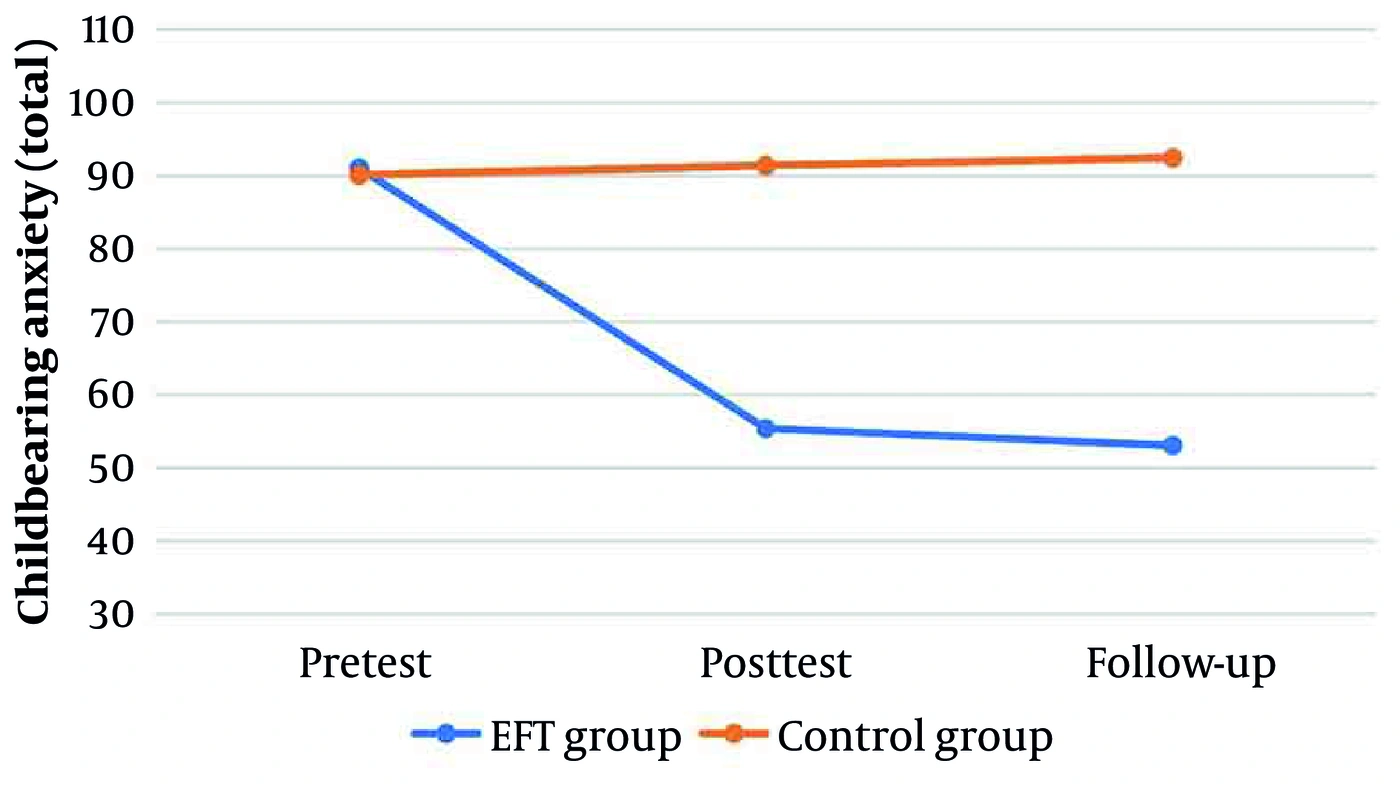
Figure 1.
Mean trajectories of total childbearing anxiety across the three assessment points
5. Discussion
This study assessed the association between EFT and reductions in different dimensions of childbearing anxiety among couples. Self-reported anxiety decreased in the EFT group, and this reduction was maintained at the 3-month follow-up; the control group showed no comparable change. These findings suggest that childbearing anxiety may have a relational component that is responsive to an attachment-based intervention, at least in the short term and as assessed by self-report.
A possible mechanism is EFT’s focus on attachment security and emotional co-regulation (11). The expectation that having a child may reduce marital intimacy or lead to difficult mood fluctuations can create a psychological barrier to childbearing (18). By restructuring negative interactional cycles into more responsive communication, EFT aims to establish a more secure relational base (19). When partners express vulnerable emotions, such as fear of inadequacy or emotional abandonment, without immediate defensiveness or withdrawal, relational anxiety may decrease (20). This mechanism is consistent with the observed reductions in fears of adverse marital changes and maternal mood fluctuations.
The intervention was also associated with reductions in fear of childbirth, concern about having a child with a physical or developmental disability, and concern about losing personal autonomy. Although couple therapy cannot change the biological risks or physiological realities of pregnancy, it may influence how partners perceive and respond to these concerns (21). Grounded in adult attachment theory, EFT encourages a shift from individual coping to a shared, dyadic approach (22). Concerns about medical complications or lifestyle changes may be reframed as shared challenges rather than overwhelming individual burdens (12). Feeling more securely supported by a partner may reduce perceived threats and strengthen a prospective parent’s sense of agency.
These findings are broadly consistent with the literature emphasizing the dyadic nature of transition-related anxiety. Smith et al. (8) reported that emotion-focused interventions may reduce perinatal anxiety through improved emotional co-regulation and dyadic empathy. Najafi et al. (23) similarly reported that stronger marital attachment was associated with reduced psychological distress in the context of fertility challenges. The present findings suggest that, even before conception, a more secure relational bond may be associated with lower self-reported anticipatory reproductive fears.
These findings support further investigation of couple-centered approaches in pre-pregnancy counseling. Childbearing anxiety has often been addressed through individual psychoeducation. The observed pattern suggests that brief emotion-focused interventions warrant further study in family-planning settings.
Several methodological limitations should be considered. First, convenience recruitment was restricted to Isfahan. Because childbearing anxiety is influenced by cultural values and financial stressors, generalizability to other socioeconomic or cultural populations is limited. Second, although allocation within the convenience sample was random, it occurred after recruitment, and residual selection bias cannot be excluded. Third, individual partners were the observational units, although they were nested within couples. This dependence was noted, but a fully multilevel model accounting for dyadic clustering was not applied and may have affected standard-error estimates. Fourth, self-reported outcomes may be affected by social desirability and expectancy biases. Fifth, the waiting-list control received neither an active intervention nor attention-matched contact. Therapist attention, social contact, and repeated assessment may therefore have contributed to group differences. Sixth, neither participants nor assessors were blinded. Seventh, the 3-month follow-up limits conclusions about longer-term effects. Eighth, formal validation evidence for the PRAQ among nonpregnant couples and male respondents is limited. Finally, the study assessed only self-reported anxiety and did not measure reproductive decision-making, subsequent pregnancies, or healthcare use; therefore, behavioral effects cannot be inferred.
5.1. Conclusions
Emotionally focused training was associated with a short-term reduction in self-reported childbearing anxiety, maintained at the 3-month follow-up. Its focus on secure attachment and dyadic emotional regulation may help couples experience less anticipatory distress about reproduction. However, convenience sampling, the waiting-list control, self-reported outcomes, short follow-up, and the absence of behavioral outcome data mean that the findings should be considered preliminary. Further longitudinal research should include larger, more diverse samples, active comparators, multilevel analyses, and direct assessment of reproductive decision-making before stronger conclusions about clinical utility are drawn.