


1. Background
2. Methods
2.1. Isolation and Identification of Bacteria
2.2. Antibiotic Susceptibility Assay and Detection of ESBL Production
2.3. DNA Preparation and PCR Screening
| Primers | Sequences (5’ → 3’) | Gen and Size | PCR | Cycles | ||
|---|---|---|---|---|---|---|
| Denaturation | Annealing | Extension | ||||
| CTX-M1GF | CGC TTT GCG ATG TGC AG’ | blaCTX-M1- 550 bp | 94°C- 30 s | 56°C- 30 s | 72°C- 30 s | 35 |
| CTX-M1GR | ACC GCG ATA TCG TTG GT | |||||
| CTX-M2GF | TTA ATG ACT CAG AGC ATT C’ | blaCTX-M2- 902 bp | 94°C- 30 s | 56°C- 45 s | 72°C- 45 s | 35 |
| CTX-M2GR | GAT ACC TCG CTC CAT TTA TTG | |||||
2.4. DNA Sequencing
2.5. Statistical Analysis
3. Results
3.1. Bacteria
3.2. Antibiotic Susceptibility Pattern and ESBL Producing Bacteria
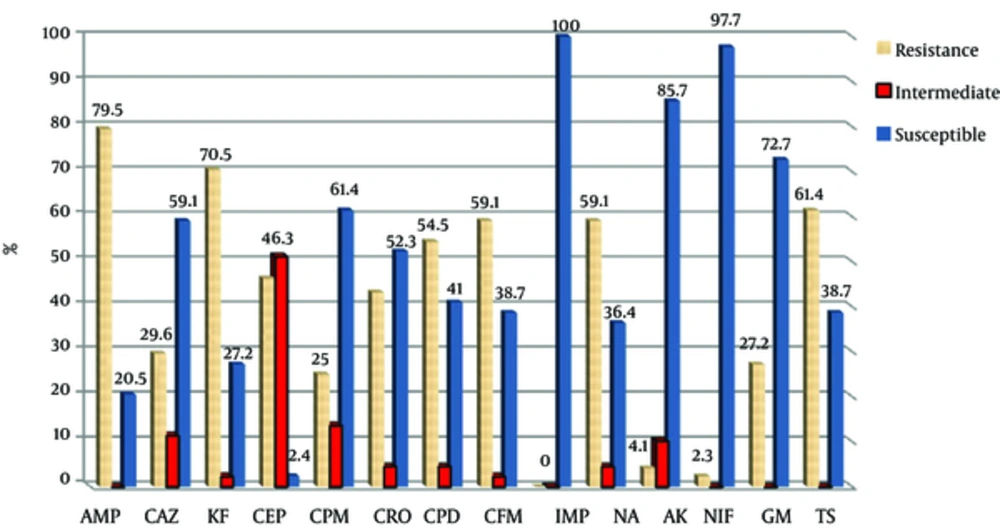
Antibiotic Susceptibility Pattern of Urinary E. coli Isolates from Mashhad (AMP; Ampicillin, CAZ; ceftazidime, KF; Cephalothin, CEP; Cefotaxime, CPM; Cefepime, CRO; Ceftriaxone, CPD; Cefpodoxime, CFM; Cefixime, IMP; Imipenem, NA; Nalidixic Acid, AK; Amikacin, NIF; Nitrofurantoin, GM; Gentamicin, TS; Cotrimoxazole)
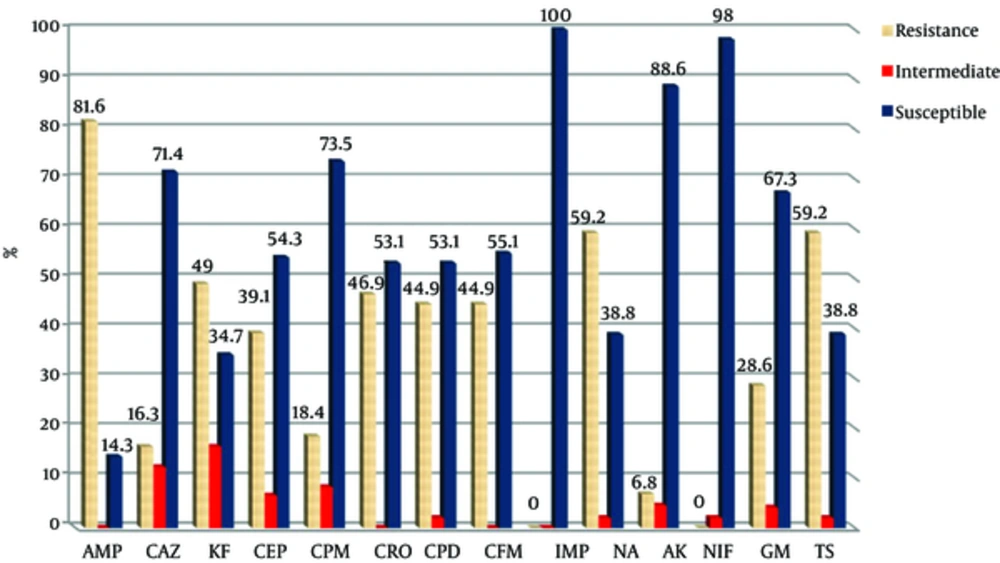
Antibiotic Susceptibility Pattern of Urinary E. coli Isolates from Qom (AMP; Ampicillin, CAZ; Ceftazidime, KF; Cephalothin, CEP; Cefotaxime, CPM; Cefepime, CRO; Ceftriaxone, CPD; Cefpodoxime, CFM; Cefixime, IMP; Imipenem, NA; Nalidixic Acid, AK; Amikacin, NIF; Nitrofurantoin, GM; Gentamicin, TS; Cotrimoxazole)
3.3. Results of Genetic Analysis
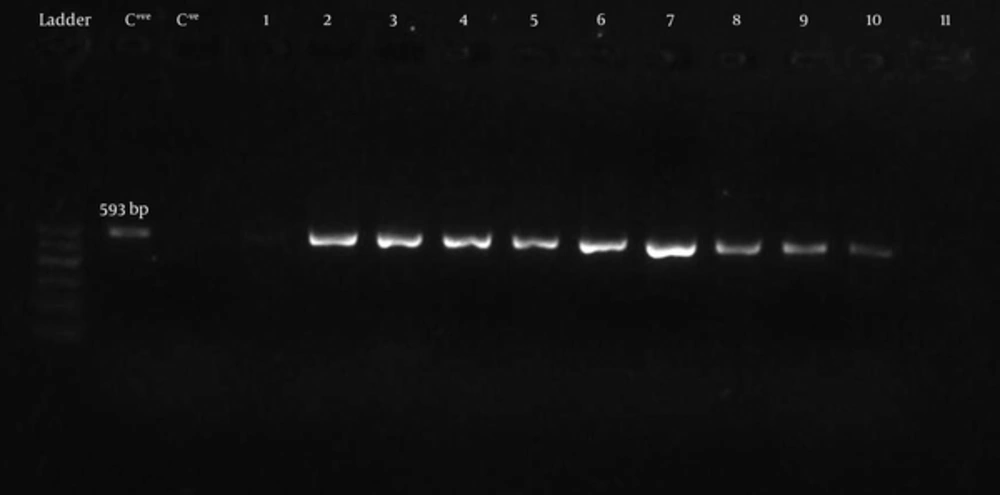
PCR Products of CTX-M Type ESBL Producing Isolates on 1.5% gel Agarose (C + ve; Positive Control, C-ve; Negative Control, Ladder; Marker 100 bp
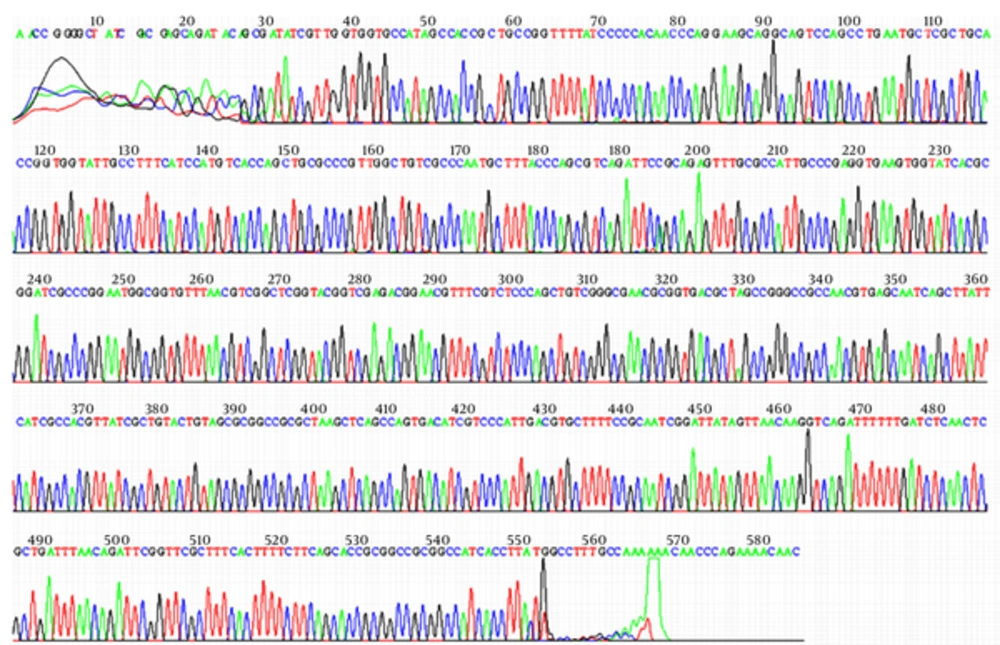
Sequencing of blaCTX-M-1PCR Product of One Isolate from Qom
