
1. Background
Type 1 diabetes has some adverse effects on reproduction and reproductive organs. Diabetes conditions suppress follicular development and ovarian steroidogenesis, increased granulosa cell apoptosis and compromised oocyte nuclear maturation and ovulation [1-3]. Lower nuclear matured oocyte - indicated by percentage of GVBD and MII ova proportion at ovulation - were recovered from superovulated diabetic mice. Insulin treatment of type 1 diabetes lead to truncate this maturation delays that confirmed by several previous studies [4, 5]. Insulin treatment not only improve the maturation rate of oocytes in Streptozotocin (STZ) induced diabetics [5], but reverses the diabetes effects on in vitro maturation outcome in rat [4]. Several studies confirmed the antidiabetic effects of Aloevera, a plant from liliacae family [6, 7]. Polysaccharides, mannans, anthraquinones, lectins, salicylic acid, urea, nitrogen, cinnamic acid, phenol, sterols and sulphur have been reported as active compounds of Aloevera [8]. Anti-hyperglycemic activity of this plant has well confirmed in STZ or Alloxan induced diabetic animals [3, 9]. Free radicals generated in diabetes conditions could adversely affect reproductive organs and tissues. The antioxidant activity of Aloevera has reported, that could effectively ameliorate the oxidative stress inflicted by diabetes condition in hepatic and kidney tissues [6, 10]. Free radicals play a key role in granulosa cell apoptosis in follicle atresia under the regulation of estradiol and gonadotropins that altered under diabetes condition.
2. Objectives
In this study sought to determine that Aloevera gel administration could ameliorate the effect of STZ-induced diabetes condition on follicular development, oocyte maturation and ovulation.
3. Methods
3.1. Animal Housing and Experimental Design
25 female (24 - 29 g and 8 - 10 weeks old, were purchaised from animal house center of Jundishapour Ahwaz University) NMRI mice were used. 15 mice received a single dose of 190 mg/kg stereptozotocin (STZ) to generate the diabetic model. Blood glucose was measured at 7 days after STZ injection by a glucometer (On-call plus, USA). Animals with glucose level more than 300 mg/dL considered as diabetics. The animals devided to 5 groups: 1: control group (received normal salin), 2: Aloe (received Aloevera 350 mg/kg/day by gavage), 3: Diabetic, 4: Diabetics received Aloe (350 mg/kg/day by gavage), 5: Diabetic + insulin (received Insulin). The blood glucose of some of nondiabetics was also randomly checked to ensure that it was less than 250 mg/dL. The animals were caged in plastic cages in 12 hours light/dark cycle and temperature of 22 ± 2°C and free access to food and water, and the study was approved by the animal ethics committee of the University of Shahid Charmin University, Iran.
3.2. Oocyte Collection
All animals were superovulated by 10 IU PMSG (Fariman, Iran) interaperitoneal injection followed approximately 48 hours later by 10 IU hCG (Pregnil, Netherlands). Oviducts were flashed and oocyte cumulus complexes were recovered from each ampullae approximately 16 - 18 hours after hCG injection and denuded by gently pipetting in Ham’s F-10 medium containing 10% BSA (Sigma, USA) and 1 mg/mL Hyaloronidase (Sigma, USA). Oocyte was evaluated morphologically to estimate the mature and nonmature stages oocyte percentage. Oocyte diameter was measured excluding the zonapellucida. Perivitellin space and zonaplucida diameter was measured with Image J 1.48 program.
3.3. Ovary Sectioning
The paraffin embded ovaries were sectioned in 5 µm sections and stained by hematoxylin and Eosin. Sections were studied to find the growing follicle percentage in each class. Primordial follicles charactherizes by a primary oocyte surrounded by single layer of squamous cells. If single layer of cuboidal cells surrounded the primary oocyte, it became primary follicle. Two or more layers of granulosa cells located around the oocyte of secondary follicle. When a single antrum was formed, it called tertiary follicle. The mature follicles are caractherized by formation of mature theca internal cells. Presence of pycnotic oocyte and granulose cells determined the artistic follicles.
3.4. Statistical Analysis
SPSS version 19.1 software was used for statistical analysis. Differences between all groups were compared by one-way ANOVA with LSD post hoc test. Results are expressed as means ± SEM of at P < 0.05 was considered statistically significant.
4. Results
4.1. Morphological Evaluation of Recovered Oocytes
The results determine that diabetes affected oocyte morphology and maturation rate. As represented in table 1, oocyte and perivitellin space diameter were influenced by STZ induced diabetes. Aloevera and insulin treatment increased the oocyte diameter significantly compared to diabetic group (P < 0.01). Insulin had reversed the reduction effect of diabetes on oocyte size significantly (P < 0.01), but except in perivitellin space diameter. There was no significant difference between oocyte diameters of Aloevera and insulin treated diabetic mice. Data analysis indicate that Aloevera was more effective than insulin in reduction of perivitellin space diameter in diabetic mice (P < 0.01); but it did not normalize it. There was no significant difference between oocyte diameters of Aloevera and control groups. There was no significant difference between zonapellucida diameters of ovulated oocytes in five experimental groups (P > 0.05). Results show that the ovulated oocytes adversely affected by diabetes compared to control groups. Aloevera and insulin treatment increased the ovulated oocyte number per animal compared to diabetic mice. Results indicated that Aloevera could improve ovulation rate more efficient than insulin (P < 0.01). Oocyte nuclear maturation starts with germinal vesicle break down, followed by metaphase I stage and extrusion of first polar body at metaphase II (MII) stage. Statistical analysis of oocyte nuclear stage indicates that MII oocyte percentage (maturation rate) was decreased significantly in diabetic group (72.22 ± 4) compared to control group (91.50 ± 1.95, P < 0.001). Aloevera and insulin administration were reversed the effects of diabetes on maturation rate (Table 2). Further investigation shows that the percentage of MI stage oocytes in diabetic group (18.88 ± 1.11) was higher than Aloevera and insulin treated groups (10.79 ± 2.77 and 7.97 ± 2.81 respectively, P < 0.01). Comparison of MI percentage in two treated diabetic groups shows that insulin diminished it more than Aloevera (P < 0.05). Maturation rate were adversely affected by diabetes (P < 0.001). MII oocyte percentage was decreased significantly in diabetic group compared to control mice. Aloevera and insulin administration were effectively reversed the diabetes effects on maturation rate (Table 2).
4.2. Follicular Development in Response to Superovulation Regimen
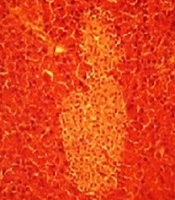
The follicle percentage in each class was statistical analyzed. Data shows that primary follicle percentage was decreased in diabetes condition significantly compared to control group (P < 0.001).The primary follicle percent was increased by Aloevera and insulin treatment compared to diabetic group. Statistical analysis represents a significant increasing in tertiary follicles percentage in three diabeticgroups compared to control group that was coincised with decreasing in ovulation rate as compared to control animals. Mature follicles have been increased in diabetic mice and diabetics which treated by insulin, but Aloevera treatment turn them to control group. The other histological finding was the increasing of the vascularity in Aloevera treated groups compare to the other groups.
Table 1.
The Oocyte Number Per Animal, Oocyte Diameter (µm), Privitellin and Zonapellucida Diameter (µm), in 5 Experimtal groups (Mean ± SEM)
| Group | Oocyte Number | Oocyte Diameter, µm | Zona Pellucid Diameter, µm | Perivitellin Space Diameter, µm |
|---|---|---|---|---|
| Control | 21 ± 2.36 | 71.21 ± 0.40 | 7.86 ± 0.10 | 3.31 ± 0.18 |
| Aloe | 24.42 ± 2.14 | 72.15 ± 6.53 | 7.87 ± 0.09 | 4.01 ± 0.23 |
| Diabetic | 5.2 ± 1.48 | 63.08 ± 0.57 | 8.09 ± 0.37 | 6.22 ± 0.29 |
| Diabetic + Aloe | 17 ± 1.52 | 69.66 ± 0.25 | 8.29 ± 0.21 | 4.19 ± 0.23 |
| Diabetic + Insulin | 14.7 ± 1.34 | 68.68 ± 0.46 | 7.79 ± 0.12 | 5.71 ± 0.51 |
Table 2.
Mean ± SEM Value of Primary, Secondary, Tertiary and Mature Follicles, CL and Ovulation rate in 5 Groups
| Group Follicle Class | Control | Aloe | Diabetic | Diabetic + Aloe | Diabetic + Insulin |
|---|---|---|---|---|---|
| Primary F. | 46.89 ± 1.26 | 47.73 ± 1.23 | 26.20 ± 0.77 | 38.64 ± 0.99C | 31.77 ± 4.01 |
| Secondary F. | 21.38 ± 0.86 | 24.68 ± 2.20 | 16.94 ± 0.33 | 20.36 ± 0.85BC | 16.67 ± 1.41 |
| Tertiary F. | 3.89 ± 0.51 | 4.28 ± 0.32A | 5.20 ± 0.59 | 4.7 ± 0.52B | 4.7 ± 0.54 |
| Mature F. | 2.14 ± 0.60 | 2.40 ± 0.24 | 3.8 ± 0.49 | 2.35 ± 0.45A | 2.76 ± 0.47A |
| Atretic F. | 19.69 ± 0.82 | 14.81 ± 1.47 | 42.88 ± 1.10 | 28.15 ± 1.08C | 38.90 ± 3.05 |
| CH + CL | 5.98 ± 0.05 | 6.07 ± 0.33 | 4.9 ± 0.54C | 5.74 ± 0.25AB | 5.10 ± 0.29 |
| Ovulation rate (oocyte No/animal) | 2.36A ± 21 | 2.14B ± 24.42 | 1.48 C ± 5.2 | 1.52 D ± 17 | 14.7 ± 1.34 |
5. Discussion
Many earlier studies showed that ovulation impairs in diabetic conditions [3, 10], that is in accordance with our findings. Approximately one third of ova were ovulated following superovulation in diabetic mice compared with controls. Accurate analysis of ovulated oocytes shows that diabetes delayed meiotic progression to metaphase II, and lowered morphological quality of the ovulated oocytes in diabetic mice, that represented by reduction of oocyte diameter and increase of perivitelline space. And Aloevera and insulin administration were effectively reversed the diabetes effects on meiosis process.
The communication between cumulus and oocyte may cause inability of oocyte to complete maturation at the time of isolation. It is reported that overnight culture of denuded oocytes lead to complete meiosis (98%) at control level, while in COC culture, MII reached oocytes were significantly lowered compared to controls [11]. Powers et al. [12], suggest that the decreasing in ovulation rate may be due to impairment of nitric oxide protection, due to a defect in the blood follicle barrier in diabetic ovaries. The endothelial defects may cause a delay in the hCG-stimulated influx of the serum glycoprotein, interα-inhibitor that is associated with a deficit in superoxide dismutase activity. Severe hyperglycemic condition of STZ induced diabetes diminished ovulation rate in mice [13]. Insulin is disabling to prevent or reverse vasculopathy and complication of type 1 diabetes mellitus (Waxman et. al. 1993). It has found that the vascularity was more in Aloevera treated groups than the others. This effect of Aloevera on ovarian structure was reported in previous studies [14]. The other probable mechanisms of hypoovulation are hypothalamic ovarian defect in diabetics associated with suppressed LH surge in ovarian steroidogenesis, or low response to hormones. The analysis of follicular development and ovulation rate, suggests that diabetes cause some effects on secondary follicles to tertiary and therefore mature follicles transition, and then anovulation of some cases occure subsequently. Aloevera improved follicle development and ovulation partially, in diabetic mice. Kosif and Aktas (2009) [14] Reported that daily Aloevera treatment (140 mg/kg by gavage) lead to decrease in primary follicle numbers, increase in secondary follicle numbers, in rats, that in accordance with our findings. They reported that Aloevera diminished the secondary follicle diameters in ovaries. It is indicated that maternal diabetes affect female foetal gonads which reflects by reduction in ovarian weight, ovarian size, follicule number and follicle diameter in the offspring ovaries even in reproductive period after birth [15]. It has reported that usage of Aloevera extract during gestational age of 18 day embryo of diabetic rats caused significant increasing in primordial follicle cell numbers in the ovary [15]. The results of present study showed that treatment of diabetic mice with Aloevera increased the ovulation and maturation rate, and, and decreased follicle atresia, significantly.