Fulltext
The full text of this article is available on the PDF file.
Zahedan Journal of Research in Medical Sciences
The Official Journal of Zahedan University of Medical Sciences
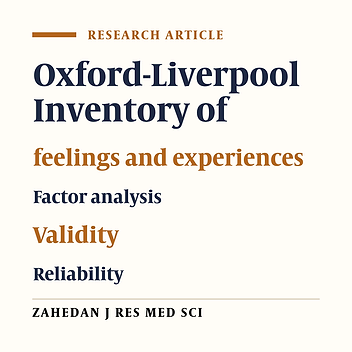
Image Credit:Zahedan J Res Med Sci
Authors
Background : The Oxford-Liverpool Inventory of Feelings and Experiences (O-LIFE) is a 104-item tool made based on the factor analysis of 15 available scales to measure schizotypy. This research aims to investigate the psychometric properties of Oxford-Liverpool Inventory of Feelings and Experiences.
Materials and Methods : Conducted as an ex-post facto survey, this study is a descriptive cross–sectional research. A sample of 482 patients was selected and assessed through stratified random sampling from different faculties of Shahid Madani University of Azarbaijan. Data were analyzed using exploratory factor analysis method by means of the Principal Component Analysis method.
Results : Factor analysis using the Principal Component Analysis method extracted five principal factors, which were named cognitive disorganization, impulsive nonconformity, unusual experiences/magical thinking, introvertive anhedonia, and isolation. In addition, two other types of validity (concurrency and correlation of subscales with the total scale and each other) and three types of reliability (test-retest, half-splitting, and internal consistency) were reported.
Conclusion : According to the findings of the present study, O-LIFE has favorable psychometric properties in the Iranian society and is applicable in psychiatric and psychologic researches as a valid tool.
© 2012, Author(s). This open-access article is available under the Creative Commons Attribution 4.0 (CC BY 4.0) International License (https://creativecommons.org/licenses/by/4.0/), which allows for unrestricted use, distribution, and reproduction in any medium, provided that the original work is properly cited.
Moslehi F, Kianimoghadam AS, Askari Z, Amanollahi Z, Babazadeh MH, et al. Psychometric Properties of the Persian Version of the Multi-Modality Unusual Sensory Experiences Questionnaire (MUSEQ) Among Students of Medical Sciences Universities in Tehran. Iran J Psychiatry Behav Sci. 2026;20(Suppl):e168341. doi: https://doi.org/10.5812/ijpbs-168341
Masoomi M, Shadloo B, Nedjat S, Bahrami Z, Sharifi V, et al. Validity and Reliability of the Persian Version of the “Quality of Life Scale” in Schizophrenia. Iran J Psychiatry Behav Sci. 2018;12(3):e67632. doi: https://doi.org/10.5812/ijpbs.67632
Heravi-Karimooi M, Rejeh N, Garshasbi A, Montazeri A, Bandari R. Psychometric Properties of the Persian Version of the Quality of Life in Early Old Age (CASP- 19). Iran J Psychiatry Behav Sci. 2018;12(2):e8378. doi: https://doi.org/10.5812/ijpbs.8378
Khanjani S, Mousavi Asl E, Foroughi A, Kazemini M, Rajabi M. Psychometric Properties of the Persian Version of the Early Life Experiences Scale (ELES). Iran J Psychiatry Behav Sci. 2023;17(1):e122454. doi: https://doi.org/10.5812/ijpbs-122454
Naderi Rajeh Y, Dolatshahi B, Pourshahbaz A, Zarghami M. Psychometric Evaluation of the Persian Version of Spontaneous Use of Imagery Scale in the Iranian Population. Iran J Psychiatry Behav Sci. 2023;17(1):e123402. doi: https://doi.org/10.5812/ijpbs-123402
Last Update: 2 weeks ago
Last Update: 2 weeks ago
Last Update: 2 weeks ago
Last Update: 10 hours ago
Last Update: 13 hours ago
Last Update: 5 days ago