
1. Background
In recent decades, research on perceptual experiences has expanded beyond clinical constructs to include subclinical manifestations, such as psychotic experiences (PE), psychotic-like experiences (PLE), and unusual sensory experiences (USE) (1, 2). According to psychosis spectrum theory, these subthreshold experiences can occur in the general population without causing functional impairment (3).
Unusual sensory experiences, sometimes termed unusual perceptual experiences, are transient unimodal or multimodal sensory perceptions characterized by a mismatch between what is experienced and the external environment (2). Although USE, PLE, and PE are sometimes used interchangeably (4), in this study, we focus on USE as a broad phenomenological category of sensory disturbances, encompassing both subclinical, non-impairing hallucinations (perceptions without external stimuli) and misperceptions (distortions of real stimuli) observed in healthy individuals and clinical groups (2). In this context, we conceptually distinguish USE from PE and PLE because PE and PLE include delusion- or hallucination-like occurrences, as well as negative features such as anhedonia or apathy, within the psychosis spectrum (5).
Consistent with this distinction, a key feature of USE is their unimodal versus multimodal nature. Although the literature has focused primarily on auditory experiences (6), recent studies have provided rigorous evidence across various dimensions of USE (7). Studies have suggested that, even within the psychosis spectrum framework, which conceptualizes perceptual anomalies broadly, the emphasis remains on explicit experiences such as visual or auditory phenomena rather than on more phenomenological and ambiguous perceptual experiences such as bodily sensations, despite their potential to cause discomfort (8). Research has indicated that multimodal hallucinations, considered here a subset of USE and varying in timing (consecutively or simultaneously), content, or origin, have a greater impact on an individual's mental health than unimodal hallucinations (9).
Given the multimodal nature of USE and the limited tools available for assessing them within modality-specific frameworks, Mitchell et al. (2) developed the MUSEQ as a valid instrument supported by confirmatory factor analysis. The MUSEQ was developed using a sample of 1,300 participants, including members of the general population, clinical groups, and students (2).
In Iran, assessment tools for perceptual anomalies are mainly limited to Persian adaptations of instruments such as the Launay-Slade Hallucination Scale (LSHS) and the Oxford-Liverpool Inventory of Feelings and Experiences (O-LIFE), which assess hallucination proneness and unusual experiences as one dimension of broader schizotypy traits, respectively (10, 11). Unlike these instruments, the MUSEQ provides separate subscale scores for each sensory modality: visual, auditory, olfactory, gustatory, bodily sensations, and sensed presence (2). To our knowledge, no validated Persian instrument specifically assesses USE across multiple sensory modalities. Moreover, a Persian adaptation of the MUSEQ would enable Iranian clinicians and researchers to examine modality-specific USE profiles and facilitate future research and structured assessment of sensory processing without conflating it with psychotic pathology.
Students at medical sciences universities constitute a large and academically diverse population in Iran. To date, no study in Iran has evaluated USE in this group using a modality-specific instrument.
2. Objectives
Given the lack of valid Persian instruments for measuring multimodal USE, this study aimed to translate the MUSEQ into Persian and evaluate its psychometric properties, including factor structure, reliability, and validity, among medical sciences university students in Tehran.
3. Methods
3.1. Participants
This descriptive cross-sectional study was conducted between September and October 2025 among students at medical sciences universities in Tehran. Participants were recruited using convenience sampling, both online via university social media groups and on campus. Participation was voluntary and anonymous, and informed consent was obtained.
The inclusion criteria were enrollment as a student at one of the medical sciences universities in Tehran at the time of the study and an age of at least 18 years. Participants who had recently graduated were included if they reported graduating during the first half of the data collection period, as indicated by their responses to the demographic questionnaire. Exclusion criteria included a current or past diagnosis of schizophrenia spectrum disorder, bipolar disorder, epilepsy, traumatic brain injury, multiple sclerosis, synesthesia, migraine, or sleep disorders, as well as random response patterns, operationalized in this study as more than 22 consecutive repetitive responses based on LongString criteria (12).
A total of 497 participants initially completed the inventories. Because sensory distortions may occur in certain neurological and psychiatric conditions and potentially mimic USE (13-16), participants reporting schizophrenia spectrum disorder (n = 5), bipolar disorder (n = 11), epilepsy (n = 5), traumatic brain injury (n = 22), multiple sclerosis (n = 4), synesthesia (n = 1), sleep disorders (n = 44), or migraine (n = 61) were excluded. Fourteen participants reported both migraine and sleep disorders and were counted once in the final exclusion total. No participants met the criterion for random responding.
For sample size estimation, a 5:1 participant-to-item ratio was selected as a conservative minimum recommendation for CFA (17). The final sample size (n = 358) exceeded this threshold, supporting stable parameter estimation. This sample was used for all psychometric analyses.
3.2. Instruments
3.2.1. Demographic and Health Questionnaire
Participants answered four questions regarding demographic characteristics: age, gender, education level, and marital status. Eleven additional items collected self-reported information on lifetime medical history, including sleep disorders, epilepsy, traumatic head injury, and neurodegenerative disease; mental health history, including schizophrenia spectrum disorder and bipolar disorder; and synesthesia. The year of diagnosis was also requested for each endorsed item.
3.2.2. Multi-Modality Unusual Sensory Experiences Questionnaire
The Multi-Modality Unusual Sensory Experiences Questionnaire (MUSEQ), developed by Mitchell et al. (2), assesses USE across sensory modalities. The MUSEQ uses a 5-point Likert scale ranging from 0 (never) to 4 (frequently, at least once a month). The 43-item MUSEQ assesses the frequency of USE across clinical and nonclinical populations using six modality-specific subscales: Auditory (7 items), Visual (8 items), Olfactory (8 items), Gustatory (8 items), Bodily Sensations (8 items), and Sensed Presence (4 items). It yields both subscale scores and a total score, with higher scores indicating a greater frequency of USE. In the original validation study, the MUSEQ demonstrated good internal consistency, with Cronbach's alpha coefficients ranging from 0.77 to 0.90 across subscales (2). In the present study, the Persian MUSEQ showed moderate fit for the six-factor structure (CFI = 0.95, RMSEA = 0.088), acceptable internal reliability for the subscales (α = 0.77 - 0.91), and high reliability for the total score (α = 0.95). A strong positive correlation with the LSHS-M-II (r = 0.69, P < 0.001) supported convergent validity. However, evidence for divergent validity was limited.
3.2.3. Launay-Slade Hallucination Scale-Modified-II
The Launay-Slade Hallucination Scale-Modified-II (LSHS-M-II) is a 16-item self-report questionnaire designed to assess proneness to hallucinatory experiences. In the present study, the adaptation developed by Larøi and Van der Linden (18) was used, excluding the follow-up questions. Each item is rated on a 5-point Likert scale ranging from 0 to 4, with higher scores indicating greater hallucination proneness. This study used the Persian adaptation of the LSHS-M-II, which has shown good internal consistency and reliability in the Iranian population (Cronbach's α = 0.87) (10). In this study, Cronbach's alpha for the total LSHS-M-II was 0.89, indicating good internal consistency. Convergent validity, measured using the bootstrapped Pearson correlation between the LSHS-M-II and MUSEQ, showed a strong positive association (r = 0.69, P < 0.001; 95% CI [0.60, 0.75]).
3.2.4. Oxford-Liverpool Inventory of Feelings and Experiences-Short Version
The Oxford-Liverpool Inventory of Feelings and Experiences-Short Version (sO-LIFE) is a 43-item self-report questionnaire that assesses schizotypal traits in nonclinical populations. The sO-LIFE comprises four subscales: Unusual Experiences (UE), Cognitive Disorganisation (CD), Introvertive Anhedonia (IA), and Impulsive Nonconformity (IN). Items are scored dichotomously (yes/no), with higher scores indicating greater expression of schizotypal traits (19). The Persian adaptation of the sO-LIFE was used in this study and has previously demonstrated good internal consistency and reliability in an Iranian sample (11). In the present study, Cronbach's alpha coefficients were 0.82 for UE, 0.83 for CD, and 0.34 for IA, indicating insufficient internal consistency for the IA subscale. Correlational analyses examining the convergent and divergent validity of the MUSEQ showed a strong positive association with the UE subscale (r = 0.67, P < 0.001; 95% CI [0.56, 0.73]), supporting convergent validity. In contrast, the correlation with CD was moderate (r = 0.43; 95% CI [0.34, 0.51]), suggesting partial conceptual overlap, whereas the correlation with IA was small (r = 0.19; 95% CI [0.08, 0.29]). Together, these findings indicate limited evidence for divergent validity.
3.3. Translation and Cultural Adaptation Process
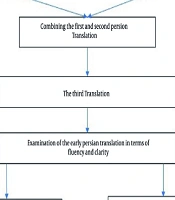
A systematic process was used to ensure the accuracy and cultural appropriateness of the Persian version. First, a psychologist and a linguist translated the original questionnaire into Persian. After review by a PhD psychologist fluent in English, another bilingual expert, who was blinded to the initial translation, performed a back-translation. The research team reviewed the back-translation and resolved discrepancies. To assess content validity, three experts in psychology and psychometrics reviewed the items and evaluated each for clarity, relevance, and cultural appropriateness using the Content Validity Index (CVI) and Content Validity Ratio (CVR). All items were considered conceptually consistent and culturally appropriate. To assess face validity, the pre-final version of the MUSEQ was administered to 10 students to evaluate clarity and comprehensibility. A supervisor then reviewed the final version to confirm content validity and suitability for the target population.
3.4. Statistical Analysis
Statistical analyses were conducted using IBM SPSS Statistics version 27 and LISREL 8.8. Key statistical assumptions were evaluated for multivariate normality, linearity, and homoscedasticity before further analyses. Univariate outliers were identified using z-scores and boxplots, with values exceeding 3 standard deviations considered outliers. Data normality was assessed by visual inspection, the Kolmogorov-Smirnov test, and skewness and kurtosis analyses (Table 1). Descriptive statistics, including means, standard deviations, skewness, kurtosis, and observed ranges, were calculated for each item and subscale. Confirmatory factor analysis was performed using maximum likelihood estimation to evaluate the MUSEQ factor structure. Model fit was assessed using multiple indices, including χ2, χ2/df, RMSEA with 90% CI, CFI, NFI, and GFI. The established criteria for adequate fit included CFI and NFI > 0.90 and RMSEA < 0.08 (20).
Table 1.
Descriptive Statistics of MUSEQ Components a
| Variables | Mean | SD | Kurtosis | Skewness | Observed Range | Alpha |
|---|---|---|---|---|---|---|
| AUD | ||||||
| Female | 7.91 | 5.70 | 0.07 | 0.72 | 0 - 27 | 0.78 |
| Male | 7.90 | 5.77 | 0.56 | 0.72 | 0 - 27 | 0.78 |
| VIS | ||||||
| Female | 5.91 | 5.76 | 2.39 | 1.38 | 0 - 32 | 0.81 |
| Male | 7.15 | 6.65 | -0.62 | 0.71 | 0 - 24 | 0.87 |
| OLF | ||||||
| Female | 4.25 | 5.83 | 4.71 | 2.05 | 0 - 32 | 0.88 |
| Male | 4.31 | 5.92 | 1.45 | 1.55 | 0 - 22 | 0.91 |
| GUS | ||||||
| Female | 3.82 | 5.03 | 4.01 | 1.92 | 0 - 25 | 0.87 |
| Male | 5.08 | 5.73 | 1.44 | 1.48 | 0 - 23 | 0.88 |
| Bod Se | ||||||
| Female | 6.54 | 6.57 | 1.72 | 1.38 | 0 - 32 | 0.87 |
| Male | 7.51 | 6.65 | 0.39 | 0.90 | 0 - 28 | 0.84 |
| Se Pr | ||||||
| Female | 2.09 | 2.91 | 4.84 | 2.06 | 0 - 16 | 0.77 |
| Male | 2.69 | 3.24 | 0.34 | 1.19 | 0 - 11 | 0.82 |
| MUSEQ | ||||||
| Female | 30.52 | 26.26 | 2.29 | 1.41 | 0 - 145 | 0.95 |
| Male | 34.65 | 29.42 | 0.71 | 1.16 | 0 - 128 | 0.96 |
a Abbreviations: AUD, Auditory; Bod Se, Bodily Sensations; GUS, Gustatory; MUSEQ, Multi-Modality Unusual Sensory Experiences Questionnaire; OLF, Olfactory; Se Pr, Sensed Presence; VIS, Visual.
Reliability was assessed using Cronbach's alpha, with coefficients calculated for all MUSEQ subscales and the total score. Convergent validity was assessed through correlations between the MUSEQ and the LSHS-M-II, whereas divergent validity was assessed by correlating the MUSEQ with sO-LIFE dimensions less relevant to USE. Effect sizes for correlational analyses were reported as Pearson's r with 95% confidence intervals. Results were considered statistically significant at P < 0.05. The conceptual structure of the model is illustrated in Figures 1 and 2.
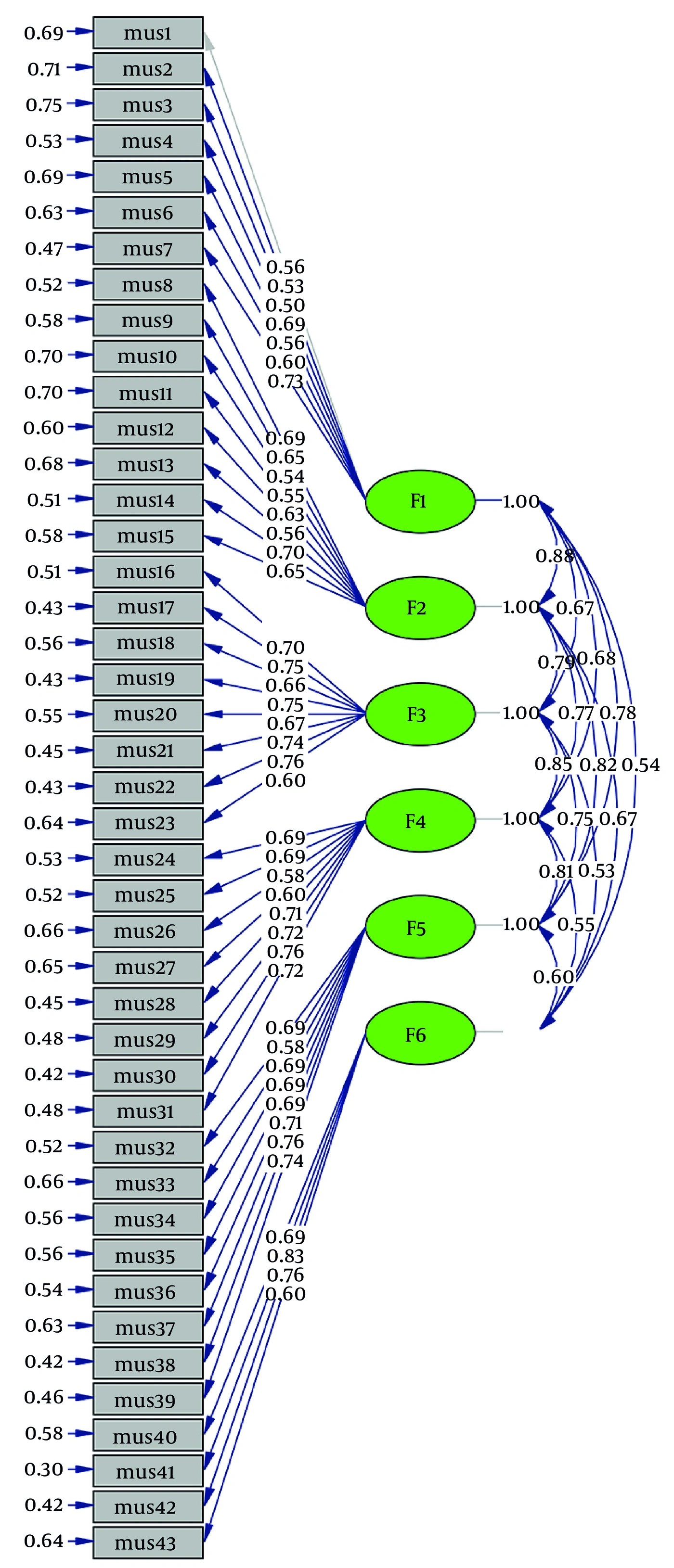
Figure 1.
Results of confirmatory factor analysis of MUSEQ
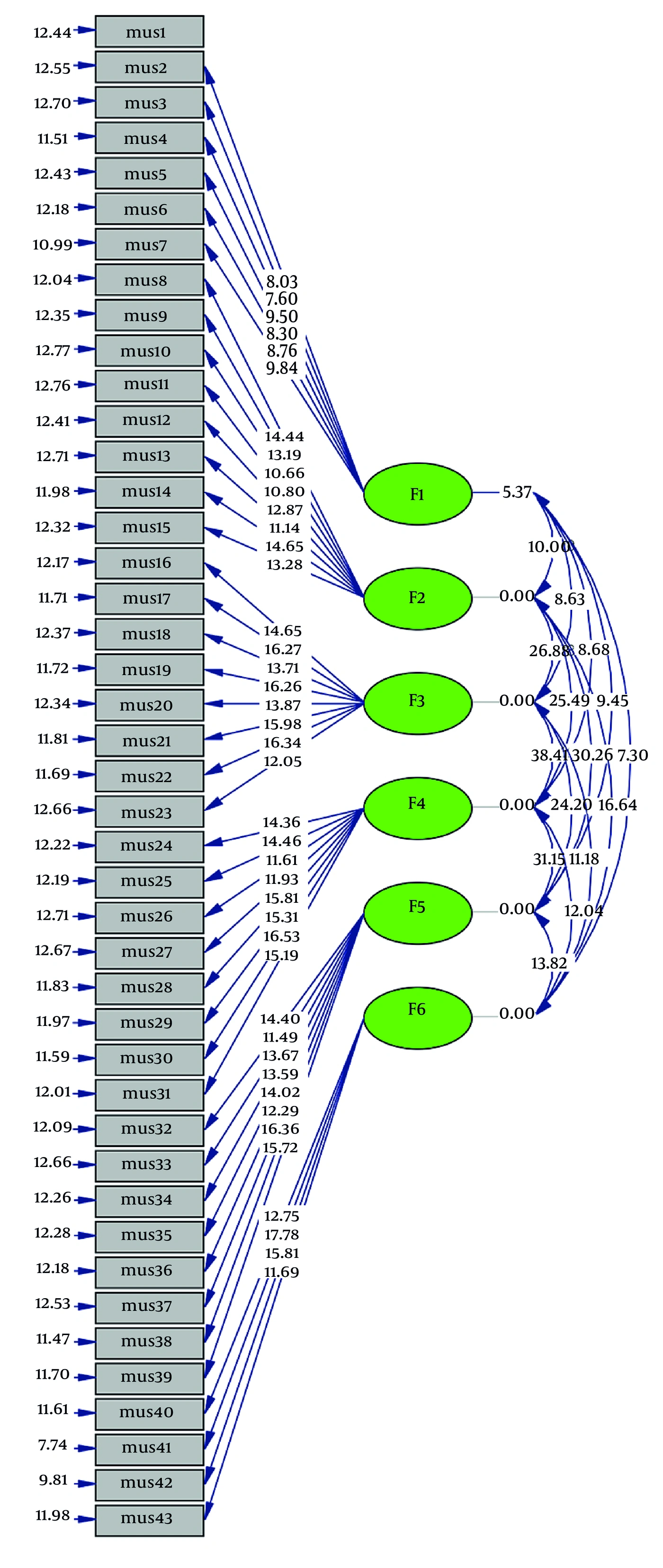
Figure 2.
Results of confirmatory factor analysis of MUSEQ
4. Results
The participants’ ages ranged from 18 to 58 years (M = 23.63, SD = 5.57). Of the participants, 287 (80.1%) were female and 71 (19.8%) were male. A total of 50 participants (13.97%) were married and 308 (86.0%) were single. Participants’ educational status included undergraduate students (n = 176, 49.2%), master’s students (n = 103, 28.8%), and doctoral students (n = 29, 8.1%). Among graduates, 21 held a bachelor’s degree (5.9%), 23 held a master’s degree (6.4%), and 6 held a doctoral degree (1.7%). Cronbach’s alpha coefficients were 0.78 for Auditory, 0.82 for Visual, 0.89 for Olfactory, 0.87 for Gustatory, 0.87 for Bodily Sensations, 0.78 for Sensed Presence, and 0.95 for the MUSEQ total (Table 1).
4.1. Confirmatory Factor Analysis
The CFA results for the six-factor MUSEQ model indicated a marginal overall fit to the data (Table 2). The χ2/df ratio was 3.75, exceeding the recommended threshold of 3.0. RMSEA was 0.088 (90% CI [0.085, 0.091]), and GFI and AGFI were 0.71 and 0.67, respectively. Comparative fit indices (CFI = 0.95, TLI = 0.95) and SRMR = 0.064 supported acceptable incremental and residual fit. All 43 items loaded significantly on their respective factors (λ = 0.50 - 0.83; Table 3).
Table 2.
Model Fit Indices
| Model | χ2 | df | P-Value | χ2/df | CFI | NFI | RMSEA | GFI | TLI |
|---|---|---|---|---|---|---|---|---|---|
| MUSEQ (6-factor model) | 3176.44 | 845 | 0.00 | 3.75 | 0.95 | 0.93 | 0.088 | 0.71 | 0.95 |
Table 3.
Standardized Factor Loadings for All Items in the Six-Factor CFA Model
| Factors and Items | M | SD | F.L. |
|---|---|---|---|
| AUD | |||
| A1 | 1.17 | 1.28 | 0.56 |
| A2 | 1.00 | 1.31 | 0.53 |
| A3 | 1.55 | 1.53 | 0.50 |
| A4 | 1.44 | 1.16 | 0.69 |
| A5 | 1.37 | 1.24 | 0.56 |
| A6 | 0.63 | 1.09 | 0.60 |
| A7 | 0.72 | 0.97 | 0.73 |
| VIS | |||
| V1 | 1.01 | 1.17 | 0.69 |
| V2 | 0.62 | 1.05 | 0.65 |
| V3 | 1.17 | 1.37 | 0.54 |
| V4 | 1.19 | 1.41 | 0.55 |
| V5 | 0.54 | 0.97 | 0.63 |
| V6 | 0.42 | 0.91 | 0.56 |
| V7 | 0.77 | 1.11 | 0.70 |
| V8 | 0.40 | 1.04 | 0.65 |
| OLF | |||
| O1 | 0.68 | 1.04 | 0.70 |
| O2 | 0.52 | 1.13 | 0.75 |
| O3 | 0.74 | 0.89 | 0.66 |
| O4 | 0.43 | 0.90 | 0.75 |
| O5 | 0.51 | 1.04 | 0.67 |
| O6 | 0.61 | 0.98 | 0.74 |
| O7 | 0.52 | 0.76 | 0.76 |
| O8 | 0.25 | 1.28 | 0.60 |
| GUS | |||
| G1 | 0.46 | 0.82 | 0.69 |
| G2 | 0.47 | 0.90 | 0.69 |
| G3 | 0.65 | 1.01 | 0.58 |
| G4 | 0.79 | 1.09 | 0.60 |
| G5 | 0.73 | 1.02 | 0.74 |
| G6 | 0.34 | 0.79 | 0.72 |
| G7 | 0.38 | 0.83 | 0.76 |
| G8 | 0.25 | 0.63 | 0.72 |
| Bod Se | |||
| BS1 | 0.87 | 1.10 | 0.69 |
| BS2 | 1.11 | 1.24 | 0.58 |
| BS3 | 0.88 | 1.18 | 0.66 |
| BS4 | 0.64 | 1.09 | 0.66 |
| BS5 | 1.11 | 1.31 | 0.68 |
| BS6 | 1.07 | 1.28 | 0.61 |
| BS7 | 0.50 | 0.98 | 0.76 |
| BS8 | 0.54 | 0.95 | 0.74 |
| Se Pr | |||
| SP1 | 0.95 | 1.17 | 0.65 |
| SP2 | 0.45 | 0.92 | 0.83 |
| SP3 | 0.42 | 0.89 | 0.76 |
| SP4 | 0.39 | 0.80 | 0.60 |
4.2. Convergent and Divergent Validity
Convergent validity analyses showed strong correlations between the MUSEQ total score and the LSHS-M-II (r = 0.69, P < 0.001) and sO-LIFE Unusual Experiences (r = 0.67, P < 0.001). Divergent validity analyses showed a moderate correlation with sO-LIFE Cognitive Disorganisation (r = 0.43, P < 0.001) and a small correlation with Introvertive Anhedonia (r = 0.19, P < 0.001). The internal consistency of the Introvertive Anhedonia subscale was low (α ≈ 0.30). These findings provide mixed evidence for divergent validity (Table 4).
Table 4.
Pearson Correlations Between MUSEQ Scores and the LSHS-M-II and sO-LIFE a
| MUSEQ (n = 358) | AUD | VIS | OLF | GUS | Bod Se | Se Pr | Total |
|---|---|---|---|---|---|---|---|
| LSHS-M-II | 0.61 b | 0.59 b | 0.49 b | 0.53 b | 0.60 b | 0.58 b | 0.69 b |
| sO-LIFE | |||||||
| UE | 0.57 b | 0.60 b | 0.49 b | 0.49 b | 0.60 b | 0.57 b | 0.67 b |
| CD | 0.42 b | 0.38 b | 0.29 b | 0.29 b | 0.42 b | 0.26 b | 0.43 b |
| IA | 0.19 | 0.13 | 0.16 | 0.16 | 0.18 | 0.04 | 0.19 |
a Abbreviations: CD, Cognitive Disorganisation; IA, Introvertive Anhedonia; LSHS-M-II, Launay-Slade Hallucination Scale-Modified-II; sO-LIFE, Oxford-Liverpool Inventory of Feelings and Experiences-Short Version; UE, Unusual Experiences.
b Correlation is significant at the 0.01 level (2-tailed).
5. Discussion
This study evaluated the psychometric properties of the Persian version of the MUSEQ among medical sciences university students in Tehran.
Confirmatory factor analysis showed mixed fit across indices. Although some absolute fit indices, including GFI and RMSEA, were suboptimal, model evaluation was based on a constellation of fit indices, with particular emphasis on CFI, TLI, and SRMR, which indicated acceptable overall model fit. These findings are consistent with the Polish validation of the MUSEQ, which also supported the six-factor structure using CFA (21). All 43 items loaded above conventional thresholds for factor loadings (22), indicating adequate representation of their respective factors. The range of factor loadings indicated variability in item–factor relationships while maintaining adequate representation of each dimension.
A strong correlation between the MUSEQ and the LSHS-M-II provided evidence of convergent validity. Evidence for divergent validity was more limited, given the moderate correlation with CD and the low reliability of the IA subscale of the sO-LIFE.
Cronbach's alpha coefficients for all subscales and the total score exceeded the commonly accepted threshold for internal consistency (23), indicating adequate reliability across sensory modalities.
This study translated and psychometrically evaluated the Persian version of the MUSEQ, thereby helping to address the lack of culturally adapted instruments for assessing USE in Iran. However, several limitations should be considered. First, the sample consisted solely of medical university students in Tehran, which may limit the generalizability of the findings to other populations. Future studies should replicate these findings in more diverse samples with respect to age, gender, educational level, and socioeconomic status. Second, the lack of a clinical comparison group limited examination of whether the MUSEQ could differentiate between clinical and nonclinical populations. Future studies should provide further evidence of criterion validity by comparing clinical and nonclinical samples. Third, the cross-sectional design did not allow assessment of temporal stability; therefore, future studies should examine test–retest reliability over an appropriate interval. Fourth, although the six-factor structure was retained, some absolute fit indices, including GFI and RMSEA, did not meet the recommended thresholds; therefore, overall model fit should be interpreted with caution. In addition, bias introduced by self-report measures may have affected the findings, suggesting the need for more objective measures in future research. The assessment of divergent validity also relied on sO-LIFE subscales with limited internal consistency and conceptual overlap with the MUSEQ, which limits firm conclusions regarding divergent validity. Future studies should evaluate divergent validity using conceptually distinct constructs, such as measures based on the Five-Factor Model of personality. Finally, potentially influential variables, including stress levels, family history of psychotic disorders, and religious or cultural beliefs, were not assessed and may have influenced participants' reporting of USE. Future studies should assess and control for these variables to better understand their potential influence on MUSEQ scores.
5.1. Conclusions
This study investigated the psychometric properties of the MUSEQ among medical sciences university students in Tehran. The findings indicated acceptable internal consistency and satisfactory convergent validity. Evidence for divergent validity was less consistent. The results supported the six-factor structure, although some absolute fit indices were marginal. Overall, the evidence suggests that the Persian MUSEQ can be cautiously regarded as a potentially valuable tool for assessing USE in nonclinical Iranian populations. Further research in more diverse and clinical populations is recommended to strengthen and extend these findings.