Fulltext
The full text of this article is available on the PDF file.
Zahedan Journal of Research in Medical Sciences
The Official Journal of Zahedan University of Medical Sciences
Image Credit:Zahedan J Res Med Sci
Authors
Background: To evaluate the association of major dietary patterns identified by factor analysis and attention deficit hyperactivity disorder (ADHD) in a group of Iranian school aged children.
Materials and Method: This cross-sectional study was conducted among 375 school-aged children in Tehran, Iran. Usual dietary intakes were assessed by a semi-quantitative food frequency questionnaire. DSM-IV questionnaire was used to determine the prevalence of ADHD. Major dietary patterns were identified by factor analysis.
Results: The prevalence of ADHD was 9.7% in this population. We identified 4 major dietary patterns: "healthy", "western", "sweet" and "fast foods" dietary patterns. Children in top quintile of "sweet dietary pattern” score had greater odds for having ADHD as compared with those in the lowest quintile (Odds ratio: 3.95 95% CI: 1.16, 15.31 p=0.03). Greater adherence to "fast food" dietary pattern was significantly associated with higher risk of having ADHD (Odds ratio: 3.21 95% CI: 1.05, 10.90 p=0.03). No overall significant associations were seen between either healthy or western dietary patterns with ADHD. All these analysis were done in the controlled model for confounders.
Conclusion: We found significant independent associations between "sweet" and "fast foods" dietary patterns and prevalence of ADHD. Prospective studies are required to confirm these findings.
© 2012, Author(s). This open-access article is available under the Creative Commons Attribution 4.0 (CC BY 4.0) International License (https://creativecommons.org/licenses/by/4.0/), which allows for unrestricted use, distribution, and reproduction in any medium, provided that the original work is properly cited.
Yadegari N, Sayehmiri K, Zamanian Azodi M, Sayehmiri F, Modara F. The Prevalence of Attention Deficient Hyperactivity Disorder Among Iranian Children: A Meta-Analysis. Iran J Psychiatry Behav Sci. 2018;12(4):e8990. doi: https://doi.org/10.5812/ijpbs.8990
Tavangar H, Morowati Sharifabad M, Pourmovahed Z, Dehghani K. Prevalence and related factors of attention deficit hyperactivity disorder in students of Yazd primary schools (2004). J Inflamm Dis. 2024;12(2):e155388. doi:
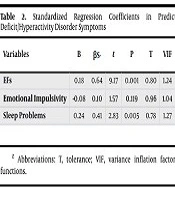
Yousefianpour A, Rezapur R. Investigating the Role of Sleep Problems, Emotional Impulsivity, and Hot and Cold Executive Functions in Students with Attention-Deficit/Hyperactivity Disorder Symptoms in Zanjan City, Iran. J Health Rep Technol. 2025;11(4):e166708. doi: https://doi.org/10.5812/jhrt-166708
Sadolahi AL, Bakhtiyari J, Salmani M, Khademi A, Mohammadi N, et al. Prevalence of attention deficit hyperactivity disorders in first to third grades primary school students in Semnan, Iran. koomesh. 2019;21(2):e153070. doi:
Tashakori A, Riahi K, Afkandeh R, Ayati AH. Comparison of Height and Weight of 5-6 Year-old Boys with Attention Deficit Hyperactivity Disorder (ADHD) and Non-ADHD. Iran J Psychiatry Behav Sci. 2011;5(2):. doi:
More by these authors
Last Update: 2 weeks ago
Last Update: 2 weeks ago
Last Update: 2 weeks ago
Last Update: 7 hours ago
Last Update: 1 day ago
Last Update: 5 days ago