Fulltext
The full text of this article is available on the PDF file.
Zahedan Journal of Research in Medical Sciences
The Official Journal of Zahedan University of Medical Sciences
Image Credit:Zahedan J Res Med Sci
Authors
Background: Intranasal route administration of opioid drugs has been shown to be an alternative treatment method without major side effects. In this study we evaluated the intranasal (IN) versus intravenous (IV) pethidine for postoperative pain relief after cesarean section.
Materials and Method: In this clinical trial , 126 women undergoing elective cesarean section with general anesthesia using thiopental sodium 5 mg/kg, succynylcholine 1.5 mg /kg, then O2/N2O with 50/50 ratio, halothane 0.5 MAC, atracurium 0.2 mg /kg and fentanyl were entered into the study. Parturients were randomized in to two groups receiving IN pethidine (1mg/kg, n=63) or IV pethidine (1mg/kg, n=63) in recovery room. Pain intensity, incidence of nausea and vomiting and systolic blood pressure were recorded after pethidine administration and then every half an hour for 4 hours. Data analyzed with independent student t-test using SPSS software.
Results: The mean visual analogue scale score in IV group was less than IN group at first two hours after pethidine administration. No significant difference in the incidence of nausea and vomiting was found between two groups. There was a significant decrease in mean systolic blood pressure in IV group compared with IN group at all the times (P<0.05).
Conclusion: Although, IN pethidine was less effective on post cesarean pain relief, it seems to be an interesting alternative route for those who had no intravenous access, or had an allergy to morphine and unabale oral intake
© 2011, Author(s). This open-access article is available under the Creative Commons Attribution 4.0 (CC BY 4.0) International License (https://creativecommons.org/licenses/by/4.0/), which allows for unrestricted use, distribution, and reproduction in any medium, provided that the original work is properly cited.
Mobaraki N, Yousefian M, Seifi S, Sakaki M. A Randomized Controlled Trial Comparing Use of Enthonox With Pethidine for Pain Relief in Primigravid Women During the Active Phase of Labor. Anesth Pain Med. 2016;6(4):e37420. doi: https://doi.org/10.5812/aapm.37420
Movahed F, Poorrostamy S. Comparison of indomethacin suppository with intramuscular pethedine on the pain after cesarean section. J Inflamm Dis. 2024;8(3):e155050. doi:
Imani F, Salmanian R, Feiz H. Comparison of co-administration of clonidine and pethidine with bupivacaine during spinal anesthesia. Zahedan J Res Med Sci. 2011;13(2):e94064. doi:
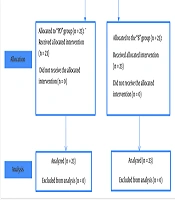
Samir El Sherbeny S, Abdel Fattah Kamel A, Mohiedeen Mohammad Abdelfattah W, Adel Shaker M, Gaber Mohamed M. Intrathecal Pethidine Plus Dexamethasone Versus Intrathecal Bupivacaine in Lower Extremity Orthopedic Surgeries: A Randomized Clinical Trial. J Cell Mol Anesth. 2024;9(4):e154413. doi: https://doi.org/10.5812/jcma-154413
Farzi F, Mirmansouri A, Forghanparast K, Heydarzadeh A, Abdollahzadeh M, et al. Addition of Intrathecal Fentanyl or Meperidine to Lidocaine and Epinephrine for Spinal Anesthesia in Elective Cesarean Delivery. Anesth Pain Med. 2014;4(1):e14081. doi: https://doi.org/10.5812/aapm.14081
Last Update: 3 weeks ago
Last Update: 3 weeks ago
Last Update: 3 weeks ago
Last Update: 6 hours ago
Last Update: 1 day ago
Last Update: 4 days ago