Fulltext
The full text of this article is available on the PDF file.
Zahedan Journal of Research in Medical Sciences
The Official Journal of Zahedan University of Medical Sciences
Image Credit:Zahedan J Res Med Sci
Authors
Background : Anti-tuberculous drug Rifampin is a potent hepatotoxicant. The aim of the present study was to evaluate the protective effect of ethanolic extract of Crocus sativus L. stigma (EECSL.S) in comparison with standard drug silimarin against rifampin-induced hepatotoxicity in the rats.
Materials and Method : 40 male Wistar rats with the mean body weight of 200 ± 20 gr and age of 10 weeks were randomly assigned into 5 groups of 8 animals and kept in specific cages with 12/12 h light/dark cycle at 21 ± 2 ο C . Group I as normal control received normal saline (10 ml/kg) and group II as toxicant control received rifampin (500 mg/kg). Group Ш as positive control received silymarin plus rifampin (500 mg/kg) and groups IV and V (50 mg/kg) received EECSL.S at 40 mg/kg and 80 mg/kg plus rifampin, respectively. All the treatments were carried out through the gavage dissolving in 10 ml/kg normal saline daily for 1 month. At the end of experiment, levels of liver function marker enzymes (Aspartate aminotransferase, Alanine aminotransferase and Alkaline Phosphatase), total bilirubin, albumin and total proteins were assessed in serum of the rats. Moreover, histopathological observation was assayed at the degree of hepatic injury.
Results : In rifampin-treated rats, silymarin and EECSL.S (40 and 80 mg/kg) significantly decreased the levels of serum biomarker of hepathic injury and total bilirubin and elevated the levels of albumin and total proteins. Histopathologically, silymarin and EECSL.S ameliorated rifampin induced hepatic injury. Histopathological changes were in agreement with biochemical findings.
Conclusion : Results indicated that EECSL.S (80 mg/kg) equals with silymarin as standard drug , point of view hepatoprotective effects against rifampin-induced hepatotoxicity
© 2011, Author(s). This open-access article is available under the Creative Commons Attribution 4.0 (CC BY 4.0) International License (https://creativecommons.org/licenses/by/4.0/), which allows for unrestricted use, distribution, and reproduction in any medium, provided that the original work is properly cited.
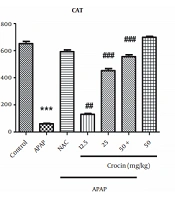
Fouladi L, Kalantar H, Khodayar MJ, Shirani M, Khorsandi L, et al. Crocin Possesses Excellent Hepatoprotective Effects Against Acetaminophen-Induced Hepatotoxicity in Mice. Jundishapur J Nat Pharm Prod. 2022;17(1):e115165. doi: https://doi.org/10.5812/jjnpp.115165
Ziaee T, Razavi BM, Hosseinzadeh H. Saffron Reduced Toxic Effects of its Constituent, Safranal, in Acute and Subacute Toxicities in Rats. Jundishapur J Nat Pharm Prod. 2013;9(1):3-8. doi: https://doi.org/10.17795/jjnpp-13168
Hosseinzadeh H, Sadeghi Shakib S, Khadem Sameni A, Taghiabadi E. Acute and Subacute Toxicity of Safranal, a Constituent of Saffron, in Mice and Rats. Iran J Pharm Res. 2013;12(1):e125648. doi: https://doi.org/10.22037/ijpr.2013.1247
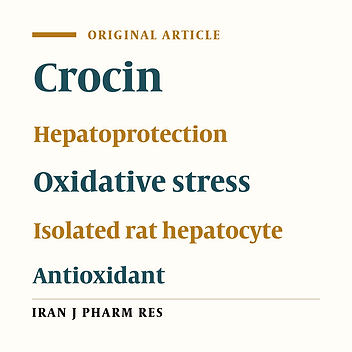
Yousefsani BS, Mehri S, Pourahmad J, Hosseinzadeh H. Crocin Prevents Sub-Cellular Organelle Damage, Proteolysis and Apoptosis in Rat Hepatocytes: A Justification for Its Hepatoprotection. Iran J Pharm Res. 2018;17(2):e124818. doi: https://doi.org/10.22037/ijpr.2018.2228
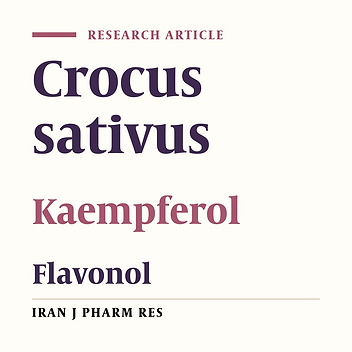
Hadizadeh F, Khalili N, Hosseinzadeh H, Khair-Aldine R. Kaempferol from Saffron Petals. Iran J Pharm Res. 2022;2(4):e127649. doi: https://doi.org/10.22037/ijpr.2010.66
Last Update: 3 weeks ago
Last Update: 3 weeks ago
Last Update: 3 weeks ago
Last Update: 2 hours ago
Last Update: 1 day ago
Last Update: 4 days ago