Fulltext
The full text of this article is available on the PDF file.
Zahedan Journal of Research in Medical Sciences
The Official Journal of Zahedan University of Medical Sciences
Image Credit:Zahedan J Res Med Sci
Authors
Background: Diabetes mellitus is a prevalent disease, which is caused by deficiency in insulin
secretion or factors that impair its function. Diabetic hyperglycemia and hyperlipidemia are
important risk factors in cardiovascular diseases. The arteriosclerosis and its accompanying
structural changes are in part due to endothelial cell injury and abnormal glycosylation of cell
surface and extra cellular matrix glycoconjugate. These are the first structural changes of
formation of atheromatous plaque. The aim of the present study was to identify the structural and
extra cellular matrix changes of terminal sugars by histochemical methods in aorta and common
carotid arteries in male diabetic rats.
Methods and Materials: A total number of 63 male Sprague Dawley rats with 250 ± 50 gr
weights were chosen and randomly divided into experimental (n=36) and control (n= 27) groups.
Diabetes was induced by IP injection of 60 mg/kg of streptozotocin in experimental group.
Experimental and control groups further divided into 2 week, 2 months and 4 months subgroups.
Animals were preserved in standard condition. After the mentioned time, samples were taken from
carotid and aorta, fixed in Boins and processed routinely. Paraffin blocks were cut with 5-6
micrometer in thickness and stained by H-E, PAS and PNA/Alcian blue pH=2.5, thereafter sections
graded according to staining intensity and data were analyzed by NPAR test of Mann Whitney.
Results: Results of this study showed significant difference only for PAS positive media
components between 2 and 4 months diabetic groups (P<0.007).There were also statistically
significant difference between elastic lamina of 2 and 4 month of diabetic group (P<0.03). PNA
showed the presence of Gal/GalNac in sub endothelial and adventitial components of arteries.
Although there was a slight difference of ECM staining between diabetic groups for the
Gal/GalNac and intense reactivity of 4-month diabetic group in comparison to 2-month and 2-week
diabetic groups, there were no significant difference between them for PAS and lectin staining.
Conclusions: It seems that in diabetes, the rate of glycosylation of cell surface and ECM
components changed slowly. Future studies will probably show the exact role of these components
in pathophysiology of diabetes.
© 2004, Author(s). This open-access article is available under the Creative Commons Attribution 4.0 (CC BY 4.0) International License (https://creativecommons.org/licenses/by/4.0/), which allows for unrestricted use, distribution, and reproduction in any medium, provided that the original work is properly cited.

Alizadeh A, Roudbari A, Heidarzadeh A, Babaei Jandaghi A, Bani Jamali M. Ultrasonic Measurement of Common Carotid Intima-Media Thickness in Type 2 Diabetic and Non-Diabetic Patients. I J Radiol. 2012;9(2):. doi: https://doi.org/10.5812/iranjradiol.7564
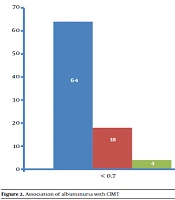
Dehdashti Sharokh H, Zakerkish M, Sina AH, Saki A, Forouzan F, et al. Diagnostic Value of Carotid Artery Intima-media Thickness in Patients with Type 2 Diabetes and Its Correlation with HbA1c Levels. Jundishapur J Chronic Dis Care. 2021;10(2):e111308. doi: https://doi.org/10.5812/jjcdc.111308
Badalzadeh R, Layeghzadeh N, Alihemmati A, Mohammadi M. Beneficial Effect of Troxerutin on Diabetes-Induced Vascular Damages in Rat Aorta: Histopathological Alterations and Antioxidation Mechanism. Int J Endocrinol Metab. 2015;13(2):e25969. doi: https://doi.org/10.5812/ijem.25969
Dehdashti Shahrokh H, Zakerkish M, Jenabi A, Hanafi MG, Rahim F, et al. Association of Microalbuminuria and Estimated Glomerular Filtration Rate With Carotid Intima-Media Thickness in Patients With Type 2 Diabetes Mellitus. Jentashapir J Cell Mol Biol. 2015;6(2):e27584. doi: https://doi.org/10.5812/jjhr.6(2)2015.27584
Khamseh M, Soltani K, Rafiee J, Mokhber A, Baradaran H. The Association of Carotid Intima-Media Thickness and Postprandial Dyslipidemia in Patients with Type 2 Diabetes. Int J Endocrinol Metab. 2007;5(1):. doi:
Last Update: 1 month ago
Last Update: 1 month ago
Last Update: 1 month ago
Last Update: 7 hours ago
Last Update: 11 hours ago
Last Update: 4 days ago