Fulltext
The full text of this article is available on the PDF file.
Zahedan Journal of Research in Medical Sciences
The Official Journal of Zahedan University of Medical Sciences
Image Credit:Zahedan J Res Med Sci
Authors
Background: In serious competitions in order to keep the acquired fitness, athletes
are advised to reduce the exercise intensity before starting the races. This technique is
called taper. The purpose of this study was to compare four usual procedures of Taper
and effect of them on the Hematological responses by measuring Vo2 max,
hematological and biochemical factors.
Methods and materials: Sixty semi professional athletes, 20 to 35 years old with Vo2
max between 30-45 three milts/kg/min were selected. Exercises were in three stages
and took for eight weeks. In the first stage, which lastd for 4 weeks athletes did
moderate intensity exercise three days a week and 30 minutes a day. Second stage
started after the first stage with vigorous exercise three days a week and 45 minutes a
day that lasted for two weeks. In the third stage taper, the subjects were randomly
divided into four groups. The program of the first group was two days week and
exercise intensity so was done with 85%, 75%, 65% and 55% of maximum exercise
intensity. Second group program was two days a week exercise with 50% of maximum
exercise intensity. The third group program was two days a week exercise with gradual
reduction of exercise intensity. The fourth group had only rest. At second and sixth
weeks after doing progressive exercise and taper, blood samples were taken from the
cases and were sent to a reliable diagnosis lab.
Results: Collected data from different taper methods were analyzed using repeated
measures ANOVA and no significant difference between biochemical factors (P>0.05)
was seen but the data showed a significant difference among Vo2 max values after
using theses methods (P=0.04). In addition, there was significant difference in
hemoglobin, hematocrit, M.C.H, M.V.C, platelets, W.B.C and Vo2 max when measured
in second week, sixth week and later on Taper (P<0.05).
Conclusions: According to the results of this study, taper III has a considerable
effect on semi professional Hematological responses.
© 2004, Author(s). This open-access article is available under the Creative Commons Attribution 4.0 (CC BY 4.0) International License (https://creativecommons.org/licenses/by/4.0/), which allows for unrestricted use, distribution, and reproduction in any medium, provided that the original work is properly cited.
Mirdar S, Arabzadeh E, Hamidian G. Effects of two and three weeks of tapering on lower respiratory tract in the maturing rat. koomesh. 2015;16(3):e151260. doi:
Munoz I, Seiler S, Alcocer A, Carr N, Esteve-Lanao J. Specific Intensity for Peaking: Is Race Pace the Best Option?. Asian J Sports Med. 2015;6(3):e24900. doi: https://doi.org/10.5812/asjsm.24900
Nazari Radgiglou S, Safarzade A, Shirinbayan V. Comparison of Two Types of High-Intensity Interval Training: Heart Rate Based vs. Speed/Time Based. Asian J Sports Med. 2022;13(3):e123355. doi: https://doi.org/10.5812/asjsm-123355
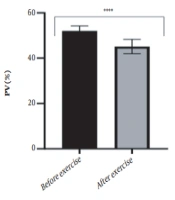
Kashef A, Zare Karizak S, Sadeghi Nikoo A, Kashef M. Response of Some Hematologic Factors to Single Session of CrossFit Exercise in Professional Male Athletes. Zahedan J Res Med Sci. 2022;24(3):e116667. doi: https://doi.org/10.5812/zjrms-116667
Sheikholeslami-vatani D, Alijani E, Boubani B, Abdi M. The effects of one vs. two exhaustive sessions exercise on Cortisol, TNF-α and Adenosine Deaminase enzyme in endurance runners. J Kermanshah Univ Med Sci. 2012;16(2):e78823. doi:
Last Update: 0 months ago
Last Update: 0 months ago
Last Update: 0 months ago
Last Update: 12 hours ago
Last Update: 15 hours ago
Last Update: 4 days ago