1. Background
The peaking period for endurance competition is characterized for a relative increase of the intensity of training, after a longer period of training relatively dominated by lower intensity and higher volume (1). However, interval training spans a wide range of intensity and duration combinations and debate continues regarding the optimization of interval training characteristics for performance enhancement (2). Common to all the interval methods is a prescription of repeated cycles of work periods and rest/recovery periods that add up to some total accumulated duration of work.
The interaction between exercise intensity and training volume as components of an adaptive signal is complex, and this complexity is perhaps even greater in interval training. Astrand (3) raised the question in their classic text of whether accumulating 16 minutes of work at 100% VO2max or 40 minutes of work at 90% of VO2max was better for eliciting physiological adaptation in endurance athletes. Implicit in their example was the potential for: 1) differing impact of varying intensity and duration combinations during interval training and 2) the non-linear relationship between exercise intensity and the capacity of the athlete to maintain high intensity training (i.e. training volume) for a longer duration.
In recent years, a new kind of HIT utilizing repeated short and, essentially, “all-out” intervals has been investigated (4-6). This method of training was originated in the 1970’s (7, 8) and it differs from the new ones in the duration (it is longer) and in the intensity (lower) of the training repetitions. Sprint interval training has been shown to produce adaptations and performance improvements in aerobic function among physically active individuals with very few training sessions (5, 9). This rapid impact has been attributed to the high degree of fast motor unit recruitment (10-12). This type of training can lead to an increase in mitochondrial biogenesis and glucose metabolism (13-15). To achieve this positive endurance response, it is necessary to perform sprints of at least 15 to 30 seconds (9, 16, 17).
It is well known that both achieving and increasing new physiological adaptations are crucial aspects for improving the athlete’s performance. In well-trained athletes (> 65 ml.Kg-1.min-1) it may be difficult to increase a vital adaptation to the performance, such as the VO2max, with continuous training. HIT has been shown as a valuable method for increasing VO2max in well-trained cyclists (2, 5, 6). However, the length of time, the intensity and the distribution of the rest periods can cause different adaptations (17).
2. Objectives
To our knowledge, no study has compared the effects of following a high intensity “sprint” protocol with a traditional strategy based on increased volumes of race pace interval work with endurance runners during a peaking period. We hypothesized that, in well-trained athletes, HIT could improve the performance more than a traditional training based on RP intensities in a 10 km race. To verify this, this study had twofold purposes: 1) quantifying and comparing the impact of HIT (~ 105% of MAV) vs RP (~ 90% of MAV) on the athletic performance during a 10 km race and 2) determining the physiological adaptations associated with peaking programs involving either high intensity sprint interval training (HIT) or race pace interval training (RP) in a group of runners.
3. Patients and Methods
3.1. Experimental Approach to the Problem
The study took place over the last 6 weeks of the autumn-winter macrocycle. The preparatory training period (12 weeks) was the same for all the participants. The maximal aerobic velocity (MAV) of the runners was determined during preliminary laboratory testing (a speed equivalent to ~ 118% of pre-intervention 10km race pace, or estimated ~ 115% race pace in post-intervention 10 km race) which was done before the intervention. They were divided into 2 groups: high intensity training (HIT) or race pace interval training (RP). HIT performed interval sessions at ~ 105% of the MAV. RP performed intervals at ~ 90% of the MAV. This pace was equivalent to an intensity of ~ 103 - 104% pre-intervention race pace, in an effort to have them train at their “goal pace for the post-intervention race”.
3.2. Participants
This study was an intervention trial. The study was approved by the Institutional Review board of European University of Madrid and all subjects provided informed written consent. 13 Well-trained males (VO2max = 68.7 ± 4.7 ml.Kg-1.min-1) who were recruited to participate in the present study were divided into two groups: HIT (N = 6) and RP (N = 7). All of them had been regularly taking part in 10km events. All subjects lived and trained in the area around Madrid, Spain (~ 600-m altitude). There was no difference in any physiological variable before intervention. Descriptive characteristics of subjects prior to the intervention are presented in Table 1.
| Variables | HIT | RP |
|---|---|---|
| N | 6 | 7 |
| Age, y | 31 ± 6 | 35 ± 4 |
| Weight, kg | 67 ± 4 | 68 ± 7 |
| Height, m | 1.76 ± 0.04 | 1.77 ± 0.05 |
| BMI, kg/m2 | 21.8 ± 0.5 | 21.8 ± 1.5 |
| VO2max, ml/kg/min | 69 ± 3 | 69 ± 6 |
| 10 k Pre∆, min:s | 35:29 ± 1:41 | 35:27 ± 1:40 |
a Data are presented as mean ± SD.
b ∆10 Km Pre is before intervention
3.3. Previous Training
Before group allocation and starting the intervention, all participants completed at least 12 weeks of similar training under the guidance of an experienced coach. Basic characteristics of this training period were a progression from 50 to 90 km/week, a progression from fartlek sessions to 2 interval training sessions/week performed mostly at anaerobic threshold, and a strength training program progressing from general circuit training to 2 resistance training sessions oriented to improve maximal strength and power, adding hills and weighted vests sessions during the referred interval training sessions.
The two interventions were compared during the competitive period, as a peaking approach for competition in a macrocycle oriented to improve their 10 km personal best. All runners competed in the same two 10km races (pre and post intervention races) under closely matched conditions before and immediately after the 6 week peaking period. Participants were assigned to HIT or RP group depending on their position competition ranking (1 to 13) after the first 10km race.
3.4. Performance and Physiological Testing
Two 10 km official races were performed before and after the training intervention with the aim of evaluating the performance of the athletes. All athletes of this study participated together and with other runners of the same area, at the same time and in the same competition. Both races were conducted in the same region, with even profile, altitude, humidity, and temperature conditions (3 vs 10 meters cumulative climb, altitude 587 vs 489 meters, 55% versus 60% relative humidity, and 18 vs 20°C at the beginning of the race). Both races started at 12:00-noon. Participants completed a graded treadmill running test until volitional exhaustion 4 days before each 10 km race (Technogym Run Race 1400 HC, Gambettola, Italy).
General warm-up consisted of 15 minutes at free easy pace plus 6 minutes at 14 km/h (~ 82% of the pre intervention 10 km race pace) to determine running economy. The graded test was started at 10 km.h-1, and running speed was increased by 0.3 km.h-1 every 30 seconds until volitional exhaustion. Treadmill grade was kept constant at 1% inclination. Gas exchange data were collected continuously with a medical graphics system (VO2000, Minnesota, USA), which was calibrated before each exercise test according to the manufacturer’s instructions. A similar protocol was previously described from out laboratory for testing competitive endurance runners (18).
MAV was determined as the minimal velocity eliciting the maximal oxygen uptake (VO2max), or in case there wasn’t a clear VO2 plateau, as peak velocity obtained for the last complete 30 seconds stage. At least two of the following criteria were required for the attainment of VO2max: a plateau in VO2 values (i.e. an increase in VO2 between two or more consecutive stages of less than 1.5 ml.kg-1.min-1 (18), a respiratory exchange ratio value ≥ 1.15, or the attainment of a maximal HR value (HR max) above 95% of the age-predicted maximum (207 - 0.7 x age) (19).
Two ventilation thresholds (VT and RCT), and the speed associated with them (vVT and vRCT), were identified according to the methodology described in earlier work (18). Running economy at 14 km/h was expressed in ml.kg-1.km-1.
During the competition, runners wore a heart rate monitor to quantify the average and peak percent of maximal heart rate which had been taken from the previous physiological test, in order to compare the degree of exhaustion between the 2 competitions.
3.5. Training Load Quantification During Intervention
HIT and RP interventions were matched for total load, after weighting of volume, intensity and work-to-recovery densities of the interval sessions. To compare the total load of training between the two groups, differences in estimated time limit capacity for the respective intensities were taken into account. Regarding maximal accumulated oxygen deficit (MAOD) assessments, previous data from our laboratory showed that these athletes were able to maintain a time limit until exhaustion of 2 - 2.5 minutes at 120% of maximal aerobic velocity (MAV) and between 4 and 6 minutes at MAV. Further, Beneke (20) estimated the time limit for anaerobic threshold (AnT) at 60 minutes. According to the personal best of the participants in the present study, they showed a running velocity at AnT of ~ 87% of MAV.
According to estimates by Peronnet and Thibault (21) with the endurance index of the subjects (fractional utilization of VO2max and the running time expressed on a logarithmic scale), we calculated the endurance index in these athletes and estimated their time limit, ~ 32 minutes for RP training (90% of MAV in Test 1), and a time limit of ~ 3 - 4 minutes for HIT training pace (105% of MAV). Thus, a ~ 9:1 proportion of this theoretical time limit calculation was the rationale for weighing every minute of HIT intensity with 9 points versus 1 point per minute in RP. To calculate a session training load, we multiplied volume x intensity x density, where volume was total training in minutes (not including rest intervals), intensity was 9 points per minute in HIT and 1 point per minute in RP, and density was the work/rest interval time ratio. Table 2 and Figure 1 show detailed scheduling and load calculations session-to-session.
| Session/Group | Reps Distance, m | Speed, m/min | Reps Number (No.) | Total Distance, m | Volume, min | Reps Time, s | Intensity (I), Score Per Minute | Rest Time, s | Density, D | Training LOAD |
|---|---|---|---|---|---|---|---|---|---|---|
| 1 | ||||||||||
| RP | 500 | 292 | 16 | 8000 | 27 | 103 | 1 | 60 | 1.7 | 47 |
| HIT | 100 | 341 | 32 | 3200 | 9 | 18 | 9 | 31 | 0.6 | 48 |
| 2 | ||||||||||
| RP | 1000 | 292 | 10 | 10000 | 34 | 205 | 1 | 120 | 1.7 | 59 |
| HIT | 200 | 341 | 20 | 4000 | 12 | 35 | 9 | 60 | 0.6 | 62 |
| 3 | ||||||||||
| RP | 2000 | 292 | 4 | 8000 | 27 | 411 | 1 | 160 | 2.6 | 70 |
| HIT | 400 | 341 | 8 | 3200 | 9 | 70 | 9 | 85 | 0.8 | 70 |
| 4 | ||||||||||
| RP | 2000 | 292 | 5 | 10000 | 34 | 411 | 1 | 180 | 2.3 | 78 |
| HIT | 400 | 341 | 10 | 4000 | 12 | 70 | 9 | 95 | 0.7 | 78 |
| 5 | ||||||||||
| RP | 2500 | 292 | 3 | 7500 | 26 | 514 | 1 | 155 | 3.3 | 85 |
| HIT | 500 | 341 | 8 | 4000 | 12 | 88 | 9 | 110 | 0.8 | 84 |
| 6 | ||||||||||
| RP | 1000 | 292 | 7 | 7000 | 24 | 205 | 1 | 55 | 3.7 | 90 |
| HIT | 200 | 341 | 14 | 2800 | 8 | 35 | 9 | 29 | 1.2 | 90 |
| 7 | ||||||||||
| RP | (∆) | 292 | (∆) | 6500 | 21 | (∆) | 1 | (∆) | 3.0 | 63 |
| HIT | (∆) | 341 | (∆) | 2600 | 7 | (∆) | 9 | (∆) | 1.0 | 63 |
a Abbreviations: V, volume; I, intensity; D, density (work duration/rest duration); Training load, VxIxD; Reps, Repetitions.
b (∆) The repetitions were on decreasing distance and proportional pauses. See Table 3 for details.
c Intervals length: HIT group were 1/5 of RP intervals length; total distance: HIT group was 60% of RP group; total volume (time): H group was 4/10 of
RP group except last session, at 65 % of distance competition; Intensity was: RP group 90% MAV in T1 (~ 103% Race Pace in T1); H group 105% MAV in T1
(~118% Race Pace in T1); intensity score: HIT group x 9, RP group x 1; rest time RP group half as HIT group; density RP group 1.5 to 4, HIT group 0.5 to 1.0
Load progression was organized with two goals: 1) equivalent training load between RP and HIT groups, and 2) to provide a progressive load over the course of the peaking period and to avoid the possibility of suffering from overtraining, with the exception of the last training session (4 days prior to 2nd competition). This approach was designed as part of the tapering strategy (Figure 1). Table 3 shows the details of the 7 training sessions and Table 4 shows the whole training program.
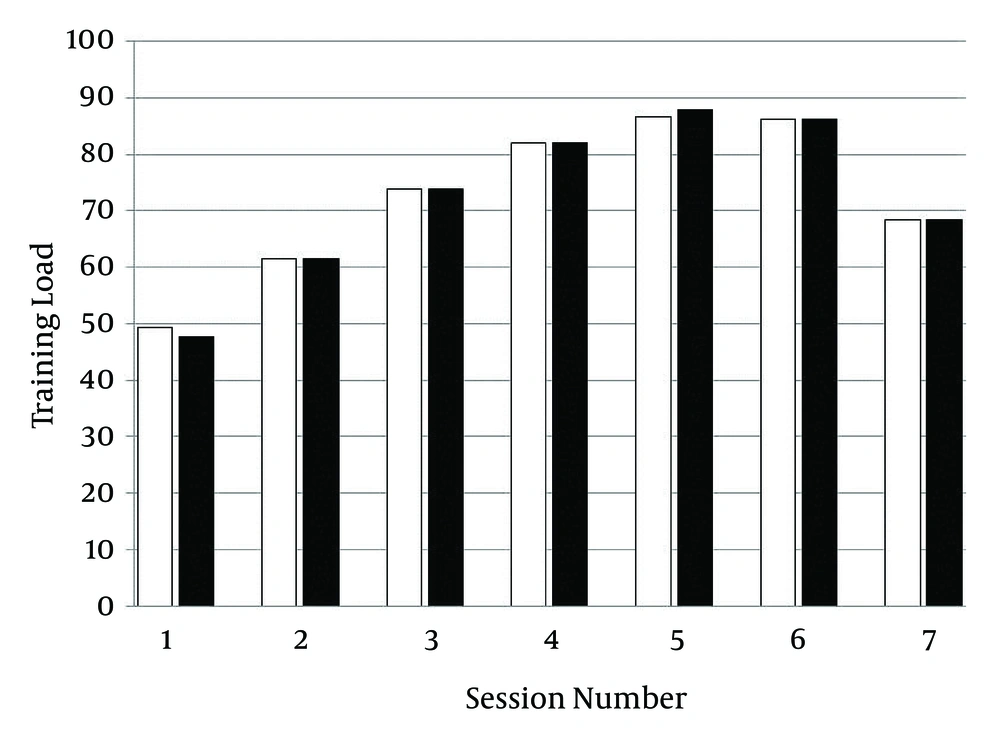
Figure 1.
Training Load Progression for Both Groups (HIT-black, RP-white)
Table 3.
Details of the 7 Different Training Sessions in Each Treatment (RP/HIT) a
| Intensity Session | RP | HIT |
|---|---|---|
| 1 | 16 × 500 90% MAV, r’ = 1: 00 | 32 × 100 105% MAV, r’ = 0:31 |
| 2 | 10 × 1000 90% MAV, r’ = 2: 00 | 20 × 200 105% MAV, r’ = 1: 00 |
| 3 | 4 × 2000 90% MAV, r’ = 2: 40 | 8 × 400 105% MAV, r’ = 1: 20 |
| 4 | 5 × 2000 90% MAV, r’ = 3: 00 | 10 × 400 105% MAV, r’ = 1: 30 |
| 5 | 3 × 2500 90% MAV, r’ = 2: 40 | 8 × 500 105% MAV, r’ = 1: 45 |
| 6 | 7 × 1000 90% MAV, r’ = 1:00 | 14 × 200 105% MAV, r’ = 30 " |
| 7 | 3000 + 2000 + 1000 + 500 90% MAV, r’ = 1/3 of the previous repetition | 800 + 600 + 500 + 400 + 300 r’ = same time as previous rep |
a r’ = rest intervals. Time is expressed in seconds (“) or minutes: seconds. The length of intervals is expressed in meters. Intensity is expressed in % of maximal aerobic velocity (MAV) previously set in the graded exercise
3.6. Additional Training During the Intervention Period
Both groups performed the same daily and total training load for 4 weeks, with the only difference being the 7 interval training sessions. The training sessions which were not interval sessions consisted of low intensity endurance training (below aerobic threshold) and strength training. “Easy” endurance training sessions (Table 4) were conducted over 40 to 60 minutes of continuous running at intensity below aerobic threshold. Strength training consisted of maximal strength and plyometrics. Maximal strength training was conducted in Multipower 90º concentric Squat and eccentric squat machine (Yo-yo Technology, Nynäshamn, Sweden), with a periodized program between 2 to 4 sets of 6 to 4 reps with 70% - 90% 1RM. The plyometrics program was conducted with different double, single, and alternating leg horizontal jumps over a total volume per session of ~150 - 80 jumps. The timing and sequence of the interval training and strength training is shown in Table 4. The 5 week mesocycle between competitions was designed with a 4:1 load distribution (4 weeks of high load plus 1 tapering week). Total weekly volume in kilometers was scheduled to be 70 - 75 - 80 - 80 - 45, including competition.
Table 4.
Distribution of Training, Test, and Competition Sessions During the Study
| Week No. | Mon | Tue | Wed | Thu | Fri | Sat | Sun |
|---|---|---|---|---|---|---|---|
| 1 | Strength | Easy | Physiological Test | Easy | - | Active rest | 1st 10 km race |
| 2 | Easy | Strength | IT no 1 (RP/HIT) | - | Strength | IT no 2 (RP/HIT) | Easy |
| 3 | Strength | - | IT no 3 (RP/HIT) | Strength | Easy | IT no 4 (RP/HIT) | Easy |
| 4 | Strength | Easy | IT no 5 (RP/HIT) | Strength | Easy | IT RP = HIT | Easy |
| 5 | Strength | - | IT no 6 (RP/HIT) | Easy | Strength | Easy | IT no 7 (RP/HIT) |
| 6 | Strength | - | Physiological Test | Active rest | - | Active rest | 2nd 10 km race |
At the midway point of the peaking program, the same saturday training was scheduled in both groups, in an effort to compensate for the fact that HIT training was always organized at intervals shorter than RP, which could possibly compromise the ability to maintain a constant pace without pausing (22). In that session both groups worked the same, performing 2 × 20 minutes at the heart rate corresponding to the respiratory compensation threshold determined from preliminary treadmill testing, with a 5 min rest in between.
3.7. Statistical Analyses
Statistical analyses were performed with the Statistical Package for Social Sciences (SPSS) 13.0 software (SPSS Inc., Chicago, IL). Wilcoxon tests for paired and unpaired samples were conducted to identify statistical differences before and after the intervention. Signification level was set as P < 0.05 for all calculations.
4. Results
4.1. Training Adherence and Compliance
Training logs and direct supervision confirmed full (100%) adherence to the experimental program, as well as relative training pace for each group. In addition, 90% of the rest of the sessions (easy running and strength training) were completed. Only the data of the subjects who met the following conditions were included: 1) complete heart-rate (HR) recordings of each training session over the total training period, 2) performing regular training session under the supervision of one of the authors (J E-L), 3) showing no signs or symptoms of overtraining over the entire training period (18, 23), and 4) performing the two 10km races before and after the intervention training period.
4.2. Performance in Competition
Both groups improved their 10km competition times significantly (Z = 2.2; P < 0.01 for HIT and Z = 2.4; P < 0.01). There were no significant differences between groups in the competition time (Figure 2), improvement or ranking score after the intervention.
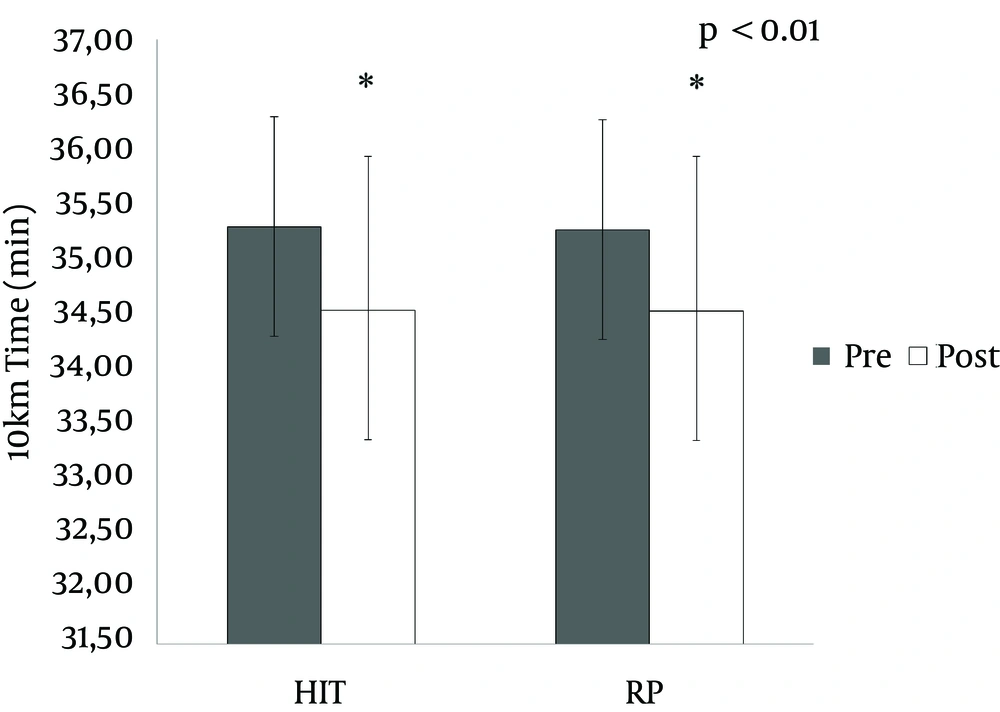
Figure 2.
10 km Pre vs. Post Time Comparison (P < 0.01)
Endurance index showed no significant difference between the two groups before intervention, but group HIT worsened significantly over the intervening period (Z = 2.2; P < 0.01). However, no change was significant in the RP group.
4.3. Physiological Testing
There were no significant differences between groups in any performance or physiological variable before the intervention (P > 0.05). VO2max increased significantly in HIT group (Z = 2; P < 0.05), with no change in RP (Z = 0.5; P > 0.05) (Figure 3). In contrast, running economy decreased significantly in HIT group (Z = 2; P < 0.05), with no decrease in the RP group (Figure 4) (Z = 0; P > 0.05).
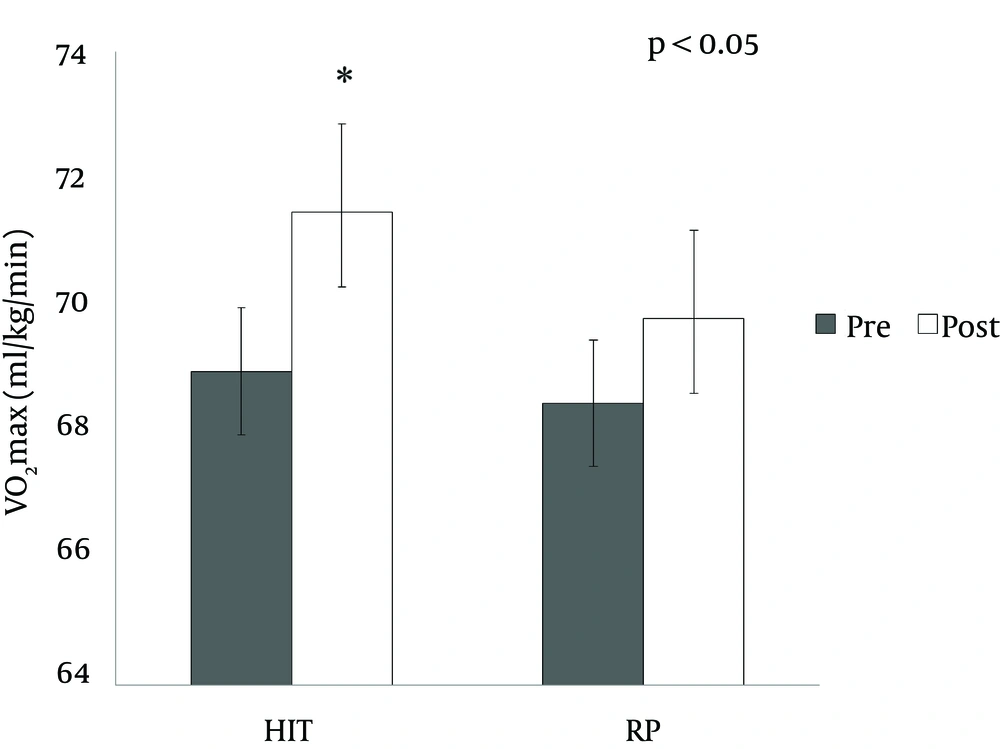
Figure 3.
Maximum O2 Consumption Pre vs. post Intervention (P < 0.05)
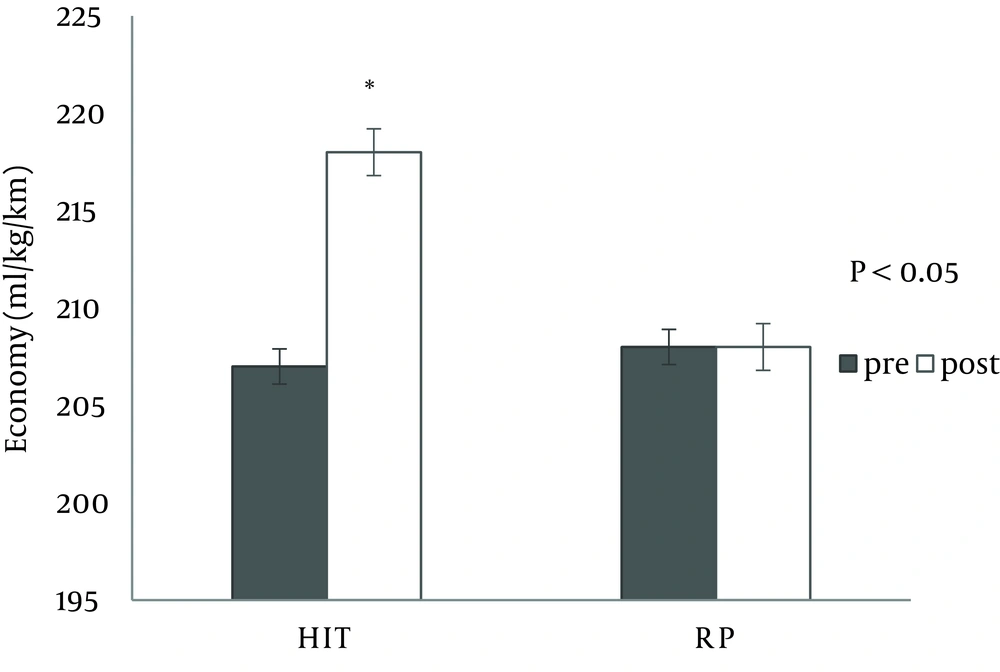
Figure 4.
Changes in the Running Economy: Pre vs. Post (P < 0.01)
There were no significant changes in MAV in any group (HIT pre 19.5 ± 1.2 km/h , post 19.5 ± 1.0; RP pre 19.3 ± 0.8 km/h , post 19.4 ± 0.7) (Z = 0.1; P > 0.05 for HIT and Z = 1.3; P < 0.05 for RP). There were no significant changes in vRCT in any group (HIT pre 17.2 ± 0.9 km/h, post 17.3 ± 0.9 ; RP pre 16.6 ± 0.7, post 16.9 ± 0.7) (Z = 0; P > 0.05 for HIT and Z = 0.7; P > 0.05 for RP).
5. Discussion
The key finding of the present study was that both race pace interval training at 90% MAV and high intensity interval training at 105% MAV stimulated nearly identical improvements in 10km performance after a 4 week peaking program. A second finding was that the observed underlying physiological adaptations differed between the two groups. HIT stimulated an increase in maximal oxygen consumption that was slightly offset by a decline in running economy and endurance index. In contrast RP training improved running economy without stimulating further improvements in maximal oxygen consumption. No effects were found on any other physiological variable after the intervention period.
This study was conducted basing it on previous findings suggesting that a brief period of HIT can stimulate relatively large performance improvements in recreationally active cyclists (5). However, given that regular training at running speeds equivalent to 140% - 210% of VO2max may increase risks of injury (9), we were unable to reproduce the specific loads used in the previous study (5) for cyclists. Proper and efficient running form may also play a role, which may be another possibility as to why untrained people could efficiently benefit from cycle HIT (24) but not untrained runners. Given this limitation, we chose a running intensity for HIT where adaptations could occur, while being comparably less intense than those previously used in cycle HIT research (30s maximal sprints).
Percent of race performance improvement in our study was ~ 1.6 and 1.7% for both groups. Previous data from runners of similar performance standard have shown ~ 3 to ~ 6% improvements in 10km road races or 10km cross country performance after 6 to 21 week training program (18, 25). These studies suggest that different training intensity distribution can imply a higher gain in performance than a traditional model of intensity distribution (focusing the majority of the work on the zone between thresholds). However, the magnitude of differences is statistically difficult to detect with the sample sizes that are normally accessible in this type of study (i.e. ~ 36 seconds in 10 km) (18). Tying it all together, it seems that competition period is especially responsible for peaking, as it has been empirically conceived by coaches. However, actual results show that opposite physiological adaptations have occurred, producing a final equal impact on performance.
HIT-group runners improved their VO2max while reducing their running economy. HIT is not only efficient for less trained people (10), it may be mandatory for increasing VO2max in experienced ones. In relation to VO2max training response in low to mid trained athletes, there is extensive research supporting this fact (26, 27). However, the lesser amount of intense training compared to the RP-group (longer bouts of exercise, 5 times more distance in every repetition, and 60% more in every session), may have played a role in decreasing running economy. Nevertheless, running economy values are also dependent on the intensity where it is measured (24). In this case, it was closer to the RP-group’s training intensity, so this is another possible reason as to why the HIT- group compromised running economy through the “only HIT” stimuli.
It is well known that achieving a high VO2max is vital for improving the performance in endurance sports. This study has shown that through HIT this physiological variable may be improved even in well-trained athletes. However, it has already been recognized that MAV represents the interaction between VO2max and economy (28). Due to this fact, the HIT group was able to improve their VO2max although they were not capable of increasing their MAV. In this study, there was a lack of measuring the running economy at intensities close to VO2max. For this reason, we can only hypothesize that HIT group could make worse their running economy at intensities next to VO2max.
Heart rate measurements in competition revealed the high degree of exertion for both groups (average 92% HRmax) is the same as previously reported optimal HR during competitions performed at personal best. As expected, runners from HIT group reported special difficulties at the latter part of the 2nd race, since metabolic adaptations of HIT training must be taken into account depending on race distance, as it has been shown with direct metabolic analysis in real competition research (29). In contrast, RP group participants reported the difficulty to run faster than trained pace at any moment during the 2nd competition (since they never trained faster than race pace for 5 weeks).
In fact, a limitation of this study, looking at these results, was the fact that we did not compare other HIT training methods, or mixed approaches. For example, some kind of HIT approach, with long intervals, has been proposed elsewhere using 4x4 minutes intervals 4% uphill with 3 min rest, in a repetitive sequence (2 - 1 - 2 - 0 sessions a day, for 3 weeks) (30). This approach remains to be evaluated scientifically in relation to its superiority.
Further research in the field should report the benefits of other approaches or test them together with those reported in our study, in order to find an optimal peaking design. Since overall season optimal intensity distribution seems actually recognized to be the so-called “polarized training” design (1), it may now be time to focus on peaking approaches.
Going deeper in the different physiological responses to training, coaches should also be aware of the individual’s physiological profile (i.e. their superior ability in anaerobic capacity or aerobic power), in order to select training methods for them, (considering competition duration too).
Another key element for future applied research is to go deeper in the proposals for training quantification. From a global point of view, they should go beyond the scope of heart rate measurements, and weigh anaerobic training in a proper manner. It is mandatory, in order to continue studying training method comparisons, to compute training load as a whole, weighing every component (volume, intensity, density). To do this, weighing intensity as a key element, should at least be considered, and density should be included in the calculations. The actual model of quantification for this paper is only useful for two different intensities, so it is still necessary to look for reasonable density scorings at every training zone, as well as a score for continuous training.
In conclusion, HIT showed the same benefits for peaking in competitive period than Specific Race Pace Training. Physiological testing revealed that the HIT group improved VO2max in spite of worsening running economy, so final output was the same as the specific group training, which was focused on the ability to maintain race pace for long bouts of exercise.
5.1. Practical Aplication
High intensity training can provide the coaches with a method to achieve new adaptations to the training, even in well-trained runners, and improve the athlete´s performance during the peaking period. The combination of both training methods (HIT and RP) may lead to a higher training response.