1. Background
Myofascial pain syndrome is a chronic syndrome occurred in a local or focal part of the body. The basis for myofascial pain syndrome is the presence of myofascial trigger point or points, producing pain in clinical examination, which can point to the loss of function, sleep disturbance, lower quality of life, and mental problems as its important complications (1). There are muscular hard bands in trigger point, and the pain is referred ambiguously or intensely with different severities.
This syndrome is often observed during the assessment and treatment of patients with chronic pain. Pain is caused by stimulating trigger, local, and focal point, and is exacerbated by stretching affected regions, cold, and pressure. However, the exact mechanism of the trigger point is not known, it seems that myofascial pain syndrome is induced by trauma, inflammation, and other unknown leading causes (2). Trigger point might be implemented in every muscle or muscular group, but they are often observed in muscles under vigorous stress, or the muscles do not undergo full periods of contraction and relaxation. The trapezius, levator scapula, and infraspinatus muscles are involved in the upper body (3). However, the above symptoms, such as those seen in fibromyalgia, are associated with sleep disturbances, and in fact, myofascial pain syndrome and fibromyalgia are two ends of the disease spectrum (4). Therapeutic methods of trigger point are performed as two invasive and non-invasive modes. Invasive methods include injection of botox, corticosteroid, and anesthetics, and dry needling (5), and non-invasive methods consist of pharmacotherapy and common therapeutic methods in physiotherapy such as muscle stretching with cooling spray, laser, ultrasound waves, etc. (6).
In some studies, by using local anesthesia, normal saline was assessed in comparison to the placebo group. However, previous studies showed that local injection (intramuscular) of normal saline to patients with myofascial pain syndrome is effective as the injection of Mepivacaine hydrochloride 0.5% or even more (7). Although pain related to the injection of normal saline is more than local anesthesia, the results of some studies indicate more pain related to injection, but findings are controversial (8-10). Cho et al. investigated the injection of a combination of hyaluronidase and lidocaine on myofascial pain (11). Findings showed that injection of a combination of hyaluronidase and lidocaine is more effective than lidocaine alone.
2. Objectives
This study aimed to compare the effect of injection of bicarbonate, hyaluronidase, and lidocaine on myofascial pain syndrome.
3. Methods
This was a single-blind randomized controlled trial conducted in all patients with myofascial pain syndrome at trapezius muscle and upper back who referred Akhtar and Imam Hossein hospitals in 2018, which 60 eligible individuals based on the inclusion criteria were selected as the study sample. The inclusion criteria were as follows: patients aged 25 - 75 years old, the presence of chronic pain during three past months, the presence of pain at upper back, no history of allergy to bicarbonate, lidocaine, and hyaluronidase, no use of anticoagulant drugs during three days before initiation of the study, the use of analgesic drugs such as NSAIDs, acetaminophen or narcotic use in last 5 days, no presence of pain related to trauma in six months before the study, no history of surgery at shoulder and neck regions, or trigger point injection (TPI) in the region in the past three months, no presence of fibromyalgia, being obese (BMI ≥ 27 kg/m2), and specific diseases such as cancer, endocrine disorders, depression or schizophrenia, and skin infection. The article was registered in IRCT with the code of IRCT20190304042908N1, and was approved by the Ethics Committee of Shahid Beheshti University of Medical Sciences with the code of IR.Rums.REC.1398.333.
Sixty patients met the inclusion criteria and were selected randomly. The title and objectives of the study were introduced to patients, and they were ensured that they could exit the study whenever they want, and the lack of their cooperation with the physician and hospital does not affect their treatment process, and all their information is kept confidential. In addition, an informed consent form was provided to patients and explained thoroughly for them, and in case of agreement, the patient fulfilled the form and signed it. Otherwise, based on the opinion of the patient, researcher or one of the patient’s reliable attendants, any option of the form was read and asked the patient’s opinion and fulfilled the form.
After providing explanations on therapeutic protocol and measuring pain value based on VAS and the VAS score more than three was excluded from the study or taking analgesic drugs, the patients were randomly allocated to three groups of bicarbonate, hyaluronidase, and lidocaine. In addition, before the beginning of the study, the flexion rate of the neck was measured by a goniometer in degree.
The injection method was as follows: for bicarbonate (sodium bicarbonate 8.4%, caspian tamin) group, 3.2 ml of solution bicarbonate 84 mg (consists of 1 cc bicarbonate and 0.9% normal saline), for hyaluronidase (hyalase, 1.500 IU, Wockhardt, UK, 600 IU/cc) group 600 IU, 2.2 CC normal saline, (3.2 mL of solution) and for lidocaine (lidocaine HCL 2% Shahid Ghazi Tabriz-Iran) group, 3.2 mL (2% lidocaine and 0.9% normal saline) 20 mg lidocaine was injected. Based on previous studies the injection was done at the most painful two points of trapezius muscle with a linear probe sonography guide for each patient, and the injection site was pressed for two minutes to prevent bleeding. In addition, the G25 spinal needle was used for injection. The value of visual analogue scale (VAS), range of motion (ROM) before injection, and immediately after the injection, second week and fourth week was measured (12); intraclass reliability of this tool is reported as 0.85 to 0.95 (13).
Range of motion (ROM): The rate of neck flexion was measured by a goniometer. Therefore, the goniometer axis was placed parallel to the spinous process of C7 and on the proximal of the shoulder. The fixed arm was held along the horizon, and moving arm was held along the neck side-longitudinal line, and the individual was asked to move his head, move his neck forward to measure neck flexion range, and the changes in angel were recorded (14). One-way ANOVA with repeated measures was used to analyze the data. In all analyses, the significance level was considered less than 0.05.
4. Results
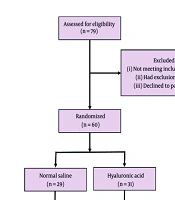
Sixty patients were recruited to participate in this research, and four patients were excluded (two patients from bicarbonate group, two patients for hyaluronidase and lidocaine groups) they left the study because of ignoring the treatment or VAS score more than three. Fifty-six patients took part, including 18 patients in the bicarbonate group, 19 patients in hyaluronidase, and 19 patients in the lidocaine group. We did not have any complications during the study. The analysis showed that there were no significant differences between the three groups for age, gender, BMI, and height (P > 0.05).
Repeated measures one-way ANOVA (week * group) 4 * 3 was used to compare the effect of three above drugs on VAS and ROM before injection, immediately after injection, second and fourth week. The results showed that the main effect of group and week is significant for VAS (P < 0.05). The results of the Post hoc Bonferroni test showed that the rate of pain declined in the hyaluronidase group was greater than groups of bicarbonate and lidocaine. In addition, the main effect of the week showed that the measurement of VAS in all groups was reduced during various stages. The results showed for the ROM variable that the main effect of the group and week was not significant (Table 1).
Table 1.
Results of VAS and ROM in Three Groupsa
| Hyaluronidase | Bicarbonate | Lidocaine | P Value | |
|---|---|---|---|---|
| VAS | ||||
| Pre-treatment | 5.6 ± 0.8 | 5.3 ± 0.8 | 5.5 ± 1.0 | 0.42 |
| Immediately after treatment | 5.1 ± 0.6 | 4.0 ± 0.1 | 3.8 ± 0.6 | 0.001 |
| 2 weeks | 2.8 ± 0.9 | 4.2 ± 0.7 | 5.3 ± 0.5 | 0.001 |
| 4 weeks | 2.5 ± 0.7 | 4.4 ± 0.9 | 5.2 ± 0.6 | 0.001 |
| ROM | ||||
| Pre-treatment | 18.6 ± 5.8 | 18.8 ± 6.2 | 18.5 ± 5.6 | 0.741 |
| Immediately after treatment | 19.3 ± 6.8 | 19.2 ± 5.8 | 19.5 ± 5.8 | 0.067 |
| 2 weeks | 18.1 ± 5.8 | 18.8 ± 5.8 | 18.4 ± 5.8 | 0.77 |
| 4 weeks | 18.0 ± 5.8 | 18.4 ± 5.8 | 18.3 ± 5.8 | 0.48 |
Abbreviations: VAS, visual analogue scale; ROM, range of motion
aHyaluronidase group permanent effect in VAS reduction.
5. Discussion
Trigger point injection with lidocaine is a valuable procedure for pain relief in patients with myofascial pain syndrome. This study aimed to compare the effect of injection of bicarbonate, hyaluronidase, and lidocaine on myofascial pain syndrome. The results showed that there were significant differences between the three groups in terms of VAS during the weeks of the study. So, the comparison of means showed that in the hyaluronidase group during weeks before injection, after injection, second and fourth week, the patients experienced gradually more decline in pain, which indicates a permanent effect of this medication on pain decline.
Although the injection of lidocaine immediately leads to a significant reduction in pain, this reduction was not permanent and disappeared in the following weeks. Other results showed that the injection of these three medications has no statistically significant effect on neck flexion range. These findings are in line with the studies by Raeissadat et al. that showed no effect of lidocaine on pain (15) and logo et al. that showed no effect of lidocaine on functional indices (16). Recently a study showed that hyaluronan might cause myofascial pain (17). There are several reasons for achieving these results (18).
First, hyaluronidase might improve abnormal condition induced by hyaluronan in patients with myofascial. Hyaluronidase might change the density or effect of hyaluronan (18) and subsequently, leads to decline in viscosity of hyaluronan between facial and trigger point of the muscle. In addition, hyaluronidase might change the pH of local anesthesia due to phosphate buffer used in their preparation.
Second, hyaluronidase is a solution that can be rapidly dispersed; thus, the trigger point is inactivated more rapidly. Hyaluronidase has a reversible depolymerizing role in hyaluronic acid, which is a component of connective tissue and interstitial barrier in muscle. Hyaluronidase was effective in the management of patients with chronic pain (18). Early recognition, timely employment of disease altering therapies can accelerate recovery (19). In our study, we followed chronic pain patients four weeks, but many investigations published about 14 days.
5.1. Conclusion
In general, the results of the study showed that pain in patients with myofascial pain syndrome can be declined by the injection of hyaluronidase in the trigger point for 4 weeks.