Fulltext
The full text of this article is available on PDF.
Authors
Introduction: Critical Thinking Disposition indicates individual’s inclination to Critical Thinking, which is one of the domains of personality. Individual characteristics are important and influential factors in the growth and development of students’ Critical Thinking. One of these influential characteristics might be self-esteem, thus this study was to determine the correlation between Critical Thinking Disposition and self-esteem in medical students.
Methods: In an analytical cross-sectional study, 289 medical students were selected through stratified random sampling method in Kermanshah University of Medical Sciences in 2011. The instrument for data collection was a questionnaire containing 3 parts: demographic data, California Critical Thinking Disposition Inventory, and Cooper-Smith Self-Esteem Inventory. The results were analyzed by SPSS-16 using descriptive statistics, Pearson and Spearman Correlation Coefficient, ANOVA, Chi-Square and Fisher exact test.
Results: Results showed that 98.6% (285) of students had deficiency, 1.4% (4) ambivalence and nobody had positive critical thinking disposition. There was a significantly negative correlation between Critical Thinking Disposition and self-esteem (r=-0.462, P<0.001). Also, there was no a significant relationship between two groups of low self-esteem , high self-esteem , negative and ambivalent Critical Thinking Disposition.
Conclusion: It seems that Critical Thinking Disposition, like other psychological variables, is influenced by social factors and social environment plays a role in promoting or undermining it. So, similar studies are recommended to investigate the factors affecting Critical Thinking in medical students.
© 2014, Educational Research in Medical Sciences. This open-access article is available under the Creative Commons Attribution-NonCommercial 4.0 (CC BY-NC 4.0) International License (https://creativecommons.org/licenses/by-nc/4.0/), which allows for the copying and redistribution of the material only for noncommercial purposes, provided that the original work is properly cited.
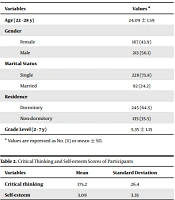
Khavanin A, Sayyah M, Ghasemi S, Delirrooyfard A. Correlations Between Critical Thinking, Self-esteem, Educational Status, and Demographic Information of Medical Students: A Study from Southwestern Iran. Educ Res Med Sci. 2021;10(1):e116558. doi: https://doi.org/10.5812/erms.116558
Iranfar S, Sepahi V, Khoshay A, Rezaei M, Karami Matin B, et al. Critical Thinking Disposition among Medical Students of Kermanshah University of Medical Sciences. Educ Res Med Sci. 2012;1(2):e77189. doi:
Sepahi V, Khazaei MR, Khoshay A, Iranfar S, Timare M. The Correlation between Critical Thinking Disposition and Academic Achievement of Preclinical and Clinical Medical Students at Kermanshah University of Medical Sciences. Educ Res Med Sci. 2014;3(1):e81198. doi:
Safari Y, Pasdar Y, Darbandi M. The comparison between critical thinking disposition of teachers and students in Kermanshah University of Medical Sciences, 2011. J Kermanshah Univ Med Sci. 2012;16(2):e78829. doi:
Heidari Gorji AM, Shafizad M, Soleimani A, Darabinia M, Goudarzian AH. Path Analysis of Self-Efficacy, Critical Thinking Skills and Emotional Intelligence for Mental Health of Medical Students. Iran J Psychiatry Behav Sci. 2018;12(4):e59487. doi: https://doi.org/10.5812/ijpbs.59487
Last Update: 3 weeks ago
Last Update: 3 weeks ago
Last Update: 3 weeks ago
Last Update: 5 days ago