1. Background
Cities are growing at speeds faster than ever in the world. Nowadays, more people live in urban than rural areas, and by 2030 the world’s urban population will reach 5 billion people (1). The United Nations (UN) projections show that the urban population will increase by 1.5 billion in the next 15 years and by 3 billion until 2050. Urbanization has the potential to improve human health, living standards, resource allocation, and economic growth because cities provide opportunities, including jobs and income. Cities are responsible for over 80 percent of gross national products across the world (1). In 2018, 55 percent of people of the world lived in urban areas. This number is a big increase in comparison to 1950, in which only 30% of the people in the world lived in cities. It is projected that by 2050, 68% of the people in the world will be living in cities. Also, predictions state that cities in Asia and Africa will grow faster than the rest of the world. Fifty-four percent of the world’s urban population lives in Asia and is followed by Europe (13%) and Africa (13 %) (2).
The 11th goal of the UN sustainable development goals (SDGs), specifically targets urban and community sustainability and aims “to make cities safe, resilient, sustainable” and healthy places for human living. In order to reach this goal, urban development should be planned efficiently and managed according to current science and technology (3). Businesses and local governmental bodies are increasingly using cities as their units of analysis. Cities not only provide a better quality of life for their citizens but also help bolster continued economic growth. Local officials should keep their cities prosperous and competitive by improving human-centric development and making sure their residents enjoy an acceptable quality of life (3). Improving city infrastructure is one way to reduce problems such as congested roads, lack of health and education facilities, and pollution caused by over-agglomeration (4, 5). However, simply improving infrastructure alone cannot solve all urban problems (3).
In parallel to these global trends, creating ‘liveable’ cities, improving population health, and reducing inequities has become a priority for various sectors (6). The term “liveability” is more about the characteristics of places and their living conditions. It imitates the perception of people about these places and whether they are suitable for living or not (7). Creating ‘liveable cities’ has now become a major concern for high-rank officials and policymakers around the world (8). Meanwhile, ranking cities according to liveability can help policymakers better understand the advantages and pitfalls of different cities in the countries that they are serving and arrange solutions (9).
Studies have ranked countries, cities and societies based on several factors, including economic factors, quality of life, people’s happiness, crisis management, and environmental variables. Tan et al. selected 21 ranking criteria and discussed their strengths and limitations (3). Liveability indices are used to compare cities and have received widespread media attention. City benchmarking compares the performance of specific cities with other cities, classified as best performing cities (10). The global liveable cities index (GLCI) is a framework constructed by Tan, Woo, and Tan. Since then, the GLCI framework has been used in several different studies (11, 12). Additionally, the GLCI index was used to specifically assess the liveability conditions of Abu Dhabi in the United Arab Emirates and cities in Greater China (13, 14). The consolidation of these theoretical understandings has led to the liveable cities framework. This framework used five themes to rank the liveability of cities. The GLCI is able to translate the understanding of liveability into an empirical framework that is quantifiable (3).
In Iran, cities have grown rapidly in recent years. According to the latest UN estimates, between 1950 and 2050, Iran has had the highest urban growth among South Asian countries. The percentage of population residing at mid-year in urban areas of Iran in 1990 was 56.3%, and in 2019, it increased to 75.4%. It is predicted that by 2050, it will reach 86%, which is the highest growth among the countries in the region (15). The aim of this study was to rank the major cities of Iran with the GLCI index, according to two scenarios, one with equal weights for each index and one according to Shapley’s weighing method and by allocating different weights to indices. The Shapley method has been used in various disciplines. Petrosjan and Zaccour (2003) used the Shapley method for allocation of the individual share of the cost of air pollution reduction to different countries (16).
2. Objectives
In this study, we aimed to provide an estimate of liveability for major Iranian cities as well as to show the status of each city in terms of each indicator. The results of this study can be valuable for policymakers who plan to improve the situation of cities in Iran.
3. Methods
3.1. Selection of Cities and Indicators
For this study, 31 major cities that were provincial centers were selected. The indicators were selected based on available published literature and information summarized in a scoping review conducted previously by our research team (17). However, the data about some of these indicators were unavailable or too costly to collect. Therefore, the number of indicators was reduced. Eventually, a total of 114 indicators in five domains were used.
The Global Liveable Cities Index is made up of five dimensions which are:
(1) Economic vibrancy and competitiveness. This domain accentuates the human craving for comfort and material abundance and is related to income level and its growth. There are three categories in this domain, namely (A) economic performance, (B) economic openness, and (C) economic infrastructure.
(2) Environmental friendliness and sustainability. This domain measures the aesthetic appreciation of nature by city residents. This environment also aims to capture the concept of systemic sustainability, which refers to the power of manufacturing utility that fulfills our needs, while ensuring that resources do not get depleted. Economic development has happened commonly at the expense of environmental damage in many world cities, and this highlights the urgency of practicing sustainable development. As such, the liveable cities framework includes the subsequent three sub-domains that point to the degree of environmental sustainability and friendliness, namely (A) environmental pollution, (B) environmental initiatives, and (C) depletion of natural resources.
(3) Domestic security and stability. This domain is about the right of the people to stay safe and secure, because of the existence of regulations and order. The absence of psychological pressure increases the liveability of a city in the same manner that an improvement in the economy does. In this domain, factors that evaluate the peace and order of a city, such as social and political stability and crime rate, have been included.
(4) Socio-cultural conditions. This domain highlights the degree of social comfort felt by the residents of a city and also the ease of living within the city, and also the cultural vibrancy experienced by the town residents. This domain incorporates a wide spectrum of social and public services-related matters, captured by the following sub-domains, including (A) medical services and healthcare, (B) education, (C) housing, transportation, and sanitation, (D) income equality and demographics, (E) diversity and, (F) cohesion in the community.
(5) Political governance. This domain is about the government’s success in offering public services, the degree of corruption, the quality of the judiciary system as well as the government's responsiveness, such as the level of accountability and transparency. Therefore, the GLCI framework during this study considers political governance across three sub-domains, including (A) policymaking and implementation, (B) government system and, (C) corruption (3).
In this study, 114 practical indicators in 15 sub-domains and five domains were used. We used 28 indicators for economic vibrancy and competitiveness, 29 indicators for environmental friendliness and sustainability, eight indicators for domestic Security and stability, 42 indicators for socio-cultural conditions and, six indicators for political governance. Appendix 1 lists the indicators used in this study for each of the five domains of the GLCI framework.
3.2. Data Sources and Constraints
This was an ecological study. Data for the year 2016 were gathered from reliable sources such as statistical yearbooks, and reports from the Environmental Protection Agency, Ministry of Health and Medical Education, Ministry of Information and Communication, Department of Tourism and Cultural Heritage, and city municipalities.
Constructing an index at city level was challenging because there were no accurate data available at the city level for some indicators. Several strategies were used to estimate the missing indicators. The first solution was to use the average of the indicator in all other cities. This method ensured that the city with missing data was not severely penalized or rewarded because of unavailable data for a specific indicator. The other solution was to use higher hierarchical information; and for example, provincial-level information was used instead of city data. This was done for many indicators. The third solution was to use a proxy indicator that was similar or related, and accessible. For example, the Modified Drinking Water Quality Index (MDWQI) was used instead of “industrial waste discharged into water sources” information. Finally, if 2016 data were not available for a particular indicator, but data was available for other years, data from the closest year were used as its proxy.
As cities differ across various dimensions, such as size and population, some adjustments to the practical indicators had to be made to maintain comparability. For instance, gross values of economic performance such as the GDP for large cities are different from smaller ones, and this can lead to unjust comparisons. Thus, in such cases, population adjustments for per capita values were done.
3.3. Ranking Algorithm
The ranking methodology used in this study follows the methodology employed by Tan et al. (2020) (3). Two scenarios were used in this study. In the first scenario, we used the “standardized score” or z-score statistical procedure. This was because of the heterogeneous nature of the 114 indicators that were used in this research and had different units of measurement. The standardized score shows the difference between a selected city and the average city in regard to any one of the indicators. The standardized score is unit-free, and it simply measures the performance of each indicator compared to the mean. Statistically speaking, the standardized score shows how many standard deviations (SD), each indicator, is away from the mean.
If the standardized score of a city is zero, this means that the city is performing close to average. A negative standardized score indicates that the city is worse than others, and a positive standardized score indicates that the city better than other cities. The further away the score from zero, the more different the particular city is from the average of the 31 cities. In this sense, a negative score with a large magnitude indicates very weak urban development, while a positive score with a large magnitude means very strong urban development. The standardized scores for each indicator were first summed for the sub-domain level, then at the domain level, and finally, overall level.
In this scenario, equal weight was given to each indicator, category, and sub-category. We assumed that all domains had the same weight, i.e., 1/5 (20%). The sub-domains encompassed under each of the domains were also assigned the same weight. A similar weighting scheme was assumed at the indicator level as well. The rank of each city was determined in terms of overall urban liveability index and each of the sub-domains of liveability, by an 8-step algorithm. The detailed methodology is mentioned elsewhere (3).
In the second scenario, because there was no standard method for weighing indicators and domains, we used an objective weighing method, named the Shapley weighing method. The Shapley value measures the marginal contribution of each agent. In this study, the agent was an indicator, sub-domain, or domain. Each agent has a different marginal contribution to the overall competitive ranking. Therefore, according to the amount of contribution, weights were assigned to the indicators, sub-domains, and domains.
We started from the first level, which included indicators, and calculated the inequality (divergence) in each specific indicator. This inequality (divergence) is called the “Shapley Value”, and is computed according to the standardized scores of each indicator. Then, from the Shapley Value, the Shapley weight is calculated. In this method, higher weights are given to indicators that have higher Shapley values. Unlike the equal weight method, where each category was thought to be equally important and was assigned a weight of 20% (or 1/5 equivalently), the Shapley weight method allocates different weights to categories. However, if two indicators carry the identical value (similar weight), they are equally important in this index scoring.
The weights of sub-domains are determined based on both absolute performance (standardized score) of that sub-domain and the weights of indicators that reside in that particular sub-domain. The weights of domains were computed in a similar way by considering the absolute performance of that domain and also the relative performance of its sub-domains. A detailed description of this method can be found elsewhere (3). Finally, the urban liveability score of each city was determined and ranked according to the weights of each indicator and domain.
4. Results
4.1. Overall Liveability Ranking
In this study, the Shapley weights were 19% for Domestic Security and Stability, 19.5% for socio-cultural conditions, 20% for Environmental friendliness and sustainability, 20.2% for economic vibrancy and competitiveness, and 21.3% for Political Governance.
The Shapley weight assigned to each domain reflects the unequal or heterogeneous liveability conditions that exist across the 31 cities in our analysis. A greater divergence in the performance of cities within a given domain is associated with a larger Shapley weight for that domain.
Among all the areas examined in this study, domestic security and stability and socio-cultural conditions were the only domains with a Shapley weight less than the equal weight level (20%) and were 19% and 19.5%, respectively. This suggests that performing indicators in these domains are the least divergent among all five domains of the index. While four other domains obtain Shapley weights above the equal weight level, which indicates performance that is more unequal. Political Governance obtained the largest weight which was 21.3%. Table 1 presents the overall urban liveability index performance of 31 cities under both the Equal and Shapley weight methods. Under both methods, the results are broadly consistent as the ranking shifts by no more than five positions.
Table 1.
Urban Liveability Ranking of 31 Iran Cities
| City | Province | Rank | Score | |||
|---|---|---|---|---|---|---|
| Equal Weight Method | Shapley Weight Method | Equal Weight Method | Shapley Weight Method | Rank Change | ||
| Tehran | Tehran | 1 | 1 | 3.054 | 2.744 | 0 |
| Sari | Mazandaran | 2 | 2 | 2.385 | 2.361 | 0 |
| Tabriz | East Azerbaijan | 3 | 3 | 1.243 | 1.482 | 0 |
| Isfahan | Isfahan | 4 | 4 | 0.794 | 0.681 | 0 |
| Yazd | Yazd | 5 | 9 | 0.558 | 0.489 | -4 |
| Shiraz | Fars | 6 | 4 | 0.53 | 0.856 | +2 |
| Ahwaz | Khuzestan | 7 | 6 | 0.529 | 0.618 | +1 |
| Qazvin | Qazvin | 8 | 7 | 0.445 | 0.549 | +1 |
| Semnan | Semnan | 9 | 8 | 0.433 | 0.541 | +1 |
| Rasht | Gilan | 10 | 10 | 0.256 | 0.321 | 0 |
| Karaj | Alborz | 11 | 13 | 0.187 | 0.105 | -2 |
| Gorgan | Golestan | 12 | 12 | 0.043 | 0.217 | 0 |
| Ardabil | Ardabil | 13 | 16 | 0.005 | -0.184 | -3 |
| Mashhad | Razavi Khorasan | 14 | 15 | -0.095 | -0.083 | -1 |
| Ilam | Ilam | 15 | 11 | -0.115 | 0.278 | +4 |
| Birjand | South Khorasan | 16 | 14 | -0.133 | 0.072 | +2 |
| Bandar Abbas | Hormozgan | 17 | 18 | -0.185 | -0.352 | -1 |
| Qom | Qom | 18 | 17 | -0.258 | -0.346 | +1 |
| Bushehr | Bushehr | 19 | 20 | -0.291 | -0.439 | -1 |
| Zanjan | Zanjan | 20 | 21 | -0.293 | -0.456 | -1 |
| Urmia | West Azerbaijan | 21 | 26 | -0.387 | -0.666 | -5 |
| Arak | Markazi | 22 | 22 | -0.426 | -0.461 | 0 |
| Sanandaj | Kurdistan | 23 | 23 | -0.475 | -0.539 | 0 |
| Hamedan | Hamedan | 24 | 19 | -0.51 | -0.385 | +5 |
| Shahre Kord | Chaharmahal & Bakhtiari | 25 | 24 | -0.523 | -0.542 | +1 |
| Yasuj | Kohgiluyeh & Boyer-Ahmad | 26 | 27 | -0.591 | -0.674 | -1 |
| Kermanshah | Kermanshah | 27 | 25 | -0.713 | -0.627 | +2 |
| Kerman | Kerman | 28 | 29 | -0.772 | -0.882 | -1 |
| Bojnourd | North Khorasan | 29 | 28 | -0.977 | -0.866 | +1 |
| khorramabad | Lorestan | 30 | 30 | -1.262 | -1.512 | 0 |
| Zahedan | Sistan and Baluchestan | 31 | 31 | -2.456 | -2.301 | 0 |
The rank change of cities between these two methods shows that cities may notice an improvement (decline) in their rank under the Shapley relative to the Equal weight method if they perform well (or poorly) on indicators where there is a high (or low) variation of performance across cities. Or it may be because the underlying concept at work is that the variation of performance of cities determines the Shapley weight. As such, higher Shapley weights are assigned to indicators where there is greater variation, leading to better performance of indicators in cities that experience greater weights in this regard. The results of Table 1 show that the cities of Tehran, Sari, Tabriz, Isfahan, are the most liveable cities in Iran, respectively, in both methods.
Yazd and Urmia had the largest drop in ranking of the urban liveability index after applying the Shapely weight method. This indicates that these two cities performed poor on indicators, where there was a high variation of performance across cities. Tehran, Sari, Tabriz, Isfahan, Rasht, Gorgan, Arak, Sanandaj, Khorramabad, and Zahedan had a consistent ranking in both methods.
4.2. Domains of Urban Liveability Ranking
Figure 1A-E shows the ranking results for the five domains of the GLCI under both the Equal and Shapley weights. Figure 1A shows the ranking for economic vibrancy and competitiveness. Tehran ranks first in this domain. While Sari, Karaj, and Tabriz hold the second to fourth ranks in both methods, respectively. Also, Qazvin, Yazd, Bandar Abbas, Bojnourd, and Yasuj had the same rank in both methods. On the other hand, Kermanshah and Birjand were the weakest in this domain and ranked 30th and 31th, respectively. The highest rank change after using the Shapely weight method was observed in Zahedan, Mashhad, and Ilam (-6, -4, and -4 rank, respectively), and these cities performed worse in the Shapely method.
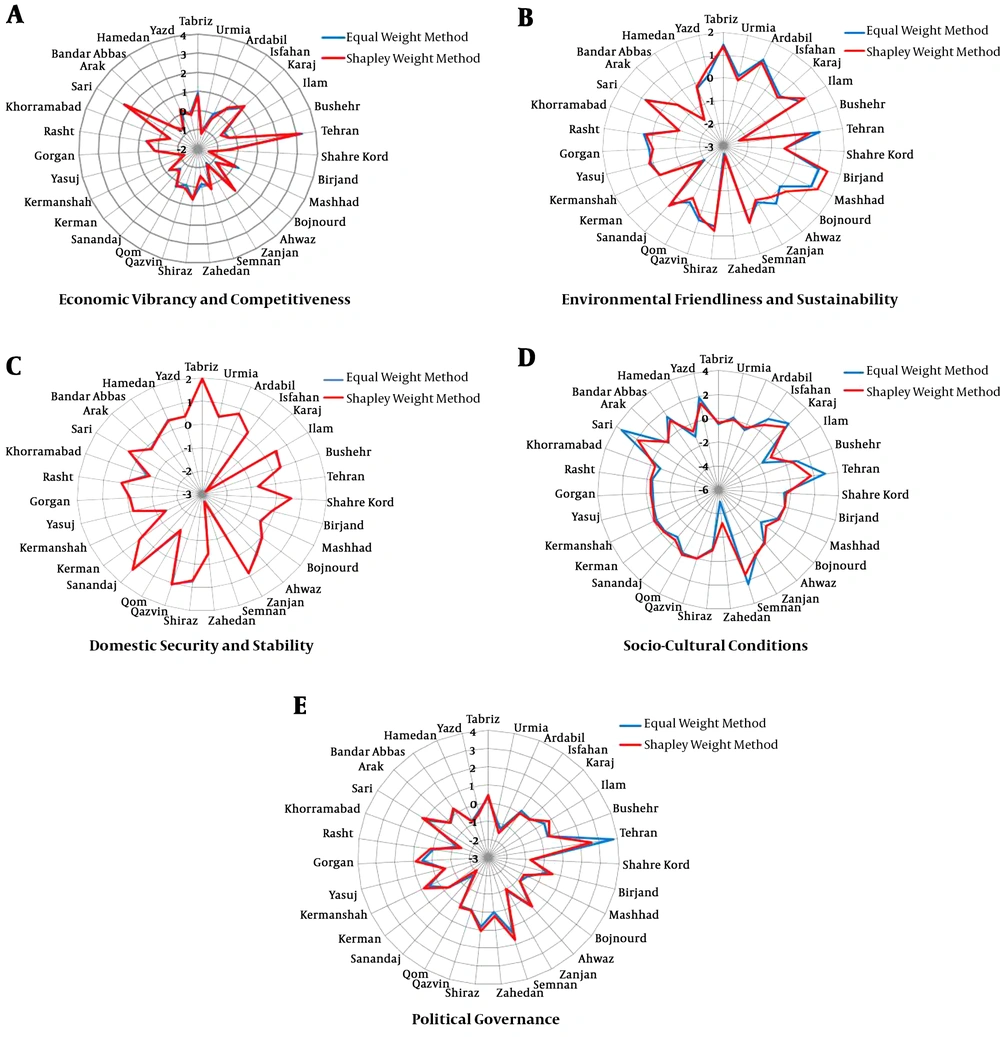
Figure 1.
Ranking of 31 Iran Cities in different five domains of urban liveability. (A) Ranking of 31 Iran Cities in the economic vibrancy and competitiveness domain. (B) Ranking of 31 Iran Cities in the environmental friendliness and sustainability domain. (C) Ranking of 31 Iran Cities in the domestic security and stability domain. (D) Ranking of 31 Iran Cities in the socio-cultural conditions domain. (E) Ranking of 31 Iran Cities in the political governance domain.
Figure 1B shows the ranking for Environmental Friendliness and Sustainability. Tabriz ranks first in this domain when assuming equal weight, while Birjand holds the first rank in the Shapley weight method. Ardabil, Birjand, Mashhad, and Tehran hold the second to fifth ranks, respectively. Hamedan, Arak, Shahre Kord, Khorramabad, Bandar Abbas, Kerman, Bushehr, and Zahedan had the lowest score and ranking in terms of this domain with both methods. Bojnourd had the highest-ranking change in this domain after using the Shapely weight method and changed from rank 20 before using the Shapely method to 13 after using the Shapely method.
Figure 1C shows the ranking for domestic security and stability. Tabriz ranks first in this domain, while Sanandaj, Qazvin, Zanjan, and Shiraz hold the second and fifth ranks, respectively. After using the Shapely weight method, there was little rank change in the position of cities in this domain.
Figure 1D shows the ranking for socio-cultural conditions. Sari ranks first in this domain, while Tehran and Semnan ranked 3rd and 4th. Further, Karaj and Yazd ranked fifth and sixth, respectively. Bojnourd, Zahedan, and Ilam had the lowest rank in this domain. Ardabil had the biggest rank change after using the Shapely method in this domain and changed from 24th to 18th.
Figure 1E shows the ranking for political governance. Tehran, Semnan, Sari, Shiraz, and Kermanshah were ranked first to fifth in this domain. There was little difference between the two methods in this domain in different cities. In 16 cities, the ranking did not change after using the Shapely weight method. Sanandaj, Ardabil, and Khorramabad had the lowest rank in this domain, respectively. Isfahan had the biggest rank change, and its rank changed from 13th to 18th after using the Shapely method.
5. Discussion
In the past few decades, there has been growing discussion on the concept of urban liveability among scientific communities. In this study, we brought multiple indicators together to plot an index that includes a combination of different values. The results show that Tehran, Sari, and Tabriz had the highest levels of liveability in both scenarios. Tehran and Sari showed a better performance across many categories, including economic vibrancy and competitiveness, socio-cultural conditions and political governance. Similarly, Tabriz city occupied the top position in Domestic Security and Stability in both scenarios and in Environmental Friendliness and Sustainability in the equal-weight scenario. The position of Tabriz may be attributed to its better situation in the Domestic Security and Stability, and the Environmental Friendliness and Sustainability domains. In 2018, Tabriz was selected as the capital of Islamic tourism. Tabriz is the fourth largest city in Iran and was the capital of Iran in the past. It is the safest and cleanest city in Iran (18).
In this study, Khorramabad and Zahedan got the lowest ranking. Khorramabad had low scores in most domains. Khorramabad city is the center of Lorestan province, and one of the oldest centers of Iranian civilization. The natural bedrock of Khorramabad city is a valley with a northern-southern direction in the Zagros Mountains. Agriculture and livestock are the main income of this region. Poverty, livestock husbandry, and unsustained urbanization have led to deforestation in this region (19). Studies have also indicated that almost half of the towns in this province do not possess suitable and adequate educational facilities (20).
Zahedan city had poor performance in some domains, especially in Environmental Friendliness and Sustainability, and socio-cultural conditions. Zabol (in the same province) was the most polluted world city in regard to ambient PM2.5 according to the 2016 WHO database of worldwide air pollution measures (21). This city is an eastern Iranian city, close to the border with Afghanistan, and has been plagued by poverty and pollution. In recent years, thick disturbing dust storms have repeatedly occurred in Zabol. This city also suffers from drying surface waters, decreasing groundwater, land subsidence, and deforestation that have happened due to unsustainable development in this area.
Comparing the ranks of different cities in the two scenarios did not show big changes, except for Hamedan and Urmia. The increase in Hamedan's liveability rank after weighting the indicators is related to its better performance in the domestic security and stability, and economic vibrancy and competitiveness domains. The decline in Urmia’s liveability rank after weighting the indicators was mainly related to its poor performance in the political and governance domain. Overall, the GLCI affirms Tehran and Sari as the most liveable cities in Iran.
Every year, the Mercer Company publishes a report about the quality of life in different world cities, which is one of the most comprehensive liveability classifications of its kind. In 2019, this company evaluated 450 cities around the world based on indicators, including political and social space, economic space, social, cultural space, health status, schools and education, public transportation equipment and services, recreational services, consumer goods, housing and environment. The only Iranian city included in this evaluation was Tehran, which was ranked the 199th (22).
In 2018, Tehran was one of the top five world cities that had 5 % points or more in liveability over the past five years, according to the Economist Intelligence Unit (EIU). The EIU reports liveability scores between 1 and 100; thus, 1 was considered intolerable, and 100 was considered ideal. Tehran’s overall livability score was 50.8 out of 100, which has had an improvement of 5% since 2013. It ranked 128 out of 140, dropping one place compared to EIU's 2017 report. According to the 2017 report, Tehran had a 5% improvement compared with the previous five years and ranked 127 with an overall score of 50.8 (23).
Tehran is Iran’s largest city, and its population is over 13.5 million. It is projected to reach 20 million by 2021. Tehran is the political capital of the country and includes the main administrative and economic structure of the country. While only 11 percent of Iran’s population lives in Tehran, about 24 percent of the national GDP belongs to this city. About half of the country’s industries reside in Tehran (24). According to the latest report of the Economist Intelligence Unit (2019), growing instability between the US and Iran was the reason for a reduction in the stability score in the domain of liveability for Tehran; while Vienna, Melbourne and Sydney had the highest rank in the stability domain among the liveable cities in the world (25).
The GLCI helped us to assess the liveability of 31 major Iranian cities, and showed their strengths and their weakness in different domains. Tan and Kaur used the GLCI method to rank the liveability of cities in China in 2015; and showed that Hong Kong, Macau and, Taipei and Kaohsiung cities in Taiwan were better in overall liveability, but some prominent cities such as Beijing, Shanghai, Guangzhou and Shenzhen were not among the top cities (13). Tan et al. accessed Abu Dhabi’s liveability using GLCI in 2015, and indicated that Abu Dhabi performed well in environmental sustainability, and scored 32 in the overall ranking of all 64 liveable cities in the world. There were only five Asian cities in the list of the top 20 liveable world cities. They were Singapore, Hong Kong, Osaka-Kobe, Tokyo, and Yokohama (13).
It is crucial to investigate the principles of success of liveable cities based on existing precedents, analyze them considering their specific individual situation, and adjust them before applying to other cities (26). Norouzian-Maleki et al. used the Delphi method to develop a structure for assessing neighborhood liveability in Iran and Estonia. Their results showed that while many similar criteria could be used in both countries, their importance varied, and this was in part because of the social and environmental differences (such as climate) that existed between the two countries (27). Another study has compared perceived liveability between residents of Tehran, Iran and Tartu, Estonia, and concluded that the proportion and scale of spaces, green areas, street characteristics, the variety of the form and age of buildings, and perceived population density was directly related to neighborhood liveability (28). Ghasemi et al. evaluated livability by multi-criteria decision-making approaches in different districts of Tehran. Their findings showed that infrastructure, sanitation, green spaces, transportation, industrial, military, and commercial places were very different in these districts (29). Another study assessed livability in the new and old areas of Tehran, in districts 22 and 10 in regard to economic, social-cultural, and environmental liveability indicators. Results showed that in access to infrastructure and welfare services, such as public transport services, the old part of district 10 had a better situation than district 22. But in environmental quality indicators, the new districts enjoyed a higher level of livability (30). Shabanzadeh Namini, (31), Hataminejad (32), Mohrekesh (33) and Veysi Nab (34) have used different methods for evaluating liveability in Tehran, Ahwaz, Zanjan, Isfahan, and Tabriz, Iran. One study has used the principal component analysis method (35) and the other has used the clustering method (36) to compare Iranian provinces in terms of urbanization, according to a limited number of indicators. However, as far as we know, no comprehensive study has been conducted to compare liveability among all Iranian metropolises before.
In addition to the indicators used in this study, there may be other indicators that can be used for measuring liveability in Iran’s context, and this needs to be explored with a diverse group of stakeholders, namely civil society engineers, non-government organizations, and advocates. Also, liveability must include both objective and subjective indicators. But, in this study, we focused only on objective indicators. Other subjective indicators such as quality of life, satisfaction, perceptions, and attitude can be investigated and added to urban liveability in future studies. One of the limitations of this study was the lack of city-level data for some indicators.
This multi-component index can help policymakers make large-scale regional decisions; however, it may not be ideal to judge cities' ranking and their various dimensions with one number. Nevertheless, this study is the first study in Iran about determining the liveability index and ranking the country's metropolises, according to this index. The findings of this study can be used in urban development by city planners, politicians, and municipalities; and can help alert policymakers about the shortcomings of liveability in Iranian cities. Besides, it emphasizes the necessity of cross-sectoral cooperation to improve urban liveability. It also helps the government to recognize the more important and effective factors in urban livability by following the example of highly liveable cities. This ranking can also create constructive competition between cities to improve their ranking by focusing on enhancing indicators affecting liveability.
It is recommended that the mechanism of influence of each of these indicators on the development of urban environment and improvement of population health be investigated in developing countries such as Iran. It is also recommended to improve urban liveability by finding ways to prioritize the more cost-effective indicators in future studies. These results can also guide policymakers in planning sustainable interventions with minimum harm to human health in parallel with urban development.
5.1. Conclusions
The results outlined in this paper show that Tehran, Sari, and Tabriz have better levels of liveability among Iranian cities. However, Tehran still ranks very low in worldwide comparisons. Iranian officials, especially in less developed provinces, should work hard toward making Iranian cities more liveable.