1. Background
Salivary gland tumors are rare and account for 3% to 5% of all head and neck neoplasms (1). Approximately, 75% to 85% of these neoplasms occur in parotid gland, of which 20% to 25% are malignant (2). They are very heterogeneous tumors (3, 4) and may be the most complex human neoplasia (5). Despite the low incidence, they raise significant concerns due to their variation in microscopic patterns and clinical behavior (1, 4, 6, 7). The prevalence of salivary gland tumors reveals vast geographic differences (1, 8-10). Furthermore, variations in the frequency of microscopic types have also been reported (8). As curriculum of cancer control declared, the early detection of the lesions lead to better treatment, increased survival, and decreased mortality (11). Therefore, the purpose of this study was to illustrate the prevalence of malignant tumors of the parotid within the Iranian population.
2. Methods
This multicenter retrospective cross sectional study assessed the recorded cases of parotid malignancies in the Cancer Research Center (CRC) of Shahid Beheshti University of Medical Sciences. Patients’ records and pathology reports of these cases were accordingly retrieved from the archive; then, they were classified on the basis of microscopic type, age, and gender. This center has been collecting information on patients with cancer from all major hospitals in Iran since the 2003. One of the primary objectives of this center is to record the changes in pattern of malignancies within the territory of Iran. Such information is classified and recorded every 3 months according to the guidelines stipulated by the cancer office of center for disease control (CDC). Recently, the data registered in this center are qualitatively assessed according to the CDC standards. These standards include monitoring the information coverage, monitoring the complete details, controlling the accuracy of information, interpretation, and the elimination of repeated cases. The data were statistically analyzed, using descriptive statistics. Since the data, from 2008 to present day, were in the process of electronic storage, the CRC did not provide us with the stated information.
3. Results
Between 2003 and 2008, a total number of 422 cases of the parotid cancer were recorded in the CRC. Among all cases, 6 cases of metastatic melanoma were excluded from the study and 416 cases of primary malignancy of parotid were taken into assessment process. Parotid cancers accounted for 0.97% of all head and neck malignancies. Most cases were diagnosed between the age range of 40 to 79 years and the peak of incidence was 6th decade. A total of 234 cases (56.25%) had occurred in men and 182 cases (43.75%) in women. The male to female ratio was 1.28.
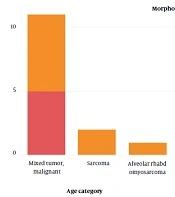
Malignancies were categorized in 2 groups [epithelial and non-epithelial (mesenchymal and hematopoietic)]. Table 1 demonstrates frequency of the histopathologic type of parotid malignancies and gender distribution. Epithelial tumors were the commonest malignancies (83.41%), of which mucoepidermoid carcinoma (MEC) made up 35.57% of all lesions followed by acinic cell carcinoma (13.94%) and carcinoma ex pleomorphic adenoma (12.5%). In non-epithelial groups, lymphomas made up 13.7% of all the lesions (Table 2). The male to female ratio was 1.37. Sarcomas constituted 2.88% of the lesions with a male to female ratio of 0.71 and about 75% of sarcomas occurred under 60 years. Among sarcomas, 41.66% were embryonal rhabdomyosarcoma. Twenty-three cases (5.52%) were detected in less than 20 years, of whom 14 (60.86%) were MEC. The male to female ratio in these age groups were equal. Sarcomas and lymphomas comprised 13.04% and 8.69% of the cancers in this age group, respectively.
Table 1.
Frequency of the Histopathologic Type of Parotid Malignancies and Gender Distribution
| Type of Tumor | Female | Male | Total |
|---|---|---|---|
| Epithelial malignancies | |||
| Mucoepidermoid carcinoma | 62 | 86 | 148 |
| Acinic cell carcinoma | 35 | 23 | 58 |
| Carcinoma ex Pleomorphic adenoma | 18 | 34 | 52 |
| Adenoid cystic carcinoma | 15 | 10 | 25 |
| Adenocarcinoma NOS | 4 | 8 | 12 |
| Salivary duct carcinoma | 5 | 6 | 11 |
| Epithelial myoepithelial carcinoma | 3 | 5 | 8 |
| Polymorphous low grade adenocarcinoma | 1 | 3 | 4 |
| Clear cell adenocarcinoma | 2 | 1 | 3 |
| Carcinosarcoma | 0 | 3 | 3 |
| Lympho epithelial carcinoma | 2 | 0 | 2 |
| Small cell carcinoma | 0 | 2 | 2 |
| Basal cell adenocarcinoma | 1 | 0 | 1 |
| Oxyphilic adenocarcinoma | 1 | 0 | 1 |
| Squamous cell carcinoma | 2 | 15 | 17 |
| Non-epithelial malignancies | |||
| Lymphoma | 24 | 33 | 57 |
| Sarcoma | 7 | 5 | 12 |
| Total | 182 | 234 | 416 |
Table 2.
Age Distribution of the Parotid Lymphomas
| Hematopoitic Malignancies | Age, y | ||||||||
|---|---|---|---|---|---|---|---|---|---|
| 0 - 9 | 10 - 19 | 20 - 29 | 30 - 39 | 40 - 49 | 50 - 59 | 60 - 69 | 70 - 79 | +80 | |
| Non Hodgkin lymphoma | |||||||||
| Diffuse large B cell lymphoma | 1 | 1 | 2 | 1 | 5 | 6 | 5 | ||
| Follicular lymphoma | 2 | 1 | |||||||
| Small lymphocytic lymphoma | 2 | 2 | 2 | ||||||
| Anaplastic large cell lymphoma | 1 | ||||||||
| MALT lymphoma | 1 | 1 | 1 | 2 | |||||
| Plasmacytoma | 1 | ||||||||
| Precursor cell lymphoblastic lymphoma | 1 | ||||||||
| Not specified | 4 | 3 | 4 | 1 | 3 | ||||
| Hodgkin Lymphoma | 1 | 3 | |||||||
| Total | 2 | 3 | 8 | 8 | 9 | 14 | 10 | 3 | |
4. Discussion
In the current study, parotid cancers accounted for 0.97% of all head and neck malignancies. This low incidence is in agreement with most of the previous published reports (2, 6, 12, 13). In our research, the most cases were diagnosed in the 5th to 8th decades of their life and the peak of incidence was the 6th decade, assimilating previous studies (9, 14). However, some carried out research studies found 7th and 8th decades as the most prevalent ranges (2, 3, 7, 8, 15). In this study, 56.25% of cases had occurred in men and 43.75% in women (ratio = 1.28). This is in accordance with the previous reports with male to female ratio 1.32 (2), 1.08 (6), 1.06 (15), and 1.15 (4).
It also should be pointed out that epithelial cancers constituted 83.41% of all malignant tumors seen during this period and MEC was the most common malignant tumor in this region. This is in compliance with most of previously published reports (6, 14, 16-19). On the contrary, Derin et al. (15) found that lymphoma and adenoid cystic carcinoma were the most malignant parotid lesions. This difference is due to the low sample size of their research.
Acinic cell carcinoma, carcinoma ex pleomorphic adenoma, and adenoid cystic carcinoma (ADCC) were the most common malignancies after MEC. These 4 types of neoplasms were the most common malignancies in many different research studies (3, 6, 7, 10, 16, 17, 20).
Albeit, some investigations maintained that other tumors, such as adenocarcinoma not otherwise specified (NOS) (2, 9) and ADCC (3, 15) were the most malignancies. The head and neck area are among the most commonly involved extra-nodal sites of non-hodgkin lymphoma (NHL) (21) and salivary glands comprise 6% to 26 % of extranodal NHL in the head and neck (22). It appears that the majority of salivary gland lymphomas are reported to originate in the parotid gland (22). Etemad-moghadam et al. (23) mentioned that parotid made up 15% of lymphoma of the head and necks. Similarly, in a study conducted by Picard et al. (24), parotid lymphoma comprised 13% of head and neck lymphomas. Lymphoma has been regarded as a relatively common malignancy in the Iranian population (25). Parotid lymphoma is generally a NHL with B-cell derivation (13) average age of 61 to 63 years (13, 22) and male predominance (13, 26). In our cases, most of the lymphoma patients were 50 to 79 years and the male to female ratio was 1.37. Shum et al. (13) found that the most microscopic types were follicular lymphoma (FL), mucosa associated lymphoid tissue lymphoma (MALT), and diffuse large B cell lymphoma (DLBL); but, in Paliga et al. (22) groups, most of the parotid lymphoma were MALT, FL, and DLBL. In addition, in a large series of Feinstein et al. (27), the commonest subtypes were MALT, FL, and DLBL. In our study, DLBL, SLL, and MALT were the most common lesions.
Malignant mesenchymal tumors of salivary gland are rare with 0.3% to 1.5% incidence (28). In a review of the literature by Cockerill et al. (28), rhabdomyosarcoma was the most frequent sarcoma in these regions, with other common histologic types being hemangiopericytoma, angiosarcoma, liposarcoma, and malignant fibrous histiocytoma. They reported that salivary gland sarcomas exhibit a male predilection with a mean age of 49 years and the most common sites of parotid glands (28). In our study, sarcomas constituted 2.88% of the lesions and rhabdomyosarcoma was the most common lesion. About 75% of sarcomas occurred under 60 years and the male to female ratio was 0.71. Sarcomas of the salivary glands behaved identically to their soft-tissue counterparts (28).
It is noteworthy that the incidences of salivary gland tumors, especially the malignant neoplasms in children, are rarely described in the literature (18). All different types are found in children as well as in adults, whereas the incidences are different (29, 30). In our research, MEC was the most prevalent carcinoma in the parotid region of children and adults.
They found that epithelial-myoepithelial carcinomas, carcinomas of the salivary duct, and mucoepidermoid carcinomas were the most common carcinomas (18). In our study, compared to parotid carcinoma of adults, 5.52% of all patients were 20 years old and younger, which was similar to other studies (18). The male to female ratio in these age groups was equal (M/F = 1). In da Cruz Perez et al.’s research (30), the gender ratio was nearly equal with slight tendency towards females. Contradictorily, other studies reported a female to male ratio of 1.9 (29) and 2.7 (33). Approximately, 13.04% of the malignancies of children were sarcomas and lymphomas, comprised 8.69% of the cancers.
5. Conclusions
In the Iranian population, like many other countries, mucoepidermoid carcinoma is the most prevalent malignancy of parotid among adults, adolescents, and children. The male to female ratio was 1.28 and the majority of the patients were in 6th decade of their life. Lymphoma was the most prevalent non-epithelial malignancies in this location. These epidemiologic findings about parotid cancers may improve the knowledge about rare malignancies in adult and younger age groups.