1. Background
After the outbreak of coronavirus disease 2019 (COVID-19) in China in December 2019, all healthcare providers worldwide focused on the disease. Fear of contracting has created fear, panic, and stress among millions worldwide (1). Many countries have used quarantine measures to prevent the further spread of the virus. The Iranian government implemented a plan called Social Distancing Plan (SDP). Social distancing refers to remaining out of congregate settings, avoiding mass gatherings, and maintaining distance from others (approximately six feet or two meters).
The quarantine can create loneliness and anger among individuals. Other issues associated with psychological distress are a decline in freedom, separation from loved individuals, the duration of quarantine, uncertainty about illness, fear of infection, frustration, defective equipment to protect against disease, inadequate and/or incorrect information about COVID-19, boredom, and fatigue (2, 3). For those in quarantine, social support decreases and is among the most critical sources of coping with stress. Previous studies examining the consequences of quarantine among individuals have reported emotional disturbance (4), depression (5), stress (6), low mood, irritability, insomnia (7), and traumatic stress symptoms (8).
2. Objectives
The present study investigated a more comprehensive range of psychological effects, symptoms, and mood states of the SDP during the COVID-19 outbreak in Iran compared to other Iranian studies.
3. Methods
3.1. Procedure and Participants
Data were collected using a cross-sectional web-based survey with a link shared via social media (i.e., WhatsApp and Telegram). Before starting the study, individuals were asked if they had any physical or mental illnesses. Only those who had no mental or physical illness and were over 18 years were included in the statistical analysis. The data collection lasted one week, from December 5 to December 11, 2020. A total of 1,524 individuals completed the survey.
3.2. Measures
3.2.1. General Health Questionnaire
The 28-item General Health Questionnaire (GHQ-28) comprises four subscales (physical symptoms, anxiety/insomnia, depression, social dysfunction), each with seven items rated on a five-point scale from 0 (never) to 4 (always). The validity and reliability of the Iranian GHQ-28 are adequate (9).
3.2.2. Stress Response Inventory
The 39-item Stress Response Inventory (SRI) assesses different aspects of stress response with seven subscales. Items are rated on a five-point scale from 0 (not at all) to 4 (absolutely). The reliability and validity were confirmed in previous studies (10).
3.2.3. Brunel Mood Scale
The 32-item Brunel Mood Scale (BRUMS-32) assesses different mood states (depression, tension, fatigue, anger, vigor, confusion, calmness, and happiness). The items are rated on a five-point scale from 0 (not at all) to 4 (extremely). Confirmatory factor analysis has confirmed the construct validity of the Iranian BRUMS-32 (RMSEA = 0.08, CFI = 0.94, TLI = 0.93). Internal consistency (tension = 0.74, vigor = 0.80, confusion =0.72, fatigue = 0.76, happiness = 0.77, calmness = 0.78, depression= 0.70, anger = 0.72, and total = 0.78) and temporal reliability (tension = 0.90, vigor = 0.87, confusion = 0.84, fatigue = 0.86, happiness = 0.87, calmness = 0.86, depression = 0.88, anger = 0.86, and total = 0.88) were confirmed (11).
Descriptive statistics were reported as percentages and means ± SD. The independent t-test and one-way ANOVA were used to investigate the association between participants’ demographic variables and psychological characteristics. The results are presented with 95% confidence intervals. All analyses were performed using SPSS-25.
4. Results
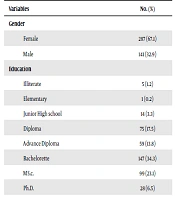
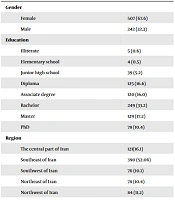
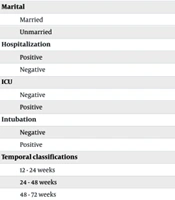
Most participants were males (65.16%) and married (66.7%). Most of them were under the age of 40 years (72%).
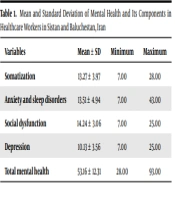
Table 1 shows the mental health characteristics of the whole sample. One-third of the participants reported physical symptoms (32.7%), 47% anxiety, 72% social dysfunction, and 28.3% depression. Approximately half of the participants (52.2%) reported at least one mental health disorder. Means and standard deviations of stress response and mood state are shown in Table 2.
Table 1.
Gender and Psychological Characteristics
| Psychological Characteristics | Mean ± SD | P-Value |
|---|---|---|
| Physical symptoms | ||
| Gender | < 0.001 | |
| Female | 5.90 ± 4.45 | |
| Male | 4.45 ± 3.99 | |
| Marital Status | 0.144 | |
| Single | 5.63 ± 4.45 | |
| Married | 5.28 ± 4.29 | |
| Anxiety/insomnia | ||
| Gender | < 0.001 | |
| Female | 8.02 ± 5.76 | |
| Male | 5.79 ± 5.15 | |
| Marital Status | 0.0908 | |
| Single | 7.22 ± 5.68 | |
| Married | 7.26 ± 5.65 | |
| Social dysfunction | ||
| Gender | 0.002 | |
| Female | 9.58 ± 4.62 | |
| Male | 8.85 ± 4.25 | |
| Marital Status | < 0.001 | |
| Single | 9.97 ± 4.60 | |
| Married | 9.01 ± 4.43 | |
| Depression | ||
| Gender | < 0.001 | |
| Female | 5.27 ± 5.54 | |
| Male | 3.67 ± 4.75 | |
| Marital Status | < 0.001 | |
| Single | 5.90 ± 5.82 | |
| Married | 4.11 ± 4.96 | |
| GHQ-28 total score | ||
| Gender | < 0.001 | |
| Female | 28.77 ± 16.35 | |
| Male | 22.76 ± 14.47 | |
| Marital Status | < 0.001 | |
| Single | 28.73 ± 16.19 | |
| Married | 25.67 ± 15.77 | |
| Tension | ||
| Gender | < 0.001 | |
| Female | 5.89 ± 5.01 | |
| Male | 4.52 ± 4.22 | |
| Marital Status | 0.002 | |
| Single | 5.94 ± 4.75 | |
| Married | 5.15 ± 4.80 | |
| Aggression | ||
| Gender | 0.032 | |
| Female | 1.59 ± 2.83 | |
| Male | 1.28 ± 2.42 | |
| Marital Status | 0.002 | |
| Single | 1.78 ± 2.96 | |
| Married | 1.33 ± 2.55 | |
| Anger | ||
| Gender | < 0.001 | |
| Female | 6.21 ± 5.64 | |
| Male | 4.55 ± 4.81 | |
| Marital Status | 0.091 | |
| Single | 5.97 ± 5.47 | |
| Married | 5.47 ± 5.39 | |
| Fatigue | ||
| Gender | < 0.001 | |
| Female | 7.01 ± 4.86 | |
| Male | 5.28 ± 4.27 | |
| Marital Status | 0.001 | |
| Single | 6.99 ± 4.95 | |
| Married | 6.12 ± 4.59 | |
| Frustration | ||
| Gender | < 0.001 | |
| Female | 8.09 ± 6.76 | |
| Male | 5.06 ± 5.26 | |
| Marital Status | 0.070 | |
| Single | 7.46 ± 6.43 | |
| Married | 6.82 ± 6.43 | |
| Vigor | ||
| Gender | < 0.001 | |
| Female | 7.34 ± 3.58 | |
| Male | 8.08 ± 3.56 | |
| Marital Status | 0.007 | |
| Single | 7.25 ± 3.71 | |
| Married | 7.77 ± 3.51 | |
| Confusion | ||
| Gender | < 0.001 | |
| Female | 5.33 ± 4.38 | |
| Male | 4.53 ± 4.09 | |
| Marital Status | < 0.001 | |
| Single | 5.96 ± 4.45 | |
| Married | 4.59 ± 4.15 | |
| Calmness | ||
| Gender | < 0.001 | |
| Female | 6.00 ± 3.78 | |
| Male | 6.85 ± 3.66 | |
| Marital Status | 0.049 | |
| Single | 6.03 ± 3.88 | |
| Married | 6.43 ± 3.69 | |
| Happiness | ||
| Gender | 0.013 | |
| Female | 6.86 ± 3.78 | |
| Male | 7.36 ± 3.68 | |
| Marital Status | < 0.001 | |
| Single | 6.37 ± 3.82 | |
| Married | 7.36 ± 3.68 |
Abbreviation: GHQ-28, General Health Questionnaire.
Table 2.
Mental Health Characteristics a
| Characteristics | Values |
|---|---|
| General Health Questionnaire | |
| Physical symptoms | |
| Healthy cases | 1025 (67.3) |
| Suspected cases | 499 (32.7) |
| Anxiety/insomnia | |
| Healthy cases | 807 (53.00) |
| Suspected cases | 717 (47.00) |
| Depression | |
| Healthy cases | 1093 (71.7) |
| Suspected cases | 431 (28.3) |
| Social dysfunction | |
| Healthy cases | 424 (28.00) |
| Suspected cases | 1098 (72.00) |
| GHQ-28 total score | |
| Healthy cases | 728 (47.8) |
| Suspected cases | 796 (52.2) |
| Stress Response Inventory | |
| Tension | 5.41 ± 4.79 |
| Aggression | 1.48 ± 2.70 |
| Anger | 5.63 ± 5.42 |
| Fatigue | 6.41 ± 4.73 |
| Frustration | 7.03 ± 6.44 |
| Brunel Mood Scale | |
| Vigor | 7.60 ± 3.59 |
| Confusion | 5.05 ± 4.30 |
| Calmness | 6.30 ± 3.76 |
| Happiness | 7.03 ± 3.75 |
Abbreviation: GHQ-28, General Health Questionnaire.
a Values are expressed as No. (%) or mean ± SD.
4.1. Gender, Marital Status, and Psychological Characteristics
Table 1 shows that the mean scores of negative psychological characteristics (physical symptoms, anxiety and insomnia, depression, tension, anger, fatigue, and frustration and confusion) were higher among females than among males, and the mean scores of positive psychological characteristics (vigor, calmness, and happiness) were lower among females than among males. These differences were significant in all the characteristics (P ≤ 0.01).
Based on Table 1, the mean scores of negative psychological characteristics were higher among single participants than among married participants, and in the case of positive psychological characteristics, the trend was reversed. These differences were significant in terms of general health dimensions (social dysfunction and depression), stress response dimensions (tension, aggression, and fatigue), and mood state dimensions (vigor, confusion, and happiness) (P ≤ 0.01).
4.2. Age and Psychological Characteristics
Table 3 shows that the mean scores of negative psychological characteristics among older participants were lower than in younger participants and that the mean scores of positive psychological characteristics were higher among older participants than in younger participants. These differences were significant in all the psychological characteristics (P ≤ 0.01).
Table 3.
Age and Psychological Characteristics
| Psychological Characteristics and Age (y) | Mean ± SD | P-Value |
|---|---|---|
| Physical symptoms | ||
| 18 - 30 | 6.00 ± 4.44 | < 0.001 |
| 31 - 40 | 5.18 ± 4.26 | |
| 41 - 50 | 5.20 ± 4.43 | |
| ≥ 51 | 3.97 ± 3.55 | |
| Anxiety and insomnia | ||
| 18 - 30 | 7.98 ± 5.73 | < 0.001 |
| 31 - 40 | 7.19 ± 5.59 | |
| 41 - 50 | 6.76 ± 5.67 | |
| ≥ 51 | 4.75 ± 4.53 | |
| Social dysfunction | ||
| 18 - 30 | 10.51 ± 4.31 | < 0.001 |
| 31 - 40 | 9.11 ± 4.51 | |
| 41 - 50 | 8.17 ± 4.35 | |
| ≥ 51 | 7.27 ± 4.10 | |
| Depression | ||
| 18 - 30 | 6.41 ± 5.83 | < 0.001 |
| 31 - 40 | 4.39 ± 5.08 | |
| 41 - 50 | 3.04 ± 4.12 | |
| ≥ 51 | 1.96 ± 3.46 | |
| GHQ-28 total score | ||
| 18 - 30 | 30.92 ± 15.95 | < 0.001 |
| 31 - 40 | 25.89 ± 15.78 | |
| 41 - 50 | 23.19 ± 15.15 | |
| ≥ 51 | 17.95 ± 12.01 | |
| Tension | ||
| 18 - 30 | 6.35 ± 4.80 | < 0.001 |
| 31 - 40 | 5.21 ± 4.72 | |
| 41 - 50 | 4.72 ± 4.80 | |
| ≥ 51 | 3.05 ± 3.47 | |
| Aggression | ||
| 18 - 30 | 2.13 ± 3.14 | < 0.001 |
| 31 - 40 | 1.30 ± 2.40 | |
| 41 - 50 | 1.02 ± 2.39 | |
| ≥ 51 | 0.28 ± 1.24 | |
| Anger | ||
| 18 - 30 | 6.84 ± 5.69 | < 0.001 |
| 31 - 40 | 5.44 ± 5.33 | |
| 41 - 50 | 4.59 ± 4.93 | |
| ≥ 51 | 2.80 ± 3.38 | |
| Fatigue | ||
| 18 - 30 | 7.57 ± 4.86 | < 0.001 |
| 31 - 40 | 6.21 ± 4.53 | |
| 41 - 50 | 5.39 ± 4.40 | |
| ≥ 51 | 3.67 ± 3.59 | |
| Frustration | ||
| 18 - 30 | 8.50 ± 6.58 | < 0.001 |
| 31 - 40 | 6.68 ± 6.32 | |
| 41 - 50 | 5.97 ± 6.23 | |
| ≥ 51 | 3.57 ± 4.04 | |
| Vigor | ||
| 18 - 30 | 7.04 ± 3.65 | < 0.001 |
| 31 - 40 | 7.65 ± 3.63 | |
| 41 - 50 | 8.25 ± 3.54 | |
| ≥ 51 | 8.73 ± 2.88 | |
| Confusion | ||
| 18 - 30 | 6.07 ± 4.37 | < 0.001 |
| 31 - 40 | 4.97 ± 4.34 | |
| 41 - 50 | 4.04 ± 3.92 | |
| ≥ 51 | 2.60 ± 2.90 | |
| Calmness | ||
| 18 - 30 | 5.71 ± 3.74 | < 0.001 |
| 31 - 40 | 6.31 ± 3.68 | |
| 41 - 50 | 6.89 ± 3.86 | |
| ≥ 51 | 7.92 ± 3.35 | |
| Happiness | ||
| 18 - 30 | 6.26 ± 3.67 | < 0.001 |
| 31 - 40 | 7.19 ± 3.75 | |
| 41 - 50 | 7.77 ± 3.74 | |
| ≥ 51 | 8.41 ± 3.29 |
Abbreviation: GHQ-28, General Health Questionnaire.
5. Discussion
The present study aimed to investigate the psychological status of Iranian individuals who experienced the Iranian government’s SDP to minimize the spread of COVID-19 during the pandemic.
The results showed that approximately half of the participants had at least one mental health disorder (52.2%). Previous studies by Noorbala et al. reported the prevalence of general mental health disorders in Iran in 1999, 2004, 2015, and 2017 as 21%, 21%, 23.4%, and 28.5%, respectively (12-14). In the present study, as in the aforementioned studies, the mean scores of mental disorders were higher among females than males. The present study also found that the mean scores of mental health disorders and negative psychological characteristics were higher among single participants than among married ones, which is inconsistent with some previous studies (12, 14, 15). One reason could be that single individuals were forced to break away from their friendship groups and spend more time with family during the enforcement of the SDP. Furthermore, the SDP meant universities were physically closed, and concerts, celebrations, and parties were canceled. Because younger individuals are more likely to attend such social gatherings, they are more likely to have been affected during the country’s lockdown. This result can be seen when comparing different age groups. The highest rates of mental health disorders and negative psychological characteristics were found among younger individuals, which is inconsistent with previous research (14, 16). Consequently, the psychological state was better among older participants than among younger participants, even though the highest mortality rate for those with COVID-19 is among the elderly (17). This age group received much attention and social support during the implementation of the SDP from relatives and friends, as well as from relevant organizations such as the Ministry of Health. Older individuals are less likely to leave the house, even under normal circumstances, so the SDP was less restrictive for them than for younger individuals. Many older individuals are retired, so the closure of markets, offices, and businesses was less likely to cause psychological harm to them. Previous studies have shown that factors such as receiving information from the media, the internet, etc., can play a role in fear of COVID-19 (18). As young people use these news sources more, the psychological distress caused by COVID-19 has become more common among these people.
The study was cross-sectional, so causal relationships could not be determined. The study was conducted utilizing online data collection, which means some could not participate. This may have led to demographic biases among the final sample of participants, with those in higher education or of higher socioeconomic status being more likely to participate. The self-selecting and self-reporting nature of data collection means that while the sample was relatively large, it was not representative of the Iranian population, and the data were subject to well-known methods biases. Another limitation of this study was that it was not determined if the respondents or one of their relatives had contracted COVID-19 or not.