1. Background
Brucellosis is caused by Gram negative, facultative intracellular bacteria of the Brucella genus. Brucella melitensis Rev-1, an attenuated smooth strain used to control B. melitensis infection gives heterologous protection against other Brucella spp. and is currently considered as the best vaccine for the prophylaxis of caprine brucellosis (1). However, due to some problems related to attenuated B. melitensis Rev1 (2, 3), subunit vaccine protective against B. melitensis is desirable. Escherichia coli is frequently used for production of recombinant proteins because of the extensive knowledge available about this organism for both physiology and genetic characterization (4). The subsequent downstream purification of products from E. coli, remains noticeably more difficult compared to secreted proteins from eukaryotic expression organisms. Since the production of protein by E. coli in most manufacturing processes is performed intracellularly, the protein product must be selectively separated from the host proteins (5).
Proteins with up to 95% purity still contain a significant amount of endotoxins. Endotoxins are lipopolysaccharides (LPS) associated with the outer membrane of Gram-negative bacteria. The inherent toxicity of these LPSs has a profound effect on biochemical events of certain cells and can interfere with in vitro experiments (6).The threshold level of endotoxin for intravenous applications is set to 5 endotoxin units (EU) per kg body weight and hour by all pharmacopoeias (7). Because of this toxicity, the removal of even minute amounts is essential for safe administration or biological cell-based application. The following study introduces a method using of Ni-NTA agarose for recombinant protein purification by which the simultaneous removal of endotoxins is made possible.
2. Objectives
To test the feasibility of our protocol, we expressed, and purified B. melitensis rHSP and rTF proteins with very low extent of LPS. Recently we have cloned hsp and tf genes of B. melitensis by Gateway Cloning system (8).
3. Materials and Methods
3.1. Expression of HSP and TF Proteins
Recombinant pDES-tf and pDEST-hsp were transformed into competent expression host E. coli BL21 (DE3). Ampicillin-resistant colonies were grown in Luria-Bertani medium (HiMedia, India) containing 100 µg of ampicillin per ml at 37°C with agitation (250 rpm) overnight. Fifteen milliliters of this culture was diluted to 500 ml and grown until it reached an OD 600 of 0.7. Protein expression was induced by adding 1 mM isopropyl-β-D-thiogalactopyranoside (IPTG), and incubating transformed cells for 5 h at 37°C. Bacteria were pelleted by centrifugation (15,000 × g, 20 min, 4°C) and frozen at -70°C.
3.2. Determination of Solubility of Recombinant Proteins
For determination of recombinant proteins solubility in PBS, pellets of five milliliter culture samples were resuspended in five milliliter PBS and bacteria were broken by sonication 3 times with 100% power at 4°C. Lysates were centrifuged and supernatants and pellets were used in Western blots. Bacterial lysates were fractionated by electrophoresis on 12% SDS-PAGE gel and transferred to nitrocellulose membrane (BioRad, The USA). The blot was blocked overnight at 4°C with PBS-0.1% Tween 20 containing 5% nonfat dry milk and subsequently incubated with anti-6-His peroxidase (Roche, Mannheim, Germany) (1/40000) for 1 h. Following washed in PBS-0.1% Tween 20, bound conjugates were detected using ECL substrate (GE Healthcare, Uppsala, Sweden), and proteins were visualized by exposing the blot to autoradiography film.
3.3. Purification and Endotoxin Removal From Recombinant Proteins
3.3.1. Purification of rHSP Under Denaturing Conditions
Bacterial cells producing rHSP were resuspended in 20 ml of lysis buffer (100 mM NaH2PO4, 10 mM Tris-Cl and 8 M urea, 10 mM imidazole,pH 8.0) having urea as denaturing agent (8 M urea, 100 mM NaH2PO4, 10 mM Tris-Cl, pH 8.0), and then sonicated for ten 1-min cycles with 25% power at 4°C. A suspension of 2 ml Ni-NTA agarose (Qiagen, Germany) was poured into two columns and pre equilibrated with lysis buffer.Inclusion bodies were pelleted at 20,000 ×g for 30 min at RT. Supernatant cleared lysate was loaded onto 10 columns to purify the protein by Ni–NTA agarose. The unbound proteins in the first column was washed using wash buffers (100 mM NaH2PO4, 10 mM Tris-Cl and 8 M urea, 20 mM imidazole) and (100 mM NaH2PO4, 10 mM Tris-Cl and 8 M urea, 40 mM imidazole). The second column was washed with the same buffer but 0.1% TritonX-114 was added to buffers. Elution was achieved by buffer (100 mM NaH2PO4, 10 mM Tris-Cl and 8 M urea, 1 M imidazole).
3.3.2. Purification of rTF Under Native Conditions
Expressed bacterial cells were lysed in 20 ml of lysis buffer (50 mM NaH2PO4, 300 mM NaCl and 10 mM imidazole, pH 8.0) and then sonicated for ten 1-min cycles with 25% power at 4◦C. The sonicated sample was centrifuged at 20,000 ×g for 30 min at 4◦C. Like rHSP, the soluble fraction of protein present in cleared lysate was purified using Ni–NTA agarose. The cleared lysate was loaded 10 ml onto the pre equilibrated Ni-NTA agarose column with lysis buffer. Further the column was washed with wash buffers (50 mM NaH2PO4, 300 mM NaCl and 20 mM imidazole, pH 8.0) and (50 mM NaH2PO4, 300 mM NaCl and 40 mM imidazole, pH 8.0) to remove the unbound nonspecific proteins and finally protein was eluted from column using elution buffer (50 mM NaH2PO4, 300 mM NaCl and 1M imidazole, pH 8.0). The second column was washed with buffers containing 0.1% Triton X-114.
3.3.3. Elimination of Imidazole from Recombinant Proteins
To eliminate imidazole from samples, the eluted fractions were dialyzed against PBS for overnight at 4°C.
3.4. Endotoxin and Protein Concentration of Recombinant Proteins
The endotoxin content of different fractions was determined by Limulus amoebocyte lysate (Lonza, Switzerland) according to the manufacturer’s instructions. Protein concentrations were determined using Bradford method. Triton X-114 content of the aqueous phase was determined by measuring the absorbance at 280 nm.
4. Results
Transfection of pDEST- hsp and pDEST- tf into E. coli BL21 (DE3) competent bacteria resulted in production of the respective proteins with the expected sizes as revealed by SDS-PAGE and Western blotting (Figures 1 and 2). Figures 1 A and 1B show that rHSP and rTF were expressed in the insoluble (rHSP was seen just in pellet) and soluble fractions (rTF was seen in both supernatant and pellet) of E. coli cells, so they were successfully purified under denaturing and native conditions respectively (Figure 2).
The application of 0.1% Triton X-114 in the washing steps was successful to reduce endotoxins; whereas, washing steps lacking detergent were ineffective in eliminating endotoxins. In contrast to purified materials employing the standard protocol which contained more than 10,000 EU mg/1, purified recombinant proteins treated with Triton X-114 had content of less than 0.05 endotoxin units per mg of protein (less than 99% of initial endotoxin content) (Table 1). Furthermore, recovery of protein was up to 80% as compared to the standard protocol (see Figures 1 and 2 and Table 1). The elimination of endotoxins using Triton X-114 was only successful by performing the complete procedure at 4°C.
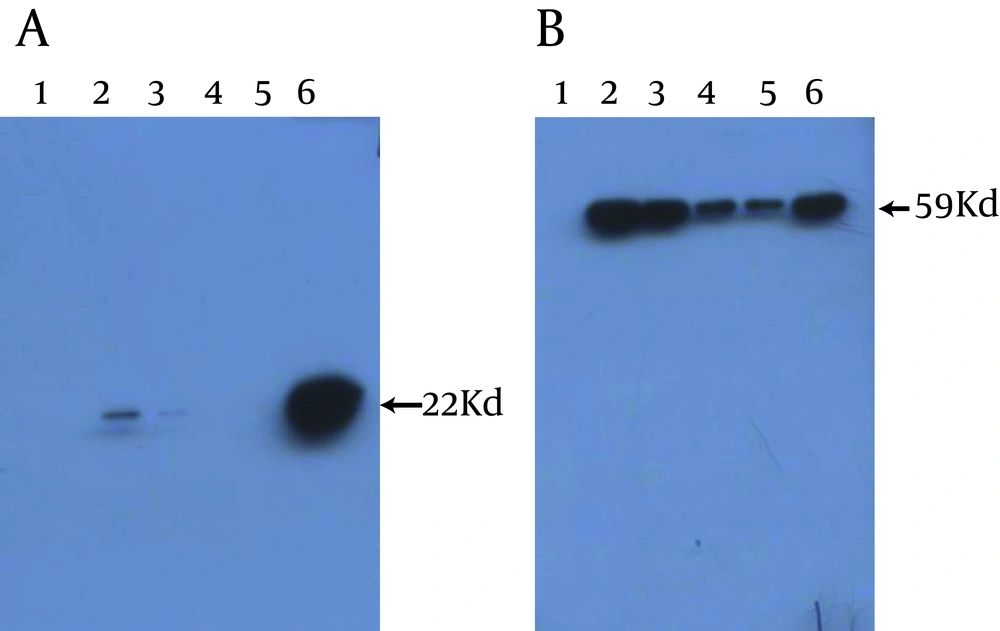
Figure 1.
1, 5 µL Bl21 without Plasmid; 2, 10 µL Supernatant of sonicated Bacteria; 3, 5 µL Supernatant of sonicated Bacteria; 4, 2 µL Supernatant of sonicated Bacteria; 5, 1 µL Supernatant of sonicated Bacteria; 6, 5 µL pellet of sonicated Bacteria
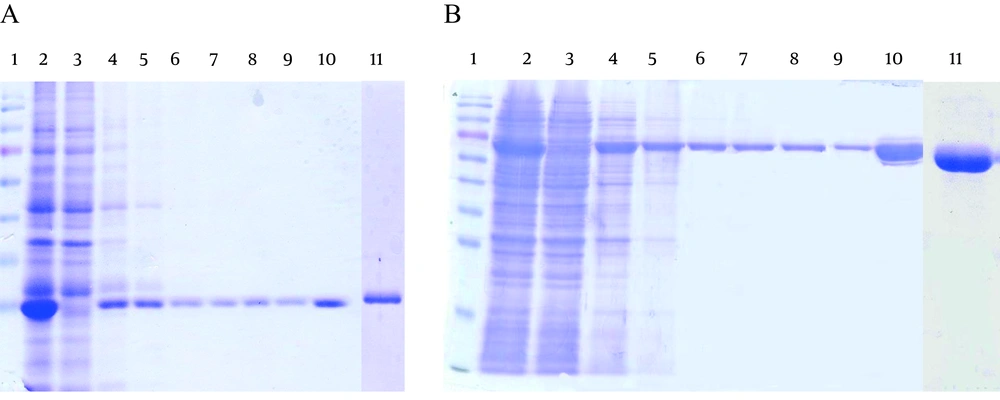
Figure 2.
Lane 1, molecular weight marker (Fermentase SM 671); Lane 2, Lysate; Lane 3, Flow through; Lanes 4 - 6, washed with the buffer containing 20 mM Imidazole; Lanes 7 and 8, washed with the buffer containing 40 mM Imidazole; Lane 9, eluted recombinant protein with modified method; Lane 10, eluted recombinant protein with standard method.
Table 1.
Endotoxin Levels of Purified Recombinant Proteins
| Samples | pI | Triton | Purification conditions | Protein recovery, mg/L | EU, mg/L |
|---|---|---|---|---|---|
| TF | 4.94 | - | N | 15 | > 10000 |
| + | N | 12 | < 0.05 | ||
| HSP | 6.10 | - | D | 17.5 | > 10000 |
| + | D | 14 | < 0.05 |
5. Discussion
Endotoxin removal is a major issue which must be addressed for E. coli expression systems if the protein product is destined to animal study. Some commonly used techniques for removing endotoxin contaminants are ultrafiltration ( 9 ), ion exchange chromatography ( 10 ), Polymyxin B affinity chromatography ( 11 ) and LPS separation based on SDS-PAGE ( 12 ). In recent years, the interest in the use of two-phase aqueous micellar systems for the purification or concentration of biological molecules, such as proteins and viruses has been growing ( 13 - 15 ). In this technique, Triton X-114 is used as nonionic surfactant micelles which separate LPS from biomolecules. In this Study, we used Triton X-114 in washing steps for removing endotoxin from recombinant proteins attaching to Ni-NTA agarose. The method used in this study, gives a product with very low extent LPS. However, twenty percent from end products were lost compared to the standard protocol (Table 1). In correlate with our results, Efficiency of Triton X-114 in LPS removal from recombinant proteins has been shown by Reichelt et al. ( 6 ). They have also shown that the addition of a Triton X-114, in wash buffer successfully removes more than 99% of the endotoxin contaminants.
This paper describes a rapid, cost effective, and large scale applicable alternative method for the efficient removal of endotoxins from B. melitensis recombinant HSP and TF proteins using Ni-NTA agarose together with a nonionic detergent.