Fulltext
Full text is available in PDF
Jundishapur Journal of Microbiology
Ahvaz Jundishapur University of Medical Sciences
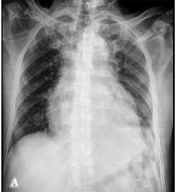
Pulmonary embolism is the fourth leading cause of pleural effusion. Pleural effusion that results from a pulmonary embolus is usually small and unilateral. A pulmonary embolus is the most common cause of pleuritic chest pain and pleural effusion in patients aged under 40 years. The incidence, characteristics, and pathogenesis of pleural effusions in patients with right-sided endocarditis (RSE) are poorly defined. Possible mechanisms of pleural fluid formation in RSE include parapneumonic effusion, septic pulmonary emboli with or without infarction, and empyema. We report 2 cases of bloody pleural effusion, combined with septic pulmonary emboli and dyspnea, as the initial manifestation of right-sided endocarditis.
Implication for health policy/practice/research/medical education:
Septic pulmonary emboli, pleural effusion and right-sided endocarditis should be considered as a possible cause of any pulmonary symptoms in drug users. Paraembolic effusions usually begin to resolve within a few days after institution of anticoagulant therapy, although those that are associated with parenchymal infiltrates may resolve more slowly.
Please cite this paper as:
Aminzadeh Z, Behzad HR. Bloody Pleural Effusion In Septic Pulmonary Emboli :A presentation of Right-Eided Endocarditis: A Report of Two Cases. Jundishapur J Microbiol. 2012;5(3):516-8. DOI: 10.5812/jjm.4061
Copyright © 2012 Kowsar Corp. All rights reserved.
© 2012, Author(s). This open-access article is available under the Creative Commons Attribution 4.0 (CC BY 4.0) International License (https://creativecommons.org/licenses/by/4.0/), which allows for unrestricted use, distribution, and reproduction in any medium, provided that the original work is properly cited.
Roodpeyma S. Infective Endocarditis Complicated by Septic Pulmonary Emboli in a Case of a Ventricular Septal Defect. J Compr Ped. 2015;6(4):e29610. doi: https://doi.org/10.17795/compreped-29610
Imani R, Roohi H. Brucella pleuritis in a 12-year old child; a case report. Arch Clin Infect Dis. 2007;2(2):. doi:
Shirani S, Abbasi S, Shakiba M. Acute Pulmonary Embolism due to Rupture of Pulmonary Valve Hydatid Cyst. I J Radiol. 2008;5(1):e79302. doi:
Ghasemi Z, Jamali S. Acute Kidney Injury Secondary to Cardiac Tamponade Caused by Severe Pericardial Effusion: A Case Report. Int Cardiovasc Res J. 2025;19(1):e166561. doi: https://doi.org/10.69107/icrj-166561
Dariya SS, Agrawal D. Recurrent Pericardial Effusion Due to Panhypopituitarism: A Rare Case Report. Int J Endocrinol Metab. 2023;21(1):e131341. doi: https://doi.org/10.5812/ijem-131341
Last Update: 5 days ago
Last Update: 5 days ago
Last Update: 5 days ago
Last Update: 6 days ago
Last Update: 2 days ago
Last Update: 4 days ago
