
1. Introduction
Pericardial effusion is a relatively common complication of cardiopulmonary and systemic diseases, which, if progressive, can lead to cardiac tamponade and multi-organ failure (1-3). Its clinical presentation is often nonspecific, including weakness, fatigue, dyspnea, and hypoxemia. In many patients, initial imaging findings may appear normal, potentially delaying diagnosis (4, 5). One important complication is acute kidney injury (AKI) secondary to hemodynamic compromise, which is reversible with prompt recognition and management (6, 7).
2. Case Presentation
The patient was a 77-year-old man with a history of chronic obstructive pulmonary disease (COPD), ischemic heart disease (IHD), and diabetes mellitus. One week earlier, he had been admitted to Hazrat Vali-Asr Hospital in Borujen for atrial fibrillation and was started on amiodarone. This hospital is a governmental center affiliated with Shahrekord University of Medical Sciences. One week after discharge, he was readmitted with complaints of weakness, dyspnea, cough, and decreased O2 saturation. On admission, his blood pressure was 100/80 mmHg, heart rate 110 beats per minute, respiratory rate 32 breaths per minute, and oxygen saturation (SpO2) 80% on room air. Fine crackles were auscultated at the bases of both lungs.
Initial laboratory results were as follows: Sodium: 138 mmol/L, potassium: 4.3 mmol/L, magnesium: 2.05 mg/dL, prothrombin time (PT): 12 s, partial thromboplastin time (PTT): 40 s, fasting blood sugar (FBS): 105 mg/dL, urea: 150 mg/dL, creatinine: 2.9 mg/dL, calcium: 10 mg/dL, metabolic acidosis: pH = 7.18, HCO3: 16.9 mmol/L, PCO2: 41 mmHg, white blood cell count (WBC): 6.8 ×10³/µL, red blood cell count (RBC): 5.17 ×10⁶/µL, hemoglobin: 12.7 g/dL, hematocrit: 40.8%, C-reactive protein (CRP, quantitative): 14.2 mg/L. Urinalysis revealed 2+ proteinuria, 3+ hematuria, no crystals, 2 - 5 WBCs, and more than 100 RBCs per high-power field. Serologic tests were performed using the enzyme-linked immunosorbent assay (ELISA) method with AESKULISA kits. All devices and diagnostic kits were calibrated prior to sample analysis.
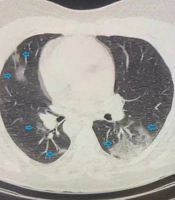
After admission, the patient was started on intravenous (IV) furosemide (Lasix). A chest computed tomography (CT) scan revealed bilateral lung involvement suggestive of pneumonia, and broad-spectrum antibiotics were initiated. Electrocardiography showed changes consistent with atrial fibrillation. Antiarrhythmic and anticoagulant medications were started.
At the request of the internal medicine team, a cardiology consultation and echocardiography were performed, which showed an ejection fraction (EF) of 55 - 60%, systolic pulmonary artery pressure (SPAP) of 30 mmHg, mild mitral regurgitation (MR), and otherwise normal findings.
Due to respiratory distress, hypoxemia, oliguria, and rising creatinine levels, anesthesia consultation was requested for intensive care unit (ICU) transfer. In coordination with the internal medicine and cardiology teams, the patient was transferred to the ICU. The IV bicarbonate therapy was started as per internal medicine orders. Oxygen supplementation via mask, nebulized Duolin, and inhaled salbutamol and Atrovent were administered to improve respiratory distress.
On the first day of admission, the patient’s SpO2 was 80% and serum creatinine was 2.9 mg/dL. In the following days, his condition deteriorated, with worsening metabolic acidosis, increased respiratory distress, and a rise in creatinine to 3.38 mg/dL. Renal and urinary tract ultrasonography showed no stones or hydronephrosis, and abdominal and pelvic CT scans revealed no urinary obstruction.
A tunneled dialysis catheter was placed, and hemodialysis was performed every other day. Despite several dialysis sessions, the patient continued to experience respiratory distress and persistent metabolic acidosis, with ongoing hypoxemia. On the recommendation of the anesthesiologist, the patient was intubated and connected to mechanical ventilation.
Nine days after admission, he was transferred to Hajar Hospital in Shahrekord, a governmental center affiliated with Shahrekord University of Medical Sciences, for nephrology consultation. At Hajar Hospital, repeat echocardiography and cardiology consultation revealed pericardial effusion. Emergency pericardiocentesis was performed, draining approximately 1800 mL of fluid. Following the procedure, the patient’s condition improved rapidly: Arterial blood gases normalized, dialysis was discontinued, and he was discharged with normal serum urea and creatinine levels. One-year follow-up confirmed normal cardiac and renal function.
3. Discussion
In this case, quantitative variables such as serum creatinine, urea, and arterial blood gas parameters were trended throughout hospitalization. Their progressive deterioration supported the diagnosis of hemodynamic AKI. Improvement after pericardiocentesis confirmed the hemodynamic nature of the injury. Recent case reports highlight the importance of recognizing pericardial effusion in patients presenting with unexplained respiratory distress and AKI. In these patients, accumulation of pericardial fluid increases central venous pressure, which in turn reduces cardiac output and leads to systemic venous congestion, ultimately impairing renal perfusion (8). In other words, the resulting kidney injury is primarily prerenal in nature and should be considered in the differential diagnosis of AKI. When cardiac tamponade occurs, this mechanism is exacerbated, as the marked reduction in cardiac output and further elevation of central venous pressure directly contribute to AKI. Case-based evidence demonstrates that pericardiocentesis — prompt drainage of pericardial fluid — induces significant diuresis and rapid recovery of renal function; for example, blood urea nitrogen and serum creatinine levels have been reported to return to baseline within 3 to 5 days following the procedure (6). Clearly, if cardiac tamponade is not identified and treated promptly, prolonged pericardial pressure and hemodynamic compromise may lead to irreversible kidney injury (9).
The differential diagnosis of AKI secondary to cardiac tamponade is often challenging, as it must be distinguished from more common causes such as hypovolemia, sepsis, or nephrotoxic drugs. However, if the underlying cardiac cause is promptly recognized and timely pericardiocentesis is performed, AKI due to tamponade is generally reversible, with renal function improving rapidly (10). Based on reviews of similar cases, supportive treatment alone (e.g., fluids and standard medications) is insufficient, whereas pericardiocentesis plays a key role in the rapid restoration of kidney function (6). This phenomenon represents an example of type 1 cardiorenal syndrome, where timely recognition and drainage of pericardial fluid significantly improve patient prognosis (2, 7). Reporting such cases is particularly important because it highlights that in patients presenting with respiratory distress and unexplained metabolic acidosis, cardiac causes — including pericardial effusion — should also be considered. Early identification can be critical for guiding treatment decisions and preventing serious complications, including death.
3.1. Conclusions
Although the patient had multiple comorbidities, several factors support tamponade-induced AKI, including normal renal imaging, absence of nephrotoxic exposure, lack of septic findings, and rapid normalization of renal function immediately after pericardiocentesis, which is consistent with hemodynamic cardiorenal mechanisms. Early recognition and therapeutic drainage of pericardial effusion may halt progression toward multi-organ failure and facilitate recovery of renal function. In elderly patients with underlying cardiopulmonary diseases presenting with respiratory distress and AKI, pericardial effusion should be considered in the differential diagnosis. Reporting such cases can help raise awareness within the medical community.
3.2. Limitations
Potential sources of bias include the single-patient nature of the report and lack of baseline renal function data.