Full Text
Full text is available in PDF
Jundishapur Journal of Microbiology
Ahvaz Jundishapur University of Medical Sciences
Authors
Introduction and objective: Hospital acquired infections are serious problems in patients care and adversely affect the mortality and morbidity despite antimicrobial therapy and advances in supportive care. The researchers aimed to determine the contamination of inanimate hospital environment to bacterial agents and their susceptibility to various antimicrobial agents. Seven different teaching hospitals were included in this study.
Materials and methods: From April 2006 to January 2007, 1208 samples (1156 wet swabs, eight water dialysis and 44 hand washing samples) were taken from surface and medical instruments in different hospitals' wards. Susceptibility test for bacterial isolates was done by disk diffusion assay.
Results: In the present study 57% of samples were positive and more than 10 species were isolated. Coagulase negative staphylococci(36.1%) and Klebsiella pneumoniae (8.9%) were the predominant isolates among Gram-positive and negative bacteria, respectively. Hands (79.5%), kitchen (71.4%), staffs' room (61.1%) and equipments (57.8%) were the most infected sites. Gram-negative enteric bacilli (50%) in food service personnel and Gram-positive cocci (46.6%) in medical personnel were predominant isolates from hand specimens. 60% of Staphylococcs aureus yielded methicillin resistant (MRSA).
Conclusion: Lack of a universal procedure for surveillance of nosocomial infection, presence of MRSA and some other pathogenic bacteria, poor hand hygiene and heavy contamination of some important surfaces are the most important problems in our hospitals.
© 2011, Author(s). This open-access article is available under the Creative Commons Attribution 4.0 (CC BY 4.0) International License (https://creativecommons.org/licenses/by/4.0/), which allows for unrestricted use, distribution, and reproduction in any medium, provided that the original work is properly cited.
Yousefi Mashouf R, Nazari M, Samarghandi M, Shams M. Evaluation of efficacy of the current disinfectants on staphylococcus epidermidis and pseudomonas aeroginosa isolated from hospitals of Hamadan in 2006. Zahedan J Res Med Sci. 2006;8(4):e94868. doi:
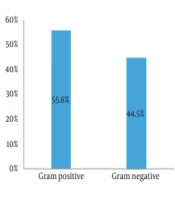
Avestan Z, Jami M, Mirzaei M, Amini Y, Ghazvini K, et al. Investigation of the Microbial Contamination of the Hands of Healthcare Workers in Different Wards of Sheikh Hospital in Mashhad. Int J Infect. 2022;9(3):e130579. doi: https://doi.org/10.5812/iji-130579
Gholam-Mostafaei FS, Alebouyeh M, Zali MR. Prevalence, Molecular Diversity, and Antimicrobial Resistance Patterns of Pathogenic Bacteria Isolated From Medical Foods, Food Staff, Cooking Instruments, and Clinical Samples in a Teaching Hospital in Tehran, Iran. Arch Clin Infect Dis. 2017;12(3):e62421. doi: https://doi.org/10.5812/archcid.62421
Sadredinamin M, Nazemi P, Delfani S, Halimi S. Antibiotic Resistance Patterns of Gram-Negative Bacilli Isolated from Inpatients Admitted to Various Wards of a Tertiary Hospital in Tehran, Iran. Arch Pediatr Infect Dis. 2025;13(3):e157490. doi: https://doi.org/10.5812/apid-157490
Armin S, Karimi A, Fallah F, Rafiei Tabatabaii S, Hoseini Alfatemi SM, et al. Antimicrobial Resistance Patterns of Acinetobacter baumannii, Pseudomonas aeruginosa and Staphylococcus aureus Isolated From Patients With Nosocomial Infections Admitted to Tehran Hospitals. Arch Pediatr Infect Dis. 2015;3(4):e32554. doi: https://doi.org/10.5812/pedinfect.32554
Last Update: 1 day ago
Last Update: 1 day ago
Last Update: 1 day ago
Last Update: 15 hours ago