
1. Context
Critical thinking (CT), a key component of competence across domains, underlies health professionals’ abilities and performance (1-3). Its deficit leads to cognitive biases, prejudices, misjudgments, and intolerances that contribute to diagnostic and therapeutic errors (4-6). In addition, CT is increasingly important in an era when biomedical science is progressing exponentially, and knowledge acquisition alone is insufficient for practitioners to function in complex clinical environments. Health professionals must also use CT to discriminate between well-justified and highly suspected data. In this regard, educational scholars have long been aware of the importance of CT as an educational ideal (7). Guiding the thinking path of the learners through a process seems not only to be effective in the difficult task of CT development (8) but also supports students in this complicated procedure (9). Accordingly, considering the importance of CT as a key educational outcome for health professionals, formulating a well-defined process for CT seems essential to promote critical problem-solving in health profession education (HPE) students.
Critical thinking conceptualization has dramatically evolved through paradigmatic transitions during the twentieth century. Critical thinking understanding as a set of skills, techniques, and logical procedures, which has been referred to Technical approach (10), is mainly influenced by the positivist tradition. Gradually, through the development of the paradigms of humanism, constructivism, feminism, and postmodernism, other dimensions arise in the discourse of CT (10). In this regard, cognitive aspects, such as creativity, intuition, insight (11, 12), and one’s attitudes and dispositions toward CT (11, 13, 14), are mentioned in CT conceptualizations. Furthermore, the conscious participation of the individual in the social construction of meaning through interactions, dialogue, and discussion is taken into account (15). Moreover, different contexts, along with the cultural and value systems embedded in those contexts, are considered in the perception of CT (10, 16, 17). Emerging from the critical theory and pedagogy, the ultimate goal of CT is to challenge traditional beliefs, as well as governing systems, to achieve social justice and freedom. In this way, a critical thinker intends to seek problems in the current systems (18). The conventional technical view of the CT process (as an inflexible, skill-based procedure derived from the positivistic-analytic tradition) has been criticized by some scholars, who consider such a mechanical process incapable of responding to complex multidimensional problems, which CT is essentially used to address such complicated issues (7, 14). Instead, various perceptions of CT emerged from the perspective of paradigms (constructivism, humanism, feminism, postmodernism), and disciplines (philosophy and psychology) should be considered to achieve comprehensive thinking. Accordingly, it seems necessary to incorporate multiple perceptions of CT, emanating from paradigms and disciplines, into its process to internalize “good thinking” in learners (10, 14, 15, 19). In this regard, the CT process is defined as a process in response to a complex problem, which does not necessarily lead to a specific response. In the CT process, the importance of thinking skills, as well as attitudinal dispositions, should be taken into consideration. Also, the supervisory role of meta-cognition over the CT process, and the context in which the CT is carried out, should not be neglected. Repetition of some steps and the round-trip between different stages, the social construction of meaning, flexibility, and discourse-oriented ness during the process are also considered. In this regard, multiple conceptualizations derived from different paradigmatic and disciplinary views of CT should be incorporated into its process. A holistic view of this multiplicity in the CT process seems to be beneficial for medical educators in guiding the learners during the process. The CT process, which is recommended in this article, is formulated based on this multiplicity. This comprehensive multi-faceted view of the CT process is neglected in most of the other processes, mostly emphasizing the CT skills, whereas the role of the dispositions, emotions, creativity, and contextual variations is overlooked.
In an attempt to achieve critical problem-solving by HPE students through a process, we identified the need to articulate multiple steps to conduct the CT process, integrating different conceptions of CT, derived from paradigmatic and disciplinary perspectives, into it. Accordingly, this study aimed to outline the CT process by CT skills and dispositions and describe how it can be used to better understand and address complex problems in HPE.
2. Evidence Acquisition
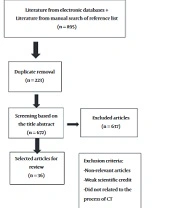
The aim of this narrative review of the literature was to scrutinize the CT process from the perspective of paradigms and disciplines. This study was performed based on the 4 stages presented by Fins et al. as cited in Demiris et al. (20) according to the following steps (Figure 1):
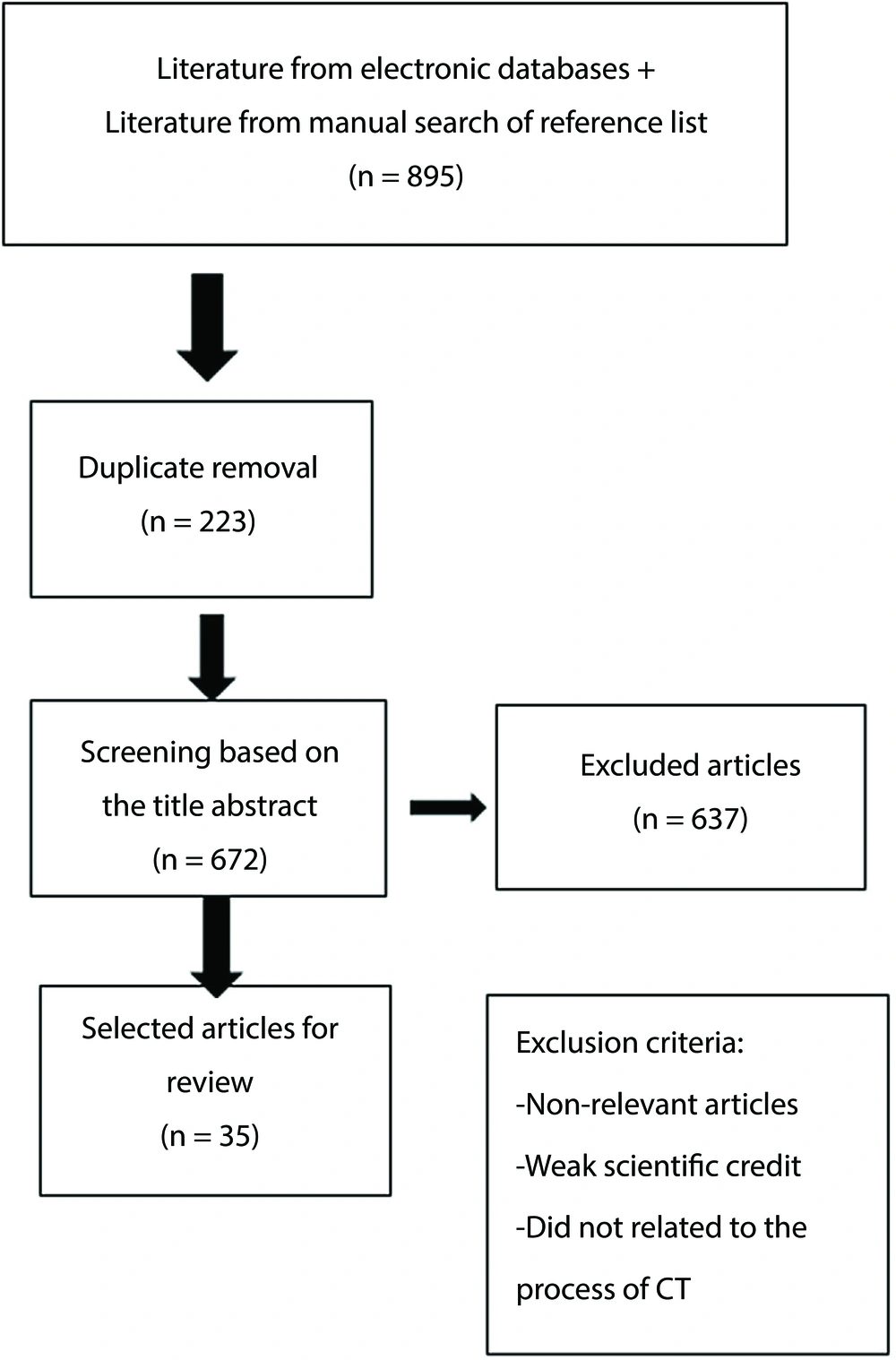
Figure 1.
The algorithm of the search strategy
(1) The search terms included critical thinking, skill, disposition, process, and health profession education, which were extracted from the key studies known to the authors in the field of CT.
- Google Scholar, SID, and PubMed databases were searched for relevant literature based on the following inclusive criteria:
-The studies that were published between 1910 (the year of the introduction of the CT process by John Dewey) and January 2023.
- The studies that were not relevant or valid based on the Joanna Briggs Institute (JBI) checklist for texts and opinions.
- The studies that were not related to the CT process.
- The published studies in English or Persian language.
(2) The articles that did not meet the inclusion criteria were excluded from the study. The electronic search was supplemented with a manual search of the reference lists from identified relevant studies and/or review articles, which resulted in 895 articles.
(3) After removing the duplicate search results (n= 223), the remaining articles (n = 672) were hand-searched by 1 author (NG) by reading the titles and abstracts to remove the papers that were not relevant or valid based on the JBI checklist for texts and opinions. The full-text versions of the remaining identified articles (n = 35) were subsequently obtained for a more detailed assessment.
(4) After reviewing the full text of the extracted studies, the current state of knowledge in the field was identified.
3. Results
Based on the results of this study, the CT process is summarized under the following steps: (Considering the flexible nature of the process, repetition of some steps and the round-trip between different stages can be done during the process. Accordingly, mentioning a specific number for each step is avoided.)
3.1. The CT Process
Sense, Notice, and Identify the Problem
I have no special talents. I am only passionately curious (Albert Einstein).
The first stage of the CT process can be considered one of the most important stages of it. The key role of "problem" at the beginning of the CT process has been considered by Ennis (21) and Facione et al. (22). Lipman (11) also emphasizes the importance of “problem-seeking” vs problem-solving.” In fact, a critical thinker who is not indifferent to surrounding phenomena intends to seek problems in the current systems. Having the mental traits of inquisitiveness and intellectual skepticism enables the critical thinker to sense, feel, observe, notice, and identify the surrounding phenomena, difficulties, and problems (22, 23). Derived from postmodernism and critical theory and pedagogy, this intellectual skepticism accounts for the basic principle on which the CT process is mounted, leading to paradigm shifts (18, 24).
Define, Clarify, and Conceptualize the Problem
Problem definition is essential in the CT process, which has been done well in advance of formulating possible solutions to the problem (21). Asking questions regarding the problem (5Ws: What? Who? When? Why? Where? and How?) is of prime importance in problem clarification. In addition, dividing the problem into manageable sub-problems and exploring the intended and actual inferential relationships among the statements and questions (i.e., analysis) are very helpful in problem comprehension (7). Critical thinkers might ask questions regarding the problem’s components, as well as its complexity, difficulty, and condition (25).
To formulate these questions, a critical thinker’s inquisitive and analytical mind leads to the useful implementation of questioning and analyzing skills, finally resulting in better problem definition.
Actively Gather Information About the Problem/Sub-problems
Once the problem and sub-problems have been defined, the critical thinker actively gathers information about the problem and its components from different sources, including observations, experiences, reflections, and communications/consultations. This information, which is mainly related to the context in which the problem has occurred, clarifies the current conditions of the problem context and its characteristics and limitations. In this regard, being familiar with information-gathering strategies about the problem from multiple sources is considered an essential skill for critical thinkers (7, 21).
In this way, the key role of the individual's mental habits toward searching and obtaining necessary and sufficient information about the problem with an open and fair mind is emphasized. In fact, all aspects of the subject, even those that are not in line with the individual's mental orientations, should be considered. Accordingly, an inquisitive critical thinker who seeks the truth, searches for resources with an open, flexible, and fair mind and has a continuous desire to be well-informed seems to be successful in her/his intellectually effortful information gathering (13, 22).
Set Goals for Solving Problems
Before choosing a solution for a problem, the goals of the problem-solving process should be set. Depending on the goals, variable solution options might develop. For example, consider a dentist (as a critical thinker) who tries to alleviate a patient’s severe toothache (solve the problem). If the dentist sets a short-term goal for reducing the patient’s pain, a prescription of anti-inflammatory drugs might be a solution option. If she/he intends to solve the patient’s problem permanently, root canal therapy or extraction of the tooth might be considered as a solution option.
Usually, goal-directed people who are purposive in nature deliberately set goals for different achievements in their lives. Therefore, having a mental trait of goal-directedness and purposiveness might enable a critical thinker to skillfully set goals for the problem-solving process.
Actively Gather Evidence About Solution Options
Based on the goals of the problem-solving process, the critical thinker actively devises and carries out a plan of systematic observation that uncovers the relevant evidence. The plan includes a critical review of the relevant peer-reviewed literature and identifying competing relevant world views. Hence, a critical thinker must be equipped with advanced information-gathering skills, including search strategies and familiarity with relevant databases, to unearth the correct sources needed to solve complex problems (7, 21).
In addition to advanced information-gathering skills, being habitually inquisitive and intellectually perseverant and having a propensity to seek reasons and truth are initiative motivators in this phase. Furthermore, respect and openness to other people’s points of view (i.e., being open and fair-minded to relevant viewpoints) are important dispositions, enabling a critical thinker to conduct this phase successfully (13, 14, 22).
Evaluate the Validity and Accuracy of the Evidence and Its Sources
Undoubtedly, a critical assessment of the evidence is an essential part of the CT process. In this way, critical evaluation of evidence itself and its sources, using the skills such as reasoning, judging, assessing, evaluating, and critical appraisal, should be considered a key phase in the CT process. Critical evaluation of evidence should be conducted based on intellectual standards, including clarity, accuracy, precision, relevance, depth, breadth, logic, significance, and fairness (14). In this way, applying the mentioned criteria in the course of evaluation of evidence, as well as the mental habits toward considering alternatives, being attentive to others' views and reasons, and revising beliefs with an open, fair, and flexible mind, are among the dispositions that enable the critical thinker to achieve "good thinking" or "perfection of thought” (13, 14, 22).
Synthesize the Evidence to Develop a Solution Option List
To synthesize the evidence, the critical thinker makes inferences and draws conclusions from relevant and valid evidence. Moreover, she/he creatively proposes alternatives to develop the solution option list (7, 8, 11, 26). Finally, the solution option list is developed based on inferring conclusions and alternative propositions.
In this regard, a comprehensive attitude toward the evidence synthesis, along with the creativity of the individual, is important to successfully conduct this phase. Accordingly, a critical thinker’s disposition toward intellectual integration of evidence, as well as her/his creativity, should be considered as effective mental traits to synthesize the evidence and develop the solution option list.
Set Criteria of Appropriateness to Impose on Options
Once the solution options are developed, the critical thinker should set the criteria of appropriateness concerning the feasibility, effectiveness, efficacy, and acceptance of options in the context (11). The critical thinker, using the skill of situational analysis, might consider if the solution options are feasible in the context of the cost, limited geographic access, stakeholders' acceptance, and time limitation. Further, reasonable expectations should be kept in mind when setting the criteria of appropriateness. For example, a sophisticated new technology, which has been proven successful in treating an illness, might not be an appropriate solution option in an underdeveloped urban area due to several factors, including a lack of expert technicians, limited financial resources, and a lack of cultural acceptance.
Obviously, to understand the needs and demands of stakeholders, dispositions such as an open and flexible mind, empathy with the stakeholders of the related context, and humility against them are very helpful in determining the criteria of appropriateness tailored to the related context (11, 13, 14).
Deliberately Weigh Options against Criteria and Select the Preferred Option
Although such multi-criteria decision-making may seem complicated at first glance, a critical thinker who is familiar with the principles and skills of reasoning, including induction and deduction (formal logic) and interpretation and inference (informal logic), can successfully weigh options against criteria and select the best solution option (27). Accordingly, a critical thinker who has autonomy, courage, and confidence in her/his decision-making procedure might successfully select the best option (14).
It should be noted that sometimes the CT process does not end with a specific result, but a number of options realize the criteria due to multiple points of view on the problem (15). Furthermore, in some circumstances, the CT process will not reach a specific conclusion and remains open-ended due to insufficient evidence and contextual limitations. Complementary investigations and seeking consensus are recommended in the aforementioned circumstances.
Design the Implementation Plan and Consider the Methodological Details of Preferred Options
Once the preferred path among all the options under consideration is determined, the critical thinker should apply the final judgment to the real situation. In this way, an implementation plan should be developed using "design thinking" skills. In planning the implementation phase, several questions concerning methodological aspects of solution options should be taken into consideration. For example, what are the methodological details in implementing the solution option/s? Are there barriers and/or limitations which should be considered in the action phase? How the required resources for the implementation phase will be provided?
The mental orientation of the critical thinker toward designing an executive plan and not ending the CT process to theoretical solution options is of key importance in the successful conduction of this stage.
Predict Consequences of Preferred Options and Acknowledge Different Outcomes of Preferred Options
Critical thinking is outcome-oriented, applied thinking. Hence, a critical thinker should be able to anticipate the outcomes of the preferred options in practice and acknowledge their consequences (11).
Seek Consensus Based on a Coherent and Dialogical Argument on a Controversial, Contemporary Topic
Given that CT is often formed in the wake of challenging and disputed questions/problems, the critical thinker should seek consensus on controversial issues, using discussion and dialogue with others, not merely to persuade them but to achieve a new socially-constructed meaning (15). Accordingly, CT’s dispositions toward constructive dialogue and debate, which results from a collaborative spirit, should be considered to seek an intellectual agreement.
Critical Reflection Over the Whole Process and Self-regulate Whenever Is Necessary
The key role of a critical thinker’s metacognition over her/his thinking process to determine any shortcomings, errors, biases, and limitations in the thinking path has been emphasized by scholars (11, 26, 28). In this way, the critical thinker should consciously reflect on her/his CT process and evaluate the potential biases.
It would appear that having an attitude of critical reflection over the own thinking process, as well as being willing to accept and correct her/his own biases, helps a critical thinker to revise the process and identify its strengths and weaknesses.
The CT process, by its skills and dispositions, is featured in Table 1.
Table 1.
The Critical Thinking Process by Its Skills and Dispositions
| Steps of the CT Process | CT Skills | CT Dispositions |
|---|---|---|
| Sense, notice, and identify the problem | Observation; Feeling | Intellectual skepticism; Seeking problem |
| Define, clarify, and conceptualize the problem | Questioning; Clarification | Inquisitiveness; Analyticity |
| Actively gather information about the problem/sub-problems | Inquisitiveness; Truthseeking; Desire to be wellinformed; Disposition toward searching resources with an open and flexible mind | |
| Set goals for solving the problem | Goal setting | Purposiveness |
| Actively gather evidence about solution options | Advanced informationgathering skills | Habitually inquisitive; Intellectual perseverant; Propensity to seek reasons and truth; Respect and openness to other people’s points of view |
| Evaluate the validity and accuracy of the evidence and its sources | Reasoning; Judging; Assessing; Evaluating; Critical appraisal | Disposition toward considering alternatives, being attentive to other people’s views and reasons, and revising beliefs with an open, fair, and flexible mind |
| Synthesize the evidence to develop a solution option list | Making inferences; Proposing creative alternatives; Synthesis | Intellectual integration and creativity |
| Set criteria of appropriateness to impose on options | Situational analysis; Setting the criteria of appropriateness | Openmindedness; Intellectual empathy and humility |
| Deliberately weigh options against criteria and select preferred options | Reasoning | Intellectual autonomy and courage; Confidence in reasoning |
| Design the implementation plan and consider methodological details of preferred options | Design thinking | Disposition toward designing an executive plan |
| Predict the consequences of preferred options and acknowledge different outcomes of preferred options | Future thinking; Anticipate outcomes; Predict consequences | Intellectual courage |
| Seek consensus based on a coherent and dialogical argument on a controversial, contemporary topic | Dialogue; Seeking consensus | Disposition toward constructive dialogue and seeking consensus |
| Critical reflection over the whole process and self-regulate whenever is necessary | Critical reflection; Selfregulation | Disposition toward critical reflection and selfregulation |
Abbreviation: CT, critical thinking.
4. Discussion
This study defined the CT process in terms of its essential elements derived from various perspectives of CT conceptualization. Accordingly, while the role of CT skills is considered in the CT process, the key role of CT dispositions, context, individual's creativity, pluralism in meaning-making, and flexible nature of the CT process should be considered. Based on the comprehensive literature review of the authors of this study, it seems that since the introduction of the first CT process by Dewey in 1910 (29), which has been synchronized with the dominancy of the positivistic tradition, the commonality of the skill-based approach has been evident in many processes. In some of these processes, derived from Bloom’s cognitive taxonomy, cognitive skills (such as explanation, analysis, inference, interpretation, evaluation, and self-regulation) are emphasized. In this way, the CT process comes with concrete objective steps that mainly include cognitive skills. Based on this approach to CT, critical thinkers are encouraged to avoid mental subjectivism, intuition, and creativity to achieve justice and fairness (17). In this regard, little attention is paid to one's dispositions, attitudes, and mental habits. Furthermore, the skill-based approach advances the process of CT regardless of the context in which thinking takes hold (12). Inspired by the skill-based approach, philosophers of this era emphasize the realization of CT using logical reasoning skills (30-33), and cognitive psychologists also highlight the role of skills in the CT process (34). Gradually, with the dramatic paradigmatic evolutions, scholars who believe in the humanistic constructivist conceptualization of CT criticize the skill-based approach due to the reduction of CT to a set of skills and procedures. Humanistic understanding of CT, which reasserts the role of human uniqueness, self-exploration, and social interaction, seeks to replace objectivity with subjectivity, abstraction with contextualization, and positivistic notions of truth with socially constructed truths (10). In this regard, the importance of one's attitudinal dispositions in the CT process is highlighted in the later conceptualizations of CT by philosophers (11, 13, 14) and cognitive psychologists (8). In addition, based on the feminist school of thought, the skill-based approach to CT is considered a logo of the Western and masculine mode of thinking that does not include feminine non-analytical, imaginative, caring, and empathetic modes of thinking (35, 36).
Despite the dominance of the skill-based approach over the discourse of the CT process, attempts have been made to add elements derived from the evolved schools of thought in the CT process path. In this manner, Ennis (13, 37) points out the role of situation and context to some extent. He also pays attention to the role of overview and revision of the thinking process in the last step of the CT process, indicating the role of metacognition. In line with Ennis, Facione, and Gittens (26) highlight “scrutinizing” in the CT process, abbreviated as "IDEAS,” , which confirms the role of reflection and internal control in advancing the process of thinking (I, identify the problem and set priorities; D, determine relevant information and deepen understanding; E, enumerate options and anticipate consequences; A, assess the situation and make a preliminary decision; S, scrutinize the process and self-correct as needed). The CT process was presented by Hitchcock in 2018 while implicitly mentioning some elements derived from humanistic approaches, such as the role of "imagination" and "counseling" in the process of CT; however, he did not highlight the key role of “context.” He also pointed out the achievement of a specific result and solution as the consequence of the process, which is contrary to the concepts of uncertainty and pluralism in the understanding of CT (7).
In conclusion, the incorporation of various perceptions of CT into its process to promote strong critical problem-solving in learners seems to be considered by medical educators. Accordingly, this study outlined a well-defined systematic procedure for the CT process, highlighting the role of CT skills and dispositions in the thinking path. In addition, the key role of the context (in which the problem has occurred), the critical thinker’s subjectivity, control over the thinking process, and the discourse-oriented nature of the procedure should not be neglected.
Formulation of the CT process, based on its multiple conceptualizations, is one of the most important strengths of this study, leading to a rich understanding of the CT process. As a weakness of this study, the limitation of the literature search to the English and Persian databases may result in some articles being overlooked.
5. Summary
The necessity to define CT based on its multiple conceptualizations to achieve strong thinking in learners, facing medical educators intending to teach CT with a difficult task. Guiding the thinking path of students through a well-defined process could partly address the hectic task of developing CT in the learners, which in turn, enables health profession students to respond successfully to complicated issues during their careers.
The CT process, in view of the multiplicity derived from paradigms and disciplines, is in response to a complex problem, not solely based on thinking skills but also the essential role of the critical thinker’s mental habits and dispositions toward CT is taken into consideration. Also, the critical thinker’s creativity, emotions, and metacognition over the thinking process should not be neglected in the CT process. Furthermore, it should be noted that contextual requirements, social construction of meaning, flexibility, and discourse-oriented ness during the process, repetition of some steps, and the round-trip between different stages are of key importance in the CT process. The CT process, in terms of the incorporation of the aforementioned elements into it, was outlined in this study.