
1. Background
Adenotonsillectomy is one of the most common surgeries in children. The two main indications for this surgery are upper airway obstruction and infection. The obstruction may be in the nasopharynx or the oropharynx (1, 2). The prevalence of childhood adenotonsillectomy was 2.5 per 1000 person-years based on epidemiologic results (3, 4). Perioperative complications of adenotonsillectomy include hemorrhage, respiratory decompensation, velopharyngeal incompetence, and subglottic stenosis (5). Bleeding and unstable hemodynamics are two critical complications of adenotonsillectomy that should be prevented (6).
Because tonsillar hypertrophy is more common in children, especially at the age of 3 to 6 years, and the risk of bleeding during and after surgery is high, maintaining stable hemodynamic stability during surgery is very important (7). Prolonged surgery and hemodynamic instability are associated with more complications in children (8).
Controlled hypotension should be used with caution to minimize the risk of damage to vital organs. Important risks that may arise from using controlled hypotension include the possibility of coronary, cerebral, or renal circulatory failure (9).
Dexmedetomidine is a central alpha 2 adrenergic agonist with both sedative and analgesic effects. Dexmedetomidine is an anxiolytic, sedative, and pain medication and is notable for its ability to provide sedation without risk of respiratory depression (10, 11). The use of this drug in children has increased due to its neuroprotective properties. According to the available findings, dexmedetomidine is one of the few drugs that does not cause cognitive impairment after anesthesia in children (12, 13).
Various studies have reported the benefits of using dexmedetomidine in surgery, including induction of controlled hypotension and reduced bleeding. With controlled hypotension following the administration of dexmedetomidine, blood pressure and the heart rate (HR) are decreased, and a safe operative procedure can be conducted (14-16).
Another important aspect of surgical procedures, especially in pediatrics, is the intensity of sedation and agitation during recovery. Increased agitation can seriously influence the pediatric experience of surgical procedures; therefore, proper management and control of agitation via suitable sedation can play a critical role in pediatric anesthesia (17-19). It has been indicated that dexmedetomidine could provide acceptable sedation and prevent agitation in children undergoing surgeries.
So far, studies have investigated the use of dexmedetomidine in reducing bleeding and agitation during various operations, and different dosages have been confirmed in this regard. However, to the best of our knowledge, no study has compared the effects of two different doses of 1 µg/kg and 2 µg/kg of dexmedetomidine on these issues during adenotonsillectomy among pediatrics. We should also note that the dose of 2 µg/kg of dexmedetomidine is currently used in clinics, and its beneficial effects have been indicated, but due to possible complications of this dosage, including bradycardia, we aimed to investigate the usage of dexmedetomidine at a dose of 1 µg/kg.
2. Objectives
The aim of the present study was to evaluate and compare these two distinct doses of dexmedetomidine in pediatrics.
3. Methods
This double-blinded randomized clinical trial was performed in 2020 in Imam Hossein pediatrics hospital affiliated with the Isfahan University of Medical Sciences. The study population consisted of pediatric patients aged 3 - 10 years that were candidates for adenotonsillectomy. The study protocol was approved by the research committee of Isfahan University of Medical Sciences, and the Ethics Committee confirmed the research protocol (Ethics code: IR.MUI.MED.REC.1398.729 and the Iranian registry of clinical trials (IRCT) code: IRCT20200325046853N1).
3.1. Inclusion Criteria
The inclusion criteria were the age of 3 - 10 years, being a candidate for adenotonsillectomy, the American Society of Anesthesiologists (ASA) classification equal to I or II, and signing the written informed consent to participate in this study by the parents. Patients with the following criteria did not enter the study: having a previous medical disease (such as cardio-pulmonary, renal, endocrine, etc.), disorders making the patients vulnerable to bleeding, impaired pre-operative coagulation tests, including prothrombin time (PT), partial thromboplastin time (PTT), and international normalizing ratio (INR), and having metabolic disorders, such as phenylketonuria or galactosemia.
3.2. Exclusion Criteria
The exclusion criteria were any complications during the surgery, including abnormal bleeding and hemodynamic instability.
The informed consent was taken from the parents after a full explanation about the methods and drugs that were used in this study, their complications, and benefits.
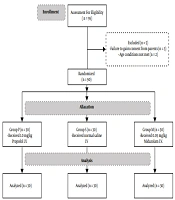
The sampling method was non-probability sequential, in which all cases who met the inclusion criteria were included in the study until the sample size was completed. A total number of 105 patients entered the study. Demographic data of all cases, including age, gender, and weight were collected. Patients were separated from their parents after pre-medication with intravenous midazolam (0.1 mg/kg) and brought to the operating room. They were then anesthetized with fentanyl (2 µg/kg), sodium thiopental (5 mg/kg), and atracurium (0.5 mg/kg), and intubated with an orotracheal tube with an appropriate size, and connected to a ventilator and anesthetized with a 1% isoflurane retainer for the maintenance of anesthesia.
In order to comply with the double-blind conditions of the study, the doses of 2 μg/kg and 1 μg/kg of diluted dexmedetomidine in a volume of 10 cc were inserted in the syringes. Another syringe was made without dexmedetomidine and contained only 10 cc of normal saline. The specialist labeled the syringes A, B, and C and provided them to the researcher on a daily basis. Thus, until the data collection was completed, the researcher and the data registrar did not know the type of drugs in the syringes. Even the data analyst was unaware of the type of groups. The drugs were administered 15 minutes before the beginning of the operations via the intravenous (IV) method.
Then, the patients were divided into three groups using random allocation software. Group A received 1 µg/kg diluted dexmedetomidine prepared by Elixir Pharmaceutical Company in a volume of 10 cc slowly over ten minutes, 15 minutes before surgery by IV method. Group B received 2 µg/kg diluted dexmedetomidine in a volume of 10 cc slowly over ten minutes, and group C received 10 cc normal saline slowly over 10 minutes. Mean arterial pressure (MAP), HR, and SPO2 were recorded every 15 minutes before induction and during anesthesia; the volume of bleeding during surgery was also recorded on a CC basis. Patients were extubated after surgery and transferred to the recovery room. The duration of extubation (from the time of discontinuation of anesthesia to the time of extubation of patients) was recorded, and in the recovery room, MAP, HR, and SPO2 were recorded every 15 minutes. The duration of stay in the recovery room based on Modified Aldrete Score (20) was recorded in three groups and compared with each other.
In the recovery room, the patient's degree of agitation was recorded every 15 minutes by the nurse observer of the patient's condition according to the Pediatric Anesthesia Emergence delirium (PAED) criteria in three groups and compared (21). According to this score, the states of inconsolable, restlessness, awareness of surroundings, purposeful actions, and having eye contact were scored from 0 to 4, and higher scores indicated worse conditions. A score equal to or greater than 10 was considered as the emergence of delirium and was treated with propofol at a dose of 1 mg/kg. We also measured the amounts of propofol usage in patients. The Ramsay Sedation Scale (RSS) was recorded in three groups every 15 minutes (22). Based on this score, the score of the patients varies from 1 (awake, anxious, agitated, or restless) to 6 (asleep, no response to light, glabella tap, or loud noise).
3.3. Statistical Analysis
The obtained data were entered into the statistical package for social sciences (SPSS) version 24. We used an independent t-test and repeated measures ANOVA to compare data at different time points in different groups. A P-value < 0.05 was considered as the significance threshold.
4. Results
In the present study, 105 pediatrics were entered based on inclusion criteria. The mean age of the pediatrics was 6.39 ± 2.05 years. Also, 57 patients (54.3%) were boys and 48 patients (45.7%) were girls. The mean weight of patients was 21.78 ± 6.54 kg. The age, gender, and weight of the subjects in the three groups showed no significant difference (P > 0.05 for all items) (Table 1). Table 2 compares the MAP, HR, and SPO2 values at different time points among three groups. Based on the evaluations, we observed no significant differences between groups of patients regarding the mentioned variables (P > 0.05) (Table 2). Evaluation of sedation and agitation scores in patients showed significant differences among the groups. Based on our data, the mean sedation score was significantly higher in group B and this score was lower in the control group at the time of entrance to the recovery room (P= 0.031). We observed no differences between the patients regarding the sedation score. Evaluation of agitation score also showed that group A had the lowest agitation score after 45 minutes of being in the recovery room (P= 0.041), and group B had the lowest agitation score after 60 minutes compared to other groups of patients (P= 0.003) (Table 3). Based on our data, the mean recovery duration was significantly lower in group A compared to other cases (P= 0.007), and the amount of bleeding was significantly lower in group B (P= 0.001). No significant differences were observed between patients regarding extubation duration (P= 0.807) and propofol usage (P= 0.182) (Table 4).
Table 1.
Comparison of Age, Gender, and Weight of the Three Groups a
| Variables | Group | P-Value | ||
|---|---|---|---|---|
| A | B | C | ||
| Age (y) | 6.5 ± 2.0 | 6.6 ± 2.01 | 6.0 ± 2.1 | 0.496 |
| Weight (kg) | 21.9 ± 6.8 | 21.6 ± 5.4 | 21.7 ± 7.3 | 0.976 |
| Gender | 15 (43) | |||
| Male | 21 (60) | 16 (46) | 20 (57) | |
| Female | 14 (40) | 19 (54) | ||
a Values are expressed as mean ± SD and No. (%).
Table 2.
Comparison of Mean Arterial Pressure (MAP), Heart Rate (HR), and SPO2 at Different Time Points a
| Variables | Time | |||||||||
|---|---|---|---|---|---|---|---|---|---|---|
| 0 | 15 min | 30 min | 45 min | 60 min | Recovery 0 | Recovery 15 | Recovery 30 | Recovery 45 | Recovery 60 | |
| MAP | ||||||||||
| A | 81.4 ± 12.5 | 81.0 ± 12.3 | 80.8 ± 40.9 | 84.4 ± 11.7 | 81.2 ± 12.2 | 83.5 ± 12.1 | 83.0 ± 11.2 | 82.2 ± 10.9 | 82.6 ± 10.9 | 82.8 ± 11.7 |
| B | 81.3 ± 8.7 | 80.6 ± 9.3 | 79.4 ± 7.7 | 79.1 ± 7.4 | 78.2 ± 7.0 | 81.5 ± 7.1 | 82.2 ± 6.6 | 81.3 ± 7.2 | 81.9 ± 7.1 | 83.3 ± 7.5 |
| C | 80.0 ± 9.9 | 79.9 ± 9.1 | 80.6 ± 9.5 | 80.4 ± 9.33 | 80.3 ± 9.04 | 80.7 ± 9.0 | 80.9 ± 9.1 | 80.8 ± 9.3 | 81.0 ± 9.2 | 80.9 ± 8.7 |
| P4 | 0.851 | 0.897 | 0.815 | 0.626 | 0.413 | 0.47 | 0.644 | 0.801 | 0.776 | 0.528 |
| HR | ||||||||||
| A | 114.4 ± 20.9 | 111.8 ± 21.6 | 110.8 ± 19.4 | 110.4 ± 20.6 | 108.4 ± 18.7 | 121.6 ± 19.8 | 119.8 ± 20.2 | 116.2 ± 19.8 | 116.0 ± 19.1 | 115.9 ± 18.4 |
| B | 112.7 ± 20.2 | 111.2 ± 20.2 | 108.4 ± 20.9 | 105.6 ± 21.0 | 104.6 ± 19.9 | 119.0 ± 23.9 | 118.4 ± 25.3 | 114.7 ± 24.1 | 115.4 ± 22.7 | 114.3 ± 22.2 |
| C | 110.9 ± 23.1 | 109.5 ± 22.5 | 108.8 ± 21.8 | 107.2 ± 22.0 | 104.3 ± 21.9 | 118.9 ± 22.0 | 116.7 ± 23.9 | 112.5 ± 24.5 | 111.8 ± 24.1 | 113.6 ± 23.5 |
| P4 | 0.798 | 0.902 | 0.881 | 0.634 | 0.641 | 0.851 | 0.855 | 0.796 | 0.692 | 0.9 |
| SPO2 | ||||||||||
| A | 97.2 ± 1.0 | 97.4 ± 1.0 | 98.3 ± 0.5 | 98.0 ± 0.9 | 97.6 ± 1.0 | 98.8 ± 1.4 | 96.7 ± 1.1 | 97.6 ± 1.2 | 98.3 ± 0.6 | 97.8 ± 0.7 |
| B | 96.9 ± 1.0 | 97.4 ± 0.7 | 98.0 ± 0.6 | 98.2 ± 0.83 | 98.0 ± 0.8 | 95.6 ± 1.6 | 96.6 ± 1.5 | 97.6 ± 0.9 | 98.0 ± 0.8 | 98.0 ± 0.8 |
| C | 96.8 ± 0.7 | 97.8 ± 0.6 | 98.2 ± 0.5 | 98.2 ± 0.6 | 97.9 ± 0.9 | 95.4 ± 1.5 | 96.5 ± 1.1 | 97.7 ± 0.7 | 98.2 ± 0.6 | 98.3 ± 0.6 |
| P4 | 0.165 | 0.089 | 0.189 | 0.575 | 0.129 | 0.564 | 0.777 | 0.821 | 0.247 | 0.07 |
a Values are expressed as mean ± SD.
| Variables | Recovery 0 | Recovery 15 | Recovery 30 | Recovery 45 | Recovery 60 |
|---|---|---|---|---|---|
| Sedation | |||||
| Group A | 4.2 ± 2.2 | 3.2 ± 1.8 | 4.0 ± 1.0 | 2.9 ± 1.1 | 2.9 ± 1.1 |
| Group B | 4.4 ± 2.3 | 3.2 ± 2.1 | 4.5 ± 1.31 | 3.3 ± 0.9 | 2.7 ± 0.9 |
| Group C | 3.0 ± 2.2 | 3.1 ± 2.1 | 4.3 ± 1.0 | 3.4 ± 1.2 | 2.6 ± 0.9 |
| P4 | 0.031 | 0.984 | 0.207 | 0.116 | 0.503 |
| Agitation | |||||
| Group A | 10.1 ± 1.5 | 9.7 ± 1.8 | 8.3 ± 1.4 | 6.4 ± 1.1 | 6.2 ± 1.3 |
| Group B | 10.4 ± 1.6 | 9.9 ± 2.3 | 8.4 ± 1.5 | 6.7 ± 1.5 | 5.4 ± 1.5 |
| Group C | 10.1 ± 1.4 | 10.6 ± 1.8 | 8.6 ± 1.6 | 7.3 ± 1.6 | 6.6 ± 1.3 |
| P4 | 0.538 | 0.21 | 0.661 | 0.041 | 0.003 |
a Values are expressed as mean ± SD.
bThe mean sedation score was significantly higher in group B, and this score was lower in the control group at the time of entrance to the recovery room (P= 0.031). Group A had the lowest agitation score after 45 minutes of the recovery (P= 0.041), and group B had the lowest agitation score after 60 minutes of the recovery compared to other groups of patients (P= 0.003).
Table 4.
Comparison of Different Variables Among Groups a
| Variables | Mean ± SD | P-Value |
|---|---|---|
| Extubation duration (min) | 0.807 | |
| A | 10.0 ± 3.3 | |
| B | 10 ± 3.2 | |
| Placebo | 9.5 ± 3.2 | |
| Recovery duration (min) | 0.007 | |
| A | 48.8 ± 6.6 | |
| B | 51.4 ± 7.5 | |
| Placebo | 54.4 ± 7.3 | |
| Bleeding volume (ml) | 0.001 | |
| A | 69.2 ± 20.4 | |
| B | 56.1 ± 21.4 | |
| Placebo | 76.7 ± 26.8 | |
| Propofol (mg) | 0.182 | |
| A | 48.8 ± 4.28 | |
| B | 50.4 ± 3.96 | |
| Placebo | 59.7 ± 6.27 |
a Values are expressed as mean ± SD.
The mean recovery duration was significantly lower in group A compared to other cases (P= 0.007), and the amounts of bleeding were significantly lower in group B (P= 0.001).
5. Discussion
During surgical procedures, especially in pediatrics, sustaining stabilized hemodynamics, reducing the duration of recovery, reducing the amounts of bleeding, and proper control of the sedation and agitation during the recovery should be critically managed.
The present study evaluated the use of dexmedetomidine at two different dosages compared to the placebo for the management of these surgical procedure complications. Based on our results, the use of dexmedetomidine had no significant effects on the patient's hemodynamics, but the mean sedation score was significantly higher in group B, and this score was lowest in the group C at the time of entrance to the recovery room showing the effectiveness of dexmedetomidine (2 µg/kg) in providing proper sedation. Assessments of agitation also showed that the administration of dexmedetomidine (1 µg/kg) led to a reduced agitation score after 45 minutes of the recovery, and group B had the lowest agitation score after 60 minutes. We also showed that the mean recovery duration was significantly lower in group A and the amounts of bleeding were significantly lower in group B.
The use of dexmedetomidine in reducing agitation after surgical procedures has been previously evaluated. In the present study, we showed that both 1 µg/kg and 2 µg/kg dosages of dexmedetomidine reduced the agitation score of pediatrics and the patients that received the dose of 2 µg/kg had lower scores within 60 minutes. It has been indicated that a single dose injection of dexmedetomidine during the surgeries could reduce the post-operation agitation of pediatrics.
A study by Guler et al. was conducted on 60 children undergoing adenotonsillectomy. They injected dexmedetomidine at a dose of 0.5 µg/kg, and the sedation and agitation scores of the pediatrics were assessed. Based on their reports, the agitation score, frequency of complications, such as cough or vomiting, and bleeding volume were significantly lower in patients receiving dexmedetomidine (0.5 µg/kg) (23). Sato et al. showed that the administration of dexmedetomidine at a dose of 0.3 µg/kg could reduce the agitation levels in pediatrics undergoing surgical procedures, but they also mentioned that further studies using high doses are required (24).
The findings of the present study were in line with these reports showing the effectiveness of dexmedetomidine in reducing the post-operative agitation scores; however, the important point is that none of the previous studies have compared two different dosages of dexmedetomidine and there is still doubt regarding the most effective dosage of this drug.
In 2019, Zhang in China showed that dexmedetomidine at a dose of 0.3 µg/kg could be helpful in reducing the agitation and providing suitable sedation in pediatrics (25). These data are consistent with the findings of our study. We found that both doses (1 µg/kg and 2 µg/kg) of dexmedetomidine are effective; however, the dose of 2 µg/kg caused a longer effect on lowering the agitation than the dose of 1 µg/kg and dexmedetomidine at 2 µg/kg provided a better sedation score in pediatric patients.
Another finding of the present study was a reduction in recovery duration and bleeding volume in pediatric patients that received dexmedetomidine at the doses of 1 µg/kg and 2 µg/kg, respectively.
These findings could also have clinical importance, especially in surgical procedures that are associated with high bleeding volumes. Phan and Nahata evaluated the clinical uses of dexmedetomidine in pediatric patients. A review on previous studies on dexmedetomidine showed that most studies have compared a single dose of 1 µg/kg or 0.5 µg/kg of dexmedetomidine with the placebo and reported its beneficial effects. They also showed that dexmedetomidine could provide a better surgeon’s satisfaction due to reduced bleeding in the surgical field (26). Other studies have also mentioned that the administration of dexmedetomidine could reduce the bleeding volume and also provide better sedation (27-29). However, these studies have administered a single dose of dexmedetomidine. The main point of our study was the comparison of two different dosages of dexmedetomidine in pediatrics.
5.1. Limitation
One of the limitations of the current study was not evaluating the surgeon’s satisfaction with the surgical field vision. However, our results showed significant effects of dexmedetomidine in providing proper sedation and reducing agitation in children.
5.2. Conclusions
Considering that dexmedetomidine at a dose of 1 µg/kg is associated with decreased agitation and shorter time spent in the recovery room and regarding the complications of dexmedetomidine that could be observed using both dosages, we recommend that anesthesiologists should pay more attention to the beneficial characteristics of dexmedetomidine at a dose of 1 µg/kg, especially in pediatric surgical procedures.