
Expanding on “Analyzing Patterns in Anesthesiology Residents' Exam Performance Using Data Mining Techniques”

Author(s):
Seyed Mohammad Seyed AlshohadaeiSeyed Mohammad Seyed AlshohadaeiSeyed Mohammad Seyed Alshohadaei ORCID1,*, Fereshteh BaghizadehFereshteh BaghizadehFereshteh Baghizadeh ORCID1
1Shahid Beheshti University of Medical Sciences, Tehran, Iran

Anesthesiology and Pain Medicine:Vol. 15, issue 2; e159478
Published online:Mar 17, 2025
Article type:Letter
Received:Jan 18, 2025
Accepted:Mar 10, 2025
How to Cite:Seyed Alshohadaei SM, Baghizadeh F. Expanding on “Analyzing Patterns in Anesthesiology Residents' Exam Performance Using Data Mining Techniques”. Anesth Pain Med. 2025;15(2):e159478. doi: https://doi.org/10.5812/aapm-159478

Dear Editor,
I thoroughly enjoyed reading the article "Analyzing Patterns in Anesthesiology Residents' Exam Performance Using Data Mining Techniques" and commend the authors for their innovative use of data mining to analyze trends and performance predictors in anesthesiology education. This work underscores the potential of data-driven insights to revolutionize resident training and curriculum design.
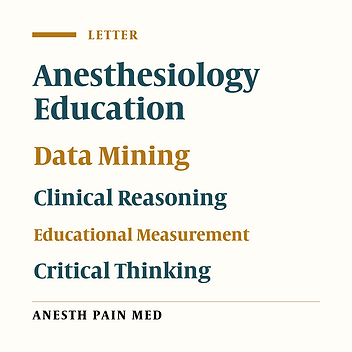
One aspect that could further enrich this research is the inclusion of clinical reasoning tests (CRT) as a tool to assess critical thinking and decision-making skills. Clinical reasoning is a cornerstone of anesthesiology, where prompt and accurate decisions directly impact patient outcomes. Incorporating CRT metrics in future analyses could provide a deeper understanding of how residents translate theoretical knowledge into practical application under pressure.
Moreover, CRT has been shown to align closely with real-world challenges in clinical practice. Studies suggest that reasoning-based assessments can identify specific areas where residents struggle, such as prioritization in emergency scenarios or adapting to rapidly evolving situations (1-3). Integrating CRT into data mining frameworks presents several key opportunities:
(1) Correlation between reasoning and exam performance: Exploring whether higher clinical reasoning scores predict stronger performance in knowledge-based exams or improved patient outcomes.
(2) Targeted interventions: Using CRT results to design focused training modules, such as simulation-based learning or scenario-driven workshops, that address specific reasoning deficiencies.
(3) Feedback loops for curriculum development: Linking CRT data with exam results to refine educational strategies and ensure alignment with real-world anesthesiology demands.
Additionally, incorporating reasoning-focused assessments into data-driven studies could provide insights into residents’ preparedness for independent practice, particularly in critical care settings where sound judgment is essential (4, 5).
This article lays a strong foundation for integrating educational data, and I encourage future research to explore clinical reasoning as a complementary dimension in performance analyses. The combination of reasoning assessments with data mining techniques has the potential to enhance anesthesiology training and improve resident competency.
Thank you for this valuable contribution to the field. I look forward to seeing how these insights evolve in future studies.
Footnotes

References

  • 1.
    Omega A, Wijaya Ramlan AA, Soenarto RF, Heriwardito A, Sugiarto A. Assessing clinical reasoning in airway related cases among anesthesiology fellow residents using Script Concordance Test (SCT). Med Educ Online. 2022;27(1):2135421. [PubMed ID: 36258663]. [PubMed Central ID: PMC9586607]. https://doi.org/10.1080/10872981.2022.2135421.
  • 2.
    Amini M, Moghadami M, Kojuri J, Abbasi H, Abadi AA, Molaee NA, et al. An innovative method to assess clinical reasoning skills: Clinical reasoning tests in the second national medical science Olympiad in Iran. BMC Res Notes. 2011;4:418. [PubMed ID: 22005350]. [PubMed Central ID: PMC3215186]. https://doi.org/10.1186/1756-0500-4-418.
  • 3.
    Sadeghi A, Ali Asgari A, Moulaei N, Mohammadkarimi V, Delavari S, Amini M, et al. Combination of different clinical reasoning tests in a national exam. J Adv Med Educ Prof. 2019;7(4):230-4. [PubMed ID: 31750362]. [PubMed Central ID: PMC6820014]. https://doi.org/10.30476/jamp.2019.83101.1083.
  • 4.
    Ramier M, Clavier T, Allard E, Lambert M, Dureuil B, Compere V. Examining the impact of sleep deprivation on medical reasoning's performance among anaesthesiology residents and doctors: a prospective study. BMC Anesthesiol. 2024;24(1):356. [PubMed ID: 39367351]. [PubMed Central ID: PMC11451214]. https://doi.org/10.1186/s12871-024-02712-5.
  • 5.
    Bengayed K, Akermi S, Amari Y, Chouigui R, Haddad F. Assessment of Clinical Reasoning in Healthcare Students via the Script Concordance Test: Situations in Anesthesia and Intensive Care. Tunis Med. 2024;102(11):871-5. [PubMed ID: 39564629]. [PubMed Central ID: PMC11668146]. https://doi.org/10.62438/tunismed.v102i11.5001.

Similar Articles

7
Dec
2024

Analyzing Patterns in Anesthesiology Residents' Exam Performance Using Data Mining Techniques

Maedeh Karimian,
Shahabedin Rahmatizadeh,
Zeinab Kohzadi,
Zahra Kohzadi,
Firoozeh Madadi,
Ali Dabbagh
,et al.

Karimian M, Rahmatizadeh S, Kohzadi Z, Kohzadi Z, Madadi F, et al. Analyzing Patterns in Anesthesiology Residents' Exam Performance Using Data Mining Techniques. Anesth Pain Med. 2024;14(6):e151686. doi: https://doi.org/10.5812/aapm-151686

5
Jan
2026
J Cell Mol Anesth

From Isolated Exams to Longitudinal Judgment: Implementing Programmatic Assessment with Multisource Data and Portfolio-Based Educational Decisions in Anesthesiology Residency

Firoozeh Madadi,
Amir Maziar,
Reza Shahghadami,
Hossein Bonakchi,
Ali Dabbagh

Madadi F, Maziar A, Shahghadami R, Bonakchi H, Dabbagh A. From Isolated Exams to Longitudinal Judgment: Implementing Programmatic Assessment with Multisource Data and Portfolio-Based Educational Decisions in Anesthesiology Residency. J Cell Mol Anesth. 2026;11(1):e169631. doi: https://doi.org/10.5812/jcma-169631

13
Apr
2009

Assessment Of Clinical Residents' Needs For Ten Educational Subjects

Mansour Razavi

Razavi M. Assessment Of Clinical Residents' Needs For Ten Educational Subjects. J Med Edu. 2002;1(3):e104955. doi: https://doi.org/10.22037/jme.v1i3.947

23
Nov
2014

Clinical Reasoning and Improvement in the Quality of Medical Education

Mohamad Matinpour,
Iraj Sedighi,
Alireza Monajemi,
Farshad Jafari,
Hossein Emad Momtaz,
Mohamad Ali Seif Rabiei

Matinpour M, Sedighi I, Monajemi A, Jafari F, Momtaz HE, et al. Clinical Reasoning and Improvement in the Quality of Medical Education. Shiraz E-Med J. 2014;15(4):e18667. doi: https://doi.org/10.17795/semj18667

23
Apr
2020

The Role of Integrative Educational Intervention Package (Monthly ITE, Mentoring, Mocked OSCE) in Improving Successfulness for Anesthesiology Residents in the National Board Exam

Ali Dabbagh,
Hedayatollah Elyassi,
A. Sassan Sabouri,
Kourosh Vahidshahi,
Seyed Amir Mohsen Ziaee,
Anesthesiology Department undefined

Dabbagh A, Elyassi H, Sabouri AS, Vahidshahi K, Ziaee SAM, et al. The Role of Integrative Educational Intervention Package (Monthly ITE, Mentoring, Mocked OSCE) in Improving Successfulness for Anesthesiology Residents in the National Board Exam. Anesth Pain Med. 2020;10(2):e98566. doi: https://doi.org/10.5812/aapm.98566


Crossmark
Crossmark
Checking
Share on
Cited by
Metrics

Ordering Reprints

Articles are published under the Creative Commons license stated on each article. No permission or royalty fee is required for uses permitted by that license. CCC handles optional bulk and customized reprint orders. Any quotation covers production and delivery services only, not copyright permission. > Request Reprints from CCC 

Search Relations

Author(s):

Related Articles