
1. Context
Diabetic peripheral neuropathy is one of the most disabling chronic complications of diabetes, occurring in almost 1/3 of people with diabetes (1). This complication results from a complex interplay of metabolic derangements, microvascular insufficiency, oxidative stress, mitochondrial dysfunction, and progressive degeneration of small sensory fibers (2). The hyperexcitability and central sensitization resulting from these peripheral changes are accentuated by maladaptive plasticity in the dorsal horn of the spinal cord and supraspinal pain networks. Clinically, painful diabetic peripheral neuropathy (PDPN) presents as burning pain, electric shock sensations, allodynia, and worsening pain at night, severely affecting sleep, mobility, and quality of life (3, 4). First-line options for some patients include duloxetine, pregabalin, gabapentin, and tricyclic antidepressants, but these treatments have dose-dependent side effects, interactions with other drugs, and limited efficacy over time. Opioids and atypical analgesics carry an unfavorable risk-benefit profile in chronic PDPN, including dependence, tolerance, adverse effects, and opioid-related harm, which generally outweigh their modest, often nonsustained analgesic benefit. Nonpharmacologic therapies, such as exercise, cognitive behavioral therapy, and lifestyle optimization, can help manage symptoms but do not provide significant analgesia in refractory situations (5). Consequently, many patients continue to experience severe pain after multimodal treatment.
Electrode-based neuromodulation has been shown to be a well-suited, clinically viable approach for refractory PDPN. Unlike systemic therapies, it directly applies electrical stimulation to peripheral nerves, dorsal root ganglia (DRG), or spinal cord pathways, thereby targeting dysfunctional circuits. These interventions affect abnormal nociceptive signaling, reestablish inhibitory tone, enhance microvascular perfusion, and can even promote the regeneration of small fibers (6). Technological advances, including high-frequency waveforms, closed-loop feedback, microelectrode arrays, and artificial intelligence (AI)-assisted programming, have broadened the applications of neuromodulation, although most have not yet been validated in PDPN.
High-frequency (10 kHz) spinal cord stimulation (SCS) has demonstrated analgesic and functional effects in randomized trials of PDPN, with some patients showing improved neurological examination findings (7). DRG stimulation is available for precise dermatomal targeting in stocking-glove neuropathy, and peripheral nerve stimulation (PNS) is available for minimally invasive focal modulation of distal lower-limb pain; however, the PDPN-specific evidence for both is more limited (8, 9). Emerging technologies, such as wearable devices, regenerative electrical stimulation, and machine learning-based optimization, are at an early stage, and their clinical value in PDPN has not been established.
This narrative review summarizes the mechanistic rationale, clinical evidence, safety considerations, and emerging technologies of electrode-based neuromodulation for refractory PDPN, grades the strength of evidence for each modality, and proposes a provisional framework for phenotype-based modality selection to guide future research.
2. Evidence Acquisition
This is a narrative rather than a systematic review. Relevant literature was identified by searching PubMed/MEDLINE, Embase, Scopus, and the Cochrane Library from database inception through 2026, using Boolean combinations of the terms “painful diabetic peripheral neuropathy,” “neuromodulation,” “peripheral nerve stimulation,” “dorsal root ganglion stimulation,” “spinal cord stimulation,” “closed-loop,” “biomarker,” and “artificial intelligence.” English-language studies involving human subjects were prioritized; mechanistic, engineering, and non-PDPN chronic pain sources were included when they informed the discussion of emerging technologies and are identified as such in the text. Evidence was narratively synthesized and appraised by experts rather than systematically pooled; no meta-analysis was performed, and comparative efficacy statements between modalities reflect narrative synthesis rather than systematic-review-level evidence.
3. Results
3.1. Overview of Current Treatments for Painful Diabetic Peripheral Neuropathy
Painful diabetic peripheral neuropathy is one of the most difficult complications of diabetes to treat, despite the many therapeutic options currently available. Pharmacologic interventions, such as serotonin-norepinephrine reuptake inhibitors (SNRIs), gabapentinoids, tricyclic antidepressants (TCAs), and topical medications, offer only partial symptom relief and do not affect the underlying neurodegenerative or electrophysiologic processes. Interventional methods (nerve blocks, corticosteroid injection, and radiofrequency) can provide short-term pain relief but do not address the diffuse pathophysiology of PDPN. These limitations highlight the importance of mechanism-based and circuit-level interventions to address the drivers of PDPN in addition to symptom modulation (5, 10-12).
3.2. Principles of Electrode-Based Neuromodulation in Diabetic Neuropathy
Neuromodulation using electrodes represents a mechanism-based treatment approach that directly targets excessive neural activity in peripheral and central pathways, which may be responsible for pain associated with PDPN. These systems now include high-frequency waveforms, closed-loop feedback, microelectrode arrays, and AI-assisted programming to achieve efficient neuronal recruitment and energy use. These technologies can regulate pain-signaling pathways but could also improve microvascular perfusion and neuro-immune balance, thereby promoting functional recovery (6). The three main modalities used in electrode-based neuromodulation for PDPN are outlined in the following sections: PNS, dorsal root ganglion stimulation (DRGS), and SCS (Figure 1).
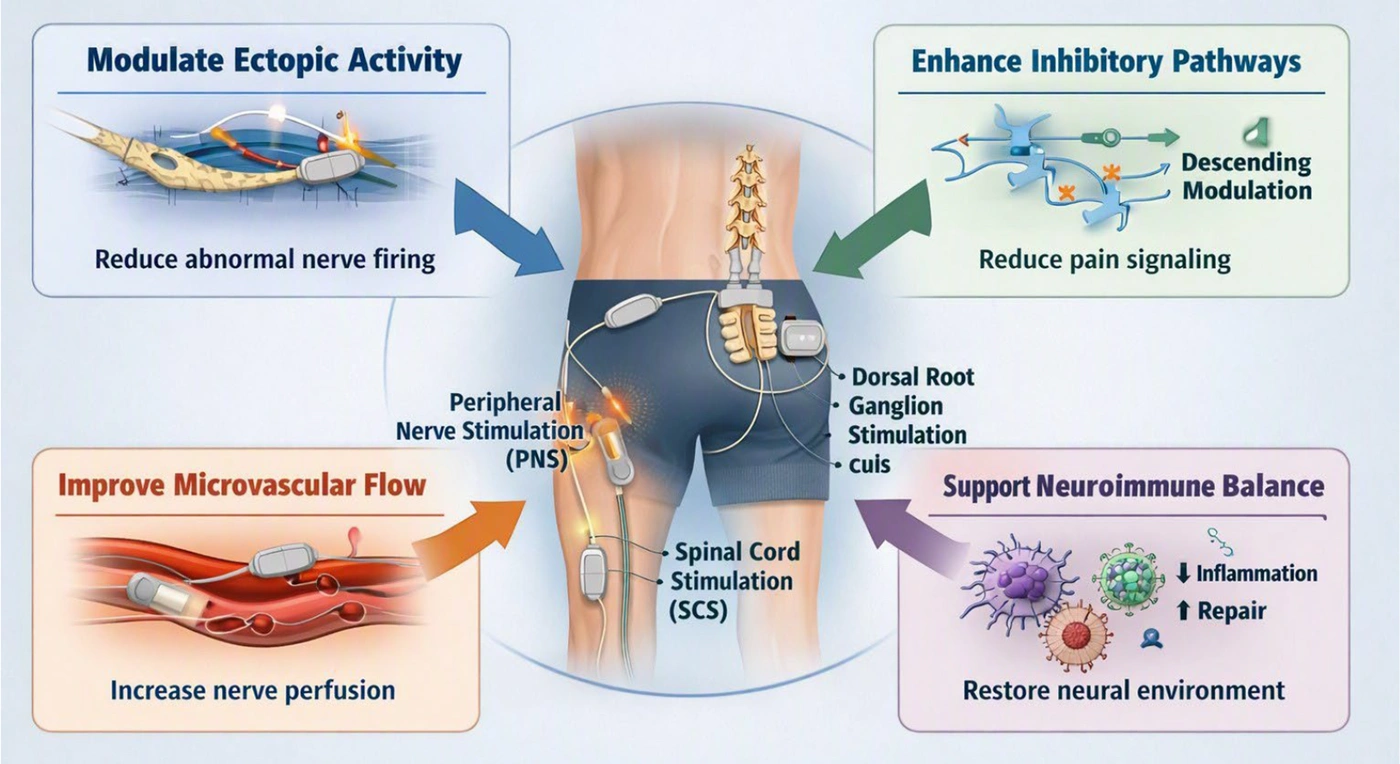
Figure 1.
Principles of Electrode-Based Neuromodulation in Diabetic Neuropathy. This schematic illustrates the three principal modalities underlying electrode-based neuromodulation for painful diabetic peripheral neuropathy (PDPN): Peripheral Nerve Stimulation, Dorsal Root Ganglion, and Spinal Cord Stimulation. Each modality targets distinct anatomical and electrophysiologic levels of the pain axis: PNS targets peripheral nerve trunks, DRGS targets the dorsal root ganglion sensory cell bodies, and SCS targets the dorsal columns and dorsal horn of the spinal cord. Abbreviations: PDPN, painful diabetic peripheral neuropathy; PNS, peripheral nerve stimulation; DRGS, dorsal root ganglion stimulation; SCS, spinal cord stimulation. This figure was produced with moderate-level AI assistance (Google Gemini) for initial graphical layout; all scientific content was created and verified by the authors.
3.3. Peripheral Nerve Stimulation
Peripheral nerve stimulation is one of the most specific and least intrusive methods of neuromodulation and provides controlled electrical pulses to stabilize hyperexcitable axons, decrease spontaneous firing, and restore more physiologic afferent signaling. This mechanism directly targets the peripheral triggers of PDPN, making PNS especially relevant for patients with pain in their feet or lower legs (13). Recently, modern PNS systems have reduced procedural trauma, benefiting people with diabetes who are at higher risk of infection and have impaired wound healing (11). An innovative form of PNS is regenerative electrical stimulation. Initial results indicate that certain stimulation patterns can help repair small fibers, improve mitochondrial activity, and increase microvascular perfusion (14). However, PNS remains a viable option for patients who prefer a less invasive approach, have limited pain patterns, or are ineligible for more comprehensive types of neuromodulation. PNS has proven useful across the PDPN spectrum because of its mechanistic specificity, safety, and regenerative potential (15).
3.4. Dorsal Root Ganglion Stimulation
Dorsal root ganglion stimulation is a neuromodulation technique for PDPN that specifically stimulates the cell bodies of neurons that transmit afferent signals from the lower limbs. In PDPN, DRG neurons are hyperexcitable, exhibit altered ion channel expression, and have impaired neuro-immune communication, all of which help maintain chronic neuropathic pain. In contrast, DRGS directly targets first-order sensory neurons to provide highly focal, dermatome-specific modulation of pathological neural activity without affecting other dorsal column pathways, unlike spinal cord stimulation (15, 16). Technological innovations continue to enhance DRGS capabilities. Closed-loop DRG stimulation is being developed to modulate stimulation in response to real-time neural feedback, maintaining consistent modulation despite fluctuations in neural excitability (17). Initial evidence suggests that DRG stimulation may help regulate the expression of inflammatory cytokines, enhance local perfusion, and promote healthy neuronal metabolism. These effects align with the metabolic and vascular pathophysiology of diabetic neuropathy and suggest that DRGS may have a disease-modifying rather than symptomatic effect (18).
3.5. Spinal Cord Stimulation
SCS, the most widely studied neuromodulation therapy for PDPN, has an effect distinct from that of PNS, which stimulates individual nerves, or DRG, which modulates segmental sensory neurons, because the blockade occurs at the level of the dorsal columns and dorsal horn. This central modulation enables SCS to treat both peripheral hyperexcitability and central sensitization, which occurs in chronic diabetic neuropathic pain (13). PDPN is characterized by hyperexcitability of dorsal horn neurons, diminished function of inhibitory interneurons, and abnormal synaptic plasticity, all induced by persistent nociceptive input from damaged peripheral fibers.
3.6. High-Frequency and Burst Spinal Cord Stimulation
New advancements in waveform technology include high-frequency (10 kHz) and burst SCS. High-frequency stimulation offers a more natural experience and is used for analgesia without sensory overlay, resulting in greater patient satisfaction than traditional low-frequency SCS, which causes paresthesia (19). Dorsal horn hyperexcitability, dysfunction of inhibitory interneuron function and maladaptive central plasticity increases nociceptive processing in PDPN. High-frequency SCS disrupts pathological synchrony in the neurons, and restores more physiologic inhibitory tone, achieving analgesia without paresthesia. New randomized controlled trials (RCTs) show significant and lasting reductions in pain intensity, increased sleep, and functional improvements, and new findings indicate possible partial sensory recovery with these treatments, indicating further microvascular and neuroimmune benefits (9, 20). High-frequency and burst SCS provide non-paresthetic, physiologically aligned modulation of spinal pain circuits. Growing evidence suggests they play a key part in mechanism-driven neuromodulation of refractory PDPN.
3.7. Closed-Loop Neuromodulation
Closed-loop neuromodulation is an important advance in SCS technology because it adjusts stimulation parameters in real time based on physiologic feedback. This provides consistent modulation despite changes in posture, spinal anatomy, or neural excitability (17). Recent studies have shown that closed-loop SCS with evoked compound action potentials (ECAPs) is more stable in terms of analgesics, has inconsistent modulation levels, and increases patient satisfaction compared with open-loop systems (21). Closed-loop systems can also minimize energy use and extend device life by keeping stimulation within an individualized therapeutic window. These results suggest that closed-loop neuromodulation could not only control symptoms but may also support functional recovery or slow the degeneration of small fibers (22). Mechanistic and imaging studies suggest that SCS may affect microvascular and neuroimmune pathways relevant to PDPN (15, 23), but the clinical significance is not established. SCS is generally considered for patients with diffuse neuropathy who need broad coverage or who have responded insufficiently to PNS or DRGS, including those with central sensitization or widespread sensory loss (24). Severe spinal deformity, advanced vascular disease, or extensive epidural scarring may favor other approaches (Table 1).
Table 1.
Mechanistic and Clinical Comparison of Neuromodulation Modalities for PDPN a
| Modality | Primary Target | Mechanistic Action | Advantages | Limitations |
|---|---|---|---|---|
| Peripheral nerve stimulation | Distal peripheral nerves (tibial, peroneal, sural) | Stabilizes hyperexcitable axons; reduces ectopic firing; improves microvascular perfusion | Minimally invasive; ultrasound-guided placement; wearable options; potential regenerative effects | Limited coverage for diffuse stocking-glove neuropathy |
| Dorsal root ganglion stimulation | Sensory neuron cell bodies in the DRG | Reduces segmental hyperexcitability; restores dermatomal signal fidelity; modulates neuroimmune activity | Highly focal; stable coverage; minimal paresthesia; strong for foot pain | Requires precise lead placement; neuritic pain risk if the ganglion is irritated |
| Spinal cord stimulation | Dorsal columns and dorsal horn | Disrupts pathological synchrony; reduces central sensitization; enhances descending inhibition | Broad coverage; strongest evidence base; closed-loop and high-frequency options | Epidural access risks; requires intact dorsal column anatomy |
| Evidence level in PDPN | - | - | PNS: limited, small studies. DRGS: limited, one cohort-controlled comparison with SCS. SCS: highest, RCTs of 10 kHz SCS | Closed-loop, regenerative, and AI-assisted approaches: investigational |
a Abbreviations: PDPN, painful diabetic peripheral neuropathy; PNS, peripheral nerve stimulation; DRG, dorsal root ganglion; DRGS, dorsal root ganglion stimulation; SCS, spinal cord stimulation; RCT, randomized controlled trial; AI, artificial intelligence.
3.8. Emerging Technologies: Wireless and Miniaturized Systems
Engineering innovations are advancing the field of PDPN by providing less invasive, more efficient, and personalized treatments. Fully implantable pulse generators with inductive power transfer and wearable systems are critical for diabetic patients with poor wound healing and increased infection risk. Comfortable, miniaturized micro-leads can target peripheral or segmental nerves with minimal tissue disruption, broadening the spectrum of patients who could previously be treated with traditional implants (25, 26). Early work suggests that these systems could improve neural selectivity, reduce off-target activation, and improve tolerability (26, 27). Low-power microelectronics, flexible biocompatible materials, and wireless telemetry may also allow remote monitoring of neural responses and adjustment of stimulation parameters (28). These platforms are largely at the preclinical or early clinical stage and have not been evaluated specifically in PDPN. If validated, they may improve access and reduce procedural complications (25). As wireless and miniaturized platforms mature, integrating computational tools is increasingly important. Simultaneously recording and transmitting neural data and controlling distributed micro-electrode systems align with AI optimization strategies.
3.9. Artificial Intelligence and Personalized Neuromodulation
AI-based optimization of stimulation parameters is an emerging, investigational concept. Conventional programming relies on patient feedback, which can be limited by sensory loss, variable excitability, and the heterogeneity of PDPN (29, 30). In principle, algorithms could adjust amplitude, pulse width, and contact configuration within an individualized therapeutic window using ECAPs, wearable sensor data, and patient-reported outcomes, and could reduce variability related to posture and daily physiological change (31, 32). To our knowledge, these applications have not been validated in PDPN neuromodulation, and the cited AI studies in diabetic neuropathy mainly address diagnosis or risk prediction (28, 30, 33). Evidence that AI-guided programming is superior to manual programming remains limited and preliminary and requires prospective, controlled evaluation. Similarly, AI-supported integration of electrophysiology, imaging, and behavioral measures to guide modality selection or detect early central sensitization remains a research goal (33). AI in neuromodulation is expected to move from reactive to proactive, closed-loop, fully individualized therapy. However, this remains an investigational rather than an established first-line treatment for refractory PDPN, pending prospective validation in PDPN-specific cohorts.
3.10. Biomarkers, Imaging, and Patient Selection in PDPN
Appropriate patient selection using objective biomarkers and advanced imaging is essential for effective electrode-based neuromodulation in PDPN, a heterogeneous condition in which patients respond unequally. Identifying neural, vascular, and metabolic features that are responsive to PNS, DRGS, or SCS is critical for optimizing outcomes and reducing procedural risk.
Quantitative sensory testing (QST) evaluates small- and large-fiber function and identifies sensory phenotypes related to responsiveness. As a hypothesis-generating but unvalidated assumption, preserved nociceptor function may favor PNS, whereas segmental sensory abnormalities may favor DRGS (34). Intra-epidermal nerve fiber density (IENFD), measured by skin biopsy, quantifies small-fiber degeneration. A low IENFD does not preclude neuromodulation, but very low values may reflect advanced disease requiring more comprehensive SCS (35). ECAPs and dorsal horn excitability indices help closed-loop systems detect neural engagement and adjust stimulation in real time. These biomarkers may aid patient selection and long-term therapy optimization (17). High-resolution ultrasound is critical for PNS planning because it visualizes target nerves, vasculature, and tissue integrity. Fluoroscopy and computed tomography (CT) guidance aid DRG lead placement in the presence of anatomical variations or spinal deformities. Magnetic resonance imaging (MRI) assesses spinal canal anatomy, dorsal column integrity, and epidural scarring, which are key factors in SCS candidacy (36). Emerging techniques, such as diffusion tensor imaging (DTI) and magnetic resonance neurography, assess microstructural nerve changes and may predict response (37).
Combining biomarkers and imaging with the clinical profile may support individualized selection. Under this provisional framework, PNS is considered for focal pain with preserved small-fiber function, DRGS for dermatomal pain or segmental hyperexcitability, and SCS (strongest evidence) for diffuse stocking-glove neuropathy, central sensitization, or diffuse sensory loss. This stratification is based on mechanistic reasoning and expert opinion (13, 38). It has not been prospectively validated, and no biomarker has been shown to predict response to neuromodulation in PDPN (Table 2).
Table 2.
Proposed Biomarker-Informed Framework for Modality Selection in PDPN (Expert Opinion; Not Prospectively Validated) a
| Assessment Domain | Key Biomarkers/Imaging | Interpretation | Best-Fit Modality |
|---|---|---|---|
| Small-fiber integrity | IENFD (skin biopsy), QST thermal thresholds | Moderate loss: preserved nociceptor function; severe loss: more diffuse degeneration (hypothesis) | Moderate loss: PNS; severe loss: SCS |
| Segmental sensory pattern | QST mechanical thresholds; dermatomal mapping | Segmental hyperexcitability or dermatomal pain | DRGS |
| Large-fiber function | NCS, vibration thresholds | Mixed sensory loss or conduction deficits | DRGS or SCS depending on distribution |
| Central sensitization | LEPs, CHEPs, pain catastrophizing scales | Amplified central processing; widespread pain | SCS |
| Anatomical feasibility | Ultrasound (PNS), fluoroscopy/CT (DRGS), MRI (SCS) | Nerve accessibility, foraminal anatomy, CSF thickness, epidural scarring | Determines the feasibility of PNS/DRGS/SCS |
| Metabolic and vascular status | HbA1c, PAD assessment, renal function | Good glycemic control, lower infection risk; severe PAD, caution with PNS/DRGS | Optimizes modality choice and timing |
| Psychological readiness | CBT/ACT engagement, expectation alignment | Higher self-efficacy may be associated with better outcomes (hypothesis) | Supports all modalities |
a Abbreviations: PDPN, painful diabetic peripheral neuropathy; IENFD, intra-epidermal nerve fiber density; QST, quantitative sensory testing; NCS, nerve conduction studies; LEPs, laser-evoked potentials; CHEPs, contact heat-evoked potentials; CT, computed tomography; MRI, magnetic resonance imaging; CSF, cerebrospinal fluid; HbA1c, glycated hemoglobin; PAD, peripheral arterial disease; CBT, cognitive behavioral therapy; ACT, acceptance and commitment therapy; PNS, peripheral nerve stimulation; DRGS, dorsal root ganglion stimulation; SCS, spinal cord stimulation.
3.11. Clinical Outcomes
There has been a significant expansion in the clinical evidence base for electrode-based neuromodulation in PDPN, with the highest level of evidence for long-term clinical efficacy with high-frequency (10 kHz) SCS. DRG stimulation is as effective as SCS for pain relief in PDPN patients with comparable efficacy at 6 months and with similar improvements in quality of life and 6 months and 12 months after surgery, suggesting that the choice of modality should be determined by the distribution of pain and anatomical feasibility, rather than by differential efficacy (39). In randomized controlled trial, 10-kHz SCS plus conventional medical management resulted in a mean reduction in pain of 79.9% from baseline at 24 months; 65.7% of patients also had clinically meaningful neurological recovery, indicating a potential to restore more than just pain management. Remarkably, there are secondary metabolic benefits, such as substantial decreases in HbA1C and weight loss, which are thought to be driven by better sleep, reduced inflammatory burden and increased physical activity (8).
This closed-loop paradigm is being further refined through technological innovations, such as closed-loop SCS systems incorporating ECAP feedback, which offer greater stability of spinal cord engagement despite changes in posture or fluctuations in neural excitability, thereby providing more stable analgesia and objective feedback on device performance than conventional open-loop systems (40). Current feasibility trials are specifically investigating this closed-loop paradigm in cohorts of PDPNs, with primary outcome measures that include pain reduction, functional improvement, and metabolic parameters at 12 months (41). At the same time, AI is proving to be a game-changer in neuromodulation, with algorithms that optimize stimulation parameters in a data-driven, phenotype-specific manner rather than subjectively, using real-time physiological signals, wearable sensor data, and patient-reported results to maximize therapeutic precision and minimize the variability inherent in manual programming (32, 33). The evidence suggests that electrode-based neuromodulation, specifically high-frequency SCS and closed-loop systems, is a highly effective, mechanism-targeted treatment for refractory PDPN and can offer benefits beyond painful symptoms (40); the advent of AI and wearable technologies marks a new era of personalized, adaptive, and accessible neuromodulatory care (Table 3).
Table 3.
Evidence Summary for Pivotal PDPN-Related Studies Cited in the Clinical Outcomes Section a
| Study Design | Population | Comparator | Follow-up | Principal Limitation |
|---|---|---|---|---|
| RCT (long-term follow-up) | PDPN | Conventional medical management | 24 months | Long-term extension of an industry-related SCS trial; the exact sample size, attrition, and blinding status at 24 months were not abstracted in this review and should be confirmed from the primary source (8) |
| RCT (primary endpoint) | PDPN | Conventional medical management | Primary trial endpoint (shorter-term) | Industry-related trial; blinding limitations inherent to SCS trials; details to be confirmed from the primary source (9) |
| Prospective cohort (single-arm) | PDPN | None (no concurrent comparator) | 8 – 10 years | No randomization or concurrent comparator; substantial long-term attrition is likely given the follow-up duration; details to be confirmed from the primary source (20) |
| Prospective cohort-controlled (non-randomized) | PDPN | DRGS vs. SCS (non-randomized comparison) | 6 and 12 months | Non-randomized, non-blinded comparison between cohorts; potential selection bias in modality assignment; the wide confidence interval around the OR reflects limited precision (39) |
| Retrospective case series | Cancer pain (not PDPN) | Closed-loop SCS vs. DRGS (combination trialing) | Not specified | Very low level of evidence (retrospective case series); the population is cancer pain, not PDPN (40) |
a Abbreviations: RCT, randomized controlled trial; PDPN, painful diabetic peripheral neuropathy; SCS, spinal cord stimulation; DRGS, dorsal root ganglion stimulation; OR, odds ratio.
3.12. Safety and Adverse Events
These benefits must be weighed against the risks associated with the surgical procedure and device, including surgical-site infection, electrode (lead) migration or fracture, hardware malfunction, reduced efficacy over time, and the potential need for revision surgery. The incidence of these events varies depending on the treatment modality, implantation technique, and duration of follow-up and should be derived directly from the primary studies concerning PDPN (8, 9, 20, 39), as these events were not consistently abstracted here. Diabetes-specific factors add further risk: impaired wound healing, peripheral arterial disease, and poor glycemic control increase the risk of infection and complications, so preimplantation glycemic optimization is advisable, although PDPN-specific data are limited. PNS, being less invasive and often temporary or externally powered, has a lower burden of infection and malfunction than permanently implanted DRGS or SCS, whereas DRGS has a higher risk of lead migration and neuritic pain from ganglion irritation. Closed-loop SCS adds complexity, with failure modes that are not yet fully characterized. Cost, limited availability outside specialized centers, and training needs hinder wider use of DRGS, closed-loop SCS, and AI-guided programming, independent of efficacy.
3.13. Future Perspectives
A structured, phenotype-driven algorithm incorporating biomarkers, imaging, symptom distribution, and metabolic and vascular factors is essential for effective neuromodulation in PDPN. Because small-fiber degeneration, segmental hyperexcitability, and central sensitization vary, no single modality suits all patients; peripheral, segmental, and central options should follow a rational pathway (42, 43). Phenotype characterization, which incorporates symptom distribution, QST, and structural biomarkers, is the first step in clinical decision-making. Peripheral nerve stimulation is ideal for patients with focal or regionally dominant pain. This approach is also supported by the maintenance of nociceptive thresholds and moderate loss of small fibers. Nerve accessibility and lead placement planning are verified with high-resolution ultrasound (11, 44). Dorsal root ganglion stimulation is more beneficial for patients with dermatomal pain patterns, segmental hyperexcitability, or mixed sensory loss (45). DRGS is well suited to stocking-glove neuropathy along sensory pathways. Imaging, particularly fluoroscopy or CT, facilitates safe access to the foramina and allows identification of anatomical constraints (36). Spinal cord stimulation is indicated for patients who present with diffuse stocking-glove neuropathy, central sensitization, or diffuse sensory loss. Prolonged, high-frequency SCS (10 kHz) covers a wide area and is better supported by evidence for PDPN (18). MRI is important for assessing canal stenosis, epidural scarring, and CSF thickness, all of which can affect lead placement and the stability of the stimulation field. Closed-loop SCS systems in which feedback is based on ECAP are especially useful for patients with variable neural excitability (17).
PNS should be assessed periodically by ultrasound, particularly in patients with fluctuating edema or soft-tissue changes, to assess lead stability and proximity to the nerve (46). DRGS follow-up focuses on confirming dermatomal coverage and adjusting stimulation intensity to reflect changes in ganglion excitability. To maintain stable dorsal column engagement, feedback signals such as ECAPs should be monitored periodically in SCS systems, especially on high-frequency or closed-loop platforms (47). These assessments may help maintain consistent analgesia and avoid drift in therapy, while long-term outcomes remain critically dependent on concurrent metabolic and vascular management, including glycemic control, lipid stabilization, blood pressure regulation, support of endothelial function, and ongoing surveillance for vascular insufficiency to ensure adequate perfusion around leads and target nerves (48).
The future of PDPN care is expected to depend on flexible, adaptive treatment pathways. Collectively, these advancements establish neuromodulation as a dynamic, personalized, and mechanistically targeted therapy that can adapt to changes in patient neurophysiology and disease progression.
3.14. Limitations
As a narrative review, this article is subject to selection bias and provides no pooled or meta-analytic effect estimates. The evidence base is markedly heterogeneous with respect to design, population, and follow-up, ranging from randomized controlled trials to small feasibility studies, retrospective case series, and engineering reports. Where PDPN-specific data were unavailable, evidence was extrapolated from other neuropathic or chronic pain populations and is identified as such. Publication bias toward positive outcomes cannot be excluded. Finally, several of the technologies discussed (closed-loop systems, AI-guided programming, regenerative stimulation, and wireless miniaturized platforms) are evolving rapidly; therefore, specific technical and performance claims may become outdated as the field advances.
4. Conclusions
In conclusion, PDPN is a complex complication driven by small-fiber degeneration, microvascular insufficiency, metabolic stress, and central sensitization, and conventional therapies offer only partial, transient relief. Electrode-based neuromodulation (PNS, DRGS, SCS) is a mechanism-targeted alternative that modulates aberrant nociceptive signaling and offers emerging microvascular, neuro-immune, and regenerative benefits. Technological advances enhance precision and durability. Biomarker-driven selection aligns phenotypes with the appropriate modality, and long-term success requires metabolic optimization, functional monitoring, and psychological support. High-frequency SCS has the strongest evidence for refractory PDPN, whereas PNS, DRGS, closed-loop systems, regenerative stimulation, and AI-guided personalization remain emerging and require PDPN-specific validation before they can be considered established disease-modifying therapies.