1. Background
Endotracheal intubation can be associated with significant hemodynamic changes and adverse outcomes (1, 2). Different measures have been proposed for blunting these effects (3, 4); however, they can have deleterious effects on hemodynamics. Moreover, drugs like opioids are not usually used for blunting hemodynamic changes after endotracheal intubation in parturient because of their adverse effects on neonate. Paracetamol is a non-opioid analgesic without potential adverse effects of opioids such as respiratory depression, nausea and vomiting. It has been successfully used for management of postoperative pain in different types of operations (5-12). It has also been used safely during labor (13).
2. Objectives
The purpose of this study was to investigate the effect of intravenous paracetamol on hemodynamic parameters following endotracheal intubation in patients undergoing cesarean section with general anesthesia. The primary outcome was to investigate its effect on mean arterial blood pressure (MAP). The secondary outcome was evaluation of the effect on pulse rates, postoperative pain, analgesic requirement and Apgar score.
3. Patients and Methods
After obtaining approval from the University ethics committee, patients informed consent and registration at IRCT with registration no. 201308254780N4, 80 parturients with ASA class I or II admitted for urgent cesarean section under general anesthesia at Qaem hospital, Mashhad, Iran were recruited for this randomized clinical trial. Exclusion criteria were duration of operation less than 30 minutes or longer than 90 minutes, allergy to paracetamol, addiction to opioids, alcohol or any other drugs, hypertension, history of ischemic heart disease, and consumption of any drugs affecting cardiovascular system.
Using a computer based randomization method, the patients were randomly assigned to receive either 100 mL normal saline or 15 mg/kg intravenous paracetamol (Apotel) diluted in 100 mL of normal saline 15 minutes before induction of anesthesia. Thiopenthal 4 mg/kg and succinylcholine were administered for induction of anesthesia and endotracheal intubation, respectively. Anesthesia was maintained with 50% nitric oxide in oxygen and 0.8 - 1.2% isoflurane before delivery. Atracurium 0.6 mg/kg was given after return of spontaneous breathing. Midazolam 0.03 mg/kg and fentanyl 2 µg/kg administered after delivery. The patients received fentanyl 1 µg/kg whenever heart rate or blood pressure increased more than 20% from baseline. Residual muscular blockade was reversed with neostigmine 0.04 mg/kg and atropine 0.02 mg/kg at the end of operation and after return of spontaneous breathing. The patients were under standard monitoring with continuous electrocardiography, pulse oximetry, capnography, respiratory rates and noninvasive blood pressure with Saadat Novin S1700 monitor.
Pulse rate (using electrocardiography) and noninvasive mean arterial blood pressure were measured at baseline, after intubation and at 1 minute interval for 5 minutes afterwards. The patients were investigated for presence and severity of pain using visual analog scale with 0 - 10 scale ( described as 0 meaning no pain and 10 as the most severe pain ever experienced) 30 minutes after entering the recovery room and at 3 and 6 hours by a trained nurse blinded to the study. Participants received intravenous meperidine 0.3 mg/kg if they reported pain with intensity greater than 4. Arithmetic mean and standard variation values for different variables were calculated and statistical analyses were performed using SPSS software for Windows, version 11.5 (SPSS Inc., Chicago, IL, USA). We used independent student t-tests to compare continuous variables with normal distribution, repeated measure ANOVA for changes within the groups and chi-squared or Fisher’s exact test for non-continuous variables. P < 0.05 was considered significant.
4. Results
The mean age of patients was 28.49 ± 4.63 years. The mean age was 28.82 ± 4.67 and 28.15 ± 4.61 years in the paracetamol and normal saline groups, respectively (P value = 0.52). The patients were similar regarding duration of operation (76.67 ± 13.50 minutes in the paracetamol and 73.50 ± 16.61 minutes in the saline group; P value = 0.50).
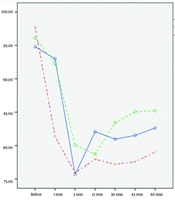
Patients in the saline group required more fentanyl intraoperatively (150 saline group and 87.5 ± 75.00 µg in the paracetamol group; P value < 0.001). Patients in the paracetamol group required less meperidine (5.73 ± 1.35 mg) than saline group (20.84 ± 12.88 mg) (P value = 0.002) in the recovery room and the ward. Patients in the saline group experienced more severe pain in the recovery room; however, both groups were similar regarding pain at 30 minutes, and 3 and 6 hours in the ward (Table 1 and Figure 1).
Table 1.
Severity of Pain Based on Visual Analogue Scalea
| Time | Saline | Paracetamol | Total | P |
|---|---|---|---|---|
| Recovery | 7.00 ± 1.24 | 6.15 ± 2.27 | 6.58 ± 1.86 | .041 |
| 30 min | 6.15 ± 1.44 | 6.55 ± 2.06 | 6.35 ± 1.78 | .318 |
| 3 h | 5.10 ± 1.86 | 6.45 ± 1.51 | 5.28 ± 1.56 | .318 |
| 6 h | 4.10 ± 1.63 | 3.95 ± 1.80 | 4.03 ± 1.70 | .697 |
aValues are presented as mean ± SD.
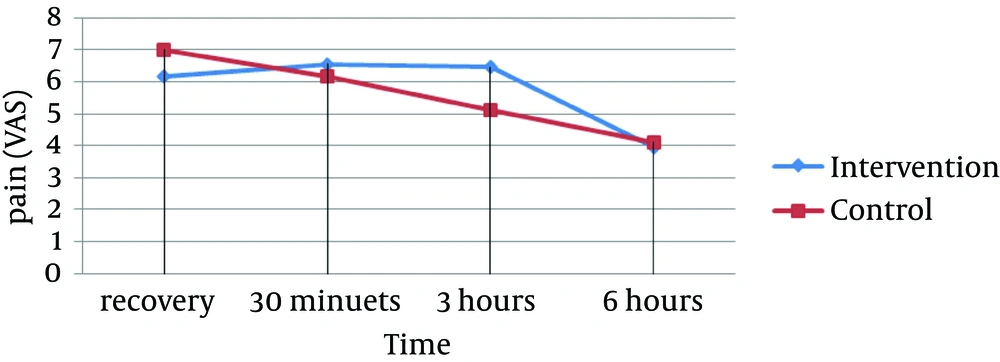
Figure 1.
Amount of Pain Based on Visual Analogue Scale (VAS)
Pulse rates and MAP were similar in the both groups at baseline. Mean blood pressure did not change significantly after intubation in the both groups (Table 2 and Figure 2). However, pulse rates demonstrated greater changes after intubation in saline than paracetamol group (Table 3 and Figure 3).
Table 2.
Pulse Rates in Patients Under Studya
| Time | Saline | Paracetamol | Total | P |
|---|---|---|---|---|
| Before intubation | 101.90 ± 16.14 | 104.10 ± 11.21 | 103.00 ± 13.85 | .481 |
| After intubation | 123.25 ± 25.47 | 109.75 ± 18.70 | 116.50 ± 21.21 | .008 |
| One minute later | 113.25 ± 24.40 | 105.40 ± 22.18 | 109.32 ± 23.50 | .136 |
| Two minutes later | 110.65 ± 19.38 | 101.10 ± 17.17 | 105.88 ± 18.82 | .022 |
| Three minutes later | 105.45 ± 16.98 | 98.90 ± 13.51 | 102.17 ± 15.60 | .060 |
| Four minutes later | 101.70 ± 19.37 | 96.55 ± 15.40 | 99.12 ± 17.58 | .192 |
| Five minutes later | 103.35 ± 17.40 | 91.95 ± 17.04 | 97.65 ± 18.05 | .004 |
| Mean after intubation | 109.61 ± 18.13 | 100.61 ± 14.97 | 105.11 ± 17.13 | .018 |
| Difference before and after intubation | 7.71 ± 17.61 | 3.49 ± 13.79 | 2.1083 ± 16.70 | .002 |
aBeats per minute; mean ± SD.
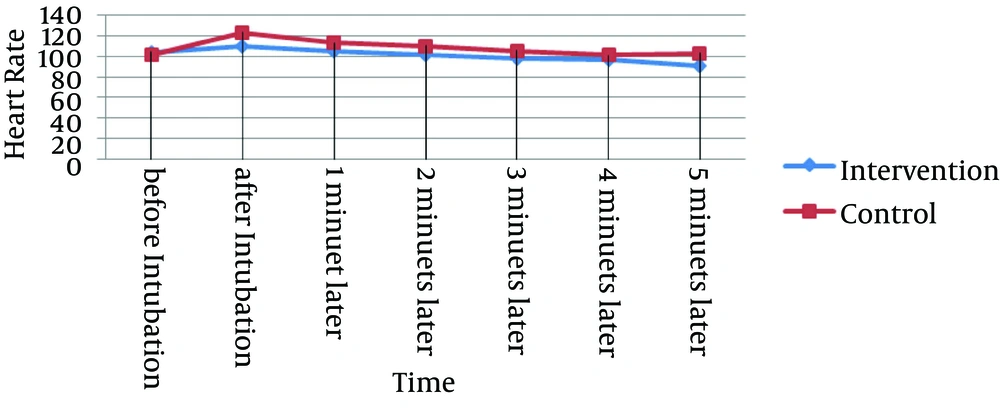
Figure 2.
Heart Rate in the Groups
Table 3.
Mean Blood Pressure in the Study Participantsa
| Time | Saline | Paracetamol | Total | P |
|---|---|---|---|---|
| Before intubation | 99.30 ± 17.57 | 101.40 ± 18.79 | 100.35 ± 18.11 | .607 |
| After intubation | 118.80 ± 25.65 | 110.10 ± 16.03 | 110.95 ± 21.27 | .723 |
| One minute later | 106.00 ± 25.75 | 106.15 ± 15.32 | 106.07 ± 18.12 | .975 |
| Two minutes later | 103.30 ± 20.71 | 105.20 ± 15.30 | 104.25 ± 18.12 | .642 |
| Three minutes later | 94.10 ± 23.11 | 100.50 ± 15.30 | 104.25 ± 18.12 | .156 |
| Four minutes later | 91.05 ± 21.76 | 98.00 ± 17.78 | 94.52 ± 20.05 | .122 |
| Five minutes later | 93.65 ± 19.95 | 88.40 ± 14.88 | 91.02 ± 17.68 | .186 |
| Mean after intubation | 100.00 ± 20.60 | 101.39 ± 12.70 | 100.70 ± 17.02 | .717 |
| Difference before and after Intubation | 0.70 ± 13.08 | -0.01 ± 18.07 | 0.35 ± 15.68 | .841 |
ammHg; mean ± SD.
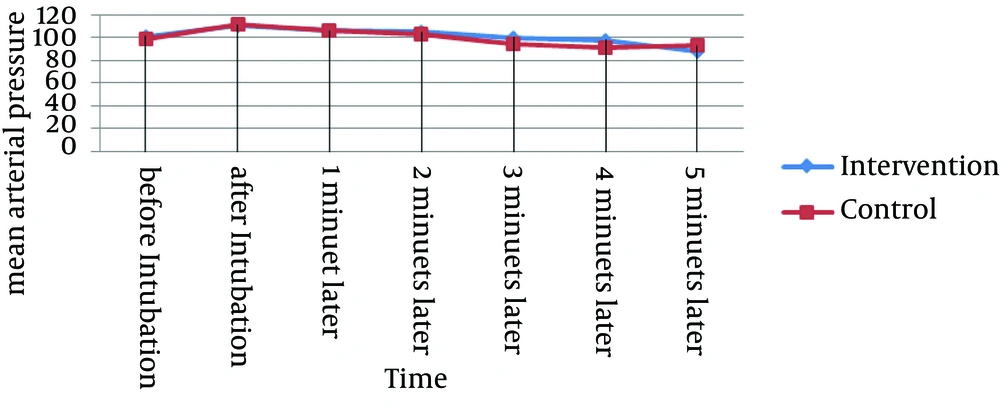
Figure 3.
Blood Pressure in the Groups
Apgar score was not different in the both groups (in saline and paracetamol groups, respectively).
5. Discussion
We showed that intravenous Paracetamol could significantly reduce Intraoperative and postoperative analgesic requirement. It was also effective in reducing early postoperative pain in parturients under cesarean section by general anesthesia. Furthermore, it could blunt pulse rate changes significantly following endotracheal intubation. However, it is not effective in reducing mean arterial blood pressure due to endotracheal intubation.
There are several reports like us suggesting beneficial effect of intravenous paracetamol for management of postoperative pain including cesarean section (14-17, 19).
It has been used effectively for mild to moderate postoperative pain (20, 21). Inal et al. suggested that paracetamol was more effective than meperidine for management of postoperative pain during cesarean section by general anesthesia with less adverse effects on mother and neonate (15).
Its administration has been more beneficial than placebo for management of postoperative pain in parturients under cesarean section by spinal anesthesia (16, 17). In another study, combination of intravenous paracetamol with suppository diclofenac has been more potent than meperidine in parturients undergoing cesarean section by spinal anesthesia (22).
Comparison of intravenous paracetamol and intramuscular meperidine revealed better pain control, less sedative requirement and adverse effects including nausea and vomiting and shorter recovery time after tonsillectomy in children (23) and adults (22).
Moreover, blunting circulatory response to endotracheal intubation is a challenging issue in parturients undergoing cesarean section. Opioids are not usually used for this purpose because of their effects on neonate. In addition, use of different devices such as glidescope videolaryngoscope has been shown to be effective for a short time to reduce hemodynamic changes in these patients (24). Therefore, application of drugs without adverse effects on mother and neonates such as paracetamol can be promising. Similar to our study, Ayatollahi et al. reported beneficial effect of intravenous paracetamol in reducing Intraoperative heart rate and early postoperative pain control in cesarean section (18). In contrast, our study did not demonstrate better blood pressure and postoperative pain control in the ward. This can be attributed to the type of surgery that is urgent versus elective in the two studies. In addition, Hassan HI used intravenous paracetamol before induction of anesthesia for elective cesarean section and found that it resulted in hemodynamic stability before delivery. In addition, it reduced postoperative pain and analgesic requirements for a few hours postoperatively (25).
In conclusion, we demonstrated that use of preoperative intravenous paracetamol can significantly reduce early postoperative pain and heart rate changes after endotracheal intubation in parturients undergoing cesarean section by general anesthesia.