
1. Background
Shivering is a common and distressing complication during cesarean delivery performed under spinal anesthesia, with reported incidence rates as high as 35% - 55% (1-4). This phenomenon results from involuntary muscle activity triggered by neuraxial-induced vasodilation, which causes redistribution of heat from the core to the peripheral compartments and alters the hypothalamic thermoregulatory set point (5, 6). Although shivering is often transient, it increases maternal oxygen consumption and carbon dioxide production and may complicate intraoperative monitoring, particularly in patients with limited cardiopulmonary reserve (7, 8).
The global increase in cesarean delivery rates and the widespread preference for spinal anesthesia, because of its rapid onset and favorable safety profile, have increased the clinical importance of effective perioperative thermoregulation (9). Various pharmacologic agents have been investigated to prevent or treat perioperative shivering, including opioids, α2-adrenergic agonists, N-methyl-D-aspartate receptor antagonists, and serotonergic agents (10-12).
Among these agents, meperidine is considered one of the most effective pharmacologic options for shivering prevention. Its anti-shivering properties are believed to be mediated through κ-opioid receptor agonism and modulation of thermoregulatory pathways within the central nervous system (6, 13). However, opioid use in obstetric anesthesia remains limited because of potential adverse effects, such as nausea, vomiting, pruritus, and possible neonatal respiratory depression (14).
Paracetamol, also known as acetaminophen, is a potential non-opioid alternative with a well-established safety profile. Its thermoregulatory effect is thought to be mediated through central cyclooxygenase inhibition and modulation of the hypothalamic thermoregulatory set point, which may influence perioperative shivering without causing sedation or respiratory depression (15, 16). Several studies have reported beneficial effects of IV paracetamol in reducing perioperative shivering in different surgical populations (17-19).
Recent clinical investigations have further explored pharmacologic strategies for shivering prevention in perioperative and obstetric anesthesia. For example, dexmedetomidine has been evaluated for its efficacy in reducing postoperative shivering through central α2-adrenergic mechanisms (1). Comparative studies have also examined the balance between efficacy and systemic safety when using intrathecal meperidine versus IV acetaminophen for shivering prophylaxis in obstetric spinal anesthesia. Additionally, corticosteroids such as dexamethasone have recently been investigated as potential adjunctive agents for shivering prophylaxis in obstetric patients. These studies highlight the ongoing search for effective and safer pharmacologic strategies for shivering prevention.
2. Objectives
The present study was designed as a randomized, double-blind clinical trial to compare the prophylactic efficacy of IV paracetamol and IV meperidine in preventing shivering during elective cesarean delivery under spinal anesthesia. Secondary objectives included the evaluation of hemodynamic stability, time to shivering onset, adverse effects, and maternal satisfaction.
3. Methods
3.1. Study Design and Setting
This randomized, double-blind clinical trial was conducted at Shahid Beheshti Hospital, Isfahan, Iran. The trial was registered with the Iranian Clinical Trial Registration Center (IRCT20240524061880N1) and approved by the Ethics Committee of Isfahan University of Medical Sciences (IR.MUI.MED.REC.1403.062). Written informed consent was obtained from all participants before enrollment after an explanation of the study design, objectives, and pain scoring system, with assurances of data confidentiality.
3.2. Inclusion and Exclusion Criteria
The inclusion criteria were pregnant women classified as American Society of Anesthesiologists physical status II, aged 18 - 45 years, who were scheduled for elective cesarean section under spinal anesthesia.
The exclusion criteria were cardiovascular, pulmonary, hepatic, or renal disease; psychiatric disorders; diabetes mellitus; thyroid dysfunction; baseline body temperature outside the range of 36.5°C - 37.5°C on admission; a known history of alcohol or substance abuse; use of vasodilator drugs; anticipated need for intraoperative blood transfusion; receipt of labor analgesia or other medications potentially affecting thermoregulation; inadequate spinal block, defined as a bilateral sensory level below T4 or T5; and intraoperative complications requiring medications outside the study protocol.
3.3. Randomization and Blinding
Participants were randomized using the Sequence Generator tool in blocks of 15 eligible patients. Drug allocation was concealed using coded, identical syringes prepared by an anesthesiologist who was not otherwise involved in patient care. The anesthesiologist who administered the spinal and IV medications, the anesthetists who recorded outcomes, and the biostatistician who performed the data analysis were all blinded to group allocation.
3.4. Sampling Method and Sample Size Calculation
The sample size was estimated based on previously reported differences in shivering incidence between the intervention and control groups. Assuming a reduction in shivering incidence from approximately 55% in the control group to 30% in the intervention group, with a significance level of α = 0.05 and a statistical power of 80%, the minimum required sample size was calculated as 40 participants per group. To improve statistical reliability and account for possible dropouts, recruitment continued until 151 patients were included in the study.
3.5. Anesthetic Management and Interventions
All patients adhered to preoperative fasting guidelines. Standard monitoring, including electrocardiography, noninvasive blood pressure, and pulse oximetry (SpO2), was applied. Intravenous fluid preloading was initiated with lactated Ringer solution at 15 mL/kg over 30 minutes, followed by maintenance at 5 mL/kg. Metoclopramide, 10 mg, was injected intravenously over 30 seconds.
Spinal anesthesia was performed using a 26-gauge Quincke needle at the L3-L4 or L4-L5 interspace via the paramedian approach, with the patient in a sitting position. After spinal drug injection, patients were immediately positioned supine with a left uterine displacement wedge, and urinary catheterization was performed.
Patients were randomly assigned to 1 of 3 groups:
- MEP-IV group: Ten minutes before spinal injection, patients received 10 mg meperidine diluted in normal saline and infused intravenously over 10 minutes. The spinal injection consisted of 2.5 - 3 mL (12.5 - 15 mg) hyperbaric bupivacaine.
- PARA group: Ten minutes before spinal injection, patients received 1 g paracetamol diluted in normal saline and infused intravenously over 10 minutes. The spinal injection consisted of 2.5 - 3 mL (12.5 - 15 mg) hyperbaric bupivacaine.
- Control group: Ten minutes before spinal injection, patients received normal saline infused intravenously over 10 minutes. The spinal injection consisted of 2.5 - 3 mL (12.5 - 15 mg) hyperbaric bupivacaine.
3.6. Monitoring and Outcome Assessment
Core body temperature was monitored intraoperatively using a tympanic thermometer (OMRON Gentle Temp 520). Operating-room temperature and humidity were maintained within standard institutional ranges, and supplemental oxygen was provided via a face mask according to routine obstetric anesthesia practice.
The following data were recorded:
- Anesthetic block characteristics: Time to peak sensory block, highest sensory block level assessed by pinprick sensation, duration of sensory block defined as the time to 2-segment regression, and complete motor block assessed using the modified Bromage criteria grade 4 (18).
- Hemodynamics and temperature: MAP, HR, and tympanic body temperature were recorded at baseline, 60 minutes after the intervention, and every 15 minutes during recovery.
- Shivering assessment: Shivering was assessed by a blinded observer using the validated 4-point scale described by Sai and Chu, 2006 (19): Grade 0, no shivering; grade 1, peripheral vasoconstriction without visible shivering; grade 2, muscle activity in 1 muscle group; grade 3, muscle activity in more than 1 muscle group but not generalized; and grade 4, generalized shivering involving the whole body.
- Rescue treatment and adverse events: Active warming with standard forced-air warmers was initiated for shivering grades 1 and 2. If shivering persisted or progressed to grade 3 or higher, IV meperidine was administered as rescue therapy. The need for rescue meperidine was recorded. Hypotension was treated with IV ephedrine. The need for ephedrine and other adverse events, including nausea, vomiting, and bradycardia, was recorded.
- Patient satisfaction: Patient satisfaction was assessed postoperatively using an 11-point numeric rating scale, ranging from 0, indicating completely dissatisfied, to 10, indicating completely satisfied.
Patients were closely monitored for potential adverse drug reactions, including nausea, vomiting, hypotension, bradycardia, and respiratory depression. If nausea or vomiting occurred, antiemetic therapy was administered. Hypotension was treated with IV ephedrine and fluid administration, whereas bradycardia was managed with atropine when clinically indicated. All adverse events were documented and managed according to standard institutional protocols.
3.7. Statistical Analysis
Data were analyzed using SPSS version 26.0 (IBM Corp). Continuous variables, including age, MAP, and temperature, are expressed as mean ± SD and were analyzed using 1-way analysis of variance for normally distributed data or the Kruskal-Wallis test for nonnormally distributed data, with Tukey post hoc analysis for significant findings. Categorical variables, including shivering incidence and medication use, were compared using the χ2 test or Fisher exact test and are reported as frequencies and percentages. Longitudinal changes in vital signs were evaluated using repeated-measures analysis of variance. Multivariable logistic regression was used to identify shivering risk factors, and adjusted odds ratios with 95% confidence intervals were reported. A 2-tailed α level of 0.05 defined statistical significance.
4. Results
4.1. Participant Flow and Group Allocation
The study enrolled 151 participants: 49 patients (32.5%) in the PARA group, 51 (33.8%) in the MEP-IV group, and 51 (33.8%) in the control group (Figure 1).
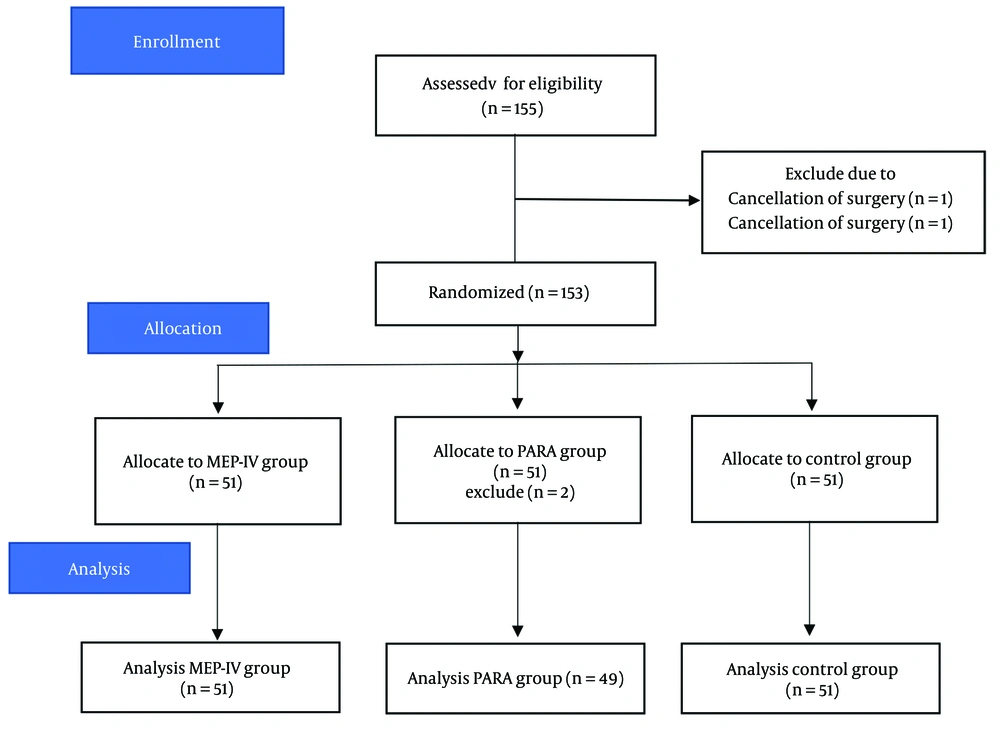
Figure 1.
The study process according to the CONSORT flow diagram
4.2. Demographic and Baseline Characteristics
The mean age was years. Age, height, weight, and body mass index did not differ significantly among the 3 groups. However, statistically significant baseline imbalances were observed. Gravidity was significantly lower in the control group than in the other 2 groups (P = 0.018). Gestational week was also significantly lower in the PARA group than in the control group but did not differ from that in the MEP-IV group (Table 1).
Table 1.
Comparison of Demographic Characteristics Among the 3 Study Groups a
| Variables | PARA (n = 49) | MEP-IV (n = 51) | Control (n = 51) | P-Value |
|---|---|---|---|---|
| Age (y) | 31.98 ± 5.66 | 31.2 ± 5.52 | 33.1 ± 5.84 | 0.240 |
| Height (cm) | 160.86 ± 9.94 | 162.63 ± 5.96 | 160.2 ± 14.7 | 0.555 |
| Weight (kg) | 80.59 ± 13.25 | 79.12 ± 13.32 | 78.43 ± 13.37 | 0.711 |
| BMI | 31.19 ± 5.1 | 29.79 ± 3.94 | 33.22 ± 25.4 | 0.209 |
| Gravidity | 2.37 ± 1.23 | 2.25 ± 0.12 | 1.76 ± 0.71 | 0.009 |
| Pregnancy week | 36.22 ± 2.55 | 37.06 ± 2.79 | 37.51 ± 1.15 | 0.018 |
a Values are expressed as mean ± SD. Abbreviation: BMI, Body Mass Index.
4.3. Hemodynamic Changes
Vital signs, including MAP and HR, were assessed at baseline and at 1, 3, 15, 30, 45, and 60 minutes after the intervention. The corresponding data are summarized in Table 2.
Table 2.
Changes in Mean Arterial Pressure and Heart Rate Among the 3 Groups Over Time a
| Variables and Time | Groups | P-Value | |||||
|---|---|---|---|---|---|---|---|
| PAR | MEP-IV | Control | Three-Group | PARA vs. MEP-IV | PARA vs. Control | MEP-IV vs. Control | |
| Mean arterial pressure (min) | |||||||
| Before | 97.81 ± 14.87 | 96.14 ± 13.8 | 94.81 ± 12.7 | 0.555 | 0.546 | 0.280 | 0.629 |
| 1 | 81.35 ± 19.68 | 92.28 ± 19.8 | 93 ± 13.2 | 0.003 b | 0.036 b | 0.021 b | 0.934 |
| 3 | 75.92 ± 15.52 | 80.0 ± 18.7 | 75.7 ± 16.3 | 0.345 | 0.941 | 0.224 | 0.201 |
| 15 | 77.95 ± 13.79 | 78.72 ± 14.9 | 82.1 ± 11.3 | 0.261 | 0.774 | 0.125 | 0.187 |
| 30 | 77.2 ± 14.98 | 83.43 ± 13.8 | 80.96 ± 13.7 | 0.048 b | 0.029 b | 0.187 | 0.384 |
| 45 | 77.59 ± 12.48 | 85.07 ± 11.4 | 81.52 ± 12.8 | 0.007 b | 0.002 b | 0.092 | 0.146 |
| 60 | 79.04 ± 10.91 | 82.23 ± 11.2 | 82.64 ± 12 | 0.027 b | 0.007 b | 0.116 | 0.284 |
| P-value for comparison over time | < 0.0001 b | 0.013 b | < 0.0001 b | 0.090 c | 0.061 c | 0.045 b, c | 0.542 c |
| Before vs. 1 | -16.46 (-21.85 to -11.07) b | -3.86 (-23.37 to 15.39) | -1.82 (-3.67 to 0.031) | - | - | - | - |
| Before vs. 3 | -21.89 (-27.38 to -16.39) b | -16.09 (-21.33 to -10.84) b | -19.14 (-23.55 to -14.73) b | - | - | - | - |
| Before vs. 15 | -19.86 (-25.85 to -13.86) b | -17.41 (-22.13 to -12.69) b | -12.72 (-17.71 to -7.73) b | - | - | - | - |
| Before vs. 30 | -20.61 (-26.54 to -14.68) b | -12.71 (-16.7 to -8.76) b | -13.85 (-18.79 to -8.91) b | - | - | - | - |
| Heart rate (min) | |||||||
| Before | 99.38 ± 16.86 | 103.1 ± 18.1 | 102.5 ± 16.1 | 0.500 | 0.272 | 0.358 | 0.843 |
| 1 | 101.6 ± 20.74 | 98.27 ± 21.0 | 101.69 ± 17 | 0.628 | 0.401 | 0.981 | 0.287 |
| 3 | 102.4 ± 22.82 | 96.82 ± 19.85 | 92.12 ± 26.42 | 0.019 b | 0.202 | 0.028 b | 0.286 |
| 15 | 99.22 ± 19.95 | 92.25 ± 18.6 | 94.0 ± 19.7 | 0.182 | 0.309 | 0.181 | 0.731 |
| 30 | 94.1 ± 15.95 | 96.35 ± 15.22 | 94.96 ± 17.8 | 0.730 | 0.493 | 0.794 | 0.665 |
| 45 | 90.27 ± 12.98 | 91.45 ± 13.2 | 88.14 ± 13.1 | 0.435 | 0.652 | 0.418 | 0.246 |
| 60 | 85.98 ± 13.17 | 87.94 ± 14.31 | 89.2 ± 12.3 | 0.478 | 0.462 | 0.229 | 0.662 |
| P-value for comparison over time | < 0.0001 b | < 0.0001 b | < 0.0001 b | 0.823 c | 0.833 c | 0.545 c | 0.684 c |
| Before vs. 1 | 2.22 (-4.45 to 8.9) | -4.83 (-12.38 to 2.78) | -0.82 (-4.17 to 2.52) | - | - | - | - |
| Before vs. 3 | 3.02 (-11.51 to 0.49) | -6.28 (-13.45 to 0.48) | -10.39 (-18.5 to -2.27) b | - | - | - | - |
| Before vs. 15 | -0.143 (-6.72 to 6.43) | -10.85 (-14.15 to -2.3) b | -8.51 (-13.84 to -3.18) b | - | - | - | - |
| Before vs. 30 | -5.26 (-11.05 to 0.52) b | -6.75 (-11.4 to -1.83) b | -7.54 (-12.42 to -2.67) b | - | - | - | - |
a Values are expressed as mean ± SD or mean difference (95% CI). Abbreviations: CI, confidence interval; MEP-IV, intravenous meperidine; PARA, intravenous paracetamol.
b Comparison over time between groups.
c Significant at the 0.05 level.
Over time, MAP decreased significantly in all 3 study groups (Figure 2). However, the reduction was more pronounced in the PARA group, with significantly lower values at 1, 45, and 60 minutes after the intervention (Table 2).
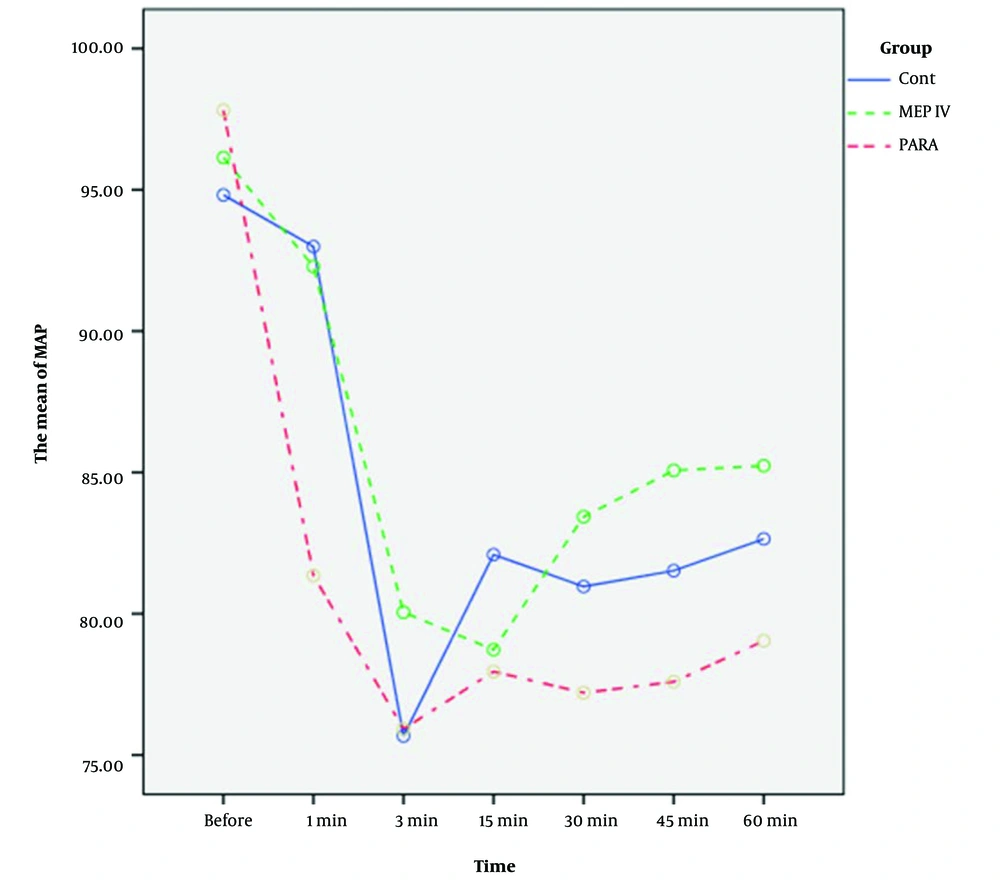
Figure 2.
Changes in mean arterial pressure over time by study group
Repeated-measures analysis of variance for HR did not reveal statistically significant differences in HR changes over time among the groups (P = 0.823). The MEP-IV and control groups showed reductions in HR after the intervention, whereas the PARA group showed a transient increase followed by a progressive decline (Figure 3).
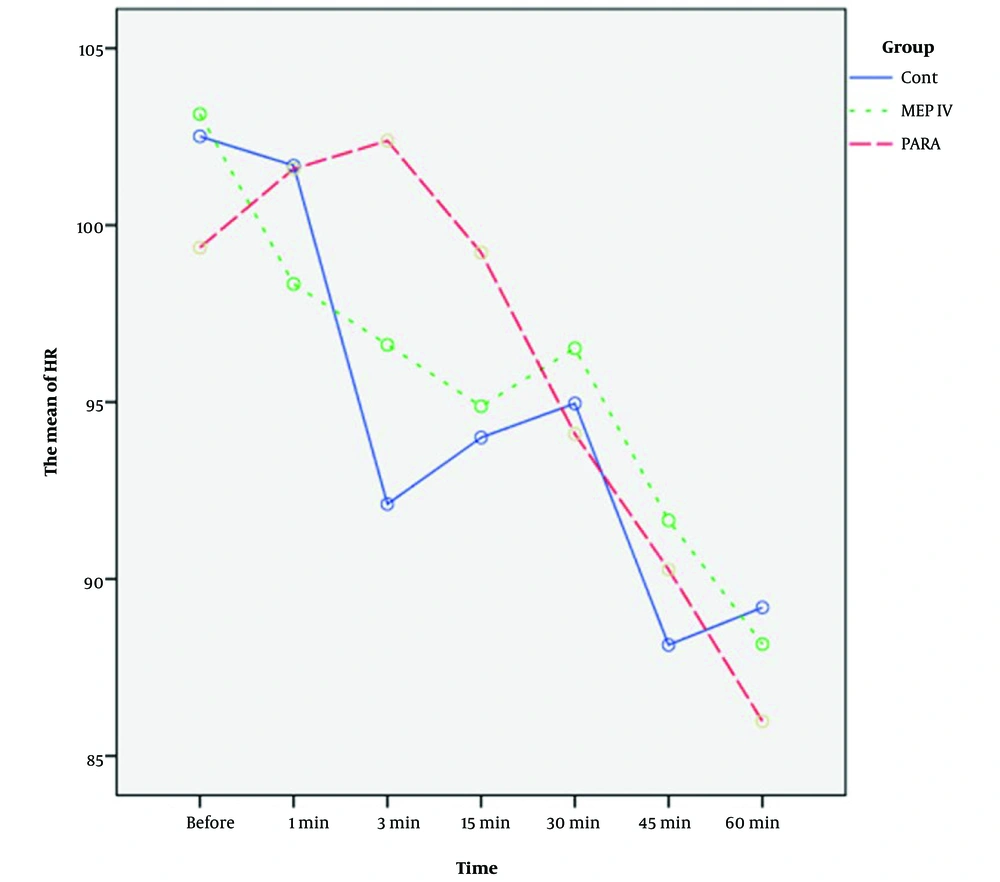
Figure 3.
Changes in mean heart rate over time by study group
Analysis of MAP over time did not show a significant overall difference among the 3 groups (P = 0.09). However, pairwise comparisons revealed statistically significant differences between the PARA group and the control group. As shown in Figure 2, the PARA group exhibited a more pronounced decrease in MAP over time than did the control group.
4.4. Shivering Outcomes and Temperature
Shivering time in the PARA group was significantly shorter than that in the other 2 groups (P = 0.001). Temperature comparisons revealed significant baseline differences among the groups (P < 0.0001): The PARA group was warmer than the MEP-IV group, which was warmer than the control group. Pairwise comparisons showed a significant difference between the PARA and control groups (P < 0.0001), but no significant differences between the PARA and MEP-IV groups (P = 0.083) or between the MEP-IV and control groups (P = 0.175). During shivering, temperature differences were no longer significant overall (P = 0.122), with identical values in each group and no significant pairwise differences (Table 3).
Table 3.
Clinical Characteristics Related to Shivering Among Patients in the 3 Treatment Groups a
| Variables | Groups | P-Value | |||||
|---|---|---|---|---|---|---|---|
| PARA | MEP-IV | Control | Three-Group | PARA vs. MEP-IV | PARA vs. Control | MEP-IV vs. Control | |
| Shivering | |||||||
| Yes | 24 (49) | 17 (33.3) | 25 (49) | 0.146 | 0.105 | 0.998 | 0.159 |
| No | 25 (51) | 34 (66.7) | 26 (51) | ||||
| Shivering intensity | |||||||
| No to mild shivering (grade 0 - 1) | 35 (71.4) | 36 (70.6) | 37 (72.5) | 0.976 | 0.926 | 0.901 | 0.826 |
| Moderate to very severe shivering (grade 2 - 4) | 14 (28.6) | 15 (29.4) | 14 (27.5) | ||||
| Time of shivering, median (IQR) | 5 (0, 45) | 45 (37.5, 60) | 45 (33.75, 45) | < 0.001 | < 0.001 | < 0.001 | 0.091 |
| Temperature before intervention | 37.11 ± 0.17 | 37.02 ± 0.26 | 36.94 ± 0.14 | < 0.0001 | 0.083 | < 0.0001 | 0.175 |
| Temperature during shivering | 36.98 ± 0.23 | 36.97 ± 0.21 | 36.85 ± 0.18 | 0.122 | 0.998 | 0.493 | 0.137 |
a Values are expressed as No. (%) or mean ± SD. Abbreviations: IQR, interquartile range; MEP-IV, intravenous meperidine; PARA, intravenous paracetamol.
4.5. Demographic and Clinical Associations With Shivering
Associations between demographic and clinical variables and shivering incidence and shivering intensity were analyzed independently in each group. Because no participants in the PARA group had shivering intensity grade 3 or 4, a comprehensive analysis of the effects of the studied variables on shivering intensity in this group was not feasible.
The results showed no statistically significant correlations between any evaluated demographic or clinical variables and shivering incidence or shivering intensity in any of the 3 groups, as detailed in Table 4. These findings suggest that participant demographic and clinical characteristics did not notably affect shivering responses.
Table 4.
Relationship Between Demographic and Clinical Variables and Shivering Incidence and Intensity by Group a
| Groups and Independent Variables | Shivering (Yes) | Shivering Intensity | ||
|---|---|---|---|---|
| OR | 95% CI | OR | 95% CI | |
| PARA | ||||
| Age | 1.068 | 0.962 to 1.186 | - | - |
| BMI | 1.013 | 0.907 to 1.132 | - | - |
| Gravidity | 1.392 | 0.856 to 2.264 | - | - |
| Pregnancy week | 0.954 | 0.763 to 1.195 | - | - |
| Changes in MAP at 1 min | 1.025 | 0.991 to 1.060 | - | - |
| Changes in MAP at 3 min | 1.008 | 0.979 to 1.039 | - | - |
| Changes in MAP at 15 min | 0.017 | 0.988 to 1.046 | - | - |
| Changes in HR at 1 min | 1.016 | 0.990 to 1.043 | - | - |
| Changes in HR at 3 min | 0.993 | 0.968 to 1.018 | - | - |
| Changes in HR at 15 min | 1.027 | 0.997 to 1.058 | - | - |
| MEP-IV | ||||
| Age | 0.982 | 0.883 to 1.092 | 1.057 | 0.821 to 1.361 |
| BMI | 1.021 | 0.879 to 1.185 | 0.776 | 0.496 to 1.214 |
| Gravidity | 0.667 | 0.326 to 1.366 | 1.948 | 0.308 to 12.306 |
| Pregnancy week | 0.989 | 0.803 to 1.218 | 0.880 | 0.545 to 1.421 |
| Changes in MAP at 1 min | 1.003 | 0.995 to 1.013 | 0.997 | 0.979 to 1.015 |
| Changes in MAP at 3 min | 0.958 | 0.924 to 0.993 b | 1.064 | 0.938 to 1.207 |
| Changes in MAP at 15 min | 0.998 | 0.963 to 1.033 | 1.034 | 0.941 to 1.136 |
| Changes in HR at 1 min | 1.020 | 0.994 to 1.047 | 1.027 | 0.969 to 1.088 |
| Changes in HR at 3 min | 1.010 | 0.984 to 1.036 | 1.088 | 0.974 to 1.215 |
| Changes in HR at 15 min | 0.980 | 0.948 to 1.012 | 0.981 | 0.913 to 1.054 |
| Control | ||||
| Age | 1.026 | 0.93 to 1.13 | 1.054 | 0.86 to 1.28 |
| BMI | 1.07 | 0.89 to 1.13 | 0.861 | 0.62 to 1.18 |
| Gravidity | 1.302 | 0.59 to 2.87 | 0.223 | 0.02 to 1.89 |
| Pregnancy week | 1.184 | 0.72 to 1.94 | 2.835 | 0.79 to 18.59 |
| Changes in MAP at 1 min | 1.004 | 0.92 to 1.09 | 1.007 | 0.83 to 1.21 |
| Changes in MAP at 3 min | 1.012 | 0.98 to 1.05 | 0.98 | 0.92 to 1.06 |
| Changes in MAP at 15 min | 0.993 | 0.96 to 1.03 | 1.005 | 0.01 to 1.06 |
| Changes in HR at 1 min | 0.969 | 0.90 to 1.02 | 1.008 | 0.90 to 1.11 |
| Changes in HR at 3 min | 0.996 | 0.981 to 1.01 | 0.996 | 0.95 to 1.04 |
| Changes in HR at 15 min | 1.013 | 0.982 to 1.04 | 1.02 | 0.96 to 1.07 |
a Abbreviations: BMI, Body Mass Index; CI, confidence interval; HR, heart rate; MAP, mean arterial pressure; MEP-IV, intravenous meperidine; OR, odds ratio; PARA, intravenous paracetamol.
b Significant at the 0.05 level.
5. Discussion
Shivering remains a common complication of neuraxial anesthesia for cesarean delivery. This randomized, double-blind trial compared the prophylactic efficacy of IV paracetamol with that of IV meperidine for the prevention of shivering during cesarean delivery under spinal anesthesia.
In our study, the overall incidence of shivering did not differ significantly among the 3 groups. Although the incidence was numerically lower in the meperidine group, this difference did not reach statistical significance. These findings are generally consistent with previous reports describing the anti-shivering properties of meperidine, which are believed to result from its central opioid and adrenergic effects on thermoregulatory pathways (6, 13, 20).
Despite the lack of a significant reduction in the overall incidence of shivering, IV paracetamol appeared to modify the clinical characteristics of shivering. In particular, the paracetamol group demonstrated a significantly delayed onset of shivering, and no cases of severe shivering, defined as grade 3 or 4, were observed. These findings support the proposed mechanism by which paracetamol acts through central inhibition of cyclooxygenase pathways and modulation of the hypothalamic thermoregulatory set point (15, 16).
Recent clinical studies have investigated additional pharmacologic strategies for shivering prevention in perioperative settings. For example, dexmedetomidine has been reported to reduce postoperative shivering through its central α2-adrenergic effects (1). Comparative investigations have also examined the relative efficacy and systemic safety of intrathecal meperidine and IV acetaminophen in obstetric spinal anesthesia. In addition, recent research has explored dexamethasone as a potential adjunctive agent for shivering prophylaxis in obstetric patients. These studies highlight the growing interest in opioid-sparing strategies for shivering management.
Regarding hemodynamic variables, HR did not differ significantly among the groups during the study period. A more pronounced early reduction in MAP was observed in the paracetamol group. However, this decrease was transient, clinically well tolerated, and did not lead to increased vasopressor requirements. Therefore, the observed change in MAP should be interpreted cautiously and does not appear to compromise the overall hemodynamic safety profile of IV paracetamol.
Baseline temperature imbalances among groups represent an important limitation of the present study and may have influenced the observed incidence of shivering. Although temperatures during shivering episodes were not significantly different, the baseline differences suggest the possibility of imperfect randomization or environmental influences. Additionally, baseline differences in gravidity and gestational week were observed among groups. However, multivariable analysis did not demonstrate a significant association between these variables and shivering outcomes.
Overall, our findings suggest that IV paracetamol may represent a useful non-opioid option for perioperative shivering management. Although it did not significantly reduce the overall incidence of shivering, its association with delayed onset and lower shivering severity may provide clinically relevant benefits.
5.1. Limitations
Several limitations of this study should be acknowledged. First, baseline differences in body temperature were observed among the study groups, which could potentially influence the incidence of shivering. These differences may reflect environmental factors or imperfect randomization. Second, baseline imbalances in gravidity and gestational age were identified among groups. Although no significant associations were found between these variables and shivering outcomes, they remain potential confounding factors. Finally, the study was conducted at a single center, which may limit the generalizability of the findings to other populations or clinical settings.
5.2. Conclusions
Although IV paracetamol did not significantly reduce the overall incidence of shivering compared with meperidine or placebo, it was associated with delayed onset and lower severity of shivering. These findings suggest that IV paracetamol may serve as a potential non-opioid option for shivering management during cesarean delivery under spinal anesthesia, although further studies are warranted.