
1. Background
Blood loss reduction and hemodynamic stability are important in spinal surgeries. In some cases, blood loss increases to the extent that transfusion of blood and blood products is necessary (1).
Blood loss reduction helps achieve stable hemodynamics in the patient and provide a blood-free surgical field and better visibility for the surgeon. The latter is of crucial importance in spinal surgeries due to close proximity to the nervous system. Furthermore, improved visibility reduces the duration of operation and subsequently leads to less blood loss (2). In addition, blood loss reduction decreases the need for transfusion of blood and blood products, which, in turn, reduces its side effects such as hemolytic and non-hemolytic transfusion reactions.
One way to prevent hemodynamic instability and reduce intraoperative blood loss is to use α2 agonist drugs such as clonidine and dexmedetomidine (3). The administration of these drugs either orally before the surgery or intravenously during the surgery has proven to be useful in maintaining hemodynamic stability (4). The α2 agonist drugs are sympatholytic and affect the central receptors to reduce peripheral norepinephrine release by the stimulation of prejunctional inhibitory α2 adrenoceptors (5).
2. Objectives
In this study, we compared the effects of oral clonidine premedication and intraoperative dexmedetomidine in blood loss reduction in elective spinal surgery.
3. Methods
This randomized, double-blind clinical trial was carried out in 120 patients undergoing spine surgery. The study was approved by the Ethics Committee of Ahvaz Jundishapur University of Medical Sciences, Ahvaz, Iran, with IRCT registration number IRCT2016011225982N1. The inclusion criteria were having an age of 20 to 50 years, ASA class I or II, and spine surgery. The exclusion criteria included patients with hypertension, diabetes, pregnancy, coagulation disorders, ischemic heart disease, history of beta-blockers or calcium channel blockers intake, drug or alcohol abuse, and the operating time of over 150 minutes.
The patients were randomly divided into three groups. Group C received oral clonidine 0.2 mg tablets, 90 minutes before entering the room and 100 cc saline as placebo 15 minutes before anesthesia induction. Group D received placebo pills and 0.5 µ/kg dexmedetomidine 15 minutes before anesthesia induction for 10 minutes in 100 cc saline infusion and 0.25 µ/kg/h continuous infusions during the operation. Group P received placebo tablets and 100 cc saline infusion 15 minutes before anesthesia induction and during the operation as the control group.
All patients were monitored before starting anesthesia with standard monitoring (ECG monitoring, pulse oximetry, and noninvasive blood pressure monitoring). They received 7 cc/kg ringer solution using a peripheral IV line. General anesthesia was induced with midazolam 0.05 mg/kg, fentanyl 3 mcg/kg, sodium thiopental 5 mg/kg, and atracurium0.5 mg/kg. The anesthesia was maintained using 1% isoflurane in the oxygen and N2O mixture. In addition to standard monitoring, a radial arterial line was inserted. Heart rate, systolic, diastolic, and mean arterial pressure were monitored before intubation as the baseline and after intubation, 15, 30, and 60 minutes after starting the surgery, and after extubation.
The amount of intraoperative blood loss was estimated based on the volume of blood in the suction bottle and the number of the blood-soaked gauze pads (20 mL for a completely blood-soaked gauze and 50 mL for a completely blood-soaked long gauze). Recording of the vital signs and the amount of blood loss in each patient was done by an assistant anesthesiologist who was unaware of the study groups.
3.1. Statistical Analysis Methods
The data are reported based as means ± standard deviation. The significance level was set at P < 0.05. In order to compare the obtained data between the groups, the normal distribution of data was studied using the analysis of variance (ANOVA) and chi-square tests. All statistical analyses were performed using SPSS software (version 19).
4. Results
In this clinical study, two patients from group D were excluded due to severe bradycardia and one patient from group P due to hypertension and using nitroglycerin during the surgery.
The demographic characteristics such as age, gender, weight, and ASA class were not significantly different between the three groups and the duration of surgery was the same in the study groups (109.55 ± 11.46, 107.31 ± 12.59, 107.63 ± 889 minutes, respectively; P = 0.2935) (Table 1).
Table 1.
Demographic Profile and Duration of Surgeries (Means ± SD)
| Variable | Group C | Group D | Group P | P Value |
|---|---|---|---|---|
| Age, y | 39.9 ± 8.37 | 40.1 ± 2.31 | 42.0 ± 4.54 | 0.1833 |
| Sex, female: male | 29: 11 | 34: 6 | 32: 8 | 0.6055 |
| Weight, Kg | 67.65 ± 5.32 | 68.30 ± 4.12 | 67.81 ± 6.32 | 0.8215 |
| ASA grade, I: II | 33: 7 | 36: 4 | 34: 6 | 0.7069 |
| Duration of surgery, min | 109.55 ± 11.46 | 107.31 ± 12.59 | 107.63 ± 889 | 0.2935 |
Abbreviations: Group C, clonidine group; Group D, dexmedetomidine group; Group P, control group.
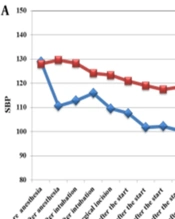
The changes in heart rate, systolic, diastolic, and mean arterial blood pressure in the three groups were compared. No statistically significant difference was observed between the groups of clonidine and dexmedetomidine at different stages of the surgery (P > 0.05), whereas there was a significant difference between the mentioned groups and the control group (P < 0.05) (Tables 2-5).
Table 2.
Changes in the Heart Rate (bpm) in the Three Groups (Means ± SD)
| Heart Rate (bpm) | Group C | Group D | Group P | P Value |
|---|---|---|---|---|
| Baseline | 81.70 ± 6.31 | 94.35 ± 6.48 | 88.30 ± 8.59 | 0.71738 |
| After intubation | 82.95 ± 6.68 | 81.40 ± 6.71 | 112.25 ± 6.85 | 0.00001 |
| 15 minutes after starting surgery | 76.10 ± 7.21 | 74.65 ± 7.03 | 93.66 ± 10.34 | 0.00009 |
| 30 minutes after starting surgery | 73.80 ± 10.25 | 70.95 ± 8.51 | 83.60 ± 11.03 | 0.00051 |
| 60 minutes after starting surgery | 71.15 ± 11.01 | 68.10 ± 9.24 | 85.80 ± 9.62 | 0.00023 |
| After extubation | 77.75 ± 8.03 | 71.95 ± 8.68 | 109.55 ± 7.34 | 0.00001 |
Abbreviations: Group C, clonidine group; Group D, dexmedetomidine group; Group P, control group.
Table 3.
Changes in Systolic Arterial Pressure (mmHg) in the Three Groups (Means ± SD)
| SAP | Group C | Group D | Group P | P Value |
|---|---|---|---|---|
| Baseline | 126.92 ± 7.32 | 138.05 ± 8.12 | 134.80 ± 8.82 | 0.46557 |
| After intubation | 118.80 ± 6.49 | 111.43 ± 6.45 | 142.50 ± 8.62 | 0.00001 |
| 15 minutes after starting surgery | 104.50 ± 9.36 | 101.30 ± 6.20 | 114.05 ± 7.13 | 0.00073 |
| 30 minutes after starting surgery | 98.80 ± 6.68 | 92.35 ± 7.82 | 104.10 ± 7.35 | 0.00031 |
| 60 minutes after starting surgery | 98.95 ± 7.82 | 95.85 ± 8.37 | 109.35 ± 7.03 | 0.00012 |
| After extubation | 110.55 ± 7.34 | 106.60 ± 10.57 | 138.75 ± 10.46 | 0.00001 |
Abbreviations: Group C, clonidine group; Group D, dexmedetomidine group; Group P, control group; SAP, systolic arterial pressure.
Table 4.
Changes in Diastolic Arterial Pressure (mmHg) in the Three Groups (Means ± SD)
| DAP | Group C | Group D | Group P | P Value |
|---|---|---|---|---|
| Baseline | 77.11 ± 9.83 | 81.41 ± 7.35 | 82.20 ± 9.77 | 0.97670 |
| After intubation | 75.80 ± 10.31 | 74.35 ± 3.64 | 83.25 ± 10.67 | 0.00011 |
| 15 minutes after starting surgery | 71.85 ± 6.23 | 68.35 ± 8.86 | 77.35 ± 9.15 | 0.00327 |
| 30 minutes after starting surgery | 65.10 ± 6.28 | 66.40 ± 8.11 | 76.10 ± 9.60 | 0.00531 |
| 60 minutes after starting surgery | 69.55 ± 6.44 | 67.85 ± 8.25 | 74.25 ± 7.21 | 0.00102 |
| After extubation | 70.05 ± 7.01 | 72.85 ± 9.49 | 81.25 ± 9.39 | 0.00001 |
Abbreviations: DAP, diastolic arterial pressure; Group C, clonidine group; Group D, dexmedetomidine group; Group P, control group.
Table 5.
Changes in Mean Arterial Pressure (mmHg) in the Three Groups (Means ± SD)
| MAP | Group C | Group D | Group P | P Value |
|---|---|---|---|---|
| Baseline | 92.50 ± 9.54 | 94.25 ± 8.03 | 94.60 ± 9.63 | 0.79895 |
| After intubation | 85.85 ± 8.83 | 81.25 ± 7.87 | 102.45 ± 9.57 | 0.00017 |
| 15 minutes after starting surgery | 74.75 ± 11.10 | 76.50 ± 6.85 | 101.40 ± 8.18 | 0.00001 |
| 30 minutes after starting surgery | 73.75 ± 6.07 | 73.70 ± 6.84 | 87.15 ± 8.36 | 0.00694 |
| 60 minutes after starting surgery | 71.70 ± 6.49 | 69.15 ± 6.66 | 79.95 ± 6.70 | 0.00701 |
| After extubation | 85.60 ± 6.68 | 79.10 ± 8.93 | 96.75 ± 7.99 | 0.00001 |
Abbreviations: Group C, clonidine group; Group D, dexmedetomidine group; Group P, control group; MAP, mean arterial pressure.
Table 6.
Intraoperative Bleeding (mL) in the Three Groups (Means ± SD)
| Group C | Group D | Group P | P Value | |
|---|---|---|---|---|
| Intraoperative bleeding, mL | 289.3 ± 130 | 344.7 ± 145 | 462.3 ± 115 | 0.00101 |
Abbreviations: Group C, clonidine group; Group D, dexmedetomidine group; Group P, control group.
The results showed the amount of intraoperative bleeding was significantly different between the three groups. There was a significant reduction in intraoperative blood loss in patients who received clonidine (289 ± 130 mL) and dexmedetomidine (344 ± 145 mL) compared to the control group (462 ± 15 mL) (P = 0.001) (Table 6).
5. Discussion
Intraoperative bleeding was one of the main variables in this study. Therefore, the effect of dexmedetomidine and clonidine on intraoperative bleeding was compared in spinal surgeries (1).
Javaherforooshzadeh et al. evaluated the amount of bleeding and hemodynamic changes between dexmedetomidine infusion and remifentanil infusion for controlled hypotensive anesthesia in lumbar discopathy surgery; they found no significant difference regarding hemodynamic changes and blood loss (6).
Somayaji and Raveendra evaluated the effect of dexmedetomidine on blood loss in functional endoscopic sinus surgery. The results showed hemodynamic stability with minimizing intraoperative blood loss (7).
Rahimzadeh et al. showed lower intraoperative blood pressure, heart rate, and bleeding in patients receiving dexmedetomidine versus remifentanil for posterior spinal fusion surgery (8).
Singh investigated the effects of prescribing clonidine compared to atenolol for creating better visibility during surgery, reducing the amount of intraoperative blood loss, and maintaining hemodynamic stability in nose surgeries under general anesthesia. The results showed a lower amount of blood loss in the group taking clonidine (P < 0.001) and thus, better visibility during the operation was achieved (9).
Taghipour Anvari et al. conducted a study on the effect of clonidine premedication on decreasing intraoperative bleeding in spinal surgeries. In this study, the amounts of intraoperative bleeding and prescribed narcotic were significantly lower in the group receiving clonidine than in the placebo group (P < 0.001) (10).
The study by Ibraheim et al. supported this claim by comparing the results of prescribing esmolol and dexmedetomidine in intraoperative bleeding and hemodynamic changes in patients undergoing scoliosis operation. The results indicated that adding dexmedetomidine and esmolol to anesthetic drugs would result in equally stabilized hemodynamics and reduced the intraoperative bleeding in patients undergoing scoliosis operation. The amount of bleeding was significantly lower in the dexmedetomidine group than in the group taking esmolol (P < 0.001) (11).
Ebneshahidi and Mohseni performed a study on the effects of oral clonidine on reducing the intraoperative blood loss and maintaining hemodynamic stability in cesarean sections under general anesthesia. The results showed that the amount of intraoperative blood loss and using opioid were significantly lower in the group receiving clonidine compared to the control group receiving placebo pills (P < 0.001) (12).
The findings of our study showed that dexmedetomidine and clonidine are both effective in lowering intraoperative bleeding compared to the control group. Clonidine was more effective than dexmedetomidine and the difference between the two groups was significant (P < 0.001).
Other factors that affect intraoperative bleeding are the surgeon's experience, the patient's position during the operation, and putting the proper rolls. In our study, all these factors were taken into account and remained unchanged in various groups; therefore, their effects on the findings were not significant. Additionally, patients with bleeding disorders were not included in the study. Therefore, the most effective ways that decreased the intraoperative bleeding were preventing excessive sympathetic activity, reducing the effects of sudden catecholamine release, and maintaining hemodynamic stability during the operation.
5.1. Conclusions
This survey indicates that the use of both dexmedetomidine and clonidine, as α2 agonist drugs, was equally effective in maintaining the hemodynamic stability in patients during the operation. These drugs do not have severe side effects with appropriate dose administration and good monitoring. Additionally, the use of these drugs resulted in less intraoperative bleeding. In this study, clonidine effect on bleeding reduction was more significant than the effect of dexmedetomidine.