
1. Background
Warts, as very common disorders, can even be debilitating and very painful in some cases. They are thick hyperkeratotic lesions created by the human papillomavirus (HPV) (1) and are more common in children and young adults. Their prevalence is 2 - 20% in children in different societies (2). Diagnosis and treatment of the disease in terms of cosmetics, prevention of the further spread of warts, and differential diagnoses, are crucial in this regard (3). Various treatments are used to remove warts, including two main treatment groups, topical and surgical (4). Topical treatments are not often accepted by patients owing to the need for skin allergy and continuous use (3, 4).
Furthermore, surgical treatments have become ineffective owing to the fear of surgery, complications, such as surgical scars, and the possibility of wart recurrence (3, 4). Therefore, researchers seek to find effective and less-complicated treatment methods for warts, especially treatment-resistant ones (3). Some of these treatment methods include CO2 laser and trichloroacetic acid (TCA) (5, 6). However, none of the treatment methods had 100% effectiveness, and there is still a possibility of recurrence of warts even with all treatment methods (7).
A review study by Ockenfels and Hammes in Germany in 2008 reported that CO2 laser was the best ablative treatment method for warts, especially warts resistant to other treatments, and it had up to 75% therapeutic effectiveness (8). In a study by Azizjalali et al. in Iran in 2012 (9), 160 patients with genital warts were classified into two groups, those receiving CO2 laser and cryotherapy with TCA and 95% of patients in the CO2 group, and 46.2% in the TCA group had improvement. Furthermore, the recurrence rate was lower in patients treated with the laser than in the TCA group (9). Takac conducted a study in Croatia in 2000 and investigated the effectiveness of CO2 laser in the treatment of warts, obtaining good results in patients with relatively shorter complete remission periods and no side effects, especially pain after the treatment (10). Serour and Somekh examined 40 children with treatment-resistant warts in Israel in 2003 and treated them with a CO2 laser (11). In a study by Lim and Goh in Singapore in 1992, 40 patients with warts were treated with CO2 laser, and the 10-month efficacy rate was 57.4%, and there was no significant treatment complication (12). According to Pezeshkpoor et al., 62 patients were treated with 35% and 80% TCA in Iran, with 46.7% responding to treatment in the 80% group and 12% responding to treatment in the 35% group (13). In a study by Taner et al. in Turkey, 51 patients with genital warts were treated with 85% TCA, and all patients had good treatment responses to TCA (14). Godley et al. treated patients with warts with TCA in England in 1988 and reported good treatment efficacy and few complications (15). The present study compared the effects of CO2 laser and trichloroacetic acid in the treatment of warts in patients who visited Khanevadeh Hospital from October 2013 to October 2014.
2. Objectives
Given the different wart treatment methods in the world and as none of the treatment methods are 100% effective and warts cause complications for patients, the present study aimed to compare the two treatment methods, CO2 laser and trichloroacetic acid, in terms of the efficacy and side effects of the treatment in patients with warts who visited Khanevadeh Hospital.
3. Methods
The present interventional study had a double-blind, randomized clinical trial type. A sample size of 60 individuals was included in the study according to the results of previous studies that indicated the efficacy of 95% and 45% in the CO2 and TCA laser groups based on the statistical formula. Therefore, 60 patients with warts who visited Khanevadeh Hospital from October 2013 to October 2014 and were diagnosed with a dermatologist were included in the study. The patients were classified into two groups after matching the lesions based on the number, size, and location of lesions. Patients with a history of a weak immune system, use of immunosuppressive drugs, a history of taking viral topical medicines in the previous two weeks, pregnancy, breastfeeding, and use of destructive treatments were excluded from the study (Figure 1). A group of patients was treated with CO2 laser, and the other group was treated with 80% TCA. Images were taken from lesions before treatment. Two weeks after the treatment, the patients were re-examined, and the lesions were imaged again. A dermatologist, without any information about treatment methods, determined the efficacy of the CO2 laser and 80% TCA treatment by taking all images before and after the treatment. The side effects of the two treatment methods were also compared. The efficacy of the treatment was determined based on each lesion as follows: Mild (reduction in the number of lesions by less than 50%), moderate (reduction in the number of lesions by more than 50%), and complete (complete remission and return of skin scars or creation of scars without the presence of a warty lesion).
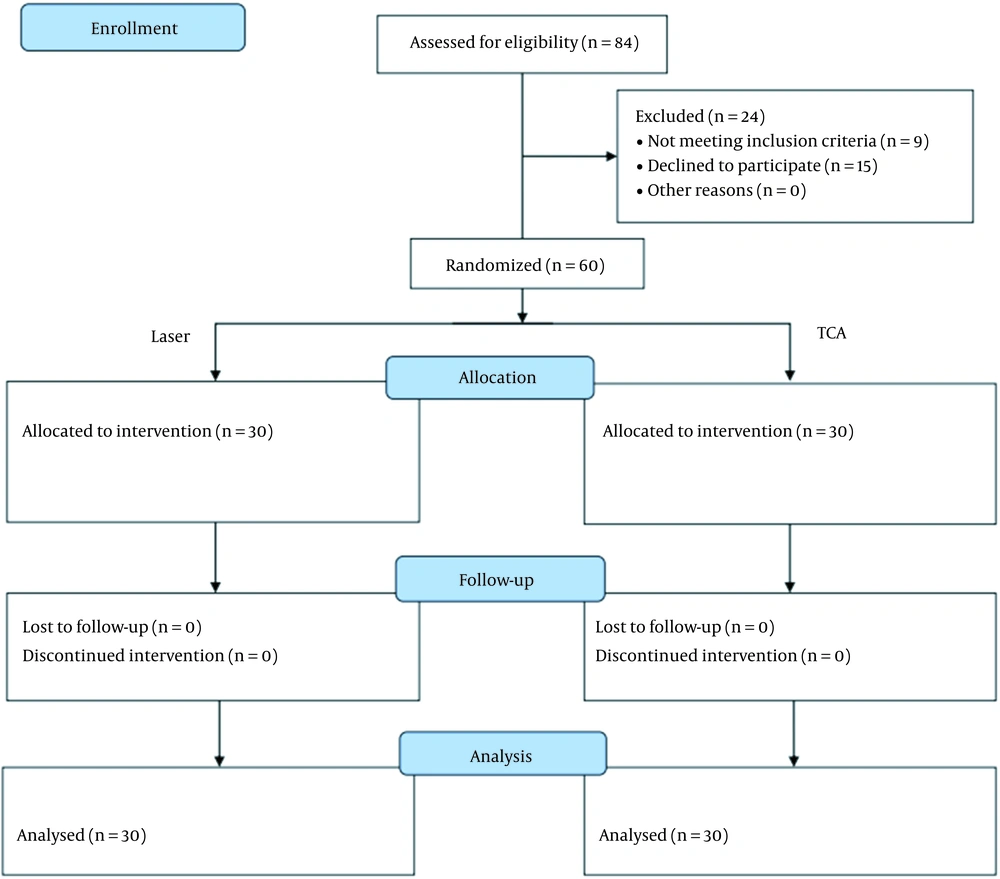
Figure 1.
RCT flow diagram
According to the Helsinki Accords, the study was conducted with consent and written consent from all patients. After data collection, data were analyzed by SPSS 22. Statistical tests, including the Fisher's test, chi-square test, and independent t-test, were used in this study, and a P-value < 0.05 was considered significant for interpreting relationships among variables.
4. Results
A total of 60 patients with warts were evaluated in the study, and all of them were male. Their mean age was 21 years, with a standard deviation of 2.5 years. Regarding wart location, 33.3% were on foot, 63.3% on the hands, and 3.3% on the neck. The number of wart lesions was matched in the two groups before starting the treatment. The average number of lesions was 3.7 in the laser-treated group and 3.73 in the TCA-treated group. In terms of the complete efficacy of the treatment and fading of the lesions in the two groups, which a dermatologist did by comparing the images before and after the treatment, the efficacy was 56.7% in the group treated with CO2 laser and 20% in the group treated with TCA, indicating a statistically significant difference (P = 0.005). There was no treatment complication in any of the two groups.
5. Discussion
Researchers are looking for effective and less complicated ways to treat warts. The CO2 laser and TCA are among these methods (5, 6). Since each of these methods has its efficacy and side effects, identifying and introducing effective treatment requires conducting interventional clinical trials. Therefore, the present study compared the effects of CO2 laser and TCA on the treatment of warts in patients who visited Khanevadeh Hospital from October 2013 to October 2014. It was found that the complete efficacy rate was 56.7% in the laser group and 20% in the TCA group, indicating a statistically significant difference. The two treatment methods showed no side effects. In a survey by Azizjalali et al. in Iran in 2012, 106 patients with external genital warts were divided into two groups. Each group consisted of 80 patients treated with CO2 laser or cryotherapy. Clearance and recurrence rates were evaluated for three months. Complete clearance was achieved in 76 lesions (95%) treated by CO2 laser and 37 lesions (46.2%) treated by cryotherapy, which was significantly different (P < 0.001). In the CO2 laser group, lesions required only one treatment to be removed, while in the cryotherapy group, lesions required two (12%) even up to three (12.2%) treatments for some patients to be removed completely. Laser therapy was associated with less recurrence rate than cryotherapy (0.05% vs. 0.18%) (9). In our study, the CO2 laser showed better efficacy than TCA. In a study by Qayum et al. in Pakistan in 2022, 90 patients with anogenital warts were treated with 100% TCA and had an efficacy of 82.2%, which was higher than our study, but 100% TCA was used in this study (16).
In a randomized controlled trial investigating Verruca plana in children and adults, weekly applications of TCA were compared with weekly cryotherapy sessions over eight weeks. The investigators observed total remission in 85.7% of participants treated with 10% TCA, 92.6% treated with 25% TCA, and 92% treated with cryotherapy (17). However, the response rate was lower in our study. A recent small randomized controlled trial comparing CO2 laser with cryotherapy demonstrated no significant difference in the resolution of warts in both groups; the remission rate was 89.7% in the laser group and 70.4% in the cryotherapy group (P = 0.069) (18). The response rate of the laser group in our study was 56.7%. Scarring, hypopigmentation, postoperative pain, and prolonged wound healing are adverse effects of CO2 laser (19). In our study, no complication was observed in any patient.
Pezeshkpoor et al. compared the efficacy of 80% TCA and 35% TCA in the treatment of common warts. At the end of the six-week study, 46.7% of participants achieved a good response (> 75% of lesions cleared) in the 80% TCA group compared to 12% in the 35% TCA group (13). The results were consistent with our study. Newer modalities of laser therapy, such as pulsed dye lasers (PDL), are more subtle and can destroy the dilated superficial capillaries rather than the tissue itself and reduce complications. Pulsed dye lasers therapy has been used to treat simple and recalcitrant common, palmar, plantar, and flat warts, with variable remission rates ranging from 47% to 100% (19). In this study, we used a CO2 laser.
In light of the findings of this study, lasers were far more effective than TCA in treating warts; therefore, lasers can be recommended for wart treatment due to their safety and efficacy.