
1. Background
Running is a widely popular physical activity in the United States, with approximately 30 million individuals using it for exercise, including around 10 million who engage in regular running (1) A comprehensive study on lower limb injuries related to running, which analyzed approximately 2000 cases, revealed that the highest percentage of injuries (42.1%) occurred in the knee, followed by the ankle (16.9%) (2). Stress fractures are a prevalent concern among athletic individuals, with reported rates ranging from 1.5% to 31% (3). Remarkably, among runners, stress fractures can account for up to 50% of all reported injuries (2). These fractures result from repetitive loading on the bones, impeding their effective remodeling during training (4).
Numerous risk factors contribute to the increased incidence of stress fractures, including gender, low bone density, exercise surfaces and techniques, and footwear (5). It has been noted that specific types of footwear, such as certain sports shoes or poorly constructed footwear like boots, can amplify the excessive load on biological tissues (6). An important factor contributing to the elevated injury rates in runners and military personnel is the excessive external load they endure (7).
The characteristics of footwear appear to influence changes in muscle activity (8, 9). Muscles can adapt their firing patterns in response to footwear and external loads, with the goal of absorbing shock and protecting the body’s structures (10, 11). For example, a muscle may initiate or delay its activation as a preemptive measure, or it may prolong its activity. However, when these adaptations exceed reasonable limits, they can subject the involved structures to excessive stress, making them more susceptible to injury (12).
Military boots are typically constructed with soles made of rubber or materials like polyurethane (PU) and thermoplastic polyurethane (TPU) (13). Advanced materials such as Vibram, known for their high-performance rubber properties, are frequently used in the soles of premium brands. Additionally, Poron XRD, a type of PU, is commonly employed as a metatarsal protection foam due to its ability to provide firmness during high-velocity impacts (14). However, there is currently no documented research on how Iranian military boots specifically affect the electromyography activity of lower limb muscles during running. Therefore, the primary focus of this study was to investigate how TPU and rubber military boots impact the activity of lower limb muscles during running.
2. Objectives
The aim of this study was to evaluate the effects of wearing military boots made of TPU and Rubber over a period of six months on the muscle activities in the lower limbs during running.
3. Methods
3.1. Participants
The research methodology employed was quasi-experimental and conducted in a laboratory setting. Sample size estimation was performed using G*Power, considering an alpha level of 0.05, a statistical power of 95%, and an effect size of 0.70 based on a previous study related to muscle activities (15). The analysis indicated that a minimum of 15 participants in each group would be required to detect significant interaction effects. Therefore, a total of 30 individuals aged 20 - 25 years were selected using convenience sampling. The participants were divided into two groups: One with 15 individuals wearing rubber boots and the other with 15 individuals wearing TPU boots (Table 1).
Table 1.
Group-Specific Anthropometric Characteristics of Our Participants a
| Anthropometric Characteristics | Groups | P-Value | |
|---|---|---|---|
| Rubber | Thermoplastic Polyurethane | ||
| Age, y | 21.60 ± 1.49 | 22.3 ± 1.7 | 0.128 |
| Height | 179.49 ± 4.14 | 162.3 ± 6.5 | 0.346 |
| Body mass, kg | 69.16 ± 12.46 | 62.4 ± 9.3 | 0.166 |
a Values are expressed as mean ± SD.
All participants in the study were healthy individuals who had engaged in regular physical activities, including walking and/or running training, for at least one year. They participated in three sessions per week, each lasting 50 minutes. Additionally, all participants were right-dominant, and they had previous experience with the specific shoe model used in this experiment. The predetermined exclusion criteria included a medical history of trunk and/or lower limb surgery, as well as the presence of neuromuscular or orthopedic disorders.
The research protocol received approval from the Ethics Committee at Ardabil's Mohaghegh Ardabili University in Iran under the code IR.UMA.REC.1401.026, and it was registered in the Iranian Registry of Clinical Trials with the code IRCT20220714055469N1. Written informed consent was obtained from all participants.
3.2. Experimental Procedures
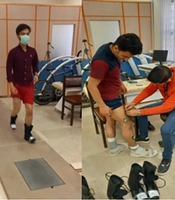
The participants were provided with new boots manufactured by Arsan Sanat Aghanezhad, a private company in Iran-Tabriz specializing in the production of rubber and TPU boots, for the initial tests (pre-tests). During the pre-test phase, running assessments were conducted on a straight 15-meter track at a running speed of 3.2 m/s (16). Participants were instructed to use these boots consistently throughout the entire six-month intervention period while performing the task. After the six-month period, the participants returned to the laboratory for a post-test evaluation. During the post-test, the same boots that had been used during the intervention were worn by the participants (17). Three successful running tests were conducted for each condition and were subsequently used for statistical analysis. Maximum isometric voluntary contraction (MVIC) tests were employed to standardize and normalize the electromyography (EMG) amplitude.
We utilized a wireless EMG system (Biometrics Ltd., Newport, UK) equipped with 8 Ag/AgCl electrodes. These electrodes were positioned with a center-to-center distance of 20 mm and had a CMRR exceeding 110 dB (18). With this system, we recorded the activity of various muscles in the dominant leg, including the tibialis anterior (TA), gastrocnemius medialis (Gas-Med), biceps femoris (BF), semitendinosus (ST), vastus lateralis (VL), vastus medialis (VM), rectus femoris (RF), and gluteus medius (Glut-Med) (19). These muscles were selected for their stabilizing role during running (20). The raw EMG signals were sampled at a rate of 1000 Hz and wirelessly transmitted via Bluetooth to a computer for subsequent analysis. In accordance with SENIAM guidelines, we shaved the skin over the specified muscle areas and then cleaned it with alcohol (21). GRF and EMG data were synchronized, and MVIC data were used to normalize EMG amplitude during running. To improve the quality of the EMG signals and reduce interference from external sources, we applied a bandwidth filter ranging from 10 to 500 Hz and a notch filter set at 50 Hz (22).
3.3. Statistical Analyses
After assessing the normal distribution using the Shapiro-Wilk-Test, we conducted a separate analysis. Specifically, we performed a 2 (groups: New vs. used boots) × 2 (time: Pre- and post-intervention) ANOVA with repeated measures. Subsequent post-hoc examinations were carried out using a paired sample t-test with adjustments made using the Bonferroni method. If we identified any significant differences between the groups at the baseline, we included the relevant parameter as a covariate in our statistical analyses. Effect sizes were calculated using partial eta-squared (η2p). We set the significance level at P < .05 for all statistical analyses. These analyses were conducted using SPSS 26.0.
4. Results
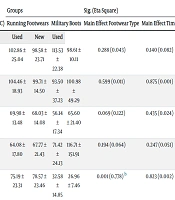
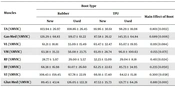
The results did not reveal a significant main effect of "boots" or "time" for muscle activities during the loading phase. Furthermore, the findings showed a significant main effect of boot-by-time interactions for TA (P = 0.037, η2p = 0.146), Gas-Med (P = 0.023, η2p = 0.172), and Glut-Med (P = 0.038, η2p = 0.144) during the loading phase. Pairwise comparisons indicated that Gas-Med activity was significantly greater in the rubber military boots group compared to the TPU military boots group during running. Additionally, pairwise comparisons revealed that Glut-Med and TA activity was significantly greater in the TPU military boots group compared to the rubber military boots group during running (Table 2).
Table 2.
Muscle Activity in Two Conditions During Loading Phase a
| Muscles | Boot Type | Sig. (Effect Size) | |||||
|---|---|---|---|---|---|---|---|
| Rubber | TPU | Main Effect of Boot | Main Effect of Time | Interaction: Boot × Time | |||
| New | Used | New | Used | ||||
| TA (%MVIC) | 99.58 ± 22.01 | 108.09 ± 19.57 | 110.07 ± 30.70 | 99.52 ± 12.72 | 0.993 (0.001) | 0.760 (0.003) | 0.037 b (0.146) |
| Gas-Med (%MVIC) | 118.79 ± 60.86 | 106.62 ± 40.49 | 98.77 ± 36.97 | 149.05 ± 71.65 | 0.395 (0.026) | 0.216 (0.054) | 0.023 b (0.172) |
| VL (%MVIC) | 66.94 ± 30.42 | 58.92 ± 16.67 | 59.15 ± 31.25 | 54.99 ± 16.84 | 0.320 (0.035) | 0.390 (0.027) | 0.741 (0.004) |
| VM (%MVIC) | 56.91 ± 22.21 | 62.82 ± 39.69 | 68.20 ± 37.77 | 95.54 ± 102.47 | 0.170 (0.066) | 0.274 (0.043) | 0.499 (0.016) |
| RF (%MVIC) | 34.05 ± 13.82 | 31.99 ± 8.90 | 31.30 ± 7.69 | 27.50 ± 5.69 | 0.199 (0.058) | 0.180 (0.063) | 0.754 (0.004) |
| BF (%MVIC) | 56.17 ± 13.98 | 74.96 ± 35.56 | 61.87 ± 13.87 | 72.45 ± 40.64 | 0.820 (0.002) | 0.072 (0.111) | 0.559 (0.012) |
| ST (%MVIC) | 65.50 ± 18.99 | 70.22 ± 16.33 | 63.64 ± 15.01 | 77.99 ± 22.47 | 0.537 (0.014) | 0.057 (0.124) | 0.316 (0.036) |
| Glut-Med (%MVIC) | 104.89 ± 77.59 | 91.53 ± 37.50 | 92.82 ± 45.70 | 146.88 ± 77.91 | 0.174 (0.056) | 0.223 (0.050) | 0.038 b (0.144) |
Abbreviations: MVIC, maximum isometric voluntary contraction; TA, tibialis anterior; Glut-med, gluteus medius; Gas-Med, gastrocnemius medialis; BF, biceps femoris; ST, semitendinosus; VL, vastus lateralis; VM, vastus medialis; RF, rectus femoris; Glut-Med, gluteus medius.
a Values are expressed as mean ± SD unless otherwise indicated.
b P ≤ 0.05 was considered statistically significant.
The results showed no significant effects of "boots" and "time" on muscle activities during the mid-stance phase. However, there was a significant effect of boot-by-time interactions for TA (P = 0.003, η2p = 0.278) during the mid-stance phase. Pairwise comparisons indicated that TA activity was significantly greater in the rubber military boots group compared to the TPU military boots group during running (Table 3).
Table 3.
Muscle Activity in Two Conditions During Mid-Stance Phase a
| Muscles | Boot Type | Sig. (Effect Size) | |||||
|---|---|---|---|---|---|---|---|
| Rubber | TPU | Main Effect of Boot | Main Effect of Time | Interaction: Boot × Time | |||
| New | Used | New | Used | ||||
| TA (%MVIC) | 102.29 ± 17.33 | 115.08 ± 23.37 | 113.98 ± 21.64 | 98.18 ± 9.89 | 0.554 (0.013) | 0.779 (0.003 | 0.003 b (0.278) |
| Gas-Med (%MVIC) | 105.63 ± 53.33 | 120.43 ± 47.25 | 101.34 ± 47.00 | 99.79 ± 47.72 | 0.340 (0.033) | 0.598 (0.010) | 0.530 (0.014) |
| VL (%MVIC) | 65.36 ± 35.03 | 55.91 ± 20.88 | 57.15 ± 17.25 | 64.06 ± 21.46 | 0.995 (0.001) | 0.866 (0.001) | 0.116 (0.086) |
| VM (%MVIC) | 48.13 ± 13.38 | 67.73 ± 20.68 | 69.30 ± 24.66 | 111.55 ± 147.74 | 0.110 (0.089) | 0.124 (0.082) | 0.569 (0.012) |
| RF (%MVIC) | 34.86 ± 13.21 | 31.26 ± 8.83 | 31.85 ± 14.59 | 26.79 ± 7.21 | 0.238 (0.049) | 0.128 (0.081) | 0.815 (0.002) |
| BF (%MVIC) | 62.72 ± 22.05 | 63.50 ± 26.18 | 60.81 ± 21.13 | 77.28 ± 44.60 | 0.324 (0.035) | 0.359 (0.030) | 0.195 (0.059) |
| ST (%MVIC) | 134.84 ± 267.48 | 61.62 ± 14.55 | 62.69 ± 10.27 | 68.09 ± 36.04 | 0.362 (0.030) | 0.333 (0.034) | 0.276 (0.042) |
| Glut-Med (%MVIC) | 104.38 ± 79.08 | 115.09 ± 75.08 | 99.02 ± 61.53 | 144.75 ± 71.58 | 0.466 (0.019) | 0.181 (0.063) | 0.296 (0.039) |
Abbreviations: MVIC, maximum isometric voluntary contraction; TA, tibialis anterior; Glut-med, gluteus medius; Gas-Med, gastrocnemius medialis; BF, biceps femoris; ST, semitendinosus; VL, vastus lateralis; VM, vastus medialis; RF, rectus femoris; Glut-Med, gluteus medius.
a Values are expressed as mean ± SD or unless otherwise indicated.
b P ≤ 0.05 was considered statistically significant.
The findings also revealed no significant effects of "boots" and "time" on muscle activities during the push-off phase. However, there was a significant effect of boot-by-time interactions for Gas-Med (P = 0.046, η2p = 0.135) during the push-off phase. Pairwise comparisons showed that Gas-Med activity was significantly greater in the rubber military boots group compared to the TPU military boots group during running (Table 4).
Table 4.
Muscle Activity in Two Conditions During Push-Off Phase a
| Muscles | Boot Type | Sig. (Effect Size) | |||||
|---|---|---|---|---|---|---|---|
| Rubber | TPU | Main Effect of Boot | Main Effect of Time | Interaction: Boot × Time | |||
| New | Used | New | Used | ||||
| TA (%MVIC) | 103.94 ± 26.97 | 108.86 ± 26.45 | 111.96 ± 30.61 | 98.29 ± 18.08 | 0.801 (0.002) | 0.590 (0.010) | 0.074 (0.110) |
| Gas-Med (%MVIC) | 126.29 ± 68.83 | 119.17 ± 61.22 | 87.58 ± 26.12 | 145.35 ± 64.84 | 0.689 (0.006) | 0.088(0.101) | 0.046 b (0.135) |
| VL (%MVIC) | 61.21 ± 18.81 | 55.09 ± 15.49 | 65.47 ± 32.47 | 65.07 ± 19.95 | 0.119 (0.084) | 0.644 (0.008) | 0.523 (0.015) |
| VM (%MVIC) | 63.38 ± 35.33 | 56.08 ± 23.75 | 65.19 ± 28.74 | 96.11 ± 100.63 | 0.155 (0.071) | 0.433 (0.022) | 0.193 (0.060) |
| RF (%MVIC) | 28.77 ± 5.97 | 29.00 ± 5.57 | 32.23 ± 13.09 | 29.04 ± 8.18 | 0.411 (0.024) | 0.545 (0.013) | 0.421 (0.023) |
| BF (%MVIC) | 68.38 ± 16.98 | 61.07 ± 26.60 | 62.25 ± 22.63 | 85.73 ± 34.95 | 0.235 (0.050) | 0.168 (0.067) | 0.053 (0.127) |
| ST (%MVIC) | 108.43 ± 159.45 | 67.78 ± 22.19 | 66.91 ± 17.40 | 64.12 ± 15.18 | 0.300 (0.038) | 0.301 (0.038) | 0.383 (0.027) |
| Glut-Med (%MVIC) | 89.45 ± 43.14 | 126.05 ± 122.31 | 87.53 ± 35.73 | 121.77 ± 64.26 | 0.881 (0.001) | 0.058 (0.123) | 0.955 (0.001) |
Abbreviations: MVIC, maximum isometric voluntary contraction; TA, tibialis anterior; Glut-med, gluteus medius; Gas-Med, gastrocnemius medialis; BF, biceps femoris; ST, semitendinosus; VL, vastus lateralis; VM, vastus medialis; RF, rectus femoris; Glut-Med; gluteus medius.
a Values are expressed as mean ± SD or unless otherwise indicated.
b P ≤ 0.05 was considered statistically significant.
5. Discussion
This study represents the first attempt to assess the impact of wearing TPU and Rubber military boots on lower limb muscle activities during running over a 6-month period. Additionally, it is the first study to evaluate and compare the muscle activities of military personnel while wearing TPU and Rubber military boots.
Our findings indicate that there was significantly greater muscle activity in the TA and Glut-med during the loading response phase in the group wearing TPU military boots compared to the group wearing rubber military boots. This difference in muscle activity between TPU and rubber military boots may be attributed to the mechanical characteristics and support provided by each type of boot.
TPU boots are well-known for their durability and stability, and they may provide more substantial support and resistance during the loading response phase, leading to increased muscle engagement. On the contrary, rubber boots, known for their flexibility, may allow for greater freedom of movement and reduced muscle activation during the same phase (23, 24). Additionally, variations in running styles, foot anatomy, and individual musculoskeletal conditions could contribute to distinct muscle activity patterns when wearing different types of footwear (25).
A similar study conducted by Motawi yielded comparable results, showing that participants wearing TPU military boots exhibited higher activity in the TA muscle during the propulsion phase compared to those wearing traditional leather military boots. This consistency in findings suggests that TPU boots may consistently promote greater engagement of the TA muscle during military tasks involving propulsion, indicating a potential trend across various footwear comparisons (26).
Conversely, Hill et al. reported that there were no significant differences in lower extremity muscle activity between different types of military footwear (27). The variations in outcomes between these studies may be attributed to several factors, including the diverse materials used in the boots, variations in participant characteristics, and the specific military tasks under analysis.
Furthermore, differences in research methodologies, such as measurement techniques and data analysis, could also contribute to disparities in the observed patterns of muscle activation. Additionally, previous research has demonstrated the significance of ankle plantarflexion during the loading phase of running (28). This movement allows the TA muscle to gradually lower the foot to the ground. In cases where the TA muscle does not generate sufficient force, excessive flexion speed occurs at the top of the foot. Ankle plantarflexion is associated with foot pronation and internal rotation of the tibia (28). When the foot makes contact with the ground in a fully extended position, the knee undergoes flexion, coordinated by the eccentric action of the quadriceps muscles. Simultaneously, the hip starts extending through the concentric action of the hip extensors, including the gluteus maximus and hamstrings (28, 29).
The human body employs both passive and active strategies to mitigate shock waves. Passive mechanisms encompass factors like pad deformation and soft tissue vibrations to diminish the magnitude of shock waves. Active mechanisms involve actions such as knee flexion and calcaneus eversion to minimize the spread of shock waves (30). Our findings reveal higher TA muscle activity during the mid-stance phase in the group wearing new TPU military boots compared to the group wearing used TPU military boots. Substantial muscle activity around the hip joint in the frontal plane is observed during the middle stance and terminal stance phases (28). When the opposite foot is raised off the ground, the pelvis is supported solely by the hip of the stance phase, sustained through the contraction of the hip abductor muscles, particularly the Glut-med and tensor fascia lata (31).
Nevertheless, our study did not reveal any significant difference in Glut-med muscle activity. The Glut-med possesses both the structural and functional characteristics necessary to generate substantial abduction forces, crucial for maintaining femoropelvic stability in the frontal plane (32).
It can be hypothesized that any impairment in the functioning of the Glut-med might lead to reduced pelvic stability in the coronal plane or an increase in hip adduction movement during running, potentially elevating the risk of injury. Additionally, the duration of heavy use and the total mileage covered by the shoe have biomechanical implications, particularly related to its cushioning properties, which could further contribute to the risk of injury (33).
Previous research has established a correlation between shoe age and the incidence of running-related injuries. As shoes age, they tend to become stiffer, potentially impacting biomechanical factors such as loading rates or the peak of tibial acceleration. Interestingly, these factors have been linked to the occurrence of stress fractures (34).
Furthermore, our study found significantly higher Glut-med activity in the group wearing rubber military boots compared to the group wearing TPU military boots during running. Studies have indicated the importance of specific muscles in facilitating different aspects of running, such as the rectus femoris muscle for hip flexion and the gluteus maximus and semitendinosus muscles for hip extension during various phases of the running cycle (35).
Therefore, it appears that military rubber boots may enhance running speed, while TPU boots could be associated with improved overall health parameters.
This study has several limitations that are worth addressing. Firstly, the study only included healthy male participants. As a result, the applicability of the findings to females may be constrained, given that gender-specific differences in anatomical structures and neuromuscular activation patterns can influence biomechanical data.
Secondly, it is possible that any observed effects related to the impact of shoe aging could be influenced by concurrent effects of physical training that might have occurred during the intervention period. However, it is important to note that participants had similar levels of physical activity before the study began, and they did not alter their physical activity routines during the six-month intervention period. Consequently, it is unlikely that training effects played a significant role, as physical activity levels remained consistent both before and during the study.
Lastly, a notable limitation of this study was the absence of kinematic analyses, which could have provided valuable insights but were not included in the research.