
1. Background
Physical training is an integral part of job requirements for defense personnel, encompassing activities such as walking, jumping, and running. During these activities, recruits wear a variety of footwear, ranging from army boots to casual sneakers (1). However, it has been found that the type of footwear worn by military personnel can increase the risk of overuse injuries, particularly when running in military boots (2). Chronic lower extremity musculoskeletal injuries are prevalent within the military, with injury rates varying from 15 to 50 percent among new recruits (2-4). These injuries are commonly linked to the rigorous physical training involved (5). The accumulation of small, repetitive injuries due to constant physical exertion and abrupt intensity changes escalates the risk of injury among military recruits (6). The frequent occurrence of overuse injuries significantly hampers military training, leading to increased missed training sessions and higher medical expenses (2). One study found that 22,000 male recruits suffered injuries during a 12-week basic training, resulting in more than 53,000 lost training days and an estimated annual cost of over $16.5 million (7). The high injury rates were attributed to army boots, which are believed to contribute to the problem by not effectively absorbing vertical impact loads (8-10). Epidemiological analyses show a direct link between the severity of shock and the development of chronic wounds (11, 12). This connection is thought to stem from the fact that military boots are primarily designed for protection and stability to prevent ankle injuries, rather than for shock absorption (13). Nevertheless, studies indicate that repetitive forces play a significant role in the likelihood of sustaining chronic running injuries, with kinematic factors also contributing to their development. Excessive movement in the frontal and transverse planes of the joints of the lower extremities is associated with the etiology of chronic injuries (13).
Sole stiffness has been shown to affect lower extremity EMG readings in runners and increase muscle activity as a function of material hardness (14). Hinz et al. demonstrated that alterations in the material of the sole impact the pressure exerted on the metatarsal region, affecting the likelihood of fractures while walking. This suggests that the choice of sole material plays a crucial role in foot health and injury prevention (15). Continuous scans can be beneficial for assessing vulnerable body areas prone to injury, and electromyography (EMG) is a useful tool for recording the strain experienced by specific muscle groups in these regions. This approach allows for detailed analysis and can aid in injury prevention strategies (16). Military boots have been shown to increase Achilles tendon strength and knee loading compared to running boots with EVA (ethylene vinyl acetate) midsoles (17, 18). However, the usual differences between Adidas running shoes and PU/TPU shoes have not been evaluated in terms of muscle activity (19). This is important to provide data that can support improvements in military boot design to reduce signs of injury in military recruits (20). Therefore, the aim of this study was to compare muscular activity between military boots made of polyurethane thermoplastic and Adidas running shoes made of polyurethane thermoplastic during running.
2. Objectives
This study aimed to analyze and compare muscle activity patterns while running in both new and used military boots and running shoes among individuals without any existing health issues. By examining how muscles are engaged differently in these footwear options, the research seeks to provide insights into the impact of footwear choice on running biomechanics and the potential implications for injury prevention and performance optimization.
3. Methods
This research is designed as a double-blinded clinical trial with repeated measures, meaning that both the participants and the researchers are unaware of which footwear condition (new or used military boots and running shoes) each participant is assigned to during multiple data collection sessions. This rigorous study design helps minimize bias and ensures the reliability and validity of the results obtained.
3.1. Participants
The researchers utilized the G*Power software tool to conduct a priori power analysis for this double-blinded clinical trial with repeated measures. The analysis, based on the F-test family (specifically ANOVA repeated measures within-between interaction), employed a Type I error rate of 0.05, a Type II error rate of 0.20 (equating to 80% statistical power), and an effect size of 0.80 for running kinetics (21). The results indicated that a minimum of 14 participants per group would be necessary to detect large interaction effects. Fifteen healthy individuals volunteered for both the military boots and running footwear groups. The study took place at the biomechanics laboratory of Mohaghegh Ardabili University in Iran. All participants were active and healthy, engaging in recreational physical training such as walking or running at least three times a week for about 50 minutes per session for a minimum of one year. The dominant lower limb was the right side for all participants. Exclusion criteria included a history of musculoskeletal surgery in the trunk or lower limbs, as well as neuromuscular or orthopedic disorders. The research protocol received approval from the ethics committee of Mohaghegh Ardabili University (IR.UMA.REC.1401.026) and was registered with the Iranian Registry of Clinical Trials (IRCT20220714055469N1). Written informed consent was obtained from all participants before their involvement in the study.
3.2. Experimental Procedures
Participants were given new military boots and running footwear before the initial tests (pre-tests) and were measured in the same boots and running footwear (used boots and running footwear) during the post-tests. The study involved testing participants' running characteristics on a 15-meter straight track at a speed of 3.2 m/s, using new military boots (Arsan Sanat Aghanezhad) and running footwear made of thermoplastic polyurethane from Adidas. The shoe’s outsole, made of thermoplastic polyurethane with molded patterns, enhances traction and durability. Participants were asked to wear these boots during a 6-month intervention period, with the aim of testing their performance in real-world conditions. Six months after the pre-test, the post-test was conducted similarly to the pre-test. Three running tests were successfully completed under each condition and used for in-depth data analysis. Subsequently, muscle-specific Maximum Voluntary Isometric Contraction (MVIC) tests were administered to normalize the electromyography (EMG) data.
3.3. Experimental Set-up and Data Processing
Electromyography recordings of muscles such as the gluteus medius (Glut-Med), rectus femoris (RF), gastrocnemius medialis (Gas Med), biceps femoris (BF), vastus lateralis (VL), semitendinosus (ST), vastus medialis (VM), and tibialis anterior (TA) of the right limb were conducted using an EMG system from Biometrics Ltd., located in Newport, UK. The system was equipped with bipolar Ag/AgCl surface electrodes with specific technical specifications, including a 20 mm center-to-center distance, an input impedance of 100 MΩ, and a common mode rejection ratio exceeding 110 dB (22). The EMG signals were recorded in their raw form at a sampling rate of 1000 Hz. In accordance with SENIAM protocols, the skin over the designated muscles was cleaned with alcohol prior to the EMG recordings (22). Ground reaction force and electromyography data were synchronized. Each muscle underwent Maximum Voluntary Isometric Contraction (MVIC) to standardize the electromyography (EMG) amplitudes while running. To enhance the accuracy of the EMG signals, a bandwidth filter spanning 10 to 500 Hz and a notch filter at 50 Hz were utilized to refine and smooth the data (23).
3.4. Statistical Analyses
The normal distribution of the data was verified using the Shapiro-Wilk Test. A two-way ANOVA with repeated measures was performed to compare the groups (running footwear vs. boots) across different time points (pre vs. post-test). Post-hoc comparisons were made using Bonferroni-adjusted paired sample t-tests. Effect sizes were evaluated using partial eta-squared (η²p), and the analyses were conducted using Statistical Package for Social Sciences (SPSS) version 26.0, with a significance level set at P < 0.05.
4. Results
The anthropometric characteristics of both groups are shown in Table 1. Results demonstrated significant main effects of "footwear type" for TA (P = 0.010, d = 0.230), VL (P = 0.001, d = 0.649), RF (P = 0.001, d = 0.938), BF (P = 0.001, d = 0.580), and ST (P = 0.001, d = 0.683) activities during the loading phase. Pairwise comparisons revealed significantly lower TA, VL, RF, BF, and ST activities in the military boots group compared to the running footwear group. No notable main effect of "time" on muscle activities during the loading phase was observed. Additionally, significant footwear type-by-time interactions were found for ST (P = 0.019, d = 0.195) and Glut-M (P = 0.010, d = 0.229) activities during the loading phase. During the loading phase, the magnitude of ST and Glut-M activities decreased at the post-test compared to the pre-test in the running footwear group and increased in the military boots group (Table 2).
Table 1.
The Anthropometric Characteristics of the Both Groups a
| Anthropometric Characteristics | Military Boots; (n = 15) | Running Footwears; (n = 15) | P-Value |
|---|---|---|---|
| Age (y) | 22.3 ± 1.7 | 24.3 ± 3.5 | 0.846 |
| Body height (m) | 1.62 ± 0.6 | 1.59 ± 0.4 | 0.722 |
| Body mass (kg) | 62.4 ± 9.3 | 59.3 ± 10.6 | 0.356 |
a Values are expressed as mean ± SD unless otherwise indicated.
Table 2.
Muscle Activities During Loading Phase in the Both Groups a
| Muscles (%MVIC) | Groups | Sig. (Eta Square) | |||||
|---|---|---|---|---|---|---|---|
| Running Footwears | Military Boots | Main Effect Footwear Type | Main Effect Time | Interaction: Footwear Type × Time | |||
| New | Used | New | Used | ||||
| TA | 131.33 ± 36.91 | 118.58 ± 27.27 | 107.34 ± 29.91 | 96.11 ± 11.93 | 0.010 (0.230) b | 0.079 (0.114) | 0.928 (0.001) |
| Gas-M | 126.31 ± 28.85 | 119.14 ± 19.41 | 98.59 ± 38.36 | 135.47 ± 50.52 | 0.611 (0.010) | 0.076 (0.116) | 0.057 (0.132) |
| VL | 111.90 ± 23.82 | 98.87 ± 21.88 | 60.65 ± 31.86 | 55.49 ± 17.36 | 0.001 (0.649) b | 0.151 (0.078) | 0.569 (0.013) |
| VM | 104.00 ± 20.67 | 89.56 ± 16.28 | 88.47 ± 39.18 | 95.46 ± 106.34 | 0.320 (0.038) | 0.706 (0.006) | 0.168 (0.072) |
| RF | 112.26 ± 17.11 | 111.70 ± 23.86 | 61.67 ± 7.83 | 77.74 ± 5.84 | 0.001 (0.938) b | 0.591 (0.011) | 0.687 (0.006) |
| BF | 117.47 ± 25.95 | 101.19 ± 16.69 | 61.87 ± 14.39 | 73.23 ± 42.06 | 0.001 (0.580) b | 0.745 (0.004) | 0.058 (0.131) |
| ST | 125.66 ± 28.99 | 108.91 ± 19.62 | 63.35 ± 15.54 | 77.84 ± 23.31 | 0.001 (0.683) b | 0.846 (0.001) | 0.019 (0.195) b |
| Glut-M | 118.77 ± 24.36 | 107.06 ± 19.01 | 89.81 ± 45.85 | 148.90 ± 80.44 | 0.617 (0.010) | 0.088 (0.108) | 0.010 (0.229) b |
a Values are expressed as mean ± SD unless otherwise indicated.
b P < 0.05 was considered statistically significant.
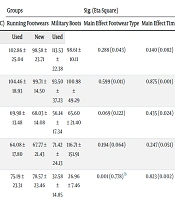
Results demonstrated significant main effects of "footwear type" for RF (P = 0.001, d = 0.778), Glut-M (P = 0.002, d = 0.321), and ST (P = 0.006, d = 0.260) activities during the mid-stance phase. Pairwise comparisons revealed significantly lower RF and ST activities in the military boots group compared to the running footwear group. Additionally, pairwise comparisons indicated that Glut-M activities were significantly higher in the military boots group compared to the running footwear group during the mid-stance phase. No significant main effect of "time" or "footwear type-by-time" interactions for muscle activities during the mid-stance phase were observed (Table 3).
Table 3.
Muscle Activities During Mid-stance Phase in the Both Groups a
| Muscles (%MVIC) | Groups | Sig. (Eta Square) | |||||
|---|---|---|---|---|---|---|---|
| Running Footwears | Military Boots | Main Effect Footwear Type | Main Effect Time | Interaction: Footwear Type × Time | |||
| New | Used | New | Used | ||||
| TA | 102.86 ± 25.04 | 98.58 ± 23.71 | 113.53 ± 22.38 | 98.61 ± 10.11 | 0.288 (0.043) | 0.140 (0.082) | 0.291 (0.043) |
| Gas-M | 104.46 ± 18.93 | 99.71 ± 14.50 | 93.50 ± 37.23 | 100.98 ± 49.29 | 0.599 (0.011) | 0.875 (0.001) | 0.508 (0.017) |
| VL | 69.98 ± 13.48 | 68.03 ± 14.08 | 56.14 ± 17.34 | 65.60 ± 21.40 | 0.069 (0.122) | 0.435 (0.024) | 0.195 (0.064) |
| VM | 64.08 ± 17.80 | 67.77 ± 21.43 | 71.42 ± 24.13 | 116.71 ± 151.91 | 0.194 (0.064) | 0.247 (0.051) | 0.333 (0.036) |
| RF | 75.19 ± 23.31 | 78.57 ± 23.46 | 32.58 ± 14.85 | 26.96 ± 7.46 | 0.001 (0.778) b | 0.823 (0.002) | 0.371 (0.031) |
| BF | 89.82 ± 36.22 | 75.44 ± 21.37 | 62.10 ± 21.30 | 79.10 ± 45.71 | 0.204 (0.061) | 0.876 (0.001) | 0.102 (0.100) |
| ST | 88.89 ± 25.67 | 78.24 ± 19.67 | 62.97 ± 10.59 | 69.48 ± 36.99 | 0.006 (0.260) b | 0.786 (0.003) | 0.147 (0.079) |
| Glut-M | 71.40 ± 22.66 | 69.79 ± 17.46 | 90.83 ± 54.70 | 142.17 ± 73.56 | 0.002 (0.321) b | 0.059 (0.131) | 0.053 (0.136) |
a Values are expressed as mean ± SD unless otherwise indicated.
b P < 0.05 was considered statistically significant.
Results demonstrated significant main effects of "footwear type" for VL (P = 0.001, d = 0.438), RF (P = 0.001, d = 0.785), BF (P = 0.001, d = 0.357), and ST (P = 0.001, d = 0.580) activities during the push-off phase. Pairwise comparisons revealed significantly lower VL, RF, BF, and ST activities in the military boots group compared to the running footwear group. Significant main effects of "time" were found for TA (P = 0.030, d = 0.169) and Gas-M (P = 0.018, d = 0.198) activities during the push-off phase. Pairwise comparisons revealed a significant decrease in TA activity in the used condition compared to the new condition. Additionally, pairwise comparisons showed a significant increase in TA activity in the used condition compared to the new condition. Furthermore, significant footwear type-by-time interactions were found for Gas-M (P = 0.007, d = 0.251) activity during the push-off phase. The magnitude of Gas-M activity increased in the military boots group (but not in the running footwear group) at the post-test compared to the pre-test (Table 4).
Table 4.
Muscle Activities During Push-off Phase in the Both Groups a
| Muscles (%MVIC) | Groups | Sig. (Eta Square) | |||||
|---|---|---|---|---|---|---|---|
| Running Footwears | Military Boots | Main effect Footwear Type | Main Effect Time | Interaction: Footwear Type × Time | |||
| New | Used | New | Used | ||||
| TA | 109.20 ± 20.28 | 98.16 ± 18.96 | 113.17 ± 31.40 | 95.80 ± 15.87 | 0.891 (0.001) | 0.030 (0.169) b | 0.589 (0.011) |
| Gas-M | 101.84 ± 23.47 | 101.19 ± 18.59 | 86.08 ± 26.43 | 143.21 ± 66.73 | 0.486 (0.019) | 0.018 (0.198) b | 0.007 (0.251) b |
| VL | 98.73 ± 26.96 | 89.98 ± 21.47 | 64.28 ± 33.36 | 65.22 ± 20.70 | 0.001 (0.438) b | 0.601 (0.011) | 0.468 (0.020) |
| VM | 95.70 ± 21.48 | 94.49 ± 32.01 | 67.18 ± 28.74 | 99.83 ± 103.35 | 0.415 (0.026) | 0.346 (0.034) | 0.237 (0.053) |
| RF | 103.56 ± 33.31 | 88.45 ± 27.51 | 52.82 ± 13.37 | 68.76 ± 8.41 | 0.001 (0.785) b | 0.095 (0.103) | 0.417 (0.025) |
| BF | 104.63 ± 30.53 | 103.37 ± 34.09 | 63.69 ± 22.75 | 87.71 ± 35.39 | 0.001 (0.357) b | 0.222 (0.057) | 0.101 (0.100) |
| ST | 103.51 ± 33.25 | 96.26 ± 28.02 | 67.48 ± 17.91 | 64.68 ± 15.59 | 0.001 (0.580) b | 0.508 (0.017) | 0.696 (0.006) |
| Glut-M | 107.50 ± 35.78 | 95.61 ± 26.89 | 81.77 ± 28.96 | 121.12 ± 66.63 | 0.993 (0.001) | 0.189 (0.066) | 0.051 (0.139) |
a Values are expressed as mean ± SD unless otherwise indicated.
b P < 0.05 was considered statistically significant.
5. Discussion
The aim of the study was to compare lower extremity muscle activity between military shoes and running shoes in healthy individuals. Our results showed that the activities of TA, VL, RF, BF, and ST were significantly reduced in the military shoe group compared to the running shoe group during the loading phase. A key distinction between military boots and other types of footwear could lie in the ankle joint's confinement, which may help restrain high peaks in activity. However, the material's resilience, combined with physiological movements such as pronation, could lead to observed elevated amplitudes in muscle activity (24). The TA muscle plays a role in dorsiflexion and supination (1). The significantly high peak and sustained levels of this muscle activity recorded with various types of footwear, including regular jogging shoes and military boots, could hold clinical significance. Our results showed that wearing thermoplastic polyurethane military boots reduced muscle activity. Excessive stress on the TA muscle is associated with shin splints, a common condition among recruits, and anterior compartment syndrome (25). It has been reported that military and leather boots are sturdy, hard-soled with relative inflexibility, and that their shape and material can significantly impact the onset of musculoskeletal disorders (24). Moreover, the results of this study indicate a decrease in muscle activity for most muscles in the military boots group during the stance phase of running. Additionally, during the loading phase, the magnitude of ST and Glut-M activities decreased after training in the running footwear group and increased in the military boots group.
Findings revealed significantly greater Glut-M activities in the military boots group compared to the running footwear group during the mid-stance phase. Once the other foot is lifted off the ground, the pelvis relies entirely on the hip of the supporting leg for stability and movement during the stance phase. The hip abductors, particularly the Glut-Med and tensor fascia lata, contract to maintain this position (26). It is important to note that the Glut-Med is well-suited, both structurally and functionally, to generate the necessary abduction forces needed to maintain balance between the femur and pelvis in the frontal plane (27). Therefore, it can be hypothesized that dysfunction in the Glut-Med muscle could potentially lead to inadequate control of the pelvis in the coronal plane or excessive inward movement of the hip during running, which could increase the likelihood of sustaining an injury (28).
The magnitude of Gas-M activity increased in the military boots group (but not in the running footwear group) at the post-test compared with the pre-test during the push-off phase. The Gas-M muscle has been reported to generate energy during walking and running (29). The Gas-M muscle plays a significant role in generating power during walking. Furthermore, no notable variations were detected in the activity of adjacent muscles like VM, RF, and BF. Conversely, previous reports have indicated that the activation of the Gas-M muscle can contribute to maintaining the arch of the foot and tension in the Achilles tendon. Greater activity of the Gas-M muscle during running can be beneficial as it has the potential to enhance the body's capacity to control movements in both the sagittal and coronal planes simultaneously (30).
This study is constrained by a small sample size and the absence of kinematic data, which limits the generalizability and depth of the findings. Therefore, further studies with a larger sample size and the inclusion of kinematic data are needed to better establish the interaction effects of running footwear types with mileage.