
1. Background
France’s health financing relies mainly on National Health Insurance (NHI) (80%), complemented by complementary health insurance (CHI) (13%), with out-of-pocket spending at just 7%, the lowest among OECD countries (1). Given the rising costs of healthcare, public authorities have relied on CHI since the 2000s to absorb a portion of healthcare expenditures, especially for hearing aids (+152.2%), dental care (+31.9%), and optical care (+16.2%) (1, 2). Lack of CHI is linked to foregoing healthcare and poorer self-reported health (3-5), while insured patients have better access to primary and specialised care (5, 6). Therefore, French governments introduced several incentives to encourage taking out private CHI. According to Pierre and Rochereau, the aim was twofold: “reduce the financial barriers to access to care, while limiting public expenditure” (7). The 2013 national interprofessional agreement (ANI) made employer co-financed health insurance mandatory in the private sector, lifting coverage to 84% by 2017 but excluding public employees, precarious workers, and pensioners (7, 8).
Key features of military health coverage: The nation provides active-duty service members (ADSMs) with guarantees and benefits (9) through a compulsory social security fund, “Caisse Nationale Militaire de Sécurité Sociale” (CNMSS), and the support of the French Military Health Service (FMHS). Compensation frameworks differentiate between service-related and non-service-related injuries (10, 11). Service-related injuries are reimbursed in full at social security rate, but active duty service members must still cover excess fees and non-service-related injuries, making their copayments similar to those of civilians. Despite good health at recruitment, ADSMs face high risks and thrill-seeking behaviors, with 18% lacking CHI (10), increasing the risk of foregoing care. In 2025, legislation extended CHI co-funding to public sector employees.
2. Objective
This study investigates CHI noncoverage among ADSM prior to the reform, to identify specific determinants and provide a baseline for post-reform evaluation.
3. Methods
3.1. Study design
We conducted a post-hoc analysis based on data from the “Enquête Nouvelle Génération” (ENG), performed in 2019 by the FMHS and the CNMSS. This national multi-thematic survey included a random sample of nearly 5,000 ADSM.
3.2. Primary outcome
The primary outcome was the prevalence of nonadherence to CHI among French ADSM.
3.3. Study population
Inclusion criteria: Being aged over 18; consenting to participate; serving in a military unit supported by the FMHS; speaking French.
Exclusion criteria: Being civilian; being a foreign military member; serving in the French Foreign Legion, either in a unit, staff, or school.
3.4. Sampling design
Five thousand service members were randomly drawn using a 2-stage sampling design, stratified on the military branch, with respect to sex, age, and rank category proportions.
3.5. Data collection procedure
The data were collected from February 15 to April 12, 2019, at assignment locations during working hours. Investigators conducted standardized group information sessions using predefined texts and digital aids, followed by systematic individual consent acquisition. Data were collected through computerized, self-administered electronic questionnaires using the Computer Assisted Personal Interviewing (CAPI) method.
3.6. Statistical analysis
ENG data were adjusted for age, sex, service, and rank via “Observatoire Social de la Défense” statistics. The sampling design and weights were applied. A subgroup analysis by CHI status was performed. All estimates are weighted. Multivariate logistic regression with sampling weights identified factors associated with CHI status. Model selection minimized the Akaike Information Criterion (AIC). The data were analyzed using R software (version 4.3.2).
This survey was funded by the National Military Social Fund in accordance with the Declaration of Helsinki. The investigation protocol was approved by the French Ethics Committee (CPP Southwest of France and Overseas Territories IV (Deliberation n ° CPP18-095a / 2018-A026-97-48 of January 28, 2019). Data collection complied with the General Data Protection Regulation (GDPR).
4. Result
4.1. Response rate
A total of 4,266 ADSM (85.6% of the 4,972 service members drawn at random) were finally included on 90 military installations. Among them, 112 did not report coverage status and were excluded from the analysis to control for classification bias (Figure 1).
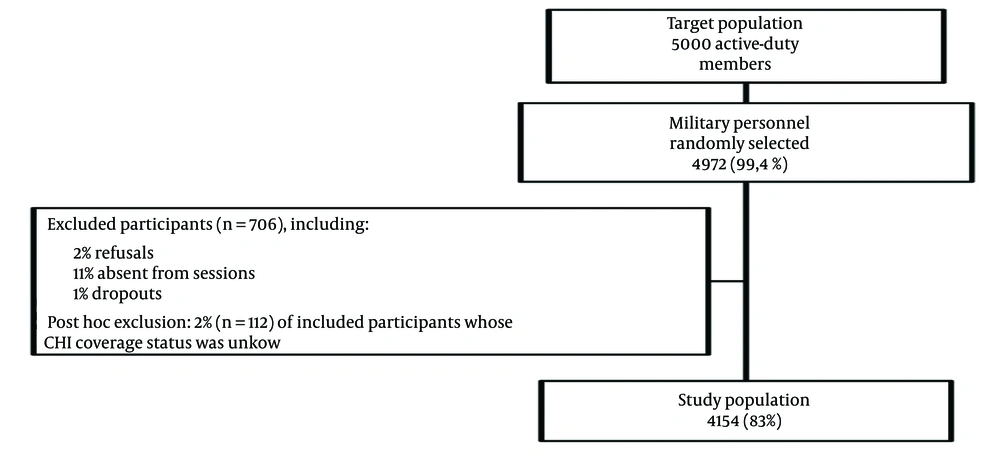
Figure 1.
Flow diagram of participant selection and inclusion in the study population
4.2. Prevalence of noncoverage
Among the military personnel surveyed, 4% (95% CI = [3.4 - 4.7], n = 165) reported not subscribing to a CHI. About half of military personnel did not enroll because they perceived it as unnecessary, while over 20% cited financial reasons; overall, chosen renunciation (“considering oneself in good health” and “don’t feel the need”) accounted for 63% (Table 1)
Table 1.
Characteristics of Military Personnel Covered by a Complementary Health Insurance a
| Characteristics | CHI (Online Percentage) | P-Value | Total | ||||
|---|---|---|---|---|---|---|---|
| No (n = 165) | CI 951 | Yes (n = 3989) | CI 951 | Total (n = 4154) | CI 951 | ||
| Gender | 0.48 | ||||||
| Female | 30 (4.5) | [3.1, 6.3] | 651 (95.5) | [93.7, 96.9] | 681 (16.4) | [15.3, 17.6] | |
| Male | 135 (3.9) | [3.2, 4.6] | 3 338 (96.1) | [95.4, 96.8] | 3 472 (83.6) | [82,4, 84.7] | |
| Age | 0.17 | ||||||
| < 35 | 100 (4.4) | [3.6, 5.4] | 2 170 (95.6) | [94.6, 96.4] | 2 269 (54.6) | [53.0, 56.3] | |
| ≥ 35 | 66 (3.5) | [2.7, 4.5] | 1 819 (96.5) | [95.5, 97.3] | 1 885 (45.4) | [43.7, 47.0] | |
| Marital status | 0.004 b | ||||||
| Single | 85 (5.1) | [4.1, 6.4] | 1 584 (94.9) | [93.6, 95.9] | 1 669 (40.2) | [38.6, 41.8] | |
| Couple | 80 (3.2) | [2.5, 4.0] | 2 405 (96.8) | [96.0, 97.5] | 2 484 (59.8) | [58.2, 61.4] | |
| Study level | 0.02 b | ||||||
| < = baccalaureate | 130 (4.5) | [3.7, 5.4] | 2 763 (95.5) | [94.6, 96.3] | 2 893 (69.6) | [68.1, 71.2] | |
| > high school diploma | 35 (2.8) | [2.0, 3.9] | 1 226 (97.2) | [96.1, 98.0] | 1 261 (30.4) | [28.8, 31.9] | |
| Geographical location | 0.9 | ||||||
| Abroad and overseas | 8 (11.7) | [5.4, 23.7] | 58 (88.3) | [76.3, 94.6] | 66 (1.6) | [1.2, 2.1] | |
| Conurbation | 120 (3.7) | [3.1, 4.5] | 3 139 (96.3) | [95.5, 96.9] | 3 260 (78.5) | [77.1, 79.8] | |
| Rural areas (< 2000 inhabitants) | 37 (4.5) | [3.2, 6.3] | 791 (95.5) | [93.7, 96.8] | 829 (19.9) | [18.7, 21.3] | |
| Service | < 0.001 b | ||||||
| Air force | 14 (2.7) | [1.8, 4.2] | 509 (97.3) | [95.8, 98.2] | 523 (12.6) | [11.7, 13.5] | |
| Health services and others joint services | 6 (3.5) | [1.5, 8.0] | 166 (96.5) | [92.0, 98.5] | 172 (4.1) | [3.6, 4.8] | |
| Military police | 19 (1.5) | [0.9, 2.5] | 1 301 (98.5) | [97.5, 99.1] | 1 320 (31.8) | [30.2, 33.4] | |
| Navy | 21 (4.1) | [3.0, 5.7] | 485 (95.9) | [94.3, 97.0] | 506 (12.2) | [11.4, 13.0] | |
| Army | 105 (6.4) | [5.2, 7.9] | 1 528 (93.6) | [92.1, 94.8] | 1 633 (39.3) | [37.7, 41.0] | |
| Rank category | < 0.001 b | ||||||
| Enlisted personnel | 88 (6.5) | [5.2, 8.1] | 1 259 (93.5) | [91.9, 94.8] | 1 346 (32.4) | [30.9, 34.0] | |
| Non-commissioned officer (NCOs) | 65 (2.9) | [2.2, 3.7] | 2 210 (97.1) | [96.3, 97.8] | 2 275 (54.8) | [53.1, 56.4] | |
| Officer | 12 (2.3) | [1.2, 4.4] | 520 (97.7) | [95.6, 98.8] | 532 (12.8) | [11.6, 14.1] | |
| Type of contract | < 0.001 b | ||||||
| Long term employment contract (LTEC) | 44 (2.3) | [1.6, 3.1] | 1 917 (97.7) | [96.9, 98.4] | 1 961 (47.2) | [45.5, 48.9] | |
| Fixed term employment contract (FTEC) | 121 (5.5) | [4.6, 6.6] | 2 072 (94.5) | [93.4, 95.4] | 2 193 (52.8) | [51.1, 54.5] | |
| Length of service (years) c | 10.4 (8.5) | [9.0, 11.8] | 13.3 (10.0) | [12.9, 13.7] | < 0.001 d | 13.2 (10.0) | [12.8, 13.5] |
| Total number of missions (duration > 1 month) c | 3.3 (4.6) | [2.6, 3.9] | 3.2 (4.4) | [3.1, 3.4] | 0.91 | 3.2 (4.4) | [3.1, 3.4] |
| Number of months away from main residence for military reasons | 0.2 | ||||||
| Never | 28 (3.4) | [2.3, 5.0] | 804 (96.6) | [95.0, 97.7] | 832 (20.0) | [18.7, 21.4] | |
| < 3 months | 56 (3.5) | [2.6, 4.6] | 1 532 (96.5) | [95.4, 97.4] | 1 587 (38.2) | [36.6, 39.8] | |
| ≥ 3 months | 81 (4.7) | [3.7, 5.9] | 1 654 (95.3) | [94.1, 96.3] | 1 735 (41.8) | [40.1, 43.4] | |
| Has been on sick leave | 0.15 | ||||||
| No | 107 (3.7) | [3.0, 4.5] | 2 817 (96.3) | [95.5, 97.0] | 2 924 (70.4) | [68.9, 71.9] | |
| Yes | 58 (4.7) | [3.6, 6.2] | 1 172 (95.3) | [93.8, 96.4] | 1 230 (29.6) | [28.1, 31.1] | |
| Military disability compensation | 0.22 | ||||||
| No | 160 (3.9) | [3.3, 4.6] | 3 931 (96.1) | [95.4, 96.7] | 4 092 (98.5) | [98.0, 98.9] | |
| Yes | 5 (7.4) | [2.7, 18.8] | 57 (92.6) | [81.2, 97.3] | 62 (1.5) | [1.1, 2.0] | |
| Health problem in the last 12 months | 0.72 | ||||||
| No | 84 (3.9) | [3.1, 4.8] | 2 086 (96.1) | [95.2, 96.9] | 2 170 (52.2) | [50.6, 53.9] | |
| Yes | 81 (4.1) | [3.3, 5.2] | 1 902 (95.9) | [94.8, 96.7] | 1 984 (47.8) | [46.1, 49.4] | |
| Self-perceived general health status | 0.43 | ||||||
| Bad | 7 (5.1) | [2.5, 10.3] | 122 (94.9) | [89.7, 97.5] | 128 (3.1) | [2.6, 3.7] | |
| Medium | 30 (4.7) | [3.2, 6.9] | 609 (95.3) | [93.1, 96.8] | 639 (15.4) | [14.2, 16.6] | |
| Good | 128 (3.8) | [3.1, 4.5] | 3 258 (96.2) | [95.5, 96.9] | 3 386 (81.5) | [80.2, 82.8] | |
| Self-perceived psychological health status | 0.02 b | ||||||
| Bad | 16 (7.6) | [4.5, 12.3] | 202 (92.4) | [87.7, 95.5] | 218 (5.2) | [4.6, 6.0] | |
| Medium | 32 (4.5) | [3.1, 6.4] | 681 (95.5) | [93.6, 96.9] | 713 (17.2) | [16.0, 18.4] | |
| Good | 117 (3.6) | [3.0, 4.4] | 3 106 (96.4) | [95.6, 97.0] | 3 223 (77.6) | [76.2, 78.9] | |
| Self-reported impact of military life on health | 0.31 | ||||||
| Bad | 55 (4.7) | [3.6, 6.2] | 1 103 (95.3) | [93.8, 96.4] | 1 158 (27.9) | [26.4, 29.4] | |
| Medium | 32 (3.4) | [2.3, 4.8] | 927 (96.6) | [95.2, 97.7] | 959 (23.1) | [21.7, 24.5] | |
| Good | 78 (3.8) | [3.0, 4.9] | 1 959 (96.2) | [95.1, 97.0] | 2 037 (49.0) | [47.4, 50.7] | |
| Self-reported psychological health status of the partner | 0.29 | ||||||
| Bad | 3 (2.9) | [0.7, 11.0] | 89 (97.1) | [89.0, 99.3] | 91 (3.7) | [2.9, 4.6] | |
| Medium | 10 (2.0) | [1.0, 3.9] | 487 (98.0) | [96.1, 99.0] | 497 (20.0) | [18.3, 21.8] | |
| Good | 67 (3.5) | [2.8, 4.5] | 1 829 (96.5) | [95.5, 97.2] | 1 897 (76.3) | [74.5, 78.1] | |
Abbreviation: CI, confidence interval; CHI, complementary health insurance.
a Values are as expressed as No. (%) or [95% CI].
b Adjusted chi-square according to an estimate of the sampling plan effect.
c Mean (SD) and interquartile range (IQR).
d Kruskal-Wallis test taking into account.
4.3. Socio-demographic and Military Profile
Coverage was similar by sex (Table 1), (men 96.1, women 95.5) and age (> 35: 96.5, < 35: 95.6), but higher among couples (96.8) than singles (Table 1), (94.9, OR = 1.63, P = 0.004); slightly higher coverage was also seen in rural (96.3) versus urban areas (95.5). The probability of a couple being covered was 1.6 times higher compared to singles (Table 2), (OR = 1.63; 95 CI [1.16 -2.28], P = 0.005).
Table 2.
Factors Associated with Enrollment in Complementary Health Insurance-Results of Univariate and Multivariate Analyses a
| Features | CHI (in Column) | Univariate | Multivariate | Adjusted | |||||||
|---|---|---|---|---|---|---|---|---|---|---|---|
| No,N = 165 | Yes,N = 3 989 | P-Value b | OR | 95 CI | P-Value b | OR | 95 CI | P-Value b | GVIF | GVIF c | |
| Type of contract | < 0.001 | 0.04 | 2 | 1.4 | |||||||
| LTEC | 44 (26.9) | 1 917 (48.0) | - | - | < 0.001 | - | - | ||||
| FTEC | 121 (73.1) | 2 072 (52.0) | 0.4 | 0.27 - 0.58 | < 0.001 | 0.57 | 0.33 - 0.97 | ||||
| Rank category | < 0.001 | ||||||||||
| Enlisted personnel | 88 (53.1) | 1 259 (31.6) | - | - | < 0.001 | - | - | 0.06 | 2 | 1.2 | |
| NCOs | 65 (39.4) | 2 210 (55.4) | 2.37 | 1.67 - 3.36 | < 0.001 | 1.74 | 1.09 - 2.78 | réf. 0.02 | |||
| Officer | 12 (7.5) | 520 (13.0) | 2.91 | 1.45 - 5.87 | 0.003 | 1.89 | 0.83 - 4.33 | 0.13 | |||
| Length of service (in years) | 10.4 ± 8.5 | 13.3 ± 10.0 | < 0.001 | 1.03 | 1.01 - 1.05 | < 0.001 | |||||
| Marital status | 0.004 | ||||||||||
| Single | 85 (51.8) | 1 584 (39.7) | - | - | 0.005 | ||||||
| Couple | 80 (48.2) | 2 405 (60.3) | 1.63 | 1.16 - 2.28 | 0.005 | ||||||
| Geographical location | 0.009 | ||||||||||
| Abroad or overseas | 8 (4.7) | 58 (1.5) | - | - | 0.02 | ||||||
| Conurbation | 120 (72.8) | 3 139 (78.7) | 3.47 | 1.45 - 8.31 | 0.005 | ||||||
| Rural areas (< 2000 inhabitants) | 37 (22.5) | 791 (19.8) | 2.83 | 1.12 - 7.14 | 0.027 | ||||||
| Study level | 0.02 | ||||||||||
| ≤ baccalaureate | 130 (78.6) | 2 763 (69.3) | - | - | 0.02 | ||||||
| > baccalaureate | 35 (21.4) | 1 226 (30.7) | 1.63 | 1.09 - 2.43 | 0.02 | ||||||
| Self-perceived psychological health status | 0.02 | ||||||||||
| Bad | 16 (10.0) | 202 (5.1) | - | - | 0.03 | ||||||
| Medium | 32 (19.4) | 681 (17.1) | 1.74 | 0.90 - 3.37 | 0.10 | ||||||
| Good | 117 (70.6) | 3 106 (77.9) | 2.18 | 1.22 - 3.89 | 0.05 | ||||||
| Has been off sick | |||||||||||
| No | 107 (64.9) | 2 817 (70.6) | 0.15 | - | - | 0.15 | |||||
| Yes | 58 (35.1) | 1 172 (29.4) | 0.77 | 0.54 - 1.10 | 0.15 | ||||||
Abbreviation: CHI, complementary health insurance; OR, odds ratio; CI, confidence interval; GVIF, generalized variance inflation factor.
a Values are as expressed as No. (%) or mean ± SD.
b Adjusted chi-square according to an estimate of the sampling plan effect; Kruskal-Wallis test taking into account the sampling plan.
c GVIF^[1/(2*df)], Null model = 1388; degrees of freedom of the null model = 4160; AIC = 1358; BIC = 1383; Deviance = 1350; degrees of freedom of residuals = 4157; No. Obs. = 4 161.
Complementary health insurance enrollment varied by service and rank: 6.4 of Army personnel were uninsured, with noncoverage at 6.5 for enlisted personnel, 2.9 for non-commissioned officers (NCOs), and 2.3 for officers. Non-commissioned officers and officers were 2.4 and 2.9 times more likely to be insured than enlisted personnel (Table 2, P < 0.001).
Coverage varied by contract type: 2.3 of long-term employment contract (LTEC) and 5.5 of fixed-term employment contract (FTEC) soldiers were uninsured, with FTEC soldiers 60 less likely to be covered. Insured personnel had longer service (Table 1) (13.3 vs. 10.4 years, P < 0.001). CHI coverage was similar across deployment history, work absences, and self-reported health impact, showing no significant differences. Insurance enrollment was higher among ADSMs reporting good psychological health (Table 1), (95.5 vs. 92.4, P = 0.02), but coverage showed no significant differences by physical health, partner status, sick leave, or disability compensation.
4.4. Factors associated in multivariate analysis
Multivariate analysis showed CHI coverage was significantly linked to contract type and rank: FTEC personnel were 43 less likely to be insured than LTEC (OR = 0.57, P < 0.04), and NCOs were more likely than enlisted personnel to have coverage (aOR = 1.74, CI [1.09-2.78], P < 0.02), with no difference between enlisted personnel and officers.
4.5. Health care renunciation and lack of cover
Among the study population, 28.4 reported foregoing healthcare due to financial reasons in the past 12 months, with no significant differences observed by coverage status, even across specific healthcare subcategories. Main foregone care due to costs included alternative medicine (14.6), specialist extra fees (11.5), dental prosthetics (11), dental care (9.6), and optical care (9.5) (Appendix in Supplementary File).
5. Discussion
Widespread cover for military personnel in 2019: This declarative study conducted in 2019 highlighted the widespread use of CHI among ADSM in the French Armed Forces. This study revealed no significant difference compared with the general French population or government employees (7, 12, 13). Our findings differed from those published by the CNMSS (10). This is probably due to underreporting. Reporting CHI enrollment to the CNMSS is a voluntary step taken by the insured. As a result, the fund may not always receive this information, and the estimate provided by the CNMSS may consequently overestimate the non-coverage rate.
Socioeconomic characteristics of noncovered service members: As observed in the general population, service members’ socioeconomic characteristics appeared to be the main determinants of CHI noncoverage (7, 12, 14). According to the univariate results, noncovered military personnel were more likely to be enlisted service members (FTEC), single, with a diploma equivalent to or lower than a baccalaureate, and to have a shorter enrollment period. Our study did not allow for direct analysis of cover according to standard of living. However, rank, type of contract, and service length can be considered proxies for standard of living (15). The noncoverage rate for enlisted personnel was much lower than that for other rank categories but comparable to this rate for public sector employees in the first living standard quintile (7).
Complementary health insurance coverage and health status: CHI coverage did not differ on the basis of whether the ADSM had reported sick leave in the past 12 months. Self-perceived health status was similar to that of the general population, as reported by Célant et al. (14). No link was found between poor self-perceived physical health and lack of coverage (7, 14), but psychological distress was associated with lower coverage. Given the cross-sectional design, causality between poorer psychological health and lower coverage cannot be determined. U.S. studies likewise connected psychological distress and insurance status to socioeconomic changes (16), with lack of coverage linked to higher depression risk (aOR = 1.71) (17). These findings should be interpreted cautiously, as healthcare systems differ: France ensures universal coverage with lower out-of-pocket costs (1 vs. 1.8 in the U.S.) (18). Given the higher PTSD risk in military settings (19-24), further research is needed to determine whether mental health issues reduce coverage or whether lack of coverage heightens anxiety about healthcare costs.
Mainly ‘chosen’ nonenrollment: Over two-thirds of military personnel did not enroll, citing good health, no need, or insufficient benefits. Financial renunciation was 20.5, versus 58.3 in the 2014 general population (EHIS-ESPS, DRESS) (14, 25). This “chosen renunciation” reflects a young, medically selected, risk-taking population covered by compulsory military insurance, consistent with previous literature (25-30). Although not significant in the multivariate analysis, lower educational level was associated with lower coverage, possibly reflecting limited health literacy and the administrative complexity of enrollment, as in the general population (7, 31). Beyond financial constraints, more than half of service members reported barriers such as lack of time (70), long waiting periods (65), and changes in military duties (48).
Cover and healthcare renunciation: Despite a low rate of financial renunciation of coverage, financial renunciation of healthcare was high compared with the general population (12.6 in EHIS 2019) (3, 32-35). Our main limitation was that the post-hoc design restricted our ability to examine how CHI contract characteristics (benefits, type, group, or individual contract) influenced foregone care. The types of foregone care also differed, likely due to differences in question wording (36, 37). The high unmet need for osteopathy may reflect the high prevalence of musculoskeletal disorders in the military population, while rates of dental and optical care refusal were similar to those in the general population (3, 32-35).
Strengths and limitations: This is the first study to examine CHI and unmet healthcare needs among French ADSM. The social and demographic profiles of participants align with estimates from the French Ministry of Armed Forces (38, 39). Our study relied on a 2019 multi-thematic survey database not specifically designed to detail CHI coverage or healthcare waivers. Comparison with the general population is limited due to missing information on CHI contract feature (provider type, guarantee levels, and participation in government support schemes). These details are crucial for understanding patient choices and social health inequalities prior to reform implementation (4, 12, 40, 41). We excluded 112 respondents unsure of their CHI status to avoid classification bias. Analysis showed no specific response pattern linked to CHI enrollment, though this may slightly underestimate the noncoverage rate.
5.1. Conclusions
This descriptive study revealed widespread CHI coverage among French active duty service members, with a 4 non-coverage rate comparable to that observed in the general population. Socioeconomic factors, such as rank and contract type, remained the main determinants of non-coverage. The reform of employer-sponsored CHI is expected to improve coverage for younger, risk-taking active duty members and lower-income or unemployed military families. Reflecting specific characteristics of active-duty service members, non-enrollment appeared voluntary, driven by perceived good health or limited benefits, rather than financial constraints. The post-hoc design limited our ability to assess how CHI characteristics influence foregoing healthcare, highlighting a key area for future research. Future studies could enable pre-post reform comparisons.