
1. Background
Burn wounds remain a serious clinical problem because disruption of the skin barrier initiates a complex and highly coordinated healing response involving inflammation, re-epithelialization, granulation tissue formation, angiogenesis, extracellular matrix deposition, and subsequent tissue remodeling (1). Although these processes are essential for restoring tissue integrity, their persistence or dysregulation may result in delayed wound closure, excessive collagen deposition, abnormal vascular remodeling, and poor-quality scar formation. The clinical consequences are particularly important in deep or extensive burns, in which prolonged inflammation and impaired tissue regeneration may compromise functional recovery and increase the risk of pathological scarring. Consequently, current burn management requires therapeutic approaches that not only prevent infection but also promote timely epithelial regeneration and appropriate progression from the proliferative to the remodeling phase of wound healing (2, 3).
Silver sulfadiazine (SSD) remains one of the most widely used topical agents for burn wounds because of its broad antimicrobial activity and established clinical use. However, experimental and clinical evidence has raised concerns regarding its effects on cells essential for tissue repair, including keratinocytes and fibroblasts, and its use has been associated with delayed re-epithelialization and wound closure in some settings (4). These limitations have stimulated interest in alternative or complementary topical treatments that can support tissue regeneration while maintaining adequate protection against wound-related complications. Several investigations have therefore examined plant-derived preparations and other biologically active compounds as potential adjuncts to conventional burn therapy. Such approaches are particularly relevant when their biological activities extend beyond wound contraction to include modulation of inflammation, oxidative stress, epithelial regeneration, extracellular matrix organization, and vascular responses during healing.
Sambucus ebulus is a medicinal plant that has attracted attention because of its reported anti-inflammatory, antioxidant, and other biologically relevant pharmacological properties (5, 6). Evidence from previous experimental studies supports its potential application in cutaneous wound repair. A previous burn-wound study reported beneficial effects of topical S. ebulus compared with silver sulfadiazine. A subsequent investigation of Iranian dwarf elder in a full-thickness thermal injury model also demonstrated favorable effects on wound healing and epidermal regeneration (5). The biological activity of S. ebulus may be influenced by its phytochemical composition, which can vary according to environmental factors such as altitude and habitat. Nevertheless, improvement in epithelial repair alone may not fully address the complex biological processes that determine the quality of healed tissue. In particular, the transition from active granulation and vascular proliferation to matrix remodeling and scar maturation represents an important stage of wound healing that may provide an additional therapeutic target (2, 7-9).
The renin-angiotensin system (RAS) has increasingly been recognized as a regulator of tissue repair and fibrotic remodeling. Angiotensin II signaling through the angiotensin II type 1 (AT1) receptor can influence inflammatory responses, fibroblast activity, extracellular matrix deposition, and collagen synthesis, thereby providing a potential mechanistic link between RAS activation and pathological tissue remodeling. Losartan potassium, a selective AT1 receptor blocker, has therefore been investigated beyond its conventional cardiovascular indications as a potential modulator of tissue fibrosis and wound repair. Experimental studies have reported that losartan can modify collagen synthesis and fibrotic responses during cutaneous wound healing (10). Furthermore, studies in burn and wound models have demonstrated that modulation of RAS signaling can influence the healing response, including vascular and matrix-related changes (11, 12). These findings provide a biological rationale for considering losartan as a systemic adjunct to a topical treatment that primarily targets the local inflammatory and regenerative environment. Rather than replacing topical wound therapy, systemic modulation of AT1 signaling may affect the deeper remodeling processes that determine the final structure of repaired tissue (11-13).
2. Objectives
Despite the reported wound-healing activity of S. ebulus and the antifibrotic and wound-modulating effects attributed to losartan, the potential benefit of combining these two therapeutic approaches for burn injury has not been adequately investigated. Specifically, it remains unclear whether topical S. ebulus, supplemented with systemic AT1 receptor blockade, can improve burn wound closure and epithelial regeneration while being associated with temporal changes in vascular density and tissue remodeling. This question is relevant because topical and systemic interventions may act on partially distinct components of the wound-healing response: S. ebulus may primarily influence the local inflammatory and oxidative milieu, whereas losartan may modulate RAS-dependent fibrotic and matrix-remodeling pathways. We hypothesized that adding systemic losartan to topical S. ebulus would enhance the healing response compared with that of topical S. ebulus alone or conventional SSD treatment. Therefore, this study evaluated the effects of combined topical Sambucus ebulus and systemic losartan potassium on macroscopic wound closure, epithelial regeneration, and vascular density across different stages of healing in a standardized rat burn model.
3. Methods
3.1. Animals, Housing, and Experimental Design
The experimental protocol was based on the previously published burn-wound protocol, with the addition of a combination-treatment group receiving topical Sambucus ebulus ointment and systemic oral losartan potassium.
Briefly, 40 adult male Wistar rats (approximately 300 g) were housed in standard polypropylene cages under controlled environmental conditions (temperature, 25°C; relative humidity, 50%; 12-hour light/dark cycle), with ad libitum access to standard laboratory pellet chow and filtered tap water. All animals underwent a 7-day acclimatization period before the experimental interventions.
The rats were randomly allocated to four experimental groups:
1) Untreated control group
2) Topical 1% silver sulfadiazine group
3) Topical 10% Sambucus ebulus ointment group
4) Combination group: topical 10% Sambucus ebulus ointment plus oral losartan potassium, 50 mg/kg/day
To avoid artificial disruption of the wound-healing bed, repeated punch biopsies were not performed. Instead, a scheduled serial-euthanasia design was used. Macroscopic wound area was documented on day 7 for all rats (n = 10 per group), after which three rats per group were randomly selected and humanely euthanized for day-7 histological assessment. Macroscopic measurements were recorded for the surviving rats (n = 7 per group), followed by the euthanasia of three rats per group for day-14 tissue harvesting. The remaining four rats per group were assessed for final macroscopic closure and then euthanized for terminal histomorphometric analyses.
3.2. Preparation of Sambucus ebulus Ointment
The aerial parts of Sambucus ebulus L. were collected from the mountainous forests of Savadkuh, Mazandaran Province, northern Iran. The plant material was authenticated at the Medicinal Plant Information Center, Faculty of Pharmacy, Tehran University of Medical Sciences, where a voucher specimen was deposited (Voucher No. PMP-370; Sambucus ebulus L., family Adoxaceae). Preparation of the hydroalcoholic extract and formulation of the 10% Sambucus ebulus ointment were performed according to the previously published protocol. The ointment was freshly prepared before the experiment.
3.3. Burn Wound Induction
A standardized second-degree burn-wound model was established according to the previously published protocol. Briefly, the dorsal hair of each rat was shaved 24 hours before the procedure. General anesthesia was induced by intraperitoneal injection of ketamine (80 mg/kg) and xylazine (10 mg/kg). After skin disinfection, a standardized second-degree burn wound was created on the shaved dorsal region using a preheated metal instrument under controlled conditions, as described previously. Following burn induction, the assigned treatments were initiated according to the experimental design.
3.4. Treatment Protocol
Following burn induction, treatments were initiated immediately and continued once daily for 21 consecutive days. Rats in the silver sulfadiazine group received topical 1% silver sulfadiazine cream, whereas those in the Sambucus ebulus group received topical 10% Sambucus ebulus ointment. In the combination group, 10% Sambucus ebulus ointment was applied topically once daily. In addition, losartan potassium tablets (Poursina Pharmaceutical Company, Iran) were dissolved in 1.5 mL of normal saline, and the calculated dose (50 mg/kg/day) was administered by oral gavage in a volume of 0.5 mL. Rats in the control group received no topical or systemic treatment. A separate vehicle-control group was not included because the ointment base (Eucerin) did not significantly affect burn-wound healing in the previous study. All topical treatments were gently applied once daily to completely cover the burn surface.
3.5. Wound Evaluation
3.5.1. Macroscopic Evaluation of Wound Healing
Macroscopic wound healing was assessed on days 7, 14, and 21 after burn induction using the same standardized protocol described in the previous study. At each time point, digital photographs of the wounds were obtained under standardized conditions, with a metric scale placed adjacent to the wound for calibration during image analysis. Wound areas were quantified using ImageJ software (National Institutes of Health, Bethesda, MD, USA), and the percentage of wound closure was calculated relative to the initial wound area. The extent of wound healing was compared among the four experimental groups.
3.5.2. Histopathological Examination
Skin-wound tissue samples were collected on days 7 (n = 3 per group), 14 (n = 3 per group), and 21 (n = 4 per group) and processed for histopathological evaluation according to the previously published protocol. Tissue specimens were fixed in 10% neutral buffered formalin, embedded in paraffin, sectioned at 5 µm, and stained with hematoxylin and eosin (H&E). Microscopic evaluation was conducted under a light microscope using ImageJ software (NIH, USA) by a histologist blinded to group identities. For quantitative histomorphometry, three serial sections per animal were prepared, and five randomly selected, nonoverlapping high-power fields (HPFs; 400×) per section within the wound bed were analyzed. Blood vessels were identified as tubular or circular structures lined by distinct endothelial cells with recognizable lumens containing or devoid of erythrocytes. Epithelial thickness (µm) and vascular density (number of vessels/HPF) were averaged across all evaluated fields to yield a single value per animal, thereby preventing pseudoreplication and ensuring that individual fields were not treated as independent biological replicates.
3.6. Statistical Analysis
Statistical analyses and graph visualizations were performed using GraphPad Prism version 8.4.0 (GraphPad Software, San Diego, CA, USA). Data normality was evaluated using the Shapiro-Wilk test, and homogeneity of variances was verified using the Brown-Forsythe/Bartlett test. Continuous variables are expressed as the mean ± standard deviation (SD). For both longitudinal wound-closure kinetics and temporal histomorphometric endpoints (vascular density across days 7, 14, and 21), data were analyzed using a two-way mixed-effects model with restricted maximum likelihood (REML). The REML approach was used to accommodate the unbalanced study design arising from progressive sacrifice of animals at predetermined time points (n = 10 on day 7, n = 7 on day 14, and n = 4 on day 21 per group). Significant effects derived from the model were further explored using Tukey's post hoc test for multiple comparisons to assess differences between treatment groups at specific time points. To prevent pseudoreplication, multiple microscopic fields evaluated per tissue section were averaged to yield a single value per animal, which served as the unit of analysis. A two-tailed P value < 0.05 was considered statistically significant.
3.7. Ethical Considerations
All experimental procedures complied with the National Institutes of Health Guide for the Care and Use of Laboratory Animals. The study protocol was approved by the Ethics Committee of AJA University of Medical Sciences (IR.AJAUMS.REC.1400.074).
4. Results
4.1. Macroscopic Evaluation of Wound Healing
Representative macroscopic images of burn wounds obtained on days 7, 14, and 21 are shown in Figure 1 (left). Progressive wound contraction and re-epithelialization were observed in all groups throughout the study period, although healing rates varied among treatments.
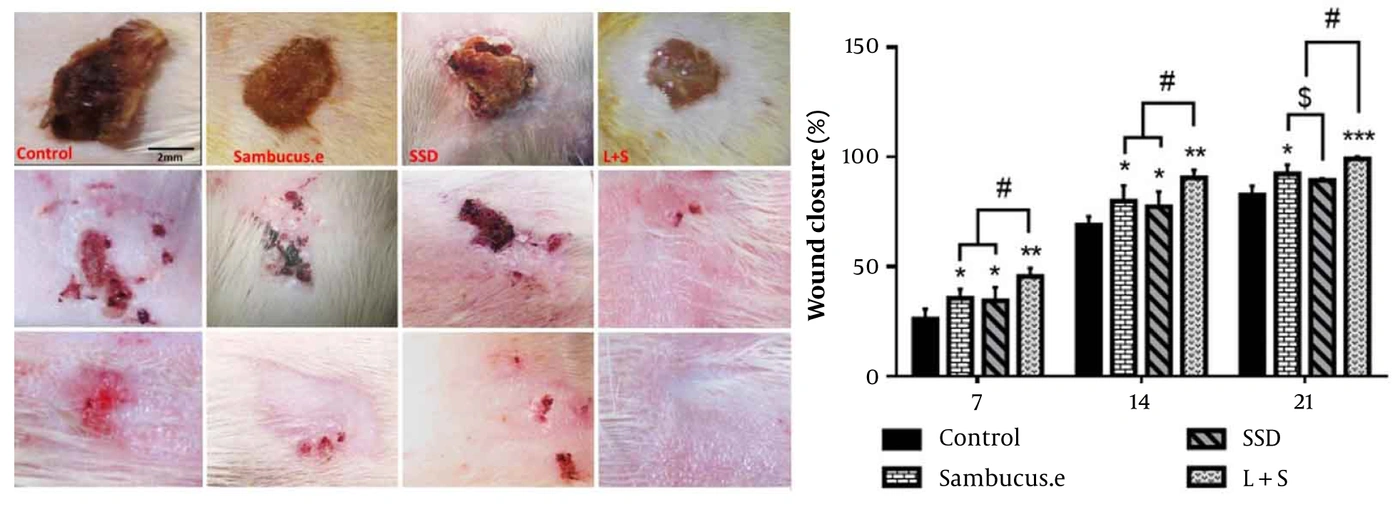
Figure 1.
Macroscopic Appearance and Rate of Wound Closure Across Experimental Groups. (Left) Representative macroscopic photographs of burn wounds in the control, Sambucus ebulus, silver sulfadiazine (SSD), and combination-treatment (Sambucus ebulus + losartan potassium; L+S) groups on days 7, 14, and 21 post-injury (scale bar = 2 mm). (Right) Quantitative analysis of wound-closure percentage on days 7, 14, and 21 after burn induction. Data are presented as mean ± SD (n = 4 - 10 per time point). *P < 0.05, **P < 0.01, ***P < 0.001 versus the control group; #P < 0.05 versus both the Sambucus ebulus and SSD groups; $P < 0.05 versus the Sambucus ebulus group. Abbreviations: SSD, silver sulfadiazine; L+S, losartan potassium plus Sambucus ebulus ointment.
Quantitative analysis showed a gradual increase in wound closure in all experimental groups from day 7 to day 21 (Figure 1, right). On day 7, topical treatment with Sambucus ebulus, silver sulfadiazine, and the combination of Sambucus ebulus plus losartan potassium significantly increased wound closure compared with that in the control group (P < 0.05). Combination therapy achieved the highest percentage of wound closure and was significantly more effective than either Sambucus ebulus or silver sulfadiazine alone (P < 0.05).
A similar pattern was observed on day 14. All treatment groups exhibited significantly greater wound closure than the control group, whereas the combination treatment produced the greatest improvement and remained significantly superior to both monotherapies (P < 0.05). By day 21, wound closure had further increased in all groups. The combination treatment continued to demonstrate the highest healing rate and remained significantly more effective than both the Sambucus ebulus and silver sulfadiazine groups (P < 0.05). In addition, wound closure in the Sambucus ebulus group was significantly greater than that in the silver sulfadiazine group (P < 0.05).
4.2. Histopathological Findings
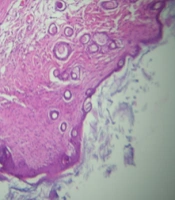
Representative hematoxylin and eosin-stained sections obtained on day 21 are shown in Figure 2 (left). Histological examination of the control group revealed incomplete re-epithelialization, persistent inflammatory cell infiltration, and irregular granulation tissue. In contrast, wounds treated with Sambucus ebulus ointment showed improved epithelial regeneration and reduced inflammatory cell infiltration compared with the control group. The silver sulfadiazine-treated group also demonstrated enhanced tissue repair, although residual inflammatory cells and less organized granulation tissue were still evident. The combination treatment with topical Sambucus ebulus ointment and systemic losartan potassium showed the most advanced histological appearance, characterized by a more continuous epidermal layer, reduced inflammatory cell infiltration, and better-organized granulation tissue compared with that in the other experimental groups.
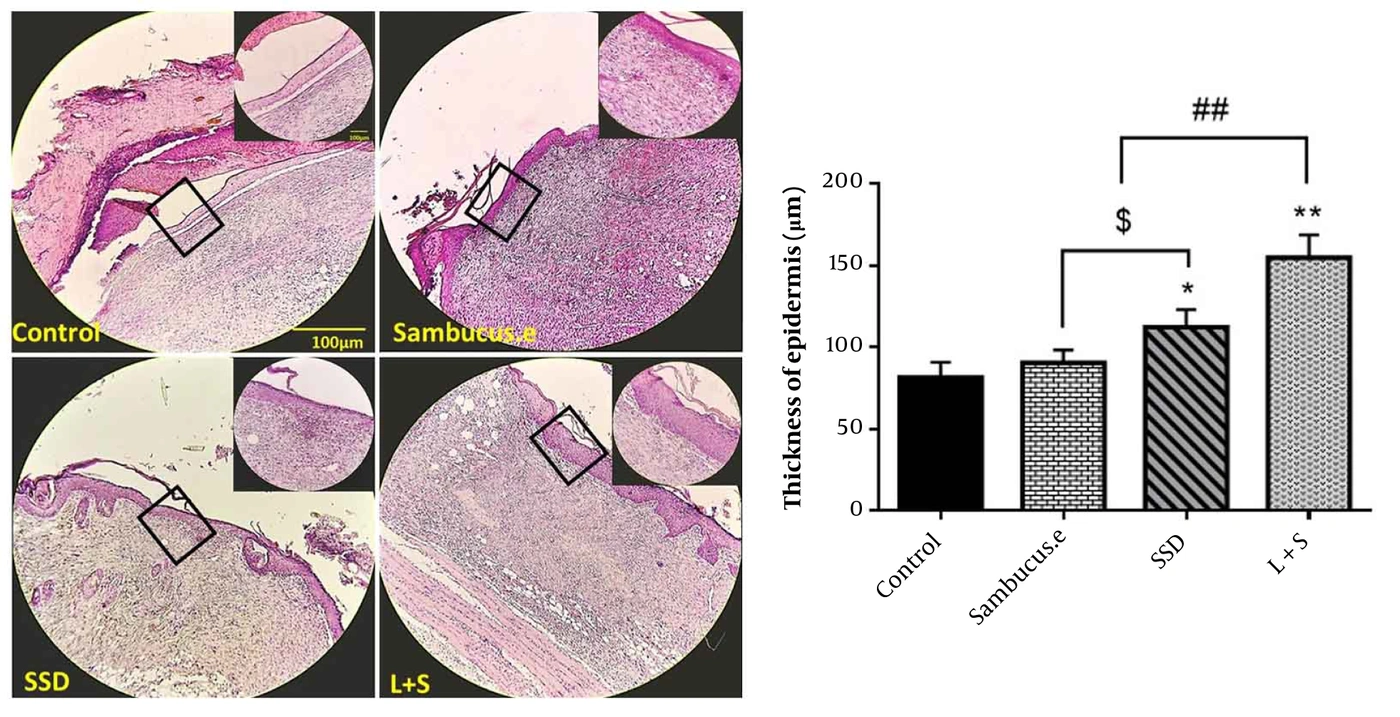
Figure 2.
Histopathological Evaluation of Re-epithelialization and Epidermal Thickness on Day 21. (Left) Representative hematoxylin and eosin (H&E)-stained histological sections of burn wounds across experimental groups on day 21 post-injury (scale bar = 100 µm). The boxed areas are shown at higher magnification (200×) in the insets in the upper-right corner of each panel (scale bar = 50 µm). (Right) Quantitative morphometric analysis of epidermal thickness (µm) on day 21 after burn induction. Data are presented as mean ± SD (n = 4 per group). *P < 0.05, **P < 0.01 versus the control group; $P < 0.05 versus the Sambucus ebulus group; ##P < 0.01 versus both the Sambucus ebulus and SSD groups. Abbreviations: SSD, silver sulfadiazine; L+S, losartan potassium plus Sambucus ebulus ointment.
4.3. Epidermal Thickness
Quantitative histomorphometric analysis performed on day 21 demonstrated significant differences in epidermal thickness among the experimental groups (Figure 2, right). Compared with the control group, the silver sulfadiazine and combination-treatment groups exhibited significantly greater epidermal thickness (P < 0.05 and P < 0.01, respectively), whereas the increase observed in the Sambucus ebulus group was not statistically significant. Furthermore, epidermal thickness in the combination-treatment group was significantly greater than that in both the Sambucus ebulus and silver sulfadiazine groups (P < 0.01). In addition, the silver sulfadiazine group showed significantly greater epidermal thickness than the Sambucus ebulus group (P < 0.05).
4.4. Neovascularization and Blood Vessel Density
Histomorphometric assessment revealed marked temporal variations in the number of blood vessels across experimental groups during the healing continuum (Figure 3). Quantitative analysis demonstrated that on day 7 post-wounding, granulation tissue in the combination-treatment group (Sambucus ebulus + losartan; L+S) exhibited the highest capillary count per high-power field, which was significantly greater than that in both the control group (P = 0.0018) and the SSD group (P = 0.0103), as shown in Figure 4. By day 14, blood vessel density in both the S. ebulus and SSD groups was significantly higher than that in the control group (P = 0.0103), reflecting active angiogenesis during the proliferative phase. During the remodeling phase on day 21, a significant physiological reduction in microvessel density was observed in the combination group compared with that in the control (P = 0.0003), S. ebulus (P = 0.0074), and SSD (P = 0.0308) groups (Figure 4), suggesting accelerated tissue maturation and vascular remodeling.
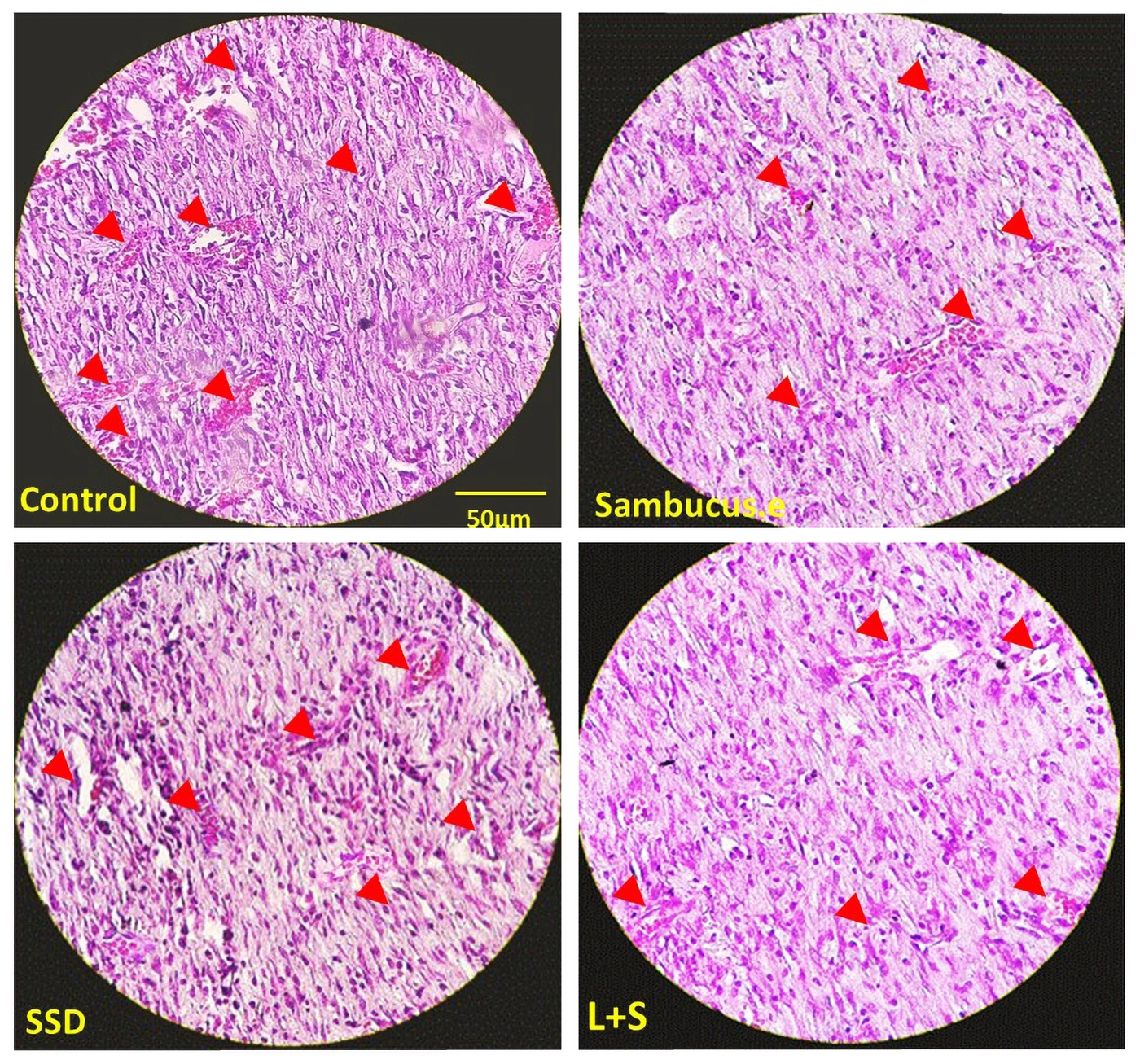
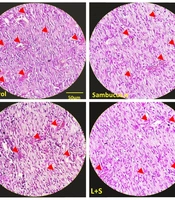
Figure 3.
Representative Photomicrographs of Granulation Tissue Neovascularization Across Experimental Groups. Histological sections of burn wounds stained with hematoxylin and eosin (H&E) from the control, Sambucus ebulus, silver sulfadiazine (SSD), and combination (Sambucus ebulus + losartan; L+S) groups on day 21 post-injury (high-power field; scale bar = 50 µm; 200× magnification). Red arrowheads indicate cross-sections of capillary lumens within the dermal repair zone.
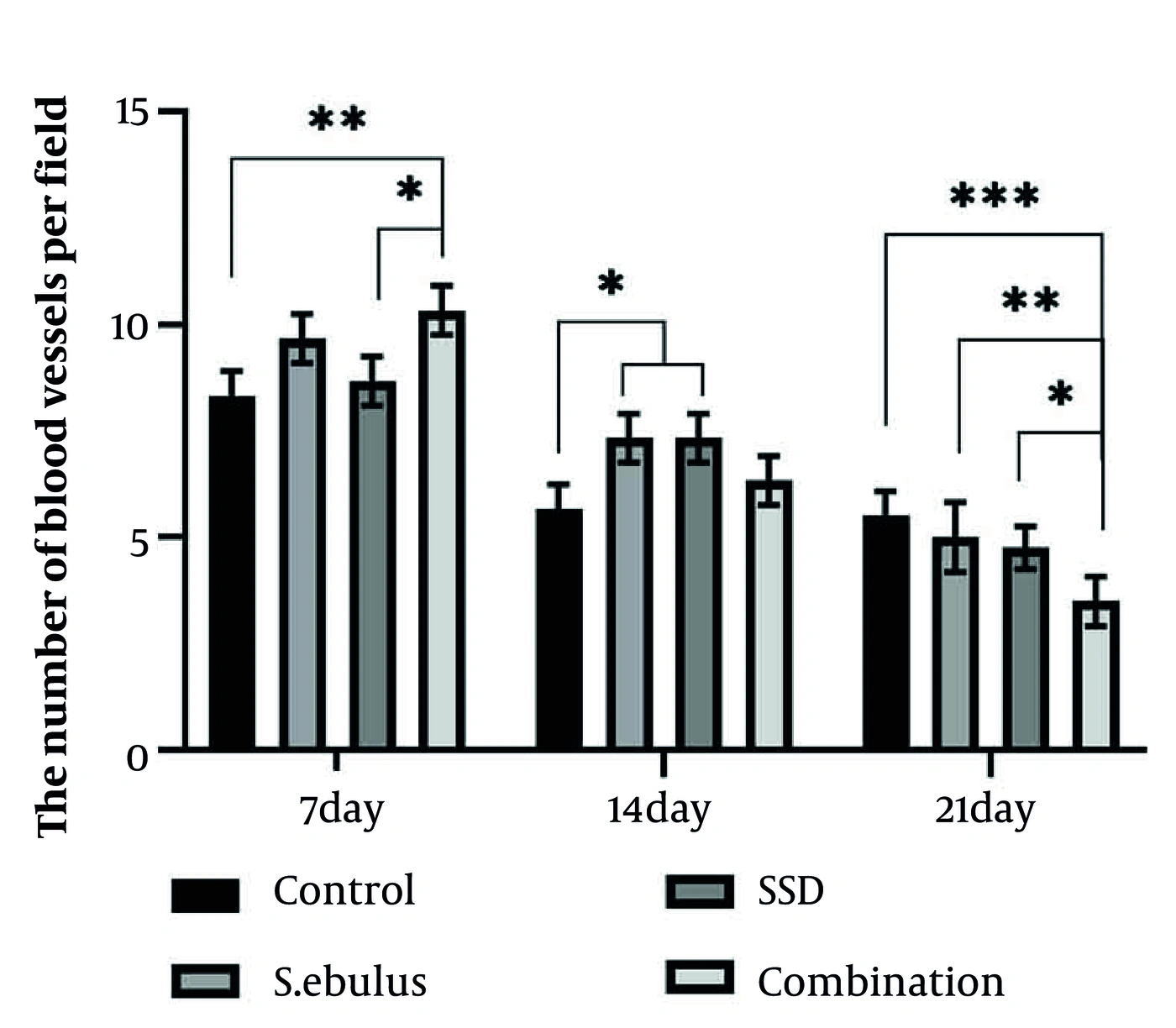
Figure 4.
Quantitative Histomorphometric Analysis of Blood Vessel Count per High-Power Field (400× Magnification). Longitudinal evaluation of newly formed blood vessels on days 7, 14, and 21 post-injury across experimental groups (control, Sambucus ebulus, SSD, and combination). Data are presented as predicted least-squares means (LS means) ± SD (n = 3 - 4 per group/time point). Statistical comparisons were conducted using a two-way mixed-effects model (REML) followed by Tukey's multiple-comparisons post hoc test. Asterisks indicate statistically significant differences between groups (*P < 0.05, **P < 0.01, ***P < 0.001).
5. Discussion
The present study demonstrated that concomitant administration of topical Sambucus ebulus ointment and systemic losartan potassium significantly improved burn-wound repair compared with standard silver sulfadiazine and topical monotherapy alone. This dual-axis regimen accelerated macroscopic wound closure, restored epidermal structural integrity, as reflected by increased epidermal thickness, and modulated microvascular architecture. Cutaneous thermal injury triggers a tightly coordinated cascade comprising hemostasis and inflammation, proliferative tissue formation, and matrix remodeling; synchronized transition through these phases is essential for functional tissue regeneration (2, 7, 8). Our findings indicate that concurrently targeting localized tissue regeneration and systemic RAS signaling may create a microenvironment that supports advanced tissue maturation.
A previous investigation demonstrated the pro-healing and epithelial-regenerative capacity of topical Sambucus ebulus extract in isolation. The current study builds on these findings by showing that co-treatment with systemic losartan potassium further enhances dermal repair kinetics and modulates microvascular remodeling during the final stages of healing.
The aerial parts of Sambucus ebulus used in this study were harvested from high-altitude mountainous habitats in Savadkuh, northern Iran. Environmental factors characteristic of high altitudes are recognized to influence secondary-metabolite biosynthesis in medicinal plants, particularly phenolic compounds, flavonoids, and anthocyanins (9). These bioactive constituents exert free-radical-scavenging, membrane-stabilizing, and anti-inflammatory activities, thereby creating a favorable local environment for cellular migration and matrix deposition.
The inclusion of systemic losartan potassium may have augmented the healing response through cellular and molecular pathways complementary to the localized phytotherapeutic actions of Sambucus ebulus. As a selective angiotensin II type 1 receptor antagonist, losartan inhibits local and systemic angiotensin II signaling, which is known to promote aberrant fibroblast differentiation and excessive TGF-β1-mediated matrix deposition (11). Previous studies have also demonstrated that losartan can accelerate re-epithelialization, suppress persistent leukocyte infiltration, and promote physiological matrix remodeling while mitigating fibrotic contracture (11). Because successful burn-wound healing depends on coordinated regulation of inflammation, angiogenesis, extracellular matrix remodeling, and epithelial regeneration, simultaneously targeting multiple biological pathways may yield favorable therapeutic outcomes (8). Consistent with these observations, the combination treatment in the present study resulted in greater wound closure, improved histopathological architecture, and increased epidermal thickness compared with either treatment alone.
The favorable outcomes observed in our model are consistent with findings by Akershoek et al., who reported that losartan reduced myofibroblast accumulation and excessive wound contraction in partial-thickness burn wounds (12). Because the present study involved a second-degree, partial-thickness thermal injury, systemic AT1 receptor inhibition may have acted synergistically with topical S. ebulus to accelerate epidermal barrier restoration and maintain dermal-epidermal structural balance without impairing healing dynamics.
A key finding of the present study was the significant reduction in vascular density observed in the combination-treatment group on day 21 compared with the control and monotherapy groups. Angiogenesis is an indispensable physiological process during the inflammatory and proliferative phases of wound healing; however, subsequent regression and pruning of newly formed microvessels are fundamental features of the remodeling phase (2, 7). Accordingly, the lower vascular density observed in the combination group suggests accelerated vascular remodeling and advanced tissue maturation rather than impaired neovascularization (2, 8). However, because angiogenesis-specific molecular markers such as CD31 and VEGF were not evaluated, this histomorphometric finding should be interpreted cautiously as suggestive of later-stage tissue maturation rather than definitive molecular evidence of remodeling.
This temporal distinction is important and may help reconcile potential discrepancies between our findings and previous reports. For instance, Braz et al. evaluated vascularization under RAS-modulating conditions during the acute wound-healing phase on postoperative day 4, a period characterized by peak granulation-tissue formation (13). In contrast, our longitudinal assessment specifically captured vascular-pruning events occurring on day 21. Although the absence of angiogenesis-related molecular markers such as CD31 and VEGF limits definitive characterization of the molecular landscape of these vessels, these histomorphometric observations suggest that combination therapy with Sambucus ebulus and losartan may promote progression toward tissue maturation.
Previous work has also shown that Sambucus ebulus fruit extract can accelerate wound closure and fibroblast proliferation in diabetic wounds and can upregulate angiogenic and regenerative mediators during active proliferative stages. In our model, combination therapy appears to have accelerated early tissue-repair kinetics, thereby reaching the vascular-refinement and maturation phase earlier than the monotherapy or SSD-treated groups.
Silver sulfadiazine remains a widely used topical antimicrobial in clinical burn care; however, its cytotoxicity toward human keratinocytes and dermal fibroblasts has been associated with delayed re-epithelialization and wound contraction compared with saline-soaked dressings (14). Randomized clinical evidence has also indicated that some herbal formulations may achieve favorable re-epithelialization outcomes compared with SSD (15), while systematic reviews have reported favorable healing outcomes with honey and Aloe vera compared with SSD in superficial and partial-thickness burns (16, 17). Our comparative results are consistent with these reports: the combined S. ebulus and losartan regimen showed greater improvement than SSD across the quantitative morphometric and macroscopic closure parameters evaluated in this study.
5.1. Study Limitations
The present study has several limitations. First, although the primary objective was to assess whether adding a systemic agent could augment the efficacy of topical Sambucus ebulus compared with standard silver sulfadiazine, a losartan monotherapy group was not included. Therefore, the isolated systemic contribution of losartan and formal pharmacodynamic synergy cannot be definitively established. Second, molecular markers associated with angiogenesis, fibrosis, and inflammation were not evaluated. In addition, collagen-specific staining and biomechanical assessment of healed skin were not performed.
5.2. Conclusions
The combination of topical Sambucus ebulus ointment and systemic losartan potassium accelerated macroscopic wound closure, increased epidermal thickness, and was associated with a temporal pattern of early neovascularization followed by lower microvessel density during later healing. These findings are consistent with an accelerated transition from active granulation toward tissue maturation, although the absence of angiogenesis-specific molecular markers limits mechanistic interpretation. Further translational studies are warranted to characterize the underlying pathways and evaluate the clinical applicability of this combined local-systemic approach.