
1. Context
Military feeding operates under constraints rarely encountered in institutional catering, including uncertain resupply, high physical workloads, compressed eating opportunities, temperature extremes, limited water and preparation equipment, and a requirement for long shelf life. Under these conditions, nutrition, food safety, packaging, logistics, and medical surveillance become interdependent. Energy requirements can rise markedly with load carriage, cold exposure, altitude, and sustained operations, whereas actual intake often declines as workload and fatigue increase (1-5). Consequently, a technically compliant ration can coexist with negative energy balance, micronutrient shortfalls, gastrointestinal symptoms, or avoidable waste.
The conventional supply-chain question—whether the required number of meals reached the unit—is necessary but insufficient. Readiness depends on whether the meal remained within specification, could be prepared safely, was accepted and consumed, and supported health and performance. Reviews describe ration nutrition and technology; however, governance is commonly divided among procurement, logistics, food services, preventive medicine, clinicians, and commanders (6, 7). This fragmentation can obscure downstream consequences related to intake, illness, and duty loss.
This expert review addresses this systems gap. Its objectives are to: (i) synthesize evidence on the main nutritional, behavioral, microbiological, and logistical failure modes of operational rations; (ii) propose a Ration-to-Readiness (R2R) framework with measurable controls; and (iii) outline a staged implementation approach for military health systems. The framework is intended for policy design and local adaptation; it is not presented as a validated clinical prediction rule.
2. Evidence Acquisition
This work was designed as an expert review with a structured evidence search. PubMed/MEDLINE was searched from database inception through July 31, 2026, and supplemented by targeted searches of official sources from the Codex Alimentarius Commission, the North Atlantic Treaty Organization, the United States Department of Defense, the Defense Logistics Agency, and relevant standards organizations. For reproducibility in this revision, the PubMed search logic was reconstructed from the concepts used in the original search and recorded as follows: ((military[Title/Abstract] OR soldier*[Title/Abstract] OR "armed forces"[Title/Abstract]) AND (ration*[Title/Abstract] OR "combat feeding"[Title/Abstract] OR "field feeding"[Title/Abstract] OR "meal ready to eat"[Title/Abstract] OR MRE[Title/Abstract])) AND (nutrition*[Title/Abstract] OR intake[Title/Abstract] OR energy[Title/Abstract] OR acceptab*[Title/Abstract] OR palatab*[Title/Abstract] OR foodborne[Title/Abstract] OR hygiene[Title/Abstract] OR packag*[Title/Abstract] OR "shelf life"[Title/Abstract] OR temperatur*[Title/Abstract] OR traceab*[Title/Abstract] OR recall[Title/Abstract] OR readiness[Title/Abstract]). No language restrictions were imposed; the end date was July 31, 2026. Reference lists of directly relevant reviews on military nutrition and rations were also examined.
Eligible sources included field and laboratory studies involving military personnel or military rations; outbreak investigations; ration acceptability and consumption studies; packaging and stability research with clear operational applicability; and authoritative standards or policy documents. Sources were excluded if they addressed only civilian retail foods without a transferable military implication, lacked sufficient methodological detail, or duplicated a more complete report. This was an expert review rather than a systematic review: sources were selected by the authors according to the stated eligibility and operational-relevance criteria, and evidence was organized by failure pathway rather than by study design. The final narrative synthesis included 28 sources. Because the original iterative search was not managed with a PRISMA-style deduplicated screening log, a defensible retrospective number of records screened cannot be reported; no estimated screening count was introduced during revision.
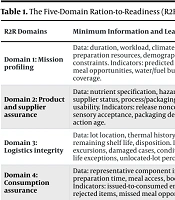
A meta-analysis was not appropriate because missions, climates, ration systems, exposure durations, and outcomes varied substantially. The synthesis therefore emphasizes direction and operational significance rather than a pooled effect estimate, with greater interpretive weight given to directly observed intake or expenditure, controlled feeding studies, documented outbreaks, and current official standards. Framework development followed four steps: recurrent failure pathways were identified from the evidence; candidate preventive controls and verification measures were mapped from empirical studies, Codex/hazard analysis and critical control points (HACCP), ISO principles, and military policies; overlapping controls were consolidated into five governance domains spanning mission requirements to health-readiness feedback; and each domain was translated into leading indicators, locally calibratable triggers, corrective actions, and accountable functions. Table 1 distinguishes the empirical or standards basis from the author-proposed integration. The five-domain structure, combined dashboard, and illustrative trigger-action examples are conceptual synthesis elements that require prospective validation.
Table 1.
The Five-Domain Ration-to-Readiness (R2R) Implementation Matrix a
| R2R Domains | Minimum Information and Leading Indicators | Evidentiary Basis and Example Accountable Function | Illustrative / Locally Calibrated Trigger and Action |
|---|---|---|---|
| Domain 1: Mission profiling | Data: duration, workload, climate, altitude, resupply, preparation resources, demographics, dietary constraints. Indicators: predicted energy range, meal opportunities, water/fuel burden, special-diet coverage. | Basis: military energy-intake evidence and alliance/policy guidance; domain integration is author-proposed. Example function: operations planning with nutrition / preventive medicine. | Profile outside the locally validated ration envelope -> tailor menu, supplement, meal schedule, or resupply plan. |
| Domain 2: Product and supplier assurance | Data: nutrient specification, hazard analysis, supplier status, process/packaging validation, field usability. Indicators: release nonconformities, sensory acceptance, packaging defects, corrective-action age. | Basis: Codex/HACCP, military policy, packaging and usability evidence; domain integration is author-proposed. Example function: procurement / quality assurance with food-safety inspection. | Defect cluster or failed release criterion -> hold lot, investigate, substitute, and verify closure. |
| Domain 3: Logistics integrity | Data: lot location, thermal history, inspection status, remaining shelf life, disposition. Indicators: excursions, damaged cases, condition-adjusted shelf-life exceptions, unlocated-lot percentage. | Basis: packaging and shelf-life evidence plus military policy and ISO food-safety/traceability principles. Example function: logistics / supply with food inspection. | Locally defined exposure limit exceeded -> segregate stock and conduct risk-based inspection / disposition. |
| Domain 4: Consumption assurance | Data: representative component intake, waste, preparation time, meal access, body-mass trend. Indicators: issued-to-consumed energy ratio, rejected items, missed meal opportunities. | Basis: military ration-intake and acceptability evidence; sampling approach and trigger values require local validation. Example function: unit leadership with nutrition / food service. | Persistent subgroup or mission-phase gap -> protect meal time, redesign menu, alter portions, or reassess preparation burden. |
| Domain 5: Health-readiness feedback | Data: enteric symptoms, duty loss, complaints, affected lots, investigation and corrective-action status. Indicators: same-unit symptom clusters, duty-loss days, time to lot hold, recurrence after closure. | Basis: outbreak/surveillance evidence and traceability standards; integrated dashboard and trigger-action loop are author-proposed. Example function: preventive medicine / medical surveillance with logistics and command. | Signal above a locally calibrated threshold -> clinical assessment, epidemiology, lot hold/recall, and after-action review. |
a Evidence- and standards-informed controls are cited in the accompanying text. The five-domain integration, example accountable functions, combined dashboard, and trigger-action examples are author-proposed. All trigger values should be prospectively calibrated to local mission risk, baseline rates, and response capacity before routine use. Abbreviation: HACCP, hazard analysis and critical control points.
3. Results
3.1. The Ration System as a Readiness Pathway
A military ration creates readiness value only after the completion of an uninterrupted pathway: mission requirements are translated into a specification; ingredients and packaging are procured; products are manufactured and released; lots are stored and distributed; meals are prepared or opened correctly; personnel consume sufficient food and fluid; and adverse health or performance signals are returned to decision-makers. Failure at any stage can nullify the quality achieved upstream.
Three distinctions are central. First, availability is not intake: issued kilocalories are a logistics measure, not a physiological exposure. Second, shelf life is conditional: the same calendar age can represent different remaining quality after temperate versus hot storage. Third, the absence of a reported outbreak is not equivalent to control: under-reporting, self-treatment, dispersed cases, and delayed laboratory confirmation may obscure a readiness-relevant signal. Table 2 translates these distinctions into auditable failure pathways.
Table 2.
Failure Pathways Linking Ration-System Weaknesses to Readiness Consequences a
| Failure Pathways | Operational Mechanism | Readiness Consequence | Primary Controls and Verification |
|---|---|---|---|
| Requirement mismatch | One ration specification is applied across dissimilar workloads, climates, durations, or dietary needs. | Under-fueling, excess carriage weight, nutrient gaps, or avoidable waste. | Mission profile; measured expenditure/intake samples; sex- and task-stratified review. |
| Underconsumption | Limited meal time, poor temperature or palatability, menu fatigue, preparation burden, or inaccessible packaging. | Negative energy balance, impaired recovery, lower morale, and discarded food. | Component-level intake/waste; field acceptability; preparation-time and meal-opportunity audit. |
| Food contamination | Unsafe water, ill handlers, cross-contamination, inadequate cooking, or time-temperature abuse. | Clustered enteric illness, evacuation, diagnostic burden, and duty loss. | GHP/HACCP; water and sanitation checks; handler health; symptom-cluster triggers. |
| Product degradation | Heat, oxygen, freeze-thaw cycles, seal damage, pests, or mechanical stress. | Loss of safety, nutrient quality, acceptability, and user confidence. | Environmental qualification; data loggers/indicators; seal inspection; lot sampling. |
| Traceability failure | Lot identity is lost between supplier, warehouse, unit issue, and consumption. | Delayed containment, overbroad disposal, persistent exposure, and supply disruption. | Common identifiers; offline records; mock recalls; time-to-containment metric. |
| Feedback failure | Medical, complaint, waste, and logistics data remain in separate reporting channels. | Repeated defects and slow recognition of a system-level risk. | Joint dashboard; named owners; action thresholds; corrective-action closure audit. |
a Abbreviations: GHP, good hygiene practices; HACCP, hazard analysis and critical control points.
3.2. Nutritional Adequacy Must Be Measured at the Point of Consumption
Military energy expenditure varies widely by task and environment. Reviews and field studies describe requirements that may exceed standard garrison needs during prolonged load carriage, cold-weather training, or special operations (1-4). In a Canadian Arctic-like exercise, approximately 5,685 kcal/d were available, whereas mean intake was only about 2,377 kcal/d, illustrating the large gap that may separate ration provision from consumption (3). British officer cadets also developed low energy availability during training, and a recent Reserve Officer Training Corps field exercise reported mean deficits of approximately 1,350 kcal/d in men and 975 kcal/d in women (4, 5). These values are not universal thresholds, but they demonstrate why issue records alone cannot verify nutritional support.
Nutrient density adds a second layer. Canadian personnel consuming field rations achieved energy intakes similar to their home diets in one short exercise, yet inadequacies remained for selected micronutrients and food groups (8). A controlled 21-day Meal, Ready-to-Eat (MRE) trial found that a modern ration could maintain most measured nutritional and cardiometabolic indicators in healthy adults, supporting the value of sound formulation and fortification (9). However, the same controlled setting cannot reproduce missed meals, ration trading, menu rejection, or the increased requirements associated with field stress. Controlled adequacy and operational effectiveness should therefore be treated as complementary, not interchangeable, evidence.
Protein distribution, carbohydrate availability, iron status, calcium, vitamin D, and other micronutrients warrant mission-specific attention. Severe energy deficit accelerates loss of body mass and fat-free mass and can impair recovery, immunity, mood, and cognition; higher protein intake may attenuate, but cannot fully correct, inadequate energy intake (10, 11, 12). Needs and menu-use patterns also vary by sex, body size, and dietary restriction. Policy should specify both nutrient composition and representative intake sampling by task, environment, and mission phase.
3.3. Acceptability and Usability Are Safety-Critical Design Variables
Palatability is sometimes treated as a secondary consumer preference, but in operational settings it governs dose: food that is discarded or exchanged delivers no nutrient value. A national survey of Canadian soldiers with Arctic experience found that food temperature, eating while moving, exercise schedules, and preparation equipment were key constraints; participants reported consuming only 61% - 71% of their rations, and 65% reported weight loss (13). Early military research similarly identified monotony, portion burden, limited eating time, and the effort required for preparation as causes of underconsumption (14).
Acceptability should be tested under representative field conditions, not by central-location taste panels alone. Useful outcomes include component consumption, preparation time, water and fuel requirements, opening with gloves, packaging litter, menu trading, gastrointestinal tolerance, and repeat acceptability. Protected meal opportunities and permission to eat during long tasks can be as important as formulation.
The design objective is not maximal liking; it is reliable consumption of a nutritionally appropriate amount without creating excessive preparation, waste, or food-safety risk. Menu variety, culturally acceptable options, vegetarian and medically indicated alternatives, and component-level modularity can improve this reliability. Procurement scoring should therefore include field consumption and usability alongside unit price, nutrient specification, and laboratory shelf-life results.
3.4. Food Safety Events Can Become Operational Events
Foodborne disease produces more than clinical morbidity. Clusters can remove multiple members of a unit at the same time, consume evacuation and diagnostic capacity, and reduce trust in the feeding system. A review of French armed forces surveillance from 1999 - 2009 identified 180 foodborne outbreaks involving 4,848 cases, with higher rates in overseas settings (15). Investigations in other forces have linked outbreaks to institutional kitchens, mass feeding, and deployed operations (16-18). Prospective and molecular studies also demonstrate that travelers' diarrhea and other enteric syndromes remain common enough to require active prevention and surveillance (19, 20).
Operational feeding combines several hazards: uncertain water quality, disrupted cold chains, bulk preparation, cross-contamination, inadequate hand hygiene, damaged packaging, pests, and pressure to retain food after time or temperature limits have been exceeded. The appropriate control model is preventive. The Codex General Principles of Food Hygiene integrate prerequisite good-hygiene practices with HACCP, requiring hazards to be identified, controlled, monitored, verified, and documented (21). Military adaptation must define who may release a lot, who can condemn food in the field, how safe water and sanitation are verified, and how operations continue when a control fails.
Surveillance should capture more than laboratory-confirmed outbreaks. Early indicators include same-unit clustering of vomiting or diarrhea, unexpectedly high use of antidiarrheal medication, food-handler illness, temperature excursions, packaging complaints, and repeated rejection of a specific lot. A low-burden reporting channel for medics, food-service staff, and commanders can shorten the interval from symptom onset to lot hold, epidemiologic assessment, and corrective action. Duty-loss days and mission restrictions are particularly useful readiness outcomes.
3.5. Packaging and Shelf Life Are Environmental Controls
Operational packaging must preserve microbiological safety, nutrient content, sensory quality, and mechanical integrity while remaining light and usable. Studies of oxygen-absorbing systems, retort foods, frozen rations, and chocolate show that oxygen exposure, thermal history, freeze-thaw cycling, and tropical storage can change product quality and spoilage risk (22-25). These effects may occur before a package reaches its printed end date. Conversely, a properly controlled lot may remain fit throughout its validated shelf life.
Calendar-based stock rotation is therefore weaker than condition-informed control. Time-temperature indicators, warehouse and vehicle data loggers, inspection of seal and barrier defects, and statistically designed lot sampling can estimate remaining shelf life more accurately (26). The control system should distinguish safety failure from loss of quality or acceptability, because each requires a different disposition. Current MRE guidance illustrates the specification approach: a complete meal is designed to provide roughly 1,250 kcal and a three-year shelf life at 80°F, but its actual serviceability still depends on storage history and inspection.
Environmental qualification should represent the intended mission. Products destined for prolonged hot storage, high altitude, maritime environments, or repeated air transport require stress profiles and packaging tests that match those conditions. Procurement contracts should state sampling plans, acceptance criteria, accelerated and real-time stability requirements, and responsibilities for investigation when complaints cluster by lot.
3.6. Traceability and Surveillance Close the Control Loop
A ration system cannot manage a hazard it cannot locate. Minimum traceability should link the supplier, production lot, inspection and release status, storage location, unit issue, and disposition. Codex, ISO food-safety management, and ISO traceability principles support risk-based documentation and rapid withdrawal (21). Military policies similarly link nutrition standards, food-service safety, inspection, and combat-feeding research, although exact organizational arrangements vary.
The key test is whether a suspect lot can be identified, held, located across dispersed units, and reconciled within an operationally meaningful period. Mock recalls should measure time to containment, stock located, quantity consumed or destroyed, and corrective-action closure. Offline capability is essential where connectivity is unreliable.
The same identifiers should link complaints and medical signals to lots. This creates a learning system: a rise in gastrointestinal symptoms, packaging defects, or component waste can trigger a targeted hold or investigation, while a recurring underconsumption pattern can lead to menu redesign, changes in portioning, or altered meal schedules.
3.7. The Ration-to-Readiness Framework
The proposed R2R framework organizes governance into five domains (Table 1). Its structure was derived by grouping the recurrent failure pathways in Table 2 into a sequential control chain: mission requirement, product release, logistics preservation, actual consumption, and health-readiness feedback. Empirical military studies and authoritative standards support many component controls, whereas the five-domain integration, example ownership assignments, and trigger-action architecture are author-proposed synthesis elements. Table 1 makes that evidentiary status explicit. The first domain, mission profiling, defines the nutritional and operational requirement using duration, task intensity, climate, altitude, resupply, preparation resources, demographic composition, and dietary constraints. Published standards and alliance examples can inform planning, but widely cited targets must be adjusted to local measurement and mission reality.
The second domain, product and supplier assurance, combines nutrient specification, sensory and usability testing, supplier qualification, process control, packaging validation, and lot release. The third domain, logistics integrity, protects the released product through condition-aware storage, transport monitoring, first-expired-first-out rotation, inspection, and documented exception management. These controls are primarily standards- and evidence-informed; their consolidation into adjacent R2R domains is part of the proposed governance model.
The fourth domain, consumption assurance, assesses whether personnel can and do eat the ration. This does not require continuous individual surveillance. Representative unit sampling - short weighed-waste studies, structured component return counts, rapid digital diaries, and pre/post exercise body-mass trends - can identify systematic gaps. Results should be stratified by mission phase and relevant personnel characteristics without turning nutrition monitoring into punitive performance management. Trigger values in this domain are illustrative and should be calibrated to local baselines and mission risk.
The fifth domain, health-readiness feedback, integrates preventive-medicine, clinical, logistics, and user data. A small dashboard can combine enteric illness incidence, duty-loss days, packaging defects, lot complaints, recall performance, and consumption indicators. Each measure requires a locally assigned accountable function and a pre-agreed, locally calibrated trigger. A trigger initiates a bounded response - such as enhanced sampling, a temporary lot hold, menu substitution, protected meal time, or a formal outbreak investigation - followed by documented closure.
The framework is deliberately based on closed loops. Specifications are revised using field evidence; suppliers receive lot-level feedback; logistics decisions account for environmental exposure; and commanders receive a readiness-relevant interpretation rather than isolated nutrition or inspection data. This approach makes ration governance an operational risk process rather than a sequence of unconnected technical checks. The proposed ownership arrangements and action thresholds should be treated as testable implementation hypotheses rather than validated universal rules.
3.8. Staged Implementation in Military Health Systems
Implementation can begin without a new enterprise information system. In phase 1, a multidisciplinary steering group maps the existing process from specification to medical reporting, assigns locally accountable functions, and selects a limited dashboard. Baseline process measures should include lot-traceability completeness, handling of temperature excursions, timeliness of corrective-action closure, component waste or consumption sampling, gastrointestinal-illness reporting, complaints, and duty loss. The accountable function may differ by force structure; Table 1 therefore lists examples rather than mandatory organizational titles.
Phase 2 should pilot the framework in one high-risk setting, such as a hot-weather exercise, a remote training area, a ship, or a prolonged field deployment. A minimum prospective evaluation set should cover five dimensions: process (traceability completeness, time to containment, corrective-action closure); health (enteric-symptom incidence or clusters); readiness (duty-loss days, missed meal opportunities, and relevant body-mass/performance trends); cost (waste, disposal, emergency resupply, investigation, and staff time); and equity (special-diet coverage and subgroup differences in meal access or consumption). Feasibility assessments should also document missing data, staff workload, reporting burden, time-to-action, and unintended consequences such as operational delay or reduced trust in monitoring.
Phase 3 should scale only elements that are feasible, change decisions, or demonstrate a favorable risk-benefit profile, while standardizing identifiers, training, audit methods, and after-action review. Lower-capacity settings need not deploy continuous digital surveillance: sentinel sampling, paper or offline registers, periodic component-return counts, and a small spreadsheet dashboard can support the same control logic. Unit-level or de-identified indicators should be preferred; any necessary individual-level data should be minimized, access-controlled, retained only as required, and separated from disciplinary decision-making. Implementation therefore requires protected staff time, basic training in nutrition/food safety and data handling, clear authority for lot holds and outbreak response, and locally appropriate privacy governance (Table 3).
Table 3.
Minimum Evaluation Set for Prospective R2R Pilot Testing
| Evaluation Dimension | Minimum Pilot Indicators | Interpretation / Feasibility Question |
|---|---|---|
| Process | Traceability completeness; time to lot containment; temperature-excursion handling; corrective-action closure. | Can the control be performed reliably and quickly with available staff and systems? |
| Health | Enteric symptom incidence or same-unit clusters; food-handler illness; adverse-event reporting. | Does surveillance identify actionable safety signals without excessive reporting burden? |
| Readiness | Duty-loss days; missed meal opportunities; representative body-mass or performance trends where appropriate. | Are observed signals temporally and operationally relevant to mission performance? |
| Cost | Ration waste/disposal; emergency resupply; investigation costs; staff time; avoidable stock loss. | Do avoided losses or improved decisions justify implementation resources? |
| Equity | Special-diet coverage; subgroup differences in meal access, consumption, or adverse effects. | Does implementation benefit mission-relevant subgroups without creating systematic access gaps? |
3.9. Interpretation, Limitations, and Research Priorities
The available evidence supports a simple conclusion: ration effectiveness cannot be inferred from nutrient composition or quantities issued. Field data repeatedly show underconsumption during demanding training (3, 4, 5, 8, 13), whereas controlled feeding demonstrates that well-designed shelf-stable rations can maintain short-term nutrient status in healthy adults (9). These findings are not contradictory; they locate the implementation gap between formulation and use. The same logic applies to food safety: validated processing and packaging are essential, but field hygiene, thermal history, traceability, and rapid surveillance determine whether protection persists.
The R2R framework extends existing standards by adding two links that are often weak: consumption assurance and explicit readiness feedback. It also treats acceptability as a control variable. This is important because an unpopular but nutrient-complete component can produce predictable under-fueling, and an unnecessarily complex preparation step can create both consumption and hygiene failures. A systems view encourages trade-offs to be evaluated before procurement: for example, a slightly higher unit cost may be justified when a product reduces waste, fuel use, preparation time, or duty loss. Conversely, adding calories without validating consumption may increase weight and waste without improving energy balance.
Health information must be used proportionately. Unit-level or de-identified indicators are usually sufficient; necessary individual data should be protected and separated from disciplinary decisions. Monitoring should detect system failure, not blame personnel for food that was inaccessible, unacceptable, or impractical.
Several evidence limitations remain. Many studies have small samples, short exercises, male-dominant cohorts, self-reported intake, or ration systems specific to one country. Laboratory shelf-life findings do not fully reproduce combined field stressors, and outbreak surveillance underestimates unreported disease. Controlled MRE studies also show that processed ration diets can alter gut microbial composition without necessarily increasing inflammation or intestinal permeability, but the operational significance of these changes remains uncertain (27, 28). In addition, the R2R framework is an author-developed conceptual synthesis: the consolidation into five domains, ownership examples, dashboard structure, and trigger-action rules have not undergone external validation or prospective calibration. They may therefore reflect interpretive choices and may not transfer unchanged across forces, climates, missions, data systems, or resource settings. Consequently, the framework should be validated against illness, duty loss, body-mass and performance trends, waste, cost, user confidence, feasibility, and equity before broad implementation.
Priority research includes multicenter evaluation across climates; sex- and task-stratified intake; comparison of consumption-monitoring methods; validation of time-temperature and remaining-shelf-life models; and economic evaluation including waste and duty loss. Cluster-randomized or stepped-wedge designs may suit meal-time, menu, or traceability interventions. Reports should identify ration version, thermal history, available and consumed energy, mission schedule, environment, and demographic composition.
4. Conclusions
Operational rations should be managed as a military health and readiness system. Compliance at manufacture or issue is only the starting point; safety and nutritional value must be maintained throughout logistics, preparation, and real-world consumption. The five-domain R2R framework links mission profiling, product and supplier assurance, logistics integrity, consumption assurance, and health-readiness feedback through measurable indicators, example accountable functions, and locally calibrated corrective actions.
Military health systems can begin with a small pilot, common lot identifiers, representative intake measurement, mock recalls, and a joint after-action process. Prospective external validation is required before adopting universal thresholds or attributing outcome improvements to the framework. Reframing the governing question from “Was a ration issued?” to “Did the feeding system safely sustain the force?” provides a testable basis for evaluating whether integrated ration governance can reduce under-fueling, enteric disease, waste, and mission disruption.