
1. Background
The rapid growth of Information and Communication Technology (ICT) has affected all aspects of life including healthcare (1). The benefits of using the Internet, including low cost, high search speed, and anonymized access to information, have made the Internet a preferred choice for searching health information (2). Currently, the Internet has become a major source of health-related information (3). The use of health information available on the Internet can have a major impact on one’s health behaviors (4) and it is necessary to have electronic health literacy to improve healthcare status (5). Electronic health literacy enables individuals to search, find, understand, and apply health information from electronic sources to solve health-related problems (6). In fact, electronic health literacy refers to the ability to find, understand, and evaluate health-related information from electronic sources and using the information to identify or solve health problems (7). With the development and advancement of information technology, various health information has become available online. In a study, 72% of Internet users in the United States reported receiving health information from the Internet (8). Internet use has many advantages in providing health services but it has not yet had a significant influence on Iranian society so that a significant number of physicians and patients tend to use the traditional processes of disease diagnosis and drug prescription. The reason for this tendency can be attributed to the inability to use information technology to maintain health, which requires the ability to read, use a computer, search for information, understand health information, and use it (9).
Various studies have been conducted in this regard worldwide. Rathnayake and Senevirathna (10) examined the electronic health literacy level of nursing students in Sri Lanka and showed that half of the students had inadequate electronic health literacy. Increasing electronic health literacy in nursing students is essential, which entails necessary planning such as changes in the educational curriculum and increasing IT-related facilities within the educational spaces. In a study by Cho et al. (11), examining the relationship between electronic health literacy and health-promoting behaviors in South Korean hospital nurses, the nurses with higher levels of electronic health literacy had significantly more health-promoting behaviors. Tubaishat and Habiballah (3) examined the electronic health literacy level of nursing students in Jordan before graduation and showed that most students were in good and very good conditions in terms of having the skill to use the Internet, as well as the continuous use of the Internet. However, some students needed to increase their Internet use skills and educational programs were necessary to enhance their health literacy. There have also been studies on electronic health literacy in Iran. In a study by Tadayon et al. (1), examining the electronic health literacy and its predictive factors among patients referring to a military hospital in Tehran in 2017, the mean score of electronic health literacy was low and patients needed to develop and enhance their knowledge of electronic health.
2. Objectives
Nurses are of the most important employees of healthcare systems who are responsible for maintaining the health of people referring to healthcare centers. Also, since as of the time of writing this paper, no study was conducted to assess the electronic health literacy level in the Iranian nursing community, the present study aimed to investigate the nurses’ electronic health literacy levels in selected military hospitals in Tehran.
3. Methods
This was a descriptive-analytical study conducted in 2019. The research population included nurses working at three selected military hospitals in Tehran. A total of 150 nurses were selected as the study sample. The questionnaires were distributed to them of which, 135 questionnaires were analyzed after eliminating 10% incomplete questionnaires. The inclusion criteria were voluntary participation, informed consent, and employment in each of the three selected military hospitals. The exclusion criteria were non-cooperation in the study and an incomplete questionnaire. The sample was selected with stratified convenience sampling.
Data were collected using a demographic questionnaire and the eHealth Literacy Scale (eHEALS).
The demographic questionnaire included sex, age, education, and the working hospital. The eight-item eHEALS was used to assess electronic health literacy (12). The eHEALS is a self-assessment questionnaire based on the knowledge and understanding of what health information resources are available on the Internet, where one can search for useful health resources, how to access these resources, how to use the Internet to answer health-related issues, the ability to evaluate online health information and identify high-quality and low-quality sources on the Internet. This questionnaire does not assess individuals’ actual knowledge but rather their perceptual knowledge (13). Nurses provided their opinion on the questionnaire items based on a five-point Likert scale from strongly disagree (option 1) to strongly agree (option 5). As a result, each participant’s final score ranged from 8 to 40 and a higher score indicated higher electronic health literacy. A score of 32 or above indicated high electronic health literacy (14). The reliability and validity of the Persian version of eHEALS were investigated by Bazm et al. (13). They reported the factor loading of items between 0.723 and 0.862, which is acceptable. The test-retest coefficient (r = 0.96, P < 0.001) and Cronbach’s alpha coefficient (alpha = 0.88, P < 0.001) were reported as acceptable. Their results showed that the translated version was equivalent to the original version of eHEALS and showed good reliability and validity (13). In the present study, Cronbach’s alpha coefficient of 0.92 was obtained.
The mean and standard deviations were used to describe the data and the Kolmogorov-Smirnov test to check data normality. The Spearman test was used to investigate the correlation between variables. The Kruskal-Wallis and Mann-Whitney tests were also used to evaluate the differences between independent groups in terms of ranking. Data were analyzed using SPSS-23 at a significance level of P < 0.05.
In this study, all nurses were assured of their voluntary participation in the study. All nurses’ information was kept confidential and published anonymously. This study did not have any cost for nurses and did not disrupt their activities. All information provided in this paper is the result of approved research work at the AJA University of Medical Sciences. All materials in this paper have not been published elsewhere and all authors contributed to the writing of the paper. The study was approved by the Ethics Committee of AJA University of Medical Sciences under the code IR.AJAUMS.REC.1398.094 in 2019.
4. Results
In this study, 150 questionnaires were distributed to the nurses. After collecting the questionnaires and excluding incomplete questionnaires, we analyzed 135 questionnaires. Of the 135 nurses participated in this study, 32 (23.7%) were working at Hospital A, 32 (23.7%) at Hospital B, and 71 (52.6%) at Hospital C; 79 (58.5 %) were male and 56 (41.5 %) were female; 23 (17 %) had an associate’s degree, 90 (66.7%) had a bachelor’s degree, and 22 (16.3%) had a master’s degree. The mean score of nurses’ electronic health literacy was 31.72 ± 5.51, with the highest and lowest scores being 40 and 18, respectively.
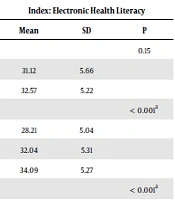
According to the Mann-Whitney U test, the level of electronic health literacy was not significantly different between male and female nurses (P > 0.05) (Table 1). The Kruskal-Wallis test results showed that the nurses’ electronic health literacy level significantly varied at different education levels and those with higher education levels had higher electronic health literacy (P < 0.05) (Table 1). Also, electronic health literacy was significantly different between nurses working at the three selected hospitals (P < 0.05) (Table 1).
Table 1.
Mean Score of Nurses’ Electronic Health Literacy by Demographic Information
| Variable | Index: Electronic Health Literacy | ||
|---|---|---|---|
| Mean | SD | P | |
| Sex | 0.15 | ||
| Male | 31.12 | 5.66 | |
| Female | 32.57 | 5.22 | |
| Education level | < 0.001a | ||
| Associate | 28.21 | 5.04 | |
| Bachelor’s | 32.04 | 5.31 | |
| Master’s | 34.09 | 5.27 | |
| Working hospital | < 0.001a | ||
| No. 1 | 34.56 | 4.39 | |
| No. 2 | 34.12 | 5.24 | |
| No. 3 | 29.36 | 5.04 | |
aThe significance level was P < 0.05.
The Spearman test results showed that nurses’ electronic health literacy had a significant correlation with their workplace, age, and education level (Table 2).
5. Discussion
This study aimed to evaluate the electronic health literacy level of nurses working at three selected military hospitals in Tehran. The mean score of nurses’ electronic health literacy was not significantly different from the score of 32 indicating a high level of electronic health literacy (14). In a study by Cho et al. (11), the mean score of electronic health literacy of nurses working at South Korean hospitals was lower than the score obtained in the present study. In a similar study by Park and Lee (15) examining electronic health literacy among nursing students in Korea, the mean score of electronic health literacy was lower than the score obtained in the present study. In a study by Rasouli et al. (2), the mean score of electronic health literacy of patients referring to a military hospital in Tehran was lower than the score obtained in the present study. These differences could be due to that the nurses working in hospitals have higher experience in dealing with diseases and how to use the Internet properly to access health information than students and patients who do not have sufficient experience in this regard.
The present study showed a significant correlation between the nurses’ electronic health literacy level and the hospital they worked in so that nurses working in Hospital C had lower electronic health literacy than those working in Hospitals A and B. This could be because Hospital C was larger and had more frequent referrals, which made nurses not having enough time to update their information. Nurses’ electronic health literacy was significantly correlated with their age; the higher was their age, the better was their level of electronic health literacy. This study showed that there was a significant direct relationship between the nurses’ electronic health literacy level and their level of education and nurses who had higher education also had higher electronic health literacy so that nurses with a master’s degree had higher electronic health literacy than those with a bachelor’s or associate degree. There was no significant difference between male and female nurses in electronic health literacy and both groups were almost at the same level.
The electronic health literacy level of nurses working at the selected military hospitals in Tehran is reported to be favorable. It appears that continuing education and pursuing higher academic degrees will increase the nurses’ electronic health literacy level. Therefore, it is necessary to encourage nurses and enable them to continue their education. Nurses working in busy hospitals have lower electronic health literacy, so measures should be taken to give nurses ample opportunity to learn more and update their knowledge. We recommend further studies on factors affecting the nurses’ electronic health literacy level.