
1. Background
Chronic diseases face a lot of problems; therefore, one of the important challenges of the health system is the management of chronic diseases, including spinal cord injury (1). Spinal cord injuries (SCI) are a variety of chronic diseases, and that various causes such as trauma may contribute to its onset (2). In patients with SCI, the costs associated with the disease, the family, as well as the healthcare system are significant. In the United States, SCI are the most costly type of injury (3, 4). On the other hand, in various studies in Iran, the prevalence of SCI has been studied, which has been reported as significant. In the study of Ramezani et al., the prevalence of SCI in hospitalized patients in the years 2015 to 2017 was between 0.2 to 0.6% of patients (5). In the study of Haddadi et al., it was equal to 906 patients (3), which is a prominent amount.
This disease can reduce function, cause pain, decrease quality of life, sexual dysfunction, and cause pressure ulcers (6-8). Other problems that appears with SCI include post-traumatic stress disorder, osteoporosis, orthostatic hypotension, and auto-reactive disorders (9, 10). SCI have long-term devastating effects, such as delay in returning to social and professional life, due to the wide range of different physical, psychological, and social dimensions (11). Participation means that individuals can participate in the design, implementation, and monitoring of health interventions that affect their health status (12). One of the problems in these patients is the problem of physical activity and, consequently, daily activities (13, 14).
Social participation is an issue broader than physical activity and means participation in activities such as religious rituals, training, recreational, cultural, charity, and outdoor affairs (15). The concept of participation involves different aspects of the individual's life and, depending on the health status of the individual, in appropriation with their health, can affect the various aspects of his or her life (16, 17). One of the most important goals for improving health status is to measure and evaluate the patient's health (17). Therefore, it is important to examine the extent of patient participation (16). Decreased muscle strength caused by sensory and motor disorders is also one of the most important concerns of these patients. In fact, physical activity has an important role in rehabilitation and prevention of diseases that should be paid special attention to (18, 19).
2. Objectives
Regarding the prevalence of SCI and its effect on the quality of life and the ability of participation in society in this group of patients, this study aimed to assess participation in daily activities of patients with SCI.
3. Methods
3.1. Study Design
In this descriptive cross-sectional study in 2019, patients with SCI in Kermanshah were included in the study using purposive sampling.
3.2. Study Population
The study population included patients with SCI in Kermanshah. According to previous studies, the sample size was estimated to be 120 patients. The researcher began the process of conducting this study after obtaining the ethical approval (ethics code: IR.KUMS.REC.1398.323).
3.3. Inclusion and Exclusion Criteria
3.3.1. Inclusion Criteria
Inclusion criteria were patients with more than one year of SCI of paraplegia, age range of 18 - 65, residency in Kermanshah province, and willingness to participate in the study. It should be noted that in this study only patients with spinal cord injury due to trauma were examined.
3.3.2. Exclusion Criteria
The patients who had another chronic disease with a question from the caregiver and other family members, such as mental, cognitive, cardiovascular, CVA, diabetes, etc., along with SCI were excluded.
3.4. Data Gathering
3.4.1. Demographic Characteristic
The instruments used in this study fell into two parts. One part included the demographic characteristics of the SCI patients including age, marital status, income, marital status, family support, time of spinal cord injury, and education.
3.4.2. Participation and Autonomy Questionnaire
The other part was a questionnaire of the rate of the Impact on Participation and Autonomy questionnaire (IPA-P) in two sections, which had 32 questions in five areas. The first section of this questionnaire included dimensions of autonomy at home, autonomy outside home, family role, social relations, work and education. The scoring range for these 32 questions is in the range (zero = very weak to four = very good). In this questionnaire, a higher score indicates more participation and autonomy, and the overall score of autonomy and participation in the areas considered is from zero to 128. The second section of the questionnaire with nine items includes mobility, self-care, family role, financial status, leisure time, social relationships, work and education, and support and assistance of others which was rated in the 3-point Likert scale (from zero = no problem to 2 = severe problem). It should be noted that the scale of the scores of the questionnaire is from zero (less effect of the injury on the nine areas) to 18 (greater effects of the injury on the nine areas) (20-22). In the study of Hosseini et al., Cronbach's alpha coefficient for total autonomy and participation was 0.90, and the reliability of the tool was confirmed (16). The researchers used the Persian version of this questionnaire.
3.4.3. Activities of Daily Living Questionnaire
This questionnaire has seven questions with the aim of examining people's daily activities. The components of this questionnaire include eating, getting dressed and undressing, going to the toilet, going to bed or going out, bathing, doing things related to appearance, and walking. In this questionnaire, the final score is between 0 - 14, and the lower the score, the higher the degree of dependence (23, 24).
3.5. Method of Research
The research method was that the trained questioners, who were part of the research team and nursing students, questioned by referring to the home of patients with SCI in Kermanshah. Thus, patients with SCI were identified by referring to welfare organization, rehabilitation centers, and hospitals. Then those patients or their family members were contacted, and if they obtained permission from the patient for an interview, the researchers referred to the patients' home and interviewed. The patients and their family members were assured that the participation or non-participation in this study had no harm to them, and if they signed informed consent, they could participate in this study. It was also assured that the questionnaires would be reported in general without first and last name. For illiterate patients, questionnaires were completed with the help of a researcher.
3.6. Data Analysis
Data were analyzed by SPSS software version 16 using descriptive tests such as mean and standard deviation, and analytical tests such as independent t-test and multiple regression at a significance level of 0.05.
4. Results
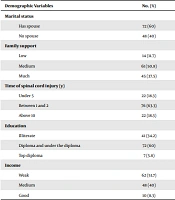
Table 1 shows, there was a significant relationship between demographic characteristics such as education (P < 0.007), time of spinal cord injury (P < 0.01), and income (P = 0.000). Also, the results showed there was a relationship between autonomy and participation, and the age of patients and their autonomy and participation decreased with age (P = 0.000, R = 0.72).
Table 1.
Patients' Autonomy and Participation Status Based on Demographic Characteristics a
| Demographic Variables | No. (%) | Autonomy and Participation | P-Value | F |
|---|---|---|---|---|
| Marital status | 0.000 | 57.88 | ||
| Has spouse | 72 (60) | 47.05 ± 6.18 | ||
| No spouse | 48 (40) | 38.16 ± 6.40 | ||
| Family support | 0.000 | 8.75 | ||
| Low | 14 (11.7) | 38.92 ± 6.70 | ||
| Medium | 61 (50.8) | 42.11 ± 6.76 | ||
| Much | 45 (37.5) | 46.80 ± 7.81 | ||
| Time of spinal cord injury (y) | 0.01 | 4.12 | ||
| Under 5 | 22 (18.3) | 39.59 ± 7.78 | ||
| Between 5 - 10 | 76 (63.3) | 44.73 ± 7.46 | ||
| Above 10 | 22 (18.3) | 43.13 ± 6.92 | ||
| Education | 0.007 | 5.12 | ||
| Illiterate | 41 (34.2) | 40.70 ± 8.13 | ||
| Diploma and under the diploma | 72 (60) | 44.65 ± 6.75 | ||
| Top diploma | 7 (5.8) | 48.00 ± 8.86 | ||
| Income | 0.000 | 8.39 | ||
| Weak | 62 (51.7) | 45.51 ± 7.50 | ||
| Medium | 48 (40) | 40.22 ± 6.24 | ||
| Good | 10 (8.3) | 46.70 ± 9.29 |
a Values are expressed as No. (%) or mean ± SD.
Table 2 shows most of the patients had severe problems with daily activities. Also, most patients had very poor scores in relation to daily living activities.
Table 2.
Frequency of Patients' Perception of the Impact of the Lesion on Their Participation in Daily Activities a
| Subgroups | No Problem | Mild Problems | Severe Problems |
|---|---|---|---|
| Mobility | 19 (15.8) | 17 (14.2) | 84 (70.0) |
| Self-care | 20 (16.7) | 45 (37.5) | 55 (45.8) |
| Activities inside and outside the home | 20 (16.7) | 55 (45.8) | 45 (37.5) |
| Financial situation | 4 (3.3) | 46 (38.3) | 70 (58.3) |
| Free time | 14 (11.7) | 54( 45) | 52 (43.3) |
| Relationships and social life | 16 (13.3) | 39 (32.5) | 65 (54.2) |
| Formal or voluntary work | 21 (17.5) | 31 (25.8) | 68 (56.7) |
| Education and training | 24 (20) | 22 (18.3) | 74 (61.7) |
| Helping and Supporting Others | 23 (19.2) | 33 (27.5) | 64 (53.3) |
a Values are expressed as No. (%).
5. Discussion
It is important to pay attention to the quality-of-life situation and the factors that may affect it (25). According to the findings, the rate of participation and autonomy of patients was poor. Also, most patients have fair participation and autonomy in family roles and social relationships; however, they have poor participation and autonomy in dimensions of autonomy at home, autonomy outside home and work, and education. In the study of Kumar and Gupta, SCI could reduce the quality of life of these patients (26), which is consistent with the results of this study. In the study of Hosseini et al., it was shown that devotees had good and very good participation in two areas of social relations and autonomy at home, while in the areas of autonomy outside the home, work and education and family life had a poor participation autonomy. On the other hand, in the study of Hosseini et al., participation and autonomy of most devotees were good and very good, respectively, which did not conform to the results of this study (16). The reasons for this inconsistency can be explained by the difference in years and the research environment that may have been effective in this regard.
According to the findings, there was a correlation between the age status and the rate of participation and autonomy of the patients. As age increased, participation and autonomy of patients, especially in mobility, were reduced. In the study of Heiland et al., the elderly age group, the activities of daily living (ADL) were declined with age, which is consistent with the results of this study (27). In the study of Khan et al., in the elderly age group, 52.5% of the elderly above the age of 75 and older had disabilities (28), which is consistent with the results of this study.
One of the strengths of this study is to examine the status of social participation and autonomy in patients with SCI, which has been studied in quantitative studies in Iran. Also, its sampling method was among the other strengths of this study, such that we tried to choose the study sample so as to present the total population. Also, in this study, sampling was carried out by referring to the home of the patients, which is one of the advantages of this study.
5.1. Conclusions
Considering the low rate of participation and autonomy in patients with SCI, it is suggested to conduct further studies to improve their self-care and social participation.