
1. Context
Spinal cord injury (SCI) is a traumatic injury that leads to impairments in the sensory, motor, and autonomic functions (1). The SCI makes patients vulnerable to experiencing lifetime secondary clinical problems that may lead to impairments in their health, wellbeing, social, and career activities (2). People with SCI are faced with motor impairments, loss of bladder or bowel control, sexual problems, pressure ulcers, and chronic pains that negatively impact their psychosocial functioning (3, 4). About 90 million people around the world suffer from SCI, with motor vehicle accidents, falls, and gunshot wounds being the leading causes worldwide (3). Currently, 80,000 patients with SCI live in Iran, the majority of whom are Iran-Iraq war veterans (5, 6).
Medical advances in recent years have improved the life expectancy of people with SCI (7). Despite these medical advances, the efforts in this area are not only focused on increasing the patients’ life expectancy, but the main challenge is to improve the people’s quality of life (QOL), as chronic disorders have well-known negative impacts on people’s QOL (4, 8). Health-related quality of life (HRQoL) is a subjective measure that includes the subject’s current health status, available health care services, and health improving activities (9). Improving QOL is the ultimate goal of rehabilitation programs for patients with SCI and a significant outcome of providing care services for these patients (10, 11). Numerous studies have shown that patients with SCI experience low levels of QOL (12-14).
There are different instruments for assessing QOL. The 36-item Short Form questionnaire (SF-36) is one of the most commonly used health-related QOL scales to assess health-level outcomes as a standard instrument. The SF-36 has been culturally adapted and translated into many different languages (15). In contrast to specialized instruments that are limited to specific groups and are always criticized in this regard, the SF-36 assesses all the important aspects of health and allows for the comparison of patients with similar or different conditions (16). The SF-36 measures two distinct physical and mental dimensions of QOL, each consisting of four subscales. The Physical Component summary (PCS) of QOL includes the subscales of physical functioning (PF), role limitation-physical (PR), bodily pain (BP), and general health (GH). The Mental Component summary (MCS) includes the subscales of vitality (V), social functioning (SF), role limitation-emotional (RE), and mental health (MH) (17). The SF-36 has been translated into Persian and validated in the Iranian population by Montazeri et al. (18).
Evidence is limited concerning health-care decision-making processes in terms of improving the HRQoL of patients with SCI; thus, up-to-date evidence-based decisions could not be made in this area. Although the systematic evaluation of HRQoL in patients with SCI has been published, no similar study has been conducted in Iranian patients.
2. Objectives
Therefore, the aim of the present study was to conduct a systematic review and meta-analysis to examine the HRQoL (based on SF-36), including physical and mental dimensions, in Iranian patients with SCI.
3. Methods
3.1. Database Search
This is a systematic review and meta-analysis study based on the PRISMA statement (19), aiming at reviewing the QOL of Iranian patients with SCI according to the published articles inside and outside of Iran. Two researchers independently searched the national and international databases, including SID, MagIran, Google Scholar, IranMedex, ISI/Web of Science, PubMed, and Scopus, without any time limitation. In addition, the reference lists of the reviewed articles were examined to find other related articles. The searches were conducted using the following keywords: (“Quality of Life” OR “Health-Related Quality of Life” OR “Life Style” OR “QOL” OR “HRQoL”) AND (“Shortform questionnaire 36” OR “SF-36”) AND (“spinal cord injury” OR “SCI”) AND “Iran”.
3.2. Data Selection and Data Extraction
First, we collected any articles addressing individuals ≥ 18 years of age with traumatic or non-traumatic SCI reported the HRQoL of patients. The exclusion criteria were as follows: articles not related to the subject, being conducted using instruments other than SF-6, being repetitive, and lacking access to the article’s full-text. We only analyzed studies that examined HRQoL based on SF-36. This tool is still the most common tool used in Iran, because the use of this general instrument facilitates comparing the scores of different dimensions of HRQoL of patients with other patients.
The results from all databases were imported to Refworks and no duplication was detected. Based on the inclusion and exclusion criteria, the studies’ titles and abstracts were screened by independent reviewers. Remaining citations were obtained in the full-text format and again were reviewed independently by two reviewers against the inclusion criteria. Where a disagreement arose, the results were discussed with a third reviewer to reach a resolution.
Information from finally included articles was summarized in a tabular format under the following headings: name of the first author, year of publication, sample size, sample characteristics, QOL score on eight subscales, and the total score on two main dimensions of QOL, i.e. physical and mental dimensions. In one particular study (20), we could not report two groups of patients (para and tetraplegia patients), due to the small number of patients (six patients with tetraplegia), which could be a source of bias in the study. Each article was reviewed independently by two researchers. In the case of disagreement between the researchers, the article was reviewed by another researcher who was an expert in meta-analysis.
3.3. Quality Assessment
To evaluate the quality of studies, we utilized a modified version of the quality of life index developed by Tsimicalis et al. (21). This instrument assessed five aspects of articles including study design, comparison group, participants’ characteristics, sample size, and instruments; each aspect received a score from 0 to 3 and higher scores indicated higher methodological quality (21-23). Some studies did not report the mean scores for the main physical and mental dimensions of HRQoL and some other studies did not report the mean scores for eight subscales of HRQoL; therefore, in each analysis, we only included articles with adequate and appropriate information in the analysis.
3.4. Statistical Analysis
Given that the QOL score had a normal distribution, the variance of each study was calculated based on the variance of normal distribution using the following formula: the weight of each article was calculated relative to its inverse variance. The mean scores of the HRQoL and its dimensions were estimated with a 95% confidence interval (CI). The I2 index and the Cochran’s Q test were used to examine the heterogeneity of the data. When I2 values were above 50% or P values for the Cochran’s Q test were below 0.05 (P < 0.05), we used a random-effects model; otherwise, a fixed-effects model was used to estimate the combined effect across the QOL subscales. Sensitivity analysis was used to determine the robustness of the results. The meta-regression analysis was used to examine the relationship of physical and mental dimensions of QOL with the participants’ mean age, articles’ year of publication, and sample sizes. A subgroup analysis was used to examine physical and mental dimensions based on the type of paralysis. The possibility of bias in publications was examined using Begg’s funnel plot. The study data were analyzed using Stata version 14 software. The significance level was set at P < 0.05.
4. Results
In the present study, all articles published in Persian and English, focusing on the quality of life of patients with SCI in Iran, were reviewed, without time limitation, based on the PRISMA statement. The initial search in national and international databases revealed a total of 205 articles published up to January 2018.
Among the articles, 197 articles were excluded due to not being related to the subject. Finally, eight Persian and English articles were reviewed according to the inclusion and exclusion criteria (Figure 1).

Figure 1.
Process of screening and selection of articles based on the PRISMA statement
The articles selected for meta-analysis were examined in terms of sensitivity. Sensitivity analysis indicated that the removal of any article did not lead to a substantial change in the estimation of mean HRQoL. Bias diagrams were used to examine whether all the studies on the HRQoL of SCI patients were included in the review. Based on the results of both Begg’s and Egger’s tests, the publication bias was not statistically significant for the physical and mental HRQoL of people with SCI (P > 0.1).
4.1. Characteristics of Studies
We reviewed eight studies with a total sample size of 848. All the selected studies were cross-sectional (Table 1).
Table 1.
Characteristics of Selected Studiesa
| First author, Year of Publication | Sex | Age | Level of Injury | Sample Size | Type of Plegia | PCS | MSC | |
|---|---|---|---|---|---|---|---|---|
| Male | Female | |||||||
| Yasami et al. (24) | 135 | 36 | 47.57 ± 14.87 | Cervical = 37; thoracic = 84; lumbar = 50 | 136 | Paraplegia | 65.20 ± 29.38 | 73.50 ± 25.66 |
| 35 | Tetraplegia | 46.17 ± 23.12 | 68.19 ± 23.86 | |||||
| Tavakoli et al. (25) | 149 | 35 | 33.2 ± 9.1 | Cervical = 94; thoracic; lumbosacral = 90 | 94 | Paraplegia | 48.70 ± 15.70 | 78.60 ± 18.70 |
| 90 | Tetraplegia | 57.90 ± 14.90 | 77.60 ± 19.40 | |||||
| Moghimian et al. (26) | 87 | 19 | 37.1 ± 1.7 | - | 106 | Unknown | 58 ± 8.4 | 54 ± 0.3 |
| Sabour et al. (27) | 85 | 19 | 52.58 ± 12.69 | Cervical = 19; thoracic = 64; lumbar = 21 | 91 | Paraplegia | 73.48 ± 18.90 | 65.95 ± 15.30 |
| 13 | Tetraplegia | 67.03 ± 20.90 | 60.93 ± 17.50 | |||||
| Yazdanshenas Ghazwin et al. (4) | 153 | 35.10 ± 16.20 | Cervical = 72; thoracic = 43; lumbar = 38 | 153 | Unknown | 28.2 ± 25.3 | 70.5 ± 19.6 | |
| Salamati et al. (6) | 47 | - | 22 | Unknown | - | - | ||
| 25 | Unknown | - | - | |||||
| Ebrahimzadeh et al. (28) | 37 | 44.84 ± 7.2 | - | 37 | Unknown | 31.75 ± 14.10 | 50.08 ± 11.80 | |
| Ebrahimzadeh et al. (20) | 52 | 49.3 ± 7.94 | - | 46 | Paraplegia | 30.80 ± 8.20 | 49.90 ± 11.80 | |
Abbreviations: MCS: Mental Component summary; PCS, Physical Component summary.
aValues are expressed as mean ± SD.
People with SCI had a lower mean score on the physical dimension of HRQoL [55.47 (95% CI: 42.50 - 68.43)] than on the mental dimension [67.91 (95% CI: 59.18 - 76.64)], as shown in Figures 2 and 3. The combined mean score for eight subscales of HRQoL is shown in Figure 4 based on the type of paralysis. According to these results, the comparison of the mean scores of eight HRQoL dimensions indicated that the unknown group had lower HRQoL mean scores on all dimensions, except for PF, than the other groups and that the highest HRQoL scores were obtained by the paraplegia group. On the physical dimension of HRQoL, individuals with tetraplegia had a mean score of 56.42 (95% CI: 46.92 - 65.91) and those with paraplegia had a mean score of 54.49 (95% CI: 34.63 - 74.35). On the mental dimension of HRQoL, individuals with tetraplegia had a mean score of 69.61 (95% CI: 59.56 - 79.66) and those with paraplegia had a mean score of 66.95 (95% CI: 54.60 - 79.31) (Figures 2 and 3).

Figure 2.
The mean scores for the physical dimension of HRQoL between patients with paraplegia and tetraplegia. The 95% CI of each article is represented as horizontal lines near the main mean line; the dashed line at the mid represents an estimate of the total mean score and the rhomboid represents the CI of the mean score of HRQoL.

Figure 3.
The mean scores for the mental dimension of HRQoL between patients with paraplegia and tetraplegia. The 95% CI of each article is represented as horizontal lines near the main mean line; the dashed line at the mid represents an estimate of the total mean score and the rhomboid represents the CI of the mean score of HRQoL.

Figure 4.
Comparison of the combined mean score for eight HRQoL subscales extracted from the SF-36 in patients with SCI based on the type of paralysis
Among the eight subscales of HRQoL, the lowest scores were on the physical functioning subscale (Table 2 and Figure 4). Individuals with tetraplegia and paraplegia had the mean scores of 26.44 and 29.59 on the physical functioning subscale, respectively. In addition, the highest HRQoL score was on the social functioning subscale. Patients with tetraplegia and paraplegia had the mean scores of 77.59 and 76.77 on the social functioning subscale, respectively. Patients with paraplegia had higher mean scores on all eight HRQoL subscales (except for social functioning) than those with tetraplegia (Table 2 and Figure 4).
Table 2.
The Mean Score of Individuals with SCI on the Physical and Mental Subscales of Quality of Life
| Subscales | Number of Studies | Mean Scores | 95% Confidence Interval | Heterogeneity | |||
|---|---|---|---|---|---|---|---|
| Down | Up | I2 | Q | P | |||
| Physical domain | |||||||
| PF | |||||||
| Tetraplegia | 3 | 26.44 | -1.42 | 54.30 | 98.9 | 187.09 | 0.0001 |
| Paraplegia | 3 | 29.59 | 37.30 | 31.88 | 19.9 | 2.50 | 0.287 |
| Unknown | 5 | 44.08 | 27.05 | 61.12 | 99.2 | 246.56 | 0.0001 |
| RP | |||||||
| Tetraplegia | 3 | 61.41 | 52.32 | 70.50 | 62.7 | 5.37 | 0.066 |
| Paraplegia | 3 | 67.62 | 61.72 | 73.53 | 63.3 | 5.45 | 0.066 |
| Unknown | 5 | 47.76 | 39.71 | 55.81 | 81 | 21.06 | 0.0001 |
| BP | |||||||
| Tetraplegia | 3 | 73.41 | 69.30 | 77.51 | - | 0.06 | 0.979 |
| Paraplegia | 3 | 75.38 | 72.25 | 78.50 | 15.6 | 2.37 | 0.306 |
| Unknown | 5 | 55.54 | 43.46 | 67.61 | 96.4 | 111.33 | 0.0001 |
| Mental domain | |||||||
| GH | |||||||
| Tetraplegia | 3 | 58.57 | 50.24 | 66.91 | 78.9 | 9.50 | 0.009 |
| Paraplegia | 3 | 60.69 | 52.11 | 69.26 | 94.4 | 35.64 | 0.0001 |
| Unknown | 5 | 53.81 | 45.18 | 62.44 | 97.8 | 185.88 | 0.0001 |
| VI | |||||||
| Tetraplegia | 3 | 72.98 | 69.74 | 76.22 | - | 0.01 | 0.994 |
| Paraplegia | 3 | 74.10 | 67.52 | 80.68 | 91.3 | 23.06 | 0.0001 |
| Unknown | 5 | 59.41 | 53.48 | 65.34 | 86.1 | 28.71 | 0.0001 |
| SF | |||||||
| Tetraplegia | 3 | 77.59 | 73.56 | 81.61 | - | 1.50 | 0.472 |
| Paraplegia | 3 | 76.77 | 70.37 | 83.17 | 72.9 | 7.39 | 0.025 |
| Unknown | 5 | 64.18 | 47.35 | 81.01 | 98.1 | 215.54 | 0.0001 |
| RE | |||||||
| Tetraplegia | 3 | 67.28 | 59.56 | 75 | 71.5 | 7.01 | 0.030 |
| Paraplegia | 3 | 70.69 | 61.68 | 79.71 | 93.1 | 29.04 | 0.0001 |
| Unknown | 5 | 52.94 | 38.36 | 67.51 | 92.8 | 55.57 | 0.0001 |
| MH | |||||||
| Tetraplegia | 3 | 70.08 | 51.97 | 88.18 | 92.5 | 26.74 | 0.0001 |
| Paraplegia | 3 | 72.80 | 57.05 | 88.55 | 97.9 | 93.07 | 0.0001 |
| Unknown | 5 | 64.09 | 54.62 | 73.57 | 97.2 | 142.54 | 0.0001 |
Abbreviations: BP, bodily pain; GH, general health; MH, mental health; PF, physical functioning; RE, role limitations; RP, role limitations; SF, social functioning; VI, vitality.
According to the meta-regression analysis, there was a significant relationship between the mental dimension of HRQoL and articles’ year of publication (P = 0.006) (Table 3). In other words, in the period from 2014 to 2017, the mental dimension of the HRQoL significantly changed (Table 3).
Table 3.
Multivariate Meta-Regression Analysis of the Physical and Mental Dimensions of HRQoL in Patients with SCI
| Variable | Coefficients | Standard Error | 95% Confidence Interval | t | P | |
|---|---|---|---|---|---|---|
| Low | Up | |||||
| Physical domain | ||||||
| Constant | -7314.88 | 19670.65 | -61929.37 | 47299.6 | -0.37 | 0.729 |
| Sample size | 0.085 | 0.184 | -0.42 | 0.59 | 0.46 | 0.668 |
| Year | 3.65 | 9.76 | -22.45 | 30.76 | 0.37 | 0.727 |
| Mental domain | ||||||
| Constant | -22723.16 | 4264.789 | -34564.11 | 10882.21 | -5.33 | 0.006 |
| Sample size | 0.046 | 0.047 | -0.085 | 0.177 | 0.97 | 0.385 |
| Year | 11.3 | 2.11 | 5.42 | 17.18 | 5.34 | 0.006 |
5. Discussion
According to the study results, individuals with SCI obtained half of the total score of the physical dimension of HRQoL and that they had a higher mean score on the psychological dimension of HRQoL than on the physical dimension. It seemed that SCI has more impact on the physical dimension of the HRQoL of patients in Iran. This finding of our study is consistent with the results of a study by Edwards et al. in Canada (29). In a study conducted in Quebec, Canada, people with paraplegia had a higher mean score on the physical dimension of HRQoL than on the mental dimension (30). Considering that patients with SCI are vulnerable to various physical complications, such as cardiovascular disease, bladder and bowel dysfunction, pain syndrome, pressure ulcers, osteoporosis, and bone fractures (31), it is expected that they experience more reduction in their physical HRQoL. Other studies have supported the current study findings that people with SCI have low levels of HRQoL (12-14). Consistent with the findings of the present study, Barker et al. found that the HRQoL of people with SCI was lower than that of the general population (7). The findings from two other studies in Sweden and the United States emphasized that the HRQoL of patients with SCI was lower than that of the general population (14, 32). Physical functioning shows the ability to perform physical tasks independently or semi-independently. Stevens et al. found that physical activity was the best predictor of HRQoL among people with SCI that could alone predict half of the variance of HRQoL in this population (33).
According to the study results, the lowest HRQoL scores belonged to the physical functioning subscale. In line with the results of the present study, a study conducted in Canada indicated that patients with SCI had low scores on the HRQoL dimensions of physical role limitation and physical functioning (30). In a study ob SCI patients in Norway, the lowest HRQoL scores were on the physical functioning subscale. In a study by Lidal et al., those who had chronic SCI for more than 20 years had lower scores on three physical HRQoL subscales (physical functioning, physical pain, and general health) and the vitality subscale than the general population (12). Forchheimer et al.’s study results support our finding that the lowest score belonged to the physical function dimension (34).
Comparison of mean scores on the HRQoL subscales in the tetraplegia and paraplegia groups indicated that the mean score of all eight HRQoL subscales (except for social functioning) was higher in the paraplegia group than in the tetraplegia group. Higher scores of people with paraplegia on the physical functioning subscale can be attributed to certain aspects of the Iranian culture, including being affectionate and high levels of support for patients from their friends and relatives. In the study by Lidal et al. (12), people with paraplegia scored lower on the HRQoL subscales of physical role limitation, physical pain, and mental role limitation than those with tetraplegia. Consistent with part of the study results, Gurcay et al. (13) found that those with paraplegia scored higher than those with tetraplegia on the HRQoL subscales of physical functioning, physical role limitation, social functioning, and emotional role limitation. This difference can be attributed to the specific culture and social context of societies in which the studies were conducted. Contrary to the studies mentioned, the results of Westgren and Levi’s study showed that there was no difference in the mean score of any dimension of quality of life between the two groups (14). The meta-regression results indicated a relationship between the articles’ year of publication and SCI patients’ mean score on the mental dimension of HRQoL; that is, with an increase in the articles’ year of publication, the mean score of the mental dimension of HRQoL also increased. This can be due to the patients’ increased level of awareness, medical advances, and the use of advanced medical devices.
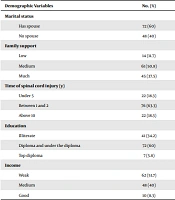
One of the limitations of this study was that some selected studies did not provide enough information, especially in the description of demographic variables; therefore, we could not examine some of the demographic information regarding HRQoL. Since we focused only on studies that used SF-36, we did not analyze studies with other tools. Therefore, it was not possible to compare the results of this study with studies using other tools. The present study is novel in its efforts to mix the results of several previous studies and report an overall result; this can be regarded as one of its advantages that make its findings useful for healthcare policymakers in proving high-quality care for patients with SCI.
5.1. Conclusions
In conclusion, the results of the present study indicated that patients with SCI had low HRQoL and that their physical dimension was lower than their mental dimension. In addition, those with paraplegia had higher HRQoL scores than those with tetraplegia in all subscales (except for social functioning). It seems necessary to provide strategies to improve the HRQoL of Iranian people with SCI, especially their physical dimensions.