
1. Background
Vascular access (VA) is among the most common invasive procedures performed in patients receiving secondary care. In some cases, this procedure is not performed optimally because of various factors, including limited surgeon experience, inadequate healthcare system resources, and the patient’s clinical condition. Inadequate VA establishment may cause discomfort, complications, and even mortality (1-3). Effective VA is an important determinant of patient survival and well-being and is recognized as a key factor in preserving the lives of patients undergoing hemodialysis. Any dysfunction in established VA can compromise patient health and create serious clinical challenges. Indeed, VA outcomes are regarded by patients, caregivers, and healthcare professionals as a critical priority and are essential for improving patient and healthcare outcomes (4-6).
Achieving a suitable fistula may be challenging or even impossible for some individuals (4). One of the most valuable indicators of graft or fistula patency is the direct assessment of arteriovenous blood flow using methods such as ultrasonography, blood pressure measurement, plethysmography, and thermodilution techniques (7, 8). Monitoring VA in patients with end-stage renal disease undergoing treatment is highly important. If VA thrombosis occurs, it may lead to irreversible and emergent complications. Thrombosis is a concerning complication and requires urgent management when it occurs (7, 9, 10).
VA care is another critical issue in patients with VA. There are no strictly defined boundaries for VA care, and multiple members of the healthcare team, including nurses and physicians, are involved in its management. Post-insertion care, troubleshooting, and complication management are essential and require coordinated teamwork (11, 12). Patients admitted to intensive care units may experience additional VA-related problems because of their complex clinical conditions (13).
Neurological disorders have a high prevalence and frequently lead to hospital admission. This group includes patients with stroke. Stroke is a cerebrovascular event characterized by a sudden reduction in cerebral blood flow due to disruption of the blood vessels supplying the brain. Under these conditions, a lack of oxygen leads to brain tissue damage (14, 15). Stroke is a major public health problem and the most common disabling neurological disorder in adults. It can impair sensory, motor, perceptual, visual, and cognitive systems (13).
2. Objectives
Given the high number of hospitalized patients diagnosed with neurological disorders, this study aimed to determine the effectiveness of VA in such patients and to assess its relationship with treatment outcomes and caregiver satisfaction among patients admitted to hospitals in Ilam city.
3. Methods
3.1. Study Design and Setting
In this cross-sectional study, 120 patients diagnosed with neurological disorders who were admitted to the intensive care units of teaching hospitals in Ilam city during 2020 - 2021 were included.
3.2. Inclusion and Exclusion Criteria
The inclusion criteria were hospitalization in hospitals in Ilam city, age 18 years or older, admission due to neurological disorders, absence of pre-existing VA, informed consent from the patient’s legal guardian to participate in the study, and the ability to cooperate and participate in the research. The exclusion criteria included pre-existing VA and unwillingness of the patient or the patient’s legal guardian to continue participation in the study.
3.3. Data Collection and Instruments
The data collection instrument consisted of four sections: a demographic characteristics form, a VA evaluation checklist, a patient companion satisfaction questionnaire, and a treatment outcomes checklist.
3.3.1. Demographic Characteristics Form
The first section included demographic information, including age, gender, level of education, type of VA (peripheral or central), place of residence (urban or rural), and supplementary insurance status (yes/no).
3.3.2. Checklist for Evaluation of Vascular Access Quality
The second section consisted of a checklist assessing VA quality, including successful VA placement by a surgeon or anesthesiologist on the first attempt (yes/no), proper fixation of VA by the physician (yes/no), proper fixation of VA by nursing staff (yes/no), absence of catheter dislodgement until completion of the required treatment in the ward, according to the guidelines of the Iranian Ministry of Health (yes/no), and absence of VA occlusion (yes/no). In this section, a "yes" response indicated a desirable condition and received a score of 1, whereas a "no" response indicated an undesirable condition and received a score of 0. The total score ranged from 0, indicating an undesirable condition, to 5, indicating a desirable condition.
3.3.3. Treatment Outcomes Checklist
The third section included a checklist of treatment outcomes, including hematoma (yes/no), phlebitis (yes/no), and swelling or redness at the catheter insertion site (yes/no). In this section, a "yes" response indicated an undesirable condition and received a score of 1, whereas a "no" response indicated a desirable condition and received a score of 0. The total score ranged from 0, indicating a desirable condition, to 3, indicating an undesirable condition.
3.3.4. Caregiver Satisfaction Questionnaire
The fourth section consisted of a questionnaire assessing caregiver satisfaction with the care provided. This instrument contained 10 questions evaluating the level of satisfaction. The scoring range was from 0, indicating low satisfaction, to 50, indicating high satisfaction.
For completion of the study instruments, demographic information was obtained from patients’ medical records. The VA evaluation checklist and treatment outcomes checklist were completed through clinical examination and observation of the patients’ condition. The caregiver satisfaction questionnaire was completed through interviews with the patient’s legal guardian. Because all instruments used in the study were researcher-made, their validity and reliability were assessed by the research team, and data collection began after confirmation of their validity and reliability.
3.4. Validity and Reliability of the Tools
The face and content validity of the demographic form, VA checklist, treatment outcomes checklist, and satisfaction questionnaire were evaluated and confirmed by a panel of experts, including a vascular surgeon, a neurologist, a PhD in nursing, and a PhD in epidemiology. The reliability of the instruments was evaluated and confirmed.
3.5. Research Procedure
The study procedure was conducted as follows: patients admitted to hospitals in Ilam who required VA were included in the study. The indication for VA was determined by the treating physician and documented in the patient’s medical record. No invasive intervention was performed as part of this research; only patients who underwent VA placement as part of routine treatment were included in the study.
3.6. Statistical Analysis
For data analysis, SPSS software version 16 was used to perform descriptive and inferential statistical analyses.
3.7. Ethical Considerations
This study adhered to the ethical guidelines approved by the Ethics Research Committee of Ilam University of Medical Sciences.
4. Results
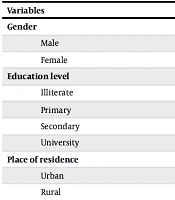
As shown in Table 1, 57.5% of the patients were male. In addition, 52.5% had primary education, 58.3% lived in rural areas, 60% had a history of diabetes, and 57.5% had a history of cardiovascular disease. The mean (SD) age of the patients was 65.4 (12.9) years.
Table 1.
Demographic Characteristics of Patients (N = 120) a
| Variables | Values |
|---|---|
| Gender | |
| Male | 69 (57.5) |
| Female | 51 (42.5) |
| Education level | |
| Illiterate | 23 (19.2) |
| Primary | 63 (52.5) |
| Secondary | 27 (22.5) |
| University | 7 (5.8) |
| Place of residence | |
| Urban | 50 (41.7) |
| Rural | 70 (58.3) |
| History of diabetes | |
| Yes | 72 (60) |
| No | 48 (40) |
| History of cardiovascular disease | |
| Yes | 69 (57.5) |
| No | 51 (42.5) |
| Age (y) | 65.4 ± 12.9 |
a Values are expressed as No. (%) or mean ± SD.
As shown in Table 2, 96.7% of VA procedures were successfully performed on the first attempt, and 97.5% were properly secured by the physician.
Table 2.
Evaluation of the Quality of Vascular Access (N = 120) a
| Vascular Access Quality Indicator | Yes | No |
|---|---|---|
| Successful vascular access on the first attempt | 116 (96.7) | 4 (3.3) |
| Proper fixation by physician | 117 (97.5) | 3 (2.5) |
| Proper fixation by nurse | 116 (96.7) | 4 (3.3) |
| No catheter dislodgement until end of treatment | 92 (76.7) | 28 (23.3) |
| No vascular access occlusion | 97 (80.8) | 23 (19.2) |
a Values are expressed as No. (%).
As shown in Table 3, 20% of the patients developed a hematoma, 24.2% experienced phlebitis, and 34.2% had swelling or redness at the catheter insertion site.
Table 3.
Treatment Outcomes Related to Vascular Access (N = 120) a
| Treatment Outcome | Yes | No |
|---|---|---|
| Hematoma | 24 (20.0) | 96 (80.0) |
| Phlebitis | 29 (24.2) | 91 (75.8) |
| Swelling or redness at catheter site | 41 (34.2) | 79 (65.8) |
a Values are expressed as No. (%).
Table 4 presents the minimum, maximum, and mean scores obtained by the patients. The mean (SD) patient companion satisfaction score was 33.55 (7.38), the treatment outcomes score was 5.21 (0.79), and the VA quality score was 4.48 (0.75).
Table 4.
Mean Scores of Vascular Access Quality, Treatment Outcomes, and Patient Companion Satisfaction (N = 120)
| Variables | Minimum | Maximum | Mean ± SD |
|---|---|---|---|
| Vascular Access Quality (0 - 5) | 0 | 5 | 4.48 ± 0.75 |
| Treatment Outcomes (0 - 6) | 3 | 6 | 5.21 ± 0.79 |
| Patient Companion Satisfaction (0 - 50) | 26 | 50 | 33.55 ± 7.38 |
Correlation analysis of the variables presented in Table 5 showed a statistically significant positive relationship between the adequacy of VA and caregiver satisfaction (r = 0.92, P < 0.001). In addition, a positive but non-significant relationship was observed between the adequacy of VA and treatment outcomes (r = 0.21, P = 0.06). A negative, non-significant relationship was also found between treatment outcomes and caregiver satisfaction (r = -0.17, P = 0.52).
Table 5.
Correlation Between Adequacy of Vascular Access, Treatment Outcomes, and Patient Companion Satisfaction
| Variables | Adequacy of Vascular Access | Treatment Outcomes | Caregiver Satisfaction |
|---|---|---|---|
| Adequacy of Vascular Access | 1 | ||
| Treatment Outcomes | r = 0.21, P = 0.06 | 1 | |
| Caregiver Satisfaction | r = 0.92, P < 0.001 | r = -0.17, P = 0.52 | 1 |
5. Discussion
VA placement requires adequate physician knowledge, clinical skills, and confidence, and appropriate management of the patient’s clinical condition must be ensured. However, this process can be challenging because of the heavy workload of healthcare staff and the shortage of specialized surgeons, which may delay VA placement. Multiple attempts to establish VA may lead to several complications, including psychological distress, anxiety, pain, venous injury, and infection. In addition, complications such as phlebitis, catheter infiltration or leakage, occlusion, and bloodstream infection have been reported as consequences of VA placement (16-19). Given the importance of VA, the present study was conducted to determine VA efficiency in patients with neurological disorders and its relationship with treatment outcomes and caregiver satisfaction among patients admitted to hospitals in Ilam city.
Among the complications observed in the present study were hematoma (20%), phlebitis (24.2%), and swelling or redness at the insertion site (34.2%). In a study by Ortiz et al. investigating complications after peripheral vascular intervention, 74.4% of patients experienced minor complications, whereas only 10.5% had severe complications requiring surgery (20). Some medications, such as aspirin, angiotensin-converting enzyme inhibitors, and calcium channel blockers, may be effective in maintaining VA, and appropriate measures should be taken regarding their prescription. Conversely, warfarin use may have negative effects on VA status in patients (21).
In the review study by Almasri et al., the results of 200 studies with a total sample size of 875,269 patients were examined. The primary patency rate after 2 years was reported as 55% in patients with fistulas, 40% in those with grafts, and 50% in those with catheters. Furthermore, mortality was highest among patients with catheters (26%), followed by those with grafts (17%), whereas the lowest mortality rate was observed in patients with fistulas (15%). Overall, autogenous access was reported as the best type of access for dialysis patients (22). In another study conducted by Ullman et al., 74 cohort studies involving different types of central venous access devices in pediatric patients were included. The results showed that approximately 25% of catheters failed before completion of therapy. The highest failure rate was reported for umbilical catheters at approximately 28.6 per 1000 catheter days, while the lowest failure rate was observed for totally implanted devices at approximately 0.15 per 1000 catheter days (23).
5.1. Study Limitations
The limitations of this study include its single-center design and relatively small sample size. Therefore, future multicenter studies with larger sample sizes are recommended to improve the generalizability of the findings.
5.2. Conclusions
The quality of VA procedures among the studied patients was satisfactory, with most procedures successfully performed on the first attempt and appropriate fixation by both nurses and physicians; all indicators were above 90%. In addition, a significant positive association was observed between VA adequacy and patient companion satisfaction. However, VA adequacy was not significantly associated with treatment outcomes.