
1. Background
Lumbar spine surgery is associated with moderate to severe postoperative pain resulting from extensive tissue dissection, muscle retraction, and osseous manipulation (1). The prevalence of severe postoperative pain after spinal surgery exceeds 30%, significantly impairing patient mobility, prolonging hospitalization, and predisposing individuals to chronic postsurgical pain syndromes (2). Poorly controlled acute pain not only delays functional recovery but also increases the risk of persistent pain, with up to 20% of patients reporting clinically significant pain at 12 months postoperatively (3).
Although opioids have historically been the mainstay of postoperative pain management after spinal procedures, their well-documented adverse effects, including nausea, vomiting, ileus, urinary retention, sedation, respiratory depression, and the potential for misuse and dependence, have prompted a paradigm shift toward multimodal analgesic strategies (4, 5). Multimodal analgesia, which combines pharmacologic agents from different classes (e.g., nonsteroidal anti-inflammatory drugs, paracetamol, and gabapentinoids) with regional anesthetic techniques, has consistently been shown to reduce opioid consumption, improve pain control, and accelerate recovery in patients undergoing spinal surgery (1, 3, 6). Enhanced Recovery After Surgery (ERAS) protocols for spine surgery recommend incorporating regional anesthetic techniques as part of opioid-sparing perioperative care (7).
The erector spinae plane block (ESPB), first described by Forero et al. in 2016 for the treatment of thoracic neuropathic pain, is a fascial plane block involving injection of local anesthetic between the erector spinae muscle and the underlying transverse process (8).
This technique is thought to provide analgesia through the spread of local anesthetic to the dorsal and ventral rami of the spinal nerves, thereby providing multisegmental analgesia without the motor blockade or hemodynamic instability associated with neuraxial techniques (9). Ultrasound guidance has made ESPB increasingly accessible, and its favorable safety profile has led to rapid adoption across a range of surgical contexts, including breast, thoracic, and abdominal procedures (10).
In spine surgery, accumulating evidence suggests that bilateral ESPB reduces early postoperative pain scores and decreases opioid requirements. Several systematic reviews and meta-analyses have demonstrated that ESPB is associated with significantly lower pain scores at 1, 6, 12, and 24 hours postoperatively, reduced total opioid consumption, and a decreased need for rescue analgesia (1, 3, 6). However, the quality of pooled evidence remains low to moderate, and recent randomized controlled trials have yielded conflicting findings. While some studies report improved early pain control with ESPB without significant opioid reduction (4), others have found no benefit in pain intensity or opioid consumption compared with placebo (2). Comparative analyses have also examined ESPB versus wound infiltration (11), fluoroscopy-guided versus ultrasound-guided approaches (12), and ESPB versus thoracolumbar interfascial plane blocks. However, existing studies have focused primarily on the efficacy of ESPB itself rather than the optimal timing of block administration. These inconsistencies underscore the need for further well-designed studies to define the optimal role of ESPB in multimodal analgesia for spine surgery.
One underexplored question concerns the timing of ESPB administration. In the original description by Forero et al. (8), ESPB was performed preoperatively, allowing sufficient time for local anesthetic spread before surgical incision. However, many subsequent studies have administered the block intraoperatively or postoperatively, either because of practical constraints or because patients were already positioned prone under anesthesia (13). Administering the block before induction of anesthesia (pre-induction) offers several theoretical advantages: the patient is awake and able to communicate discomfort or adverse effects (14), and the block has time to become fully established, potentially providing preemptive analgesia that attenuates central sensitization. Conversely, performing the block after anesthesia induction (post-induction) may be logistically simpler within operating room workflows but eliminates patient feedback during block placement and allows less time for the block to mature before the surgical stimulus begins (15). A recent randomized trial comparing preoperative with postoperative ESPB in laparoscopic cholecystectomy found that both approaches offered comparable analgesic efficacy, but preoperative ESPB provided superior intraoperative hemodynamic stability and avoided logistical challenges associated with repositioning an anesthetized patient (16). No previous study has isolated the specific comparison of pre-induction (awake, 30 minutes before incision) versus post-induction (immediately after induction, before incision) in this surgical population.
2. Objectives
This randomized controlled trial compared the analgesic efficacy of bilateral ultrasound-guided ESPB performed 30 minutes before anesthesia induction (pre-induction) versus immediately after induction (post-induction) in patients undergoing elective two- or three-level lumbar spine surgery. We hypothesized that pre-induction ESPB would improve perioperative outcomes, including postoperative analgesia, opioid consumption, and surgeon satisfaction, compared with post-induction ESPB.
3. Methods
3.1. Study Design and Setting
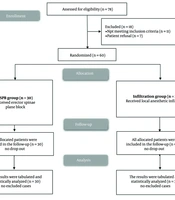
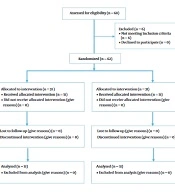
This prospective, randomized, double-blind, parallel-group study was conducted at Loghman Hakim Hospital. Ethical approval was obtained from the Institutional Review Board (IRB) (IR.SBMU.MSP.REC.1403.233), and the trial was registered as IRCT20210415050983N8. All patients provided written informed consent before enrollment. Patient enrollment, randomization, and follow-up are summarized in the CONSORT flow diagram (Figure 1).
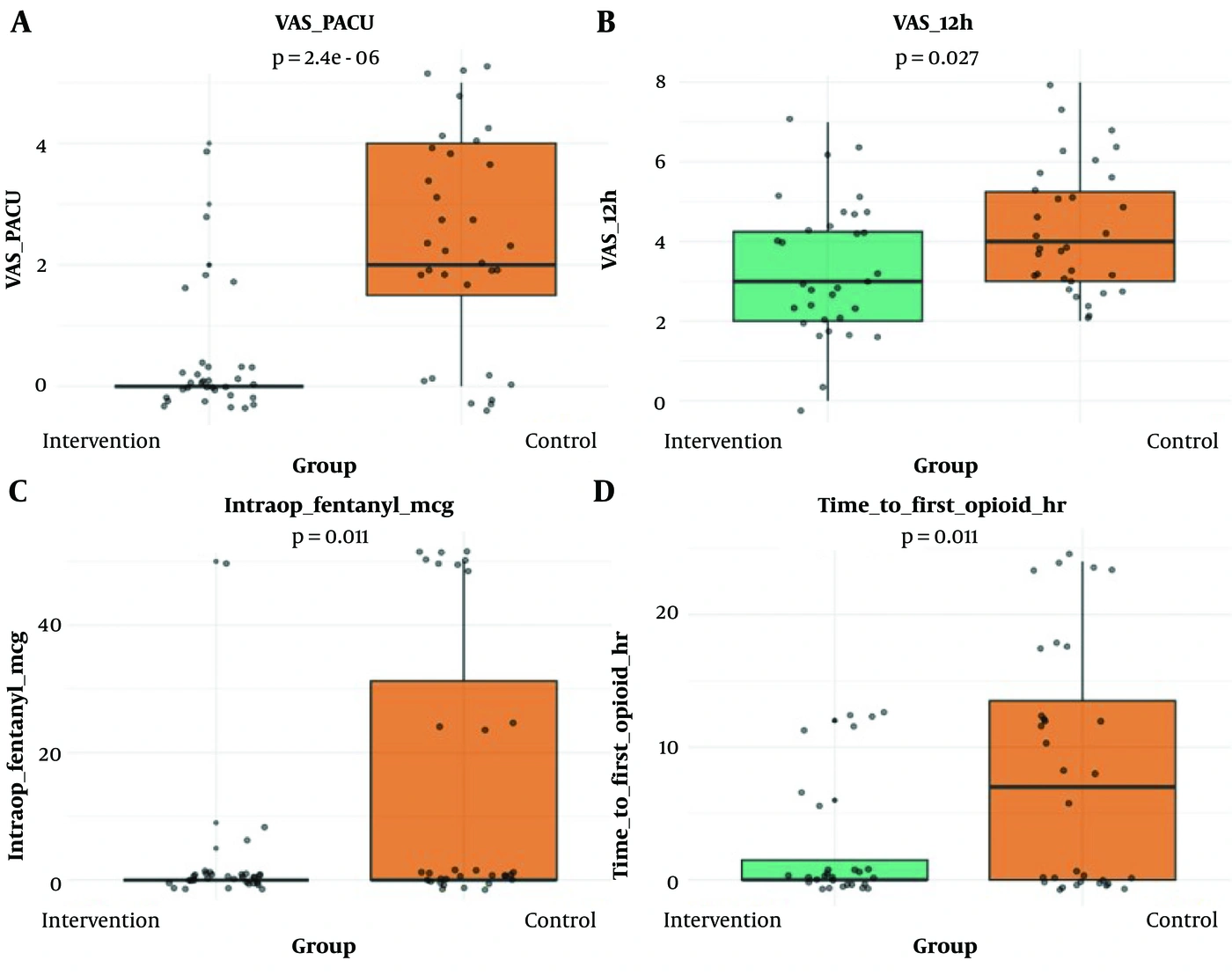
Figure 1.
CONSORT flow diagram of patient enrollment, randomization, and follow-up
3.2. Participants
Patients aged 18 - 65 years with American Society of Anesthesiologists (ASA) physical status I-II who were scheduled for elective lumbar spine surgery involving two or three levels were eligible. Key inclusion criteria were the absence of clinically significant renal or hepatic dysfunction, a body mass index (BMI) of 16 - 35 kg·m-2, no allergy to local anesthetics, and no opioid use disorder or substance abuse. Exclusion criteria were conversion to surgery involving more than three levels or protocol violation.
3.3. Randomization and Blinding
Eligible patients were randomly assigned in a 1:1 ratio to 1 of 2 groups using a computer-generated random sequence with block sizes of 4 or 6, with allocation concealed in sequentially numbered, opaque, sealed envelopes. Group allocation was concealed from outcome assessors and data analysts. The randomization sequence was generated by an investigator who was not involved in patient recruitment, anesthetic management, or outcome assessment. The anesthesiologist performing the block could not be blinded to group assignment; however, all postoperative pain assessments, fentanyl administration, surgeon satisfaction assessments, and outcome recordings were performed by a trained investigator who was blinded to group allocation.
3.4. Interventions
All blocks were performed under ultrasound guidance (linear probe, 6 - 13 MHz) with the patient in the prone position.
Group 1 (pre-induction block): Thirty minutes before induction of anesthesia, ESPB was performed bilaterally at the lumbar transverse process corresponding to the midpoint of the surgical field under ultrasound guidance. On each side, 20 mL of 0.25% ropivacaine was injected into the fascial plane deep to the erector spinae muscle. Anesthesia induction began 30 minutes after completion of the block. All ESPBs were performed by the same anesthesiologist, who had experience with more than 50 ultrasound-guided ESPBs.
Group 2 (post-induction block): After induction of anesthesia and before surgical incision, bilateral ESPB was performed using the same technique and the same volume and concentration of ropivacaine (20 mL of 0.25% per side).
3.5. Anesthesia Protocol
All patients received a standardized general anesthetic regimen. Induction consisted of fentanyl 2 μg·kg-1, midazolam 0.02 mg·kg-1, lidocaine 1 mg·kg-1, propofol 2 mg·kg-1, and atracurium 0.5 mg·kg-1. Anesthesia was maintained with isoflurane in a mixture of 50% air and 50% oxygen (total flow, 3 L/min) with controlled ventilation. Additional fentanyl boluses (0.5 - 1 μg/kg) were administered when heart rate or mean arterial pressure increased by > 20% above baseline values.
Intraoperative monitoring included electrocardiography, invasive arterial pressure monitoring via a radial artery catheter, pulse oximetry, end-tidal carbon dioxide (EtCO2), and bispectral index (BIS), which was maintained between 45 and 55. Isoflurane and opioid consumption during surgery, intraoperative blood loss, and adverse events were recorded.
3.6. Outcomes
The primary outcome was pain intensity measured using the visual analog scale (VAS, 0 - 10) at admission to the post-anesthesia care unit (PACU). Secondary outcomes included VAS pain scores at 12 hours postoperatively, intraoperative fentanyl consumption (μg), PACU fentanyl consumption (μg), time to first postoperative opioid request (hours), the need for rescue analgesia in the PACU, surgeon satisfaction (0 - 2 scale), and intraoperative blood loss (mL).
3.7. Data Collection
Data were collected through direct observation, patient interviews, and review of anesthesia and nursing records by a blinded investigator. Baseline characteristics, including age, sex, ASA physical status, and number of surgical levels, were recorded preoperatively.
3.8. Sample Size Calculation
The sample size was calculated for the primary outcome (VAS pain score at PACU admission). Based on previous ESPB studies in lumbar spine surgery, we assumed a clinically meaningful difference of 1.5 points (SD = 1.8) between groups (17, 18). Using a 2-sided α = 0.05 and power = 80%, the required sample size was 23 patients per group. Allowing for 10% dropout, we targeted 26 patients per group; to conservatively account for nonnormal distributions, we increased this to 32 patients per group (total N = 64). This sample size provided > 80% power for both parametric and nonparametric analyses and is consistent with comparable RCTs. Calculations were performed using G*Power version 3.1.9.7.
3.9. Statistical Analysis
All analyses followed the intention-to-treat principle. Continuous variables were summarized as mean (SD) and median (IQR), and categorical variables as frequencies (percentages). Normality was assessed using the Shapiro-Wilk test and Q-Q plots. For normally distributed data with equal variances, the independent-samples t-test was used; otherwise, the Mann-Whitney U test was applied. Fisher exact test was used for binary outcomes when expected cell counts were < 5. Effect sizes were reported as Cohen d or rank-biserial correlation with 95% confidence intervals.
A linear regression model (ANCOVA) was fitted for the primary outcome (VAS at PACU admission), including group assignment, age, and sex as covariates. All tests were 2-sided, and a P value < 0.05 was considered statistically significant. No adjustment for multiple comparisons was made for secondary outcomes, which were predefined and interpreted cautiously. Statistical analyses were performed using R version 4.3.1 with the tidyverse, rstatix, effectsize, and gtsummary packages.
3.10. Ethical Considerations
Ethical approval was obtained from the Institutional Review Board (IR.SBMU.MSP.REC.1403.233), and all patients provided written informed consent before enrollment. The trial was registered as IRCT20210415050983N8.
4. Results
4.1. Baseline Characteristics
A total of 64 patients (32 per group) were included in the analysis. Baseline demographic and clinical characteristics were well balanced between the two groups (Table 1). The mean age was 49.5 years (SD, 10.8), and 59% of the patients were female. The distributions of sex, ASA class, and number of surgical levels did not differ significantly between groups (P > 0.05 for all).
Table 1.
Demographic and Baseline Characteristics of Study Patients a
| Variables | Overall n = 64 | Pre-induction n = 32 | Post-induction n = 32 | P-Value b |
|---|---|---|---|---|
| Age, y | 49.5 ± 10.8; 49.5 [16.8] | 48.5 ± 10.9; 50.0 [14.8] | 50.4 ± 10.8; 48.5 [18.5] | 0.470 |
| Gender | 0.075 | |||
| Male | 26 (41) | 9 (28) | 17 (53) | |
| Female | 38 (59) | 23 (72) | 15 (47) | |
| ASA class | 0.598 | |||
| 1 | 44 (69) | 23 (72) | 21 (66) | |
| 2 | 20 (31) | 9 (28) | 11 (34) | |
| Number of Levels | 0.064 | |||
| 1 | 12 (19) | 8 (25) | 4 (13) | |
| 2 | 41 (64) | 21 (66) | 20 (63) | |
| 3 | 11 (17) | 3 (9) | 8 (25) |
a Values are expressed as mean ± SD; median [IQR] or No. (%).
b Welch 2-sample t test; Pearson chi-square test; Wilcoxon rank-sum test.
4.2. Primary Outcome: Postoperative Pain
Pain scores measured using the VAS in the PACU were significantly lower in the pre-induction group (median, 0.0 [IQR, 0.0 - 0.0]) than in the post-induction group (median, 2.0 [IQR, 0.8 - 3.2]; Mann-Whitney U test; median difference, -2.00; 95% CI, -3.00 to -2.00; P < 0.0001). The effect size was large (rank-biserial correlation, -0.62; 95% CI, -0.77 to -0.42; Figure 2A).
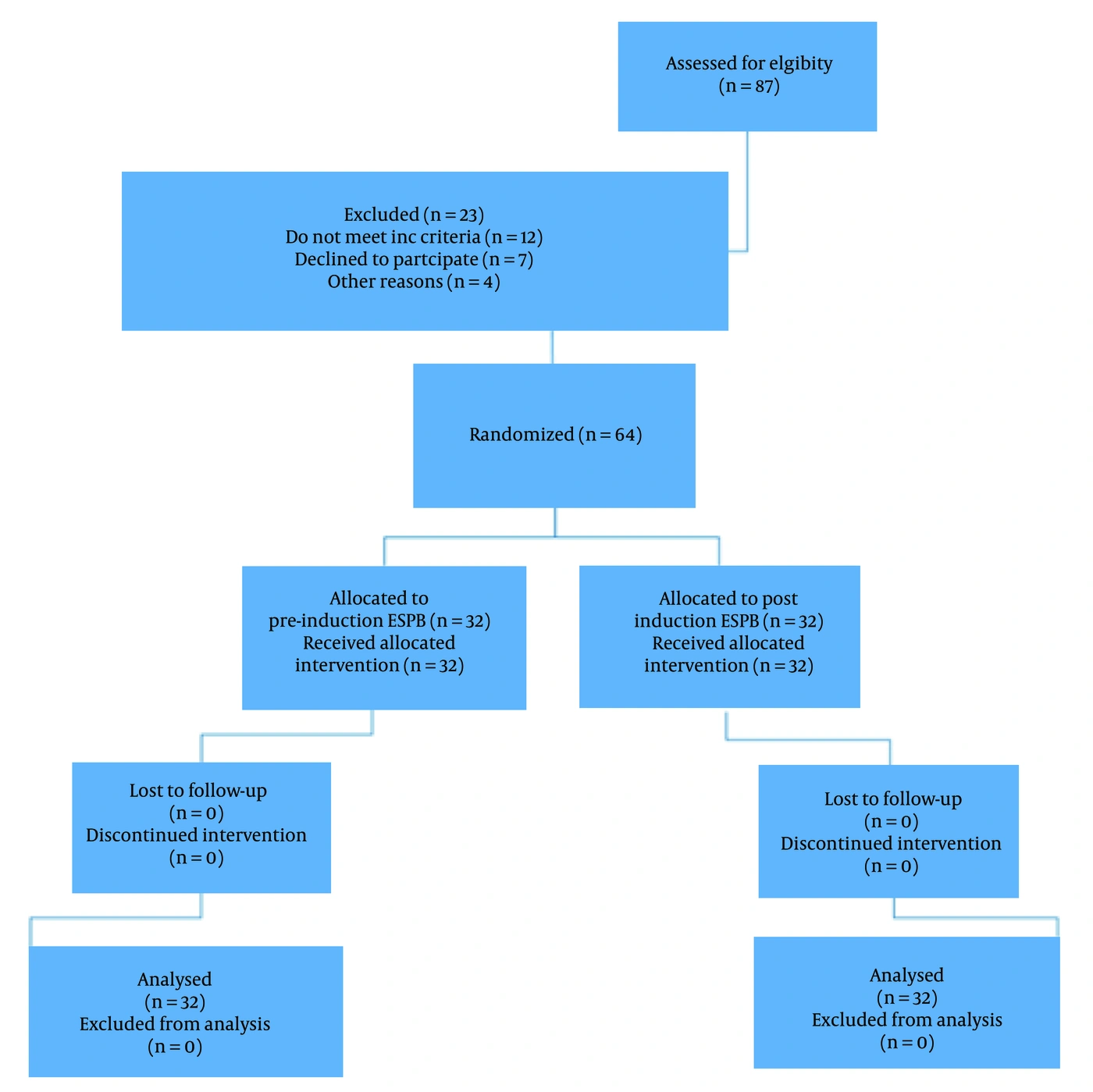
Figure 2.
Boxplots of key outcomes comparing pre-induction (intervention) and post-induction (control) groups; A, Visual analog scale (VAS) pain score at PACU admission; B, VAS pain score at 12 hours postoperatively; C, intraoperative fentanyl consumption (μg); D, time to first postoperative opioid request (hours).
At 12 hours after surgery, VAS pain scores remained lower in the pre-induction group (median, 3.0 [IQR, 1.9 - 4.1]) than in the post-induction group (median, 4.0 [IQR, 2.9 - 5.1]; difference, -1.00; 95% CI, -2.00 to 0.00; P = 0.027; rank-biserial correlation, -0.32; 95% CI, -0.55 to -0.04; Figure 2B).
4.3. Secondary Outcomes
Intraoperative fentanyl use was higher in the post-induction group (median, 0.0 μg [IQR, 0 - 15.6]) than in the pre-induction group (median, 0.0 μg [IQR, 0.0 - 0.0]). Although the median difference was 0.00 (95% CI, -0.00 to -0.00) because of the high proportion of zero values, the Mann-Whitney test indicated a statistically significant difference (P = 0.011; rank-biserial correlation, -0.27; 95% CI, -0.51 to 0.01; Figure 2C). Similarly, PACU fentanyl consumption was higher in the post-induction group (median, 0.0 μg [IQR, 0.0 - 0.0] vs. 0.0 μg [IQR, 0.0 - 0.0]; P = 0.025; Table 2).
Table 2.
Primary and Secondary Outcomes a
| Outcome | Pre-induction (n = 32) | Post-induction (n = 32) | Difference / OR (95% CI) | P-Value | Effect Size (95% CI) |
|---|---|---|---|---|---|
| Pain score (VAS) in PACU | 0.4 ± 1.0; 0.0 [0.0 - 0.0] | 2.4 ± 1.7; 2.0 [0.8 - 3.2] | -2.00 (-3.00 to -2.00) | < 0.0001 | rank-biserial = -0.62 (-0.77 to -0.42) |
| Pain score (VAS) at 12 h | 3.3 ± 1.7; 3.0 [1.9 - 4.1] | 4.3 ± 1.6; 4.0 [2.9 - 5.1] | -1.00 (-2.00 to 0.00) | 0.027 | rank-biserial = -0.32 (-0.55 to -0.04) |
| Intraoperative fentanyl (mcg) | 2.0 ± 8.9; 0.0 [0.0 - 0.0] | 14.8 ± 21.9; 0.0 [0 - 15.6] | 0.00 (-0.00 to -0.00) * | 0.011 | rank-biserial = -0.27 (-0.51 to 0.01) |
| PACU fentanyl (mcg) | 0.8 ± 4.4; 0.0 [0.0 - 0.0] | 5.5 ± 10.5; 0.0 [0.0 - 0.0] | 0.00 (-0.00 to 0.00) * | 0.025 | rank-biserial = -0.19 (-0.44 to 0.10) |
| Time to first opioid (h) | 2.6 ± 4.7; 0.0 [-0.8 - 0.8] | 8.3 ± 9.2; 7.0 [0.2 - 13.8] | 0.00 (-10.00 to 0.00) * | 0.011 | rank-biserial = -0.34 (-0.57 to -0.06) |
| Surgeon satisfaction (0 - 2 scale) | 0.1 ± 0.5; 0.0 [0.0 - 0.0] | 0.2 ± 0.6; 0.0 [0.0 - 0.0] | 0.00 (-0.00 to 0.00) | 0.164 | rank-biserial = -0.12 (-0.38 to 0.17) |
| Intraoperative blood loss (mL) | 511.9 ± 394.6; 400.0 [187.5 - 612.5] | 392.2 ± 211.8; 350.0 [193.8 - 506.2] | 50.00 (-70.00 to 200.00) | 0.447 | rank-biserial = 0.11 (-0.17 to 0.38) |
a Values are expressed as mean ± SD; median [IQR] for continuous variables and No (%) for binary variables. Median differences are reported as 0.00 because of the high proportion of zero values; the negative sign in the CI indicates direction. The odds ratio could not be reliably estimated because no event occurred in the pre-induction group. Abbreviations: CI, confidence interval; OR, odds ratio; PACU, post-anesthesia care unit.
Time to first opioid request was significantly longer in the post-induction group (median, 7.0 hours [IQR, 0.2 - 13.8]) than in the pre-induction group (median, 0.0 hours [IQR, -0.8 to 0.8]; median difference, 0.00 hours; 95% CI, -10.00 to 0.00; P = 0.011; rank-biserial correlation, -0.34; 95% CI, -0.57 to -0.06; Figure 2D).
No patient in the pre-induction group required rescue analgesia in the PACU, whereas 5 patients (15.6%) in the post-induction group did (Fisher exact test, P = 0.053; Table 2). Surgeon satisfaction scores (0 - 2 scale) did not differ between groups (P = 0.164), and intraoperative blood loss was similar between groups (P = 0.447; Table 2).
4.4. Adjusted Analysis
After adjustment for age, sex, and number of surgical levels, the pre-induction group had significantly lower pain scores in the PACU than the post-induction group (β = -1.98; 95% CI, -2.73 to -1.22; P < 0.0001). Age, sex, and number of levels were not significant predictors in the model (Table 3).
Table 3.
Adjusted Linear Regression Analysis for Pain (VAS) in the PACU
| Predictor | Estimate (β) | 95% CI | Standard Error | T-Value | P-Value |
|---|---|---|---|---|---|
| (Intercept) | 3.434 | 1.191 to 5.676 | 1.120 | 3.07 | 0.003 |
| Group (pre-induction vs post induction) | -1.977 | -2.732 to -1.223 | 0.377 | -5.25 | < 0.0001 |
| Age (per year) | -0.027 | -0.061 to 0.007 | 0.017 | -1.59 | 0.117 |
| Sex (Female vs Male) | 0.316 | -0.441 to 1.074 | 0.378 | 0.84 | 0.407 |
| Number of levels | 0.015 | -0.595 to 0.626 | 0.305 | 0.05 | 0.960 |
5. Discussion
This randomized controlled trial compared the analgesic efficacy of pre-induction versus post-induction bilateral ESPB in patients undergoing elective two- or three-level lumbar spine surgery. Patients in the pre-induction group had significantly lower pain scores in the PACU and at 12 hours postoperatively, as well as lower intraoperative and PACU fentanyl consumption. Rescue analgesia was required in no patients in the pre-induction group and in 5 patients (15.6%) in the post-induction group, although this difference did not reach statistical significance. In contrast, the time to first opioid request was longer in the post-induction group. Surgeon satisfaction and intraoperative blood loss were similar between groups. Linear regression adjusting for age and sex confirmed that pre-induction ESPB was independently associated with lower PACU pain scores.
These results indicate that performing ESPB before induction of anesthesia provides superior early postoperative analgesia compared with performing the block after induction. The magnitude of the effect at PACU admission was large (rank-biserial correlation, -0.62 [95% CI, -0.77 to -0.42]), and although the effect attenuated by 12 hours (rank-biserial correlation, -0.32 [95% CI, -0.55 to -0.04]), a clinically meaningful difference persisted. These findings suggest that the timing of ESPB administration is an important consideration when integrating ESPB into multimodal analgesia pathways for lumbar spine surgery.
The results of the present study align with a growing body of evidence supporting the efficacy of ESPB for postoperative analgesia in lumbar spine surgery. A recent systematic review and meta-analysis of 15 randomized controlled trials involving 1035 patients undergoing lumbar fusion surgery found that ESPB significantly reduced intraoperative opioid use (mean difference, -31.70 mg; 95% CI, -41.69 to -21.71), 24-hour postoperative opioid consumption (mean difference, -11.02 mg; 95% CI, -14.42 to -7.63), and resting pain scores (mean difference, -0.49; 95% CI, -0.77 to -0.22) (17). These pooled findings support reductions in postoperative pain and opioid use with ESPB. Similarly, a systematic review and meta-analysis focusing on recovery quality found that ESPB significantly improved Quality of Recovery-15 and -40 scores at 24 hours and reduced opioid consumption (18). Several individual RCTs have also reported outcomes consistent with our findings. Holderread et al. found that patients receiving preoperative ESPB required significantly fewer supplemental opioids postoperatively (P = 0.0002) and reported less severe pain during the first 3 postoperative days (P < 0.0001) (19). Jahangiri et al. reported that fluoroscopy-guided ESPB significantly reduced axial pain scores at 4 and 24 hours and reduced opioid consumption during the first 48 hours (12). An RCT comparing continuous ESPB with intravenous patient-controlled analgesia after multilevel spine surgery found lower VAS scores at all predefined time points and lower total opioid consumption over 24 hours with continuous ESPB (20). Collectively, these studies support ESPB as an adjunct to multimodal analgesia for lumbar spine surgery.
Not all studies, however, have demonstrated clear benefit. A recent double-blind RCT by Zamudio et al. found that postoperative ESPB improved early pain scores and certain functional outcomes but did not achieve its primary objective of reducing morphine consumption after lumbar spinal fusion (24-hour morphine, 18 mg [IQR, 11 - 28] vs. 21 mg [IQR, 13 - 34]; P = 0.258) (4). Importantly, this block was performed after surgery, which may be a critical distinction. Similarly, a placebo-controlled trial by van de Wijgert et al. found that ESPB performed after surgery did not significantly reduce opioid consumption (2). In contrast, another recent trial by Lonjon et al. found no additional analgesic benefit of ESPB in noninstrumented spine surgery, even with an ERAS program (21). These conflicting findings may be explained by differences in block timing, surgical complexity, instrumentation status, and baseline multimodal analgesic protocols. Our findings suggest that block timing may contribute to the heterogeneity observed across previous ESPB trials and that pre-induction administration may offer advantages over later administration.
Few studies have directly compared different timings of ESPB administration in spine surgery. A 2025 RCT by Eser Çelik et al. compared ESPB performed before anesthesia induction (preoperative) versus after induction (intraoperative) in 100 patients undergoing elective lumbar disk hernioplasty. Although postoperative Quality of Recovery-40 scores were statistically higher in the post-induction group, the difference was minimally clinically significant, and the authors concluded that differences in the timing of ESPB application did not change the results (22). Their null finding regarding pain and opioid consumption differs from our findings, which showed clear superiority for the pre-induction group. Possible explanations include the use of single-level disk hernioplasty, a less invasive procedure than the two- or three-level surgery in our study, and the larger local anesthetic volume used in their study (30 mL per side vs. 20 mL per side), which may have attenuated timing-dependent differences. Therefore, differences in surgical invasiveness, baseline pain burden, and local anesthetic volume may explain these discrepant findings.
Another randomized study by Sari et al. compared preoperative versus postoperative ESPB in 46 patients undergoing lumbar spinal surgery. They found no significant difference in total opioid consumption, although VAS pain scores were significantly lower in the postoperative block group at 18 and 24 hours (23). Their postoperative block timing, after surgery but before awakening, differs from our post-induction group, in which the block was administered after induction but before incision. Our protocol deliberately compared pre-induction with post-induction ESPB, with both blocks performed before incision, thereby isolating the effect of allowing the block time to mature before the surgical stimulus begins.
The superior pain and opioid-consumption outcomes observed in the pre-induction group may be explained by several mechanisms. Performing ESPB before induction allows the local anesthetic to saturate the target fascial plane and establish nerve blockade before surgical incision. This may provide preemptive analgesia by interrupting nociceptive input before tissue injury and attenuating central sensitization and wind-up phenomena. By the time surgery begins, approximately 30 minutes after injection, the block is fully established.
The mechanism of ESPB has been extensively investigated. Ivanusic et al. injected dye into the erector spinae plane at the T5 level and found no anterior spread to the paravertebral space involving the ventral rami; dorsal ramus involvement occurred posterior to the costotransverse foramen (24). A more recent cadaveric study by Luchsinger et al. examined erector spinae plane infiltration in the thoracic region. In 20 infiltrations targeting the T9 transverse process with 20 mL of 0.2% ropivacaine and methylene blue, no ventral ramus staining was observed, whereas the dorsal rami were consistently stained. Dye showed extensive longitudinal diffusion across the paravertebral musculature, spanning a median of 10 vertebral spaces (range, T5 - L2) (25). The authors concluded that ESPB is unlikely to act as a paravertebral-by-proxy block because injectate in the erector spinae plane does not contact the ventral rami of the segmental spinal nerves.
Thus, the analgesic effect of ESPB in posterior lumbar surgery is likely mediated predominantly through blockade of the dorsal rami, which supply the paraspinal muscles and posterior elements of the spine, including bone, ligaments, and facet joints. Surgical dissection in posterior lumbar approaches directly traumatizes these structures, making dorsal ramus blockade highly relevant. In the lumbar region, the dorsal rami are accessible within the erector spinae plane, and the spread of local anesthetic across multiple levels may explain the clinically observed multisegmental analgesic effect.
The superior pain and opioid-consumption outcomes in the pre-induction group may reflect preemptive analgesia. Performing ESPB before induction allows the local anesthetic to saturate the fascial plane and establish nerve blockade before surgical incision, potentially attenuating central sensitization. Cadaveric studies help clarify the mechanism. Ivanusic et al. found no anterior spread to the paravertebral space, with dorsal ramus involvement posterior to the costotransverse foramen (24). Luchsinger et al., in a T9/thoracic cadaveric infiltration study, found no ventral ramus staining, whereas the dorsal rami were consistently stained with extensive longitudinal spread (median, 10 vertebral spaces) (25). Thus, analgesia in posterior lumbar surgery may be mediated predominantly through dorsal ramus blockade of the nerves supplying the paraspinal muscles and posterior spinal elements. The pre-induction group's lower pain scores and fentanyl consumption may therefore reflect more complete block establishment before incision and reduced intraoperative nociceptive input.
Our study enrolled patients undergoing two- or three-level surgery, which imposes greater analgesic demands than single-level procedures. Zheng et al. (26) found that 2-level lumbar ESPB provided higher sensory coverage (100% vs. 85%; P = 0.026) and lower remifentanil requirements than 1-level injection. Although we used a single-level injection, the pre-induction group achieved superior analgesia, suggesting that pre-incision time allowed sufficient longitudinal spread, consistent with cadaveric data showing spread across a median of 10 levels. Whether 3-level surgery would benefit from 2-level injection remains an area for future investigation.
This study has several notable strengths. The randomized controlled design with concealed allocation minimized selection bias, and the standardized anesthesia protocol across both groups reduced confounding from anesthetic technique. Blinding of the outcome assessor to group allocation reduced detection bias. Inclusion of patients undergoing two- or three-level surgery, a clinically relevant and challenging population, enhances the external validity of the findings. The study was adequately powered to detect the predefined difference in the primary outcome, and complete follow-up was achieved for all 64 patients. An adjusted linear regression analysis confirmed that the observed effect was independent of age and sex. Furthermore, both parametric and nonparametric tests were used as appropriate, and effect sizes with confidence intervals were reported, facilitating interpretation of clinical significance.
5.1. Study Limitations
Participants could not be blinded to group allocation because patients in the pre-induction group received the block while awake, whereas patients in the post-induction group received it after induction of anesthesia; however, the standardized protocol and blinded outcome assessment mitigate this concern. The single-center design may limit generalizability to other settings with different surgical techniques, anesthesia protocols, or patient populations. Long-term outcomes such as chronic postoperative pain, functional recovery, or quality of life beyond 24 hours were not assessed. Zhang et al. (27) recently found that although ESPB reduced acute morphine consumption and time to first ambulation, it did not reduce the incidence of chronic pain at 3 or 6 months after posterior lumbar surgery; whether the timing of ESPB influences chronic pain incidence remains unknown and warrants prospective investigation. A single-level injection technique was used, yet patients undergoing 3-level surgery may benefit from 2-level injection to ensure more complete dermatomal coverage. No adjustment was made for multiple comparisons. Although secondary outcomes were predefined, the risk of type I error remains. The high proportion of zero values for opioid-consumption outcomes limited the interpretability of median differences and associated confidence intervals.
5.2. Ethical Considerations and Clinical Practicality
Performing ESPB in awake patients raises an important ethical consideration regarding patient discomfort.
Ultrasound-guided ESPB is not inherently painful when performed by an experienced practitioner. The technique involves skin infiltration followed by hydrodissection, which provides continuous anesthesia along the needle tract. In our study, all blocks were performed by a single anesthesiologist with extensive experience (>50 prior ESPBs), and no patient reported pain severe enough to terminate the procedure. Importantly, the awake approach may enhance safety by enabling immediate patient feedback regarding paresthesia or vascular puncture, information that is unavailable in anesthetized patients.
The magnitude of benefit observed in this study appears clinically meaningful. The effect size for the primary outcome was large (rank-biserial correlation, -0.62), with the median VAS pain score decreasing from 2.0 in the post-induction group to 0.0 in the pre-induction group at PACU admission. In addition, no patient in the pre-induction group required rescue analgesia compared with 15.6% in the post-induction group. However, the time to first opioid request was longer in the post-induction group. These findings support an early analgesic benefit of pre-induction ESPB while also indicating that not all secondary outcomes favored pre-induction timing.
The decision to perform ESPB in awake patients should be individualized based on patient assessment. Although the awake approach offers analgesic and safety advantages, patients with high anxiety or low pain tolerance may benefit from anxiolysis or sedation. However, routine deep sedation in the prone position carries potential risks, including airway compromise, hemodynamic instability, interference with neurophysiological monitoring, and increased operating room turnover. A balanced approach that considers the patient's baseline anxiety, pain threshold, and surgical complexity allows for shared decision-making between the clinician and patient. Formal evaluation of patient-reported discomfort and satisfaction during awake ESPB warrants future investigation to guide shared decision-making and refine patient selection.
5.3. Future Directions
The findings of this study generate several important questions for future research. The optimal volume and concentration of local anesthetic for ESPB in multilevel lumbar surgery require further investigation, particularly whether higher volumes (e.g., 30 mL per side) or higher concentrations (e.g., 0.375% or 0.5% ropivacaine) provide greater analgesic benefit or longer duration of action. The use of adjuncts such as dexamethasone or dexmedetomidine may prolong the duration of ESPB; a recent RCT found that adding dexmedetomidine to bupivacaine for ESPB significantly improved analgesic outcomes and reduced opioid-related adverse effects compared with bupivacaine alone (28). The optimal number of injection levels in relation to the number of surgical levels requires formal evaluation, particularly in patients undergoing 3 or more levels of fusion. The effect of ESPB timing on chronic postoperative pain incidence, which affects 20 - 40% of spine surgery patients, should be evaluated in long-term follow-up studies. The role of continuous erector spinae plane (ESP) catheters versus single-shot ESPB in extended recovery pathways also merits further study, as continuous ESPB has been shown to be a safer and more effective alternative to opioid-based patient-controlled analgesia for multilevel spine surgery (20). The cost-effectiveness of pre-induction ESPB in terms of reduced opioid consumption, faster mobilization, and shorter hospital stay should be formally assessed. Given the integration of ESPB into ERAS protocols, future studies should examine whether pre-induction ESPB facilitates earlier discharge and reduces readmission rates in ambulatory and short-stay spine surgery. Finally, comparative effectiveness trials between ESPB and other regional techniques, particularly paravertebral block and quadratus lumborum block, would help clarify the optimal regional analgesic strategy for specific surgical contexts.
The results of this study have direct clinical implications. For patients undergoing two- or three-level lumbar spine surgery, bilateral ultrasound-guided ESPB before induction of anesthesia in the awake, prone patient provided superior early postoperative analgesia compared with block placement after induction. The pre-induction approach reduced intraoperative and PACU opioid requirements and was associated with a lower need for rescue analgesia. However, the time to first opioid request was longer in the post-induction group. The favorable safety profile of ESPB and the ability of awake patients to communicate during block performance may offer practical safety advantages. Pre-induction ESPB may therefore be considered when ESPB is incorporated into multimodal analgesia for lumbar spine surgery, particularly for procedures involving 2 or more levels.
5.4. Conclusions
This randomized controlled trial showed that bilateral ultrasound-guided ESPB performed 30 minutes before induction of anesthesia provided superior early postoperative analgesia compared with ESPB performed after induction in patients undergoing two- or three-level lumbar spine surgery. Pre-induction ESPB reduced pain scores at PACU admission and at 12 hours and decreased intraoperative and PACU fentanyl consumption. Rescue analgesia was required in no pre-induction patients and in 15.6% of post-induction patients, whereas the time to first opioid request was longer in the post-induction group. No block-related adverse events occurred in either group. These findings support consideration of pre-induction ESPB as part of multimodal analgesia protocols for lumbar spine surgery. Further research is warranted to optimize block volume, concentration, and number of injection levels and to evaluate long-term effects on chronic pain and functional recovery.