
1. Background
Complex regional pain syndrome (CRPS) is a chronic, severely disabling pain disorder (1). It manifests as autonomic, sensory, and motor dysfunction that is disproportionate to the initial physical trauma (2). Although its pathophysiology is multifaceted, current consensus identifies peripheral and central sensitization, sympathetic dysregulation, and neurogenic inflammation as primary contributing mechanisms (3). These physiological alterations often present as severe, persistent pain and substantial functional impairment, particularly in the upper extremities (4).
Current therapeutic strategies for CRPS aim to mitigate sympathetically mediated pain and restore motor function (5). However, treatment remains challenging because of the syndrome’s heterogeneous nature (6). Stellate ganglion block (SGB) is regarded as a foundational interventional approach for upper-extremity CRPS and induces temporary sympathetic interruption (7). It is typically performed under ultrasound or fluoroscopic guidance, using a mixture of corticosteroids and local anesthetics (8). By modulating sympathetic outflow to the head, neck, and upper extremities, SGB is hypothesized to reduce pain intensity and interrupt the cycle of sympathetically mediated ischemia and nociception (9). Its therapeutic use has also expanded to conditions associated with sympathetic hyperactivity, including posttraumatic stress disorder, anxiety disorders, menopausal vasomotor symptoms, and post-COVID-19 syndromes (10).
Despite widespread clinical use, the durability of SGB outcomes and the concordance between pain reduction and functional restoration of the limb continue to be evaluated across heterogeneous patient populations. Although conventional clinical paradigms suggest that SGB outcomes may depend on early intervention, real-world data in older populations with prolonged disease duration remain sparse. Many previous studies have also relied on fluoroscopy or blind anatomical landmark techniques, which differ in their pharmacodynamic and risk profiles from those of real-time ultrasonography (7, 11).
2. Objectives
This study evaluated real-world clinical outcomes following ultrasound-guided SGB with bupivacaine and triamcinolone in CRPS Type I. It focused on the trajectory of pain reduction measured using the visual analog scale (VAS), patient-reported satisfaction with improvement in range of motion (ROM), and the association between the injury-to-SGB interval and clinical response.
3. Methods
3.1. Study Design and Setting
This retrospective, single-center, uncontrolled cohort study was conducted at the Pain Clinic of Imam Khomeini Hospital, Urmia University of Medical Sciences, between 2023 and 2025. The manuscript was prepared in accordance with the Strengthening the Reporting of Observational Studies in Epidemiology (STROBE) guidelines.
The study was conducted in accordance with the Declaration of Helsinki. Given the retrospective, observational nature of the study, informed consent was waived, and patient data were de-identified to ensure confidentiality. All clinical interventions were performed by attending specialists according to standard hospital protocols. No additional diagnostic or therapeutic interventions were introduced for this study. The protocol was approved by the Ethics Committee of Urmia University of Medical Sciences (Ethics Code: IR.UMSU.HIMAM.REC.1403.047).
3.2. Participants and Eligibility Criteria
A total of 62 electronic medical records of patients who received SGB for upper-extremity CRPS were initially screened. After eligibility assessment, 16 patients were excluded because of CRPS Type II (n = 4), a history of cervical spine surgery (n = 3), coagulopathy or localized infection (n = 2), active treatment with sympatholytic agents (n = 3), or incomplete clinical documentation (n = 4). The final analytical cohort comprised 46 patients with complete, verifiable documentation at baseline and at 1 week and 1 month after the intervention. Complete-case analysis was used because all 46 patients had complete follow-up datasets, with no missing outcome values at any assessment (Figure 1). All included diagnoses were established and confirmed by attending pain specialists according to the International Association for the Study of Pain Budapest Clinical Criteria. Baseline documentation confirmed continuous pain disproportionate to the inciting event, with verifiable signs and patient-reported symptoms across at least 3 symptom categories and 2 clinical sign categories (sensory, vasomotor, sudomotor/edema, and motor/trophic).
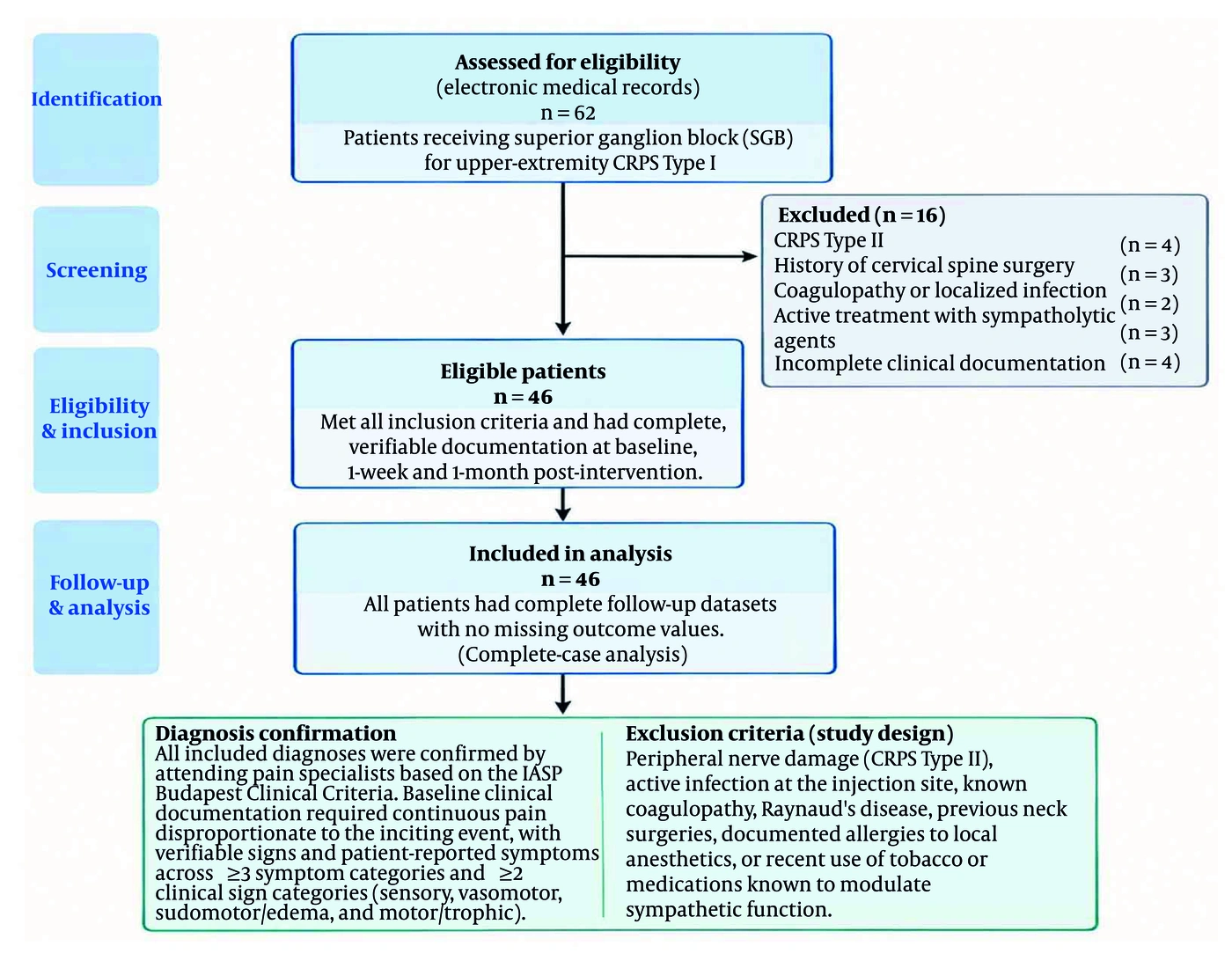
Figure 1.
STROBE flow diagram
Exclusion criteria included peripheral nerve damage (CRPS Type II), active infection at the injection site, known coagulopathy, Raynaud disease, previous neck surgery, documented allergies to local anesthetics, or recent use of tobacco or medications known to modulate sympathetic function.
3.3. Procedural Technique, Technical Verification, and Safety Monitoring
All participants (N = 46) underwent a single-session, unilateral ultrasound-guided SGB ipsilateral to the affected upper extremity in the interventional pain suite. Standard American Society of Anesthesiologists monitoring was maintained throughout the procedure. All interventions were performed by 2 experienced attending interventional pain specialists according to a uniform institutional protocol, with no technical deviations. No repeat blocks were administered during the 1-month follow-up period.
With the patient supine, the cervical spine mildly extended, and the head rotated slightly away from the target side, a high-frequency linear transducer (6 - 15 MHz, Sonosite Edge II; FUJIFILM Sonosite, Bothell, WA, USA) was placed transversely at the C6 vertebral level under sterile conditions. Sonographic landmarks included the anterior tubercle of the C6 transverse process (Chassaignac tubercle), carotid sheath, internal jugular vein, thyroid gland, and longus colli muscle deep to the prevertebral fascia.
Using an in-plane lateral-to-medial approach under continuous real-time ultrasound guidance, a 22-gauge, 50-mm echogenic needle (Quincke tip; B. Braun, Melsungen, Germany) was advanced through the prevertebral fascia until the tip rested in the subfascial plane anterior to the longus colli muscle. After negative aspiration for blood and cerebrospinal fluid, a 0.5-mL test dose of 1% lidocaine was administered to exclude intravascular entry. A standardized therapeutic injectate comprising 5 mL of 0.25% bupivacaine hydrochloride and 40 mg (1 mL) of triamcinolone acetonide was then administered under direct visualization to confirm adequate subfascial spread. Triamcinolone was included to suppress local neurogenic inflammation and prolong analgesia.
Technical success was verified within 15 - 30 minutes after injection by documenting ipsilateral Horner syndrome (ptosis, miosis, and conjunctival injection) and an increase in ipsilateral palmar skin temperature of ≥ 1.5 °C relative to baseline, measured using a continuous cutaneous thermal probe. The technical success criteria were met in 100% (n = 46) of patients.
After the intervention, patients were transferred to the postanesthesia care unit and observed for at least 60 minutes under continuous electrocardiographic, pulse oximetric, and noninvasive blood pressure monitoring. Before discharge, structured clinical screening was performed to record expected transient adverse effects related to local anesthetic diffusion, such as recurrent laryngeal nerve blockade causing hoarseness, dysphagia, or brachial plexus paresis, and to exclude major complications, including expanding cervical hematoma, pneumothorax, local anesthetic systemic toxicity, accidental neuraxial spread, or persistent neurological deficits.
3.4. Outcome Measures and Postprocedural Care
The primary outcome was the longitudinal change in pain intensity, assessed using the VAS, a 0 - 10 cm scale on which 0 represents "no pain" and 10 represents "worst imaginable pain." Scores were recorded at baseline before the procedure (T0), 1 week after the procedure (T1), and 1 month after the procedure (T2).
The secondary outcome was patient-reported satisfaction with perceived improvement in upper limb ROM and mobility at the 1-month follow-up (T2). Standardized goniometric measurements and validated upper-extremity disability questionnaires, such as QuickDASH, were not routinely recorded in this retrospective cohort. Perceived functional outcomes were therefore captured in the medical charts as narrative clinician progress notes describing patient-reported changes in limb stiffness, movement tolerance, and ease of activity.
For analysis, 2 investigators independently reviewed these narrative entries and mapped them to an operationalized 4-point ordinal satisfaction scale using predefined descriptive criteria. Disagreements were resolved by consensus:
No improvement (0%): Chart notes indicated no perceptible change in joint mobility, stiffness, or active movement relative to baseline.
Minimal improvement (< 25%): Notes documented slight subjective easing of stiffness without meaningful improvement in the ability to perform daily upper-extremity tasks.
Partial improvement (25% - 75%): Notes documented substantial self-reported easing of mobility restrictions, facilitating partial performance of activities of daily living.
Complete improvement (> 75%): Notes documented complete or near-complete perceived restoration of pain-free, functional upper limb movement.
These percentage ranges represent investigator-assigned retrospective groupings of narrative clinical documentation rather than prospective, instrument-validated patient ratings. The measure therefore reflects perceived qualitative utility rather than verified kinematic recovery.
3.5. Statistical Analysis
The normality of continuous variables was assessed using the Shapiro-Wilk test and visual inspection of normal Q-Q plots. Descriptive data are expressed as mean ± standard deviation (SD) for normally distributed continuous variables, median (interquartile range [IQR]) for skewed continuous variables, and frequencies with percentages (n, %) for categorical variables. All 46 patients had complete outcome records at every assessment (n = 46 per time point; no missing data), yielding a complete-case dataset for the primary analyses.
Longitudinal changes in VAS pain intensity across baseline (T0), 1 week (T1), and 1 month (T2) were evaluated using one-way repeated-measures analysis of variance (RM-ANOVA). Sphericity was assessed using Mauchly's test; when violations were observed, degrees of freedom were adjusted using the Greenhouse-Geisser correction. Post hoc pairwise comparisons used Bonferroni adjustment to control the familywise error rate across multiple contrasts. Effect sizes are presented as partial eta squared (ηp2) for omnibus tests and Cohen's dz for paired contrasts, together with mean differences and corresponding 95% confidence intervals (CIs).
To evaluate the robustness of within-subject analgesic trajectories while controlling for baseline heterogeneity, repeated-measures analysis of covariance (RM-ANCOVA) was performed. Prespecified baseline covariates, identified a priori from the CRPS literature, included patient age, injury-to-SGB interval, baseline opioid use, and concurrent gabapentinoid therapy. Given the right-skewed distribution of the injury-to-SGB interval, nonparametric Spearman rank correlation coefficients (ρ), with 95% CIs derived using Fisher's z-transformation, were calculated to assess monotonic relationships between this interval and reductions in pain scores (ΔVAS) at 1 week and 1 month. Statistical significance was set at a 2-tailed α = 0.05. All analyses were performed using IBM SPSS Statistics for Windows, version 27.0 (IBM Corp., Armonk, NY, USA).
3.6. Ethical Considerations
The study was conducted in accordance with the Declaration of Helsinki. Given the retrospective, observational nature of the study, informed consent was waived, and patient data were de-identified to ensure confidentiality. All clinical interventions were performed by attending specialists according to standard hospital protocols. No additional diagnostic or therapeutic interventions were introduced for this study. The protocol was approved by the Ethics Committee of Urmia University of Medical Sciences (Ref: IR.UMSU.HIMAM.REC.1403.047).
4. Results
The baseline demographic and clinical characteristics of the 46 patients with CRPS Type I who underwent ultrasound-guided SGB are presented in Table 1. The mean age was 60.9 ± 11.8 years (range, 34 - 85 years). Women comprised 65.2% (n = 30) of the cohort and men 34.8% (n = 16). The right upper extremity was affected in 58.7% (n = 27) of patients and the left in 41.3% (n = 19). The most common inciting events were distal radius or wrist fractures (47.8%, n = 22), followed by elective hand or wrist surgery (23.9%, n = 11), soft tissue crush injuries (19.6%, n = 9), and minor blunt trauma or sprains (8.7%, n = 4). The injury-to-SGB interval averaged 6.15 ± 3.82 months, with a median of 5.00 months (IQR, 3.00 - 8.25 months; range, 1.0 - 18.0 months).
Table 1.
Baseline Demographic and Clinical Characteristics of the Study Cohort a
| Characteristic | Value/Distribution (n = 46) |
|---|---|
| Age (y) | 60.9 ± 11.8 (34 - 85) |
| Gender | |
| Female | 30 (65.2) |
| Male | 16 (34.8) |
| Affected side | |
| Right | 27 (58.7) |
| Left | 19 (41.3) |
| Inciting event | |
| Distal radius/wrist fracture | 22 (47.8) |
| Elective hand/wrist surgery | 11 (23.9) |
| Soft tissue/crush trauma | 9 (19.6) |
| Minor sprain/blunt trauma | 4 (8.7) |
| Interval from injury to SGB (months) | |
| Mean ± SD | 6.15 ± 3.82 |
| Median (IQR) | 5.00 (3.00 - 8.25) |
| Range | 1.0 - 18.0 |
| Baseline budapest criteria signs/symptoms | |
| Sensory (hyperalgesia/allodynia) | 46 (100.0) |
| Vasomotor (Temperature/color asymmetry) | 41 (89.1) |
| Sudomotor/edema | 38 (82.6) |
| Motor/trophic (weakness, tremor, range of motion loss) | 46 (100.0) |
| Concurrent medications | |
| Gabapentinoids (pregabalin/gabapentin) | 39 (84.8) |
| Nonsteroidal anti-inflammatory drugs/acetaminophen | 34 (73.9) |
| Weak opioids (Tramadol) | 12 (26.1) |
| Prior conservative interventions | |
| Supervised physical/occupational therapy | 35 (76.1) |
| Prior sympathetic blocks | 0 (0.0) (block-naive) |
| Relevant comorbidities | |
| Hypertension | 18 (39.1) |
| Type 2 diabetes mellitus | 8 (17.4) |
| Osteoporosis/osteopenia | 11 (23.9) |
a Values are expressed as mean ± SD (Range) or No. (%) unless otherwise indicated. Abbreviations: SD, standard deviation; IQR, interquartile range; SGB, stellate ganglion block.
All participants fulfilled the Budapest Clinical Criteria at baseline. Sensory disturbances (hyperalgesia and allodynia) and motor/trophic impairments (weakness and reduced active ROM) were clinically documented in 100% (n = 46) of patients. Vasomotor manifestations (temperature and skin color asymmetry) and sudomotor abnormalities or edema were present in 89.1% (n = 41) and 82.6% (n = 38) of patients, respectively.
No patient had received a sympathetic block before inclusion. Supervised physical or occupational therapy had been undertaken by 76.1% (n = 35) of patients. Baseline concomitant pharmacotherapy primarily included gabapentinoids (pregabalin or gabapentin; 84.8%, n = 39), nonsteroidal anti-inflammatory drugs or acetaminophen (73.9%, n = 34), and weak opioids such as tramadol (26.1%, n = 12). Documented pre-existing comorbidities included hypertension (39.1%, n = 18), osteopenia or osteoporosis (23.9%, n = 11), and type 2 diabetes mellitus (17.4%, n = 8).
One-way repeated-measures analysis of variance demonstrated a significant omnibus reduction in VAS pain intensity across the 3 assessments (F(2, 90) = 344.8, P < 0.001, ηp2 = 0.88). Mauchly's test indicated a minor departure from sphericity (χ2(2) = 7.42, P = 0.024). After Greenhouse-Geisser correction (ε = 0.86), the longitudinal reduction remained statistically significant (F[1.72, 77.40] = 344.8, P < 0.001) (Table 2).
Table 2.
Pain Intensity (VAS) Trajectory and Repeated-Measures Post-Hoc Comparisons (N = 46) a
| Assessment Interval | Mean VAS ± SD | Comparison Contrast | Mean Difference ± SD | 95% Confidence Interval | Effect Size (Cohen's dz) | Adjusted P-Value |
|---|---|---|---|---|---|---|
| Pre-intervention Baseline (T0) | 9.04 ± 1.01 | — | — | — | — | — |
| One-Week Post-intervention (T1) | 4.80 ± 2.14 | T1 vs. T0 | -4.24 ± 2.01 | -4.84 to -3.64 | 2.11 | < 0.001 * |
| One-Month Post-intervention (T2) | 2.20 ± 1.15 | T2 vs. T0 | -6.84 ± 1.48 | -7.28 to -6.40 | 4.62 | < 0.001 * |
| — | — | T2 vs. T1 | -2.60 ± 1.82 | -3.14 to -2.06 | 1.43 | < 0.001 * |
a VAS = visual analog scale (0 - 10 cm); SD = standard deviation; CI = confidence interval. Omnibus repeated-measures analysis of variance (ANOVA): F(2, 90) = 344.8, P < 0.001, ηp2 = 0.88 (Greenhouse-Geisser corrected F(1.72, 77.40) = 344.8, P < 0.001). All pairwise contrasts were adjusted using Bonferroni correction for multiple comparisons. Covariate-adjusted repeated-measures analysis of covariance, controlling for age, injury-to-SGB interval, baseline opioid use, and gabapentinoid therapy: F(2, 82) = 318.6, P < 0.001. SGB = stellate ganglion block
* Statistically significant at P < 0.05
Post hoc pairwise comparisons with Bonferroni adjustment confirmed significant improvements from baseline (mean, 9.04; SD, 1.01) to 1 week (4.80 ± 2.14; mean difference, -4.24; 95% CI, -4.84 to -3.64; t[45] = -14.32; P < 0.001; Cohen's dz = 2.11) and 1 month (2.20 ± 1.15; mean difference, -6.84; 95% CI, -7.28 to -6.40; t[45] = -31.34; P < 0.001; Cohen's dz = 4.62). The incremental pain reduction between 1 week and 1 month was also statistically significant (mean difference, -2.60; 95% CI, -3.14 to -2.06; t[45] = -9.69; P < 0.001; Cohen's dz = 1.43).
In the RM-ANCOVA model adjusted for patient age, injury-to-SGB interval, baseline opioid use, and concurrent gabapentinoid therapy, the within-subject longitudinal pain reduction remained statistically significant (F(2, 82) = 318.6, P < 0.001). Although this adjustment accounts for selected clinical characteristics, it does not preclude unmeasured residual confounding inherent to an observational design.
The injury-to-SGB interval had a right-skewed distribution (Shapiro-Wilk test, P < 0.001), with a median of 5.00 months (IQR, 3.00 - 8.25 months; mean ± SD, 6.15 ± 3.82 months; range, 1.0 - 18.0 months). Nonparametric Spearman rank correlation analysis showed no statistically significant association between this interval and the magnitude of pain reduction at 1 week (mean ΔVAS ± SD, 4.24 ± 2.01; ρ = -0.162; 95% CI, -0.432 to 0.137; P = 0.282) or at 1 month (mean ΔVAS ± SD, 6.84 ± 1.48; ρ = -0.218; 95% CI, -0.479 to 0.078; P = 0.145; Table 3).
Table 3.
Spearman Rank Correlation Between Injury-to-SGB Interval and Pain Reduction (N = 46) a
| Outcome Metric | Median ΔVAS (IQR; cm) | Mean ΔVAS ± SD (cm) | Spearman Correlation (ρ) | 95% CI | Exact P-Value |
|---|---|---|---|---|---|
| Pain Reduction at 1 Week (ΔVAS, T0 - T1) | 4.50 (3.00 - 6.00) | 4.24 ± 2.01 | -0.162 | -0.432 to 0.137 | 0.282 |
| Pain Reduction at 1 Month (ΔVAS, T0 - T2) | 7.00 (6.00 - 8.00) | 6.84 ± 1.48 | -0.218 | -0.479 to 0.078 | 0.145 |
a Injury-to-SGB interval: median = 5.00 months (IQR, 3.00 - 8.25; range, 1.0 - 18.0 months). Abbreviations: SGB, stellate ganglion block; VAS, visual analog scale; ΔVAS, baseline VAS - follow-up VAS; CI, confidence interval; IQR, interquartile range; SD, standard deviation.
Patient-reported satisfaction with improvement in upper limb mobility at 1 month is summarized in Figure 2. Most patients reported partial improvement (56.5%, n = 26), while 26.1% (n = 12) reported minimal improvement and 15.2% (n = 7) reported complete satisfaction. Only 1 patient (2.2%) reported no improvement.
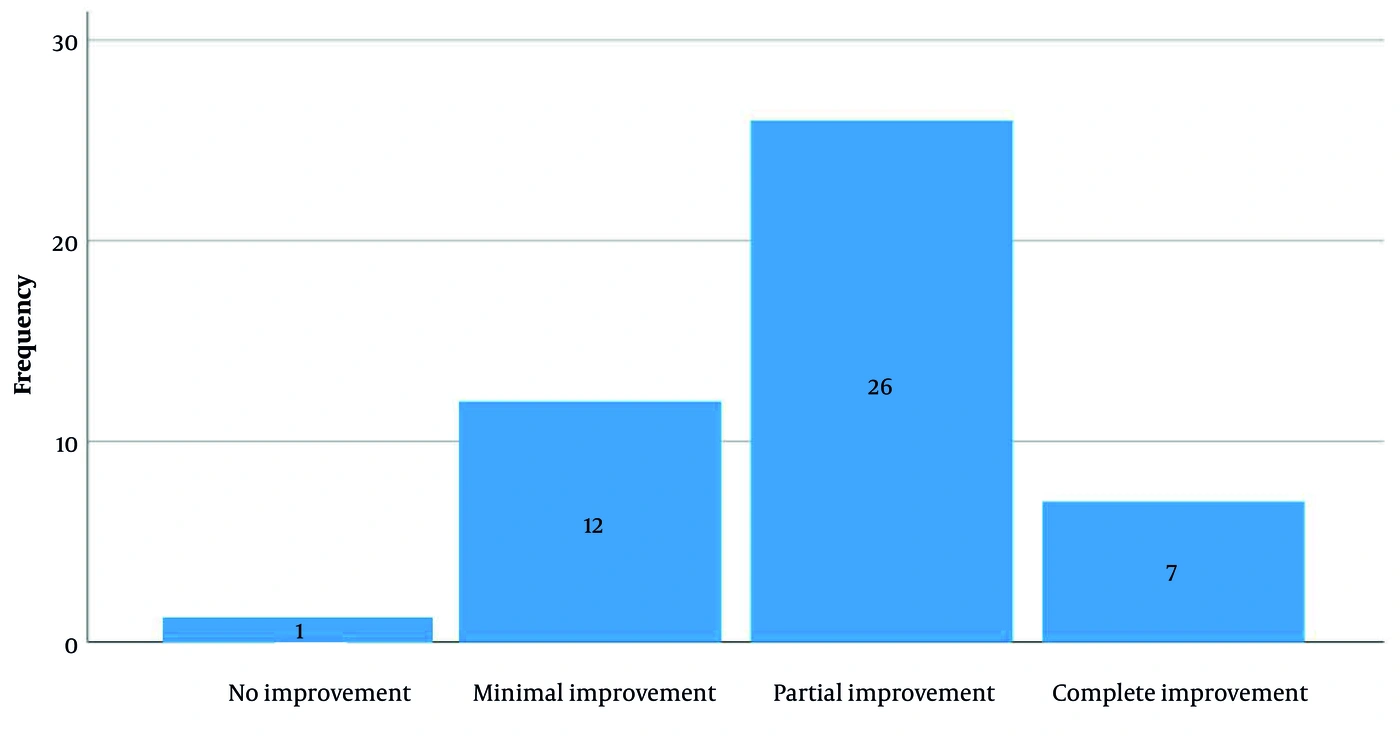
Figure 2.
Patient-reported satisfaction with upper limb mobility improvement at one month post-intervention.
4.1. Safety and Procedural Complications
No major procedural complications occurred in the cohort (N = 46). A structured review of procedural and recovery records identified no intravascular injection, expanding cervical hematoma, pneumothorax, LAST, unintended neuraxial (epidural or intrathecal) spread, or persistent neurological deficit (0% for all, n = 0). Expected minor adverse effects due to transient local anesthetic diffusion included self-limiting hoarseness, attributed to partial recurrent laryngeal nerve blockade, in 6 patients (13.0%) and mild transient dysphagia in 4 patients (8.7%). All transient symptoms resolved spontaneously within 2 - 4 hours without clinical intervention, and all patients were safely discharged on the day of the procedure.
5. Discussion
Complex regional pain syndrome is a profoundly disabling condition characterized by autonomic, sensory, and motor dysfunction disproportionate to the inciting trauma (12-15). In this retrospective study, ultrasound-guided SGB was associated with significant short-term pain reductions in patients with CRPS Type I. Mean VAS scores decreased from 9.04 ± 1.01 at baseline to 2.20 ± 1.15 at 1 month, alongside favorable patient-reported satisfaction with upper-extremity mobility (7, 16). Although SGB was historically viewed as a definitive standalone intervention, contemporary clinical guidelines emphasize its role in temporarily interrupting aberrant sympathetic-afferent coupling to provide an analgesic window for multidisciplinary rehabilitation, including physiotherapy, occupational therapy, and psychological support (17-19).
The 46 patients in this study had a mean age of 60.9 ± 11.8 years, and 65.2% were female. This demographic profile is consistent with that reported by Diepold et al. (20) and with broader epidemiological data indicating greater vulnerability among older women after upper-extremity fractures and prolonged immobilization (17, 21). The short-term pain reductions at 1 week and 1 month are consistent with those reported by Jadon et al. and other cohorts evaluating sympathetic interventions (22, 23). However, perceived mobility responses varied, with 26.1% of patients reporting only minimal improvement. This variability reflects the heterogeneous nature of CRPS and suggests that established structural and trophic changes may influence functional responses (24).
Previous studies and systematic reviews have reported conflicting SGB outcomes, largely because of heterogeneity in imaging guidance and injectate composition (25, 26). Unlike landmark-guided techniques, our protocol used real-time ultrasound guidance to deposit 0.25% bupivacaine (5 mL) combined with triamcinolone (40 mg) anterior to the longus colli muscle. Blockade was confirmed by ipsilateral Horner syndrome and an increase in extremity temperature (18, 26, 27). The corticosteroid likely prolonged local anti-inflammatory and perineural membrane-stabilizing effects beyond the transient action of local anesthetics alone (28).
Our analysis showed no statistically significant correlation between the injury-to-SGB interval and the magnitude of pain reduction at 1 month (ρ = -0.218, P = 0.145). Lewis et al. (29) reported improvements after multidisciplinary rehabilitation in both early and persistent CRPS, using a 1-year symptom-duration threshold. Their findings pertain to rehabilitation rather than sympathetic blockade. In our cohort, meaningful pain relief and patient-reported satisfaction were observed across different injury-to-SGB intervals. These findings suggest that patients with CRPS Type I should not routinely be excluded from trials of sympathetic blockade solely on the basis of the injury-to-SGB interval. However, given the retrospective, uncontrolled design, the absence of a statistically significant correlation does not establish that intervention timing has no influence on outcomes (28, 29).
5.1. Limitations and Future Directions
Several limitations should be considered. The retrospective, single-center, single-arm design, without a sham or comparator group, precludes definitive causal attribution. The observed analgesic trajectories cannot be distinguished from the natural history of the condition, procedural placebo effects, or regression to the mean after severe baseline pain (9.04 ± 1.01). Although RM-ANCOVA adjusted for measured baseline variables (age, injury-to-SGB interval, and baseline analgesic regimens), adjustment for selected covariates cannot eliminate residual confounding from unmeasured clinical, psychological, or lifestyle factors. Concurrent outpatient physical therapy, occupational rehabilitation, and minor analgesic adjustments were neither prospectively tracked nor standardized during the 1-month follow-up.
Secondary mobility outcomes were derived by retrospectively categorizing narrative chart entries on a 4-point ordinal scale rather than by prospective assessment using validated patient-reported outcome measures or objective goniometry and dynamometry. Investigator assignment introduces potential classification and interpretation bias, and the percentage boundaries should be interpreted as qualitative approximations rather than calibrated functional metrics. Although the sample size (N = 46) was adequately powered to detect primary within-subject pain score changes, it limited more granular subgroup analyses. The short observation period also limits conclusions regarding long-term durability. Adequately powered, prospective, randomized, sham-controlled trials using validated functional instruments, such as QuickDASH or PRWE questionnaires, and objective biomechanical assessments are needed to substantiate these observations.
5.2. Conclusions
In this retrospective, single-center cohort of patients with CRPS Type I, ultrasound-guided SGB was associated with statistically significant, clinically meaningful short-term reductions in VAS pain scores and favorable patient-reported satisfaction with upper limb mobility at 1 month. The injury-to-SGB interval showed no statistically significant monotonic correlation with the magnitude of pain reduction in this sample. Because of the observational, single-group design and unstandardized concurrent outpatient interventions, these findings describe postintervention clinical trajectories rather than definitive treatment efficacy. Adequately powered, prospective, sham-controlled trials incorporating validated kinematic and patient-reported functional outcome measures are needed to establish the independent efficacy of SGB within multimodal CRPS management.