
1. Introduction
Complex regional pain syndrome (CRPS) is characterized by chronic debilitating pain, inflammation, and abnormal blood flow in a limb or other regions of the body. The symptoms of CRPS are often disproportionate to the usual course of any known trauma or other injuries. This condition can occur after surgery or traumas, or it may have no known causes. Complex regional pain syndrome is divided into two categories: CRPS I (also known as reflex sympathetic dystrophy), in which there is no identifiable nerve damage; and CRPS II (also known as causalgia), which occurs when there is documented nerve damage (1). Based on the response to sympatholytic block, this syndrome can be further subcategorized into sympathetically maintained pain (SMP) or sympathetically independent pain (SIP).
The precise pathophysiology of CRPS is still unknown. Abnormal activation of the sympathetic nervous system is considered to be a key pathogenic mechanism (2). Numerous studies suggest that myelinated and unmyelinated nerve fibers (A delta and C fibers) are involved in the development of CRPS. Hypersensitivity to catecholamines and the formation of hyperactivated pain arcs after nerve damage are observed (3).
There is evidence of central and peripheral hypersensitization and increased inflammatory cytokines in individuals with CRPS. Changes in the brain cortex and glial activation may activate primary nociceptive neurons, leading to central sensitization. Peripheral sensitization may also be due to the increased sensitivity of injured axons and can explain the allodynia phenomenon (3). Genetic factors also may be involved in the pathogenesis of CRPS, with evidence supporting the association of HLA-DQ1 and HLA-DR3 with CRPS (4, 5). In addition, antinuclear antibodies and immunoglobulin G autoantibodies against surface antigens on autonomic neurons have been observed in CRPS patients (6). However, the exact pathophysiology of CRPS is not fully understood, which makes it challenging to treat. As a result, the symptoms of CRPS are often persistent and recurrent. Here we present the case of a 40-year-old man with CRPS who failed to respond to multiple treatments.
2. Case Presentation
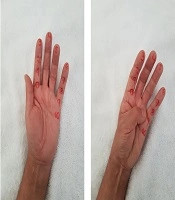
In 2016, a 40-year-old Caucasian man was referred to our pain clinic with the symptoms of severe pain and a burning sensation in his right arm and left leg, which started after nerve transplant surgery. His right arm was injured by a sharp object. The injury resulted in nerve damage and required autograft nerve transplantation. Eventually, his left sural nerve was used to repair his right ulnar nerve. Shortly after the surgery, he began experiencing pain and a burning sensation in the mentioned limbs. On presentation, he also had hyperesthesia and pain in his right arm and left leg. The pain was more severe in his arm (the visual analog scale: 10) and continued throughout the day. The skin of the affected arm was shiny and slightly edematous.
He was diagnosed with CRPS based on the Budapest criteria, and medical therapy was initiated with tramadol and pregabalin. As he did not show any improvement with several oral agents, he underwent several nerve blocks, including a stellate ganglion nerve block in March 2018, a right thoracic sympathetic nerve block in February 2020, a left common peroneal nerve block, a right ulnar nerve block, and a right thoracic sympathetic nerve block in November 2021, a right thoracic sympathetic nerve block, a left sympathetic lumbar nerve block, and a right ulnar nerve block in December 2021, a right thoracic sympathetic nerve block, a left lumbar sympathetic block, and a right ulnar nerve block in January 2022. All of the nerve blocks were unable to control his symptoms, and only a minor reduction in pain, which lasted only for a few hours, was noted. He was then treated with high doses of tramadol, pregabalin, meloxicam, and vitamin B1, all of which were ineffective. Desperate to control his symptoms, he started to use opium, which also did not help.
On May 2022, we decided to try ozone therapy. We administered medical ozone (5% O3 and 95% O2) with the major auto autohemotherapy method using the Guardian MC80 ozone therapy device. We incubated 50 mL of medical ozone in 200 mL of autologous blood. The concentration of ozone was set at 50 μg/mL and was increased to 60 μg/mL the next day and then to 70 μg/mL, and this dose was continued (7). We also administered 50 mg of ketamine (manufactured by Panpharma Co.) during each session of ozone therapy (8). The patient received this treatment daily for 14 days. A minimal reduction in pain was noted after each session, which did not last for more than six hours. As the patient failed to achieve a persistent response after 14 sessions, ozone therapy was discontinued. Lidocaine patches were also tried in August 2022. Two patches were placed, one on the lateral side of the shoulder above the deltoid muscle and another on the back of the thigh above the biceps femoris muscle. Lidocaine patches were ineffective as well. To this date, our patient continues to experience agonizing pain without any sign of alleviation.
3. Discussion
Complex regional pain syndrome is a challenging condition to treat due to its complex and variable nature. A variety of medications have been utilized for the management of CRPS; however, many patients fail to respond to treatments and experience chronic debilitating symptoms. Bisphosphonates are among the most studied drugs for treating CRPS, and several small RCTs have supported their effectiveness (9). A short course of prednisone may be beneficial for patients with CRPS, but overall, corticosteroids are ineffective in managing the chronic symptoms of CRPS (10). Gabapentin and naltrexone have received attention, but research evidence supporting their effectiveness is limited (11). Vitamin C is commonly used to prevent CRPS after extremity surgeries. Current studies have provided no evidence to support the beneficial role of NSAIDs or aspirin (11). Our patient was treated with various oral agents, all of which failed to control his symptoms. Epidural clonidine, intrathecal clonidine, adenosine, and baclofen may be effective for the treatment of CRPS, but available research is scarce (9).
Surgical treatments include spinal cord stimulation, implantable peripheral nerve stimulation, and dorsal root ganglion stimulation (DRGS). In a multicenter randomized clinical trial, DRGS resulted in a significant reduction in pain (more than 50% on VAS) in 81% of patients after three months of the surgery (12). It seems that DRGS is currently a reasonable option for refractory CRPS patients; however, it is expensive and not widely available. Amputation is a controversial surgical treatment for CRPS, which has been shown to improve symptoms in some cases, but it carries the risk of phantom limb pain and recurrence.
The sympathetic blockade is a common treatment for CRPS; however, few studies have been conducted on its effectiveness. A recent cohort study on 318 patients who underwent sympathetic blocks between 2009 and 2016 supported the effectiveness of this approach, showing that 61% of 255 patients with CRPS experienced more than 50% pain relief after the procedure, and this pain relief lasted for 1-4 weeks or longer in 85% of these patients (13). Yet, our patient did not respond to several sympathetic nerve blocks, suggesting that sympathetic nerve block has limited effectiveness in refractory cases.
Ozone therapy is a novel pain management approach that can be effective for the treatment of CRPS and other painful conditions. Ozone therapy has been noted to act through several mechanisms, a number of which may target the factors involved in the pathogenesis of CRPS, such as hypoxia, inflammation, and infection (14). Studies have shown that ozone therapy can reduce inflammation and chronic pain. A case study reported that ozone therapy was able to resolve the chronic pain caused by reflex sympathetic dystrophy in an 11-year-old girl who was unresponsive to opiate treatment. Therefore, she underwent 120 sessions of ozone therapy (five sessions per week), and the symptoms started to improve after ten sessions (7). In contrast, after 14 sessions of ozone therapy, our patient refused to continue the treatment because he felt no reduction in his symptoms. Ozone therapy is safe and relatively inexpensive, but as far as our literature review shows, this strategy has not been studied as a treatment for CRPS in clinical trials.
In addition, we tried intravenous ketamine along with ozone therapy. Ketamine targets the sensitization of NMDA nociceptive pathways, which appears to be involved in the pathophysiology of CRPS. A systematic review analyzing 14 clinical studies on the efficacy of ketamine infusion for patients with intractable CRPS reported that ketamine infusion resulted in a decrease in pain scores and relief of symptoms in 13 of the 14 included studies. The recent review suggested that ketamine infusion might be an effective therapeutic option for patients with refractory CRPS (15). Unfortunately, our patient responded to ketamine infusion neither.
This study described the case of a patient with severe refractory CRPS that was unresponsive to conventional treatments, as well as ketamine infusion and ozone therapy, as a novel treatment approach. While we are continuing our efforts to alleviate the symptoms of this patient, it should be noted that intractable and chronic CRPS is not a rare entity. As mentioned above, many treatment approaches have been studied for the management of CRPS, and many patients still fail to respond to these treatments. Most of the treatments introduced lack supportive evidence from high-quality research and are not citable for making clinical decisions. Further studies are needed to find more effective treatments.