
1. Background
One of the most important individuals in the health care system are nurses, which comprise of the largest single professional group (1).
Between 2004 and 2006, health care providers were ranked third for depressive episodes (2). Researches have shown that nurses experience psychological problems, such as stress and depression (3, 4). Low mood, loss of concentration, disability in performing mental or interpersonal tasks well, and less output are consequences of depression in individuals (5-7).
Depression in hospital nurses impacts their professional function, quality of care, and also their coworkers (2). Therefore, considering this issue is essential.
Emotional intelligence is defined as the ability of screening and explaining one’s own and other’s experiences and feelings, to differentiate them, and apply essential information to determine thoughts and actions (10, 11).
Furthermore, EI is important in definition, perception, understanding, and regulation of emotions (12).
It has been suggested that higher EI indicates better mental and physical health as well as better control of stress (13). Emotional intelligence for nurses is considered as a protective factor against stress (14). As nurses face different difficult situations in their work life, such as work overload, night shift, death of the patient, problems with colleagues, staff shortage or lack of support, higher EI will help them overcome these problems (15).
2. Objectives
Therefore, as nurses should communicate with patients in different situations and concentrate on their work to provide better care, this study was designed to evaluate depression and EI and their association with related factors in hospital nurses of Tehran University of Medical Sciences.
3. Methods
3.1. Sampling
This was a cross sectional study, which was conducted at Tehran University of Medical Sciences (TUMS) between August 2015 and August 2016. One hundred and thirty hospital nurses of TUMS in different wards, such as emergency medicine, internal medicine, and surgery, were randomly selected by means of random numbers (generated numbers by computers).
3.2. Materials
The participants were asked to fill the Persian version of beck depression inventory and the baron emotional quotient inventory (EQ-i), which have been proven to be valid and reliable (16, 17).
Emotional quotient inventory (EQ-i) includes 90 questions. It is a self-report questionnaire, which includes five categories and 15 scales. The five categories are intrapersonal (self-regard, emotional self- awareness, assertiveness, independence, and self actualization), interpersonal empathy, social responsibility, and interpersonal relationship, stress management (stress tolerance and impulse control), adaptability (reality testing, flexibility and problem solving), and general mood scale (optimism and happiness). Each question is based on a five-point Likert scale scoring system ranging from five to one (completely agree: five to completely disagree: one). The total score is the sum of all questions scores. A higher score is considered as higher emotional intelligence.
Beck depression inventory (BDI) should be answered according to the patient’s feelings in the last week, including 21 questions. The answer to each question is scored from 0 to 3 to determine the person’s depression level. Individuals with scores between 0 and 9 are not considered as depressed, scores between 10 and 18 indicate mild to moderate depression, scores between 19 and 29 indicate moderate to severe depression, and scores between 30 and 63 correspond to severe depression.
3.3. Data Analysis
Data was analyzed by the SPSS software version 20 (SPSS Inc., Chicago, IL, USA). Data were presented as mean ± standard deviation (SD) for continuous or frequencies for categorical variables. Continuous variables were compared by means of independent sample t-test. P-values of less than 0.05 were considered significant.
3.4. Ethical Considerations
All participants filled informed consent forms before study entrance.
4. Results
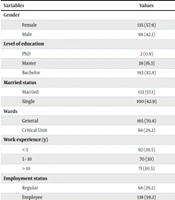
One hundred and thirteen nurses from 130 filled the questionnaires, and the response rate was 87%. Basic characteristics of enrolled cases are summarized in Table 1. Fifty-eight participants were not depressed (51.3%), 29 (25.7%) had mild depression, 20(17.7%) had moderate and 6 (5.3%) were severely depressed.
Table 1.
Baseline Characteristics of the Participants
| Variables | Values |
|---|---|
| Age, mean (SD) | 25.3 (0.5) |
| Sex, No. (%) | |
| Male | 66 (58.4) |
| Female | 47 (41.5) |
| Education level, mean (SD)a | 15.8 (0.08) |
| Ward, No. (%) | |
| Internal medicine | 40 (35.4) |
| Emergency | 40 (35.4) |
| Surgery | 33 (29.2) |
a Based on the number of years of schooling.
The correlation coefficient between BDI and total EI was 0.2, P was 0.008, indicating weak statistical significance. Also, the correlation coefficient between age and total EI was significant statistically yet weak and inverse (r = -0.2, P = 0.01).
Moreover, description of different EI items are summarized in Table 2.
Table 2.
Descriptive of Different EI Items
| Subscales | Mean (SD) |
|---|---|
| Problem solving | 14 (0.2) |
| Happiness | 14.5 (0.3) |
| Independence | 15.1 (0.3) |
| Stress tolerance | 17.2 (0.3) |
| Self-actualization | 14.9 (0.3) |
| Emotional self-awareness | 15 (0.2) |
| Reality testing | 17.3 (0.3) |
| Interpersonal relationship | 13.4 (0.3) |
| Optimism | 14.3 (0.2) |
| Self-regard | 13.9 (0.2) |
| Impulse control | 18.4 (0.4) |
| Flexibility | 17.3 (0.2) |
| Responsibility | 12.6 (0.3) |
| Empathy | 12.3 (0.3) |
| Assertiveness | 17 (0.3) |
Mean BDI and EI scores, except independence and responsibility, were not significantly different between male and female cases (Table 3).
Table 3.
Comparison Between Mean BDI and EI Items in Different Sex Groups
| Subscale | Male | Female | P-Value |
|---|---|---|---|
| Total BDI | 11.4 ± 1.2 | 11.8 ± 1.5 | 0.8 |
| Problem solving | 13.9 ± 0.3 | 14.1 ± 0.4 | 0.6 |
| Happiness | 14.1 ± 0.4 | 15.2 ± 0.5 | 0.1 |
| Independence | 15.8 ± 0.4 | 14.3 ± 0.3 | 0.01 |
| Stress tolerance | 16.9 ± 0.4 | 17.7 ± 0.5 | 0.2 |
| Self-actualization | 15 ± 0.4 | 14.7 ± 0.4 | 0.7 |
| Emotional self-awareness | 15 ± 0.3 | 15.1 ± 0.4 | 0.8 |
| Reality testing | 17.4 ± 0.4 | 17.1 ± 0.5 | 0.6 |
| Interpersonal relationship | 13.4 ± 0.4 | 13.5 ± 0.4 | 0.8 |
| Optimism | 14.1 ± 0.3 | 14.5 ± 0.4 | 0.5 |
| Self-regard | 13.8 ± 0.3 | 14.1 ± 0.3 | 0.6 |
| Impulse control | 19 ± 0.6 | 17.7 ± 0.6 | 0.1 |
| Flexibility | 17.3 ± 0.3 | 17.3 ± 0.4 | 0.8 |
| Responsibility | 13.2 ± 0.4 | 11.7 ± 0.4 | 0.02 |
| Empathy | 12.1 ± 0.4 | 12.7 ± 0.4 | 0.3 |
| Assertiveness | 16.7 ± 0.4 | 17.5 ± 0.4 | 0.1 |
| Total EI | 228.1 ± 36.4 | 227.8 ± 30.5 | 0.9 |
Mean EI and its subscales were similar in different ward’s attendance, except emotional self-awareness (Table 4).
Table 4.
Comparison of EI Items of the Participants in Different Ward
| Subscale | Internal Medicine | Surgery | Emergency Medicine | P-Value |
|---|---|---|---|---|
| Problem solving | 14.1 ± 2.8 | 13.6 ± 3.2 | 14.3 ± 3.3 | 0.6 |
| Happiness | 15 ± 3.7 | 13.9 ± 4.1 | 14.8 ± 4.3 | 0.4 |
| Independence | 16 ± 2.4 | 14.6 ± 3.7 | 14.9 ± 3.3 | 0.1 |
| Stress tolerance | 17.7 ± 2.7 | 17.1 ± 4.6 | 16.7 ± 3 | 0.5 |
| Self-actualization | 15.2 ± 3 | 14.5 ± 4 | 14.9 ± 3.2 | 0.6 |
| Emotional self-awareness | 15.9 ± 2.5 | 14.3 ± 3.3 | 14.8 ± 2.2 | 0.03 |
| Reality testing | 17.1 ± 3 | 17.7 ± 4.6 | 17.1 ± 2.7 | 0.7 |
| Interpersonal relationship | 13.8 ± 3.1 | 12.6 ± 3.8 | 14.1 ± 3.5 | 0.1 |
| Optimism | 15.1 ± 2.7 | 13.6 ± 3.5 | 14.1 ± 2.8 | 0.1 |
| Self-regard | 14 ± 2.9 | 13.5 ± 2.6 | 14.3 ± 3.3 | 0.4 |
| Impulse control | 18.9 ± 4.3 | 18.4 ± 5.6 | 17.8 ± 4.5 | 0.6 |
| Flexibility | 17.9 ± 2.6 | 17.1 ± 3.5 | 16.9 ± 2.9 | 0.3 |
| Responsibility | 12.8 ± 3.4 | 11.8 ± 3.5 | 13.3 ± 3.9 | 0.1 |
| Empathy | 12.8 ± 3.1 | 11.7 ± 3.6 | 12.6 ± 3.3 | 0.3 |
| Assertiveness | 17.2 ± 2.1 | 16.9 ± 3.8 | 17.1 ± 3.6 | 0.9 |
| Total | 233.8 ± 25.9 | 221.8 ± 38.1 | 228.5 ± 33.9 | 0.2 |
5. Discussion
The results of present study showed that mean EI and BDI were not significantly different between gender groups as well as different wards. The results also showed that mean responsibility and independence scores were significantly different between different genders. These items were higher in males.
However, Naghavi and Redzuan in their study reported that EI in females was higher than males (15). In a previous study by the current authors, mean responsibility score was significantly different between male and female medical residents (10). Although not significant, this study investigated that surgery residents had higher EI scores (10).
This study also found a weak association between EI and BDI as well as EI and age.
In a previous study conducted by Namdar et al. in Tabriz (18), mean EI score of nursing students was 332 while this score was 228 in the current study. Similar to the current findings, mean EI scores were not significantly different between males and females.
In contrast to the current results, higher EI score of college students was reported by Brackett et al. (19).
Barkhordari and Rostambeygi assessed EI of nursing students of Yazd university and reported mean EI of 331 and no difference between the scores of males and females (20).
Haghani et al. evaluated EI in Isfahan medical students, and reported significantly higher responsibility score in male participants, which is compatible with the current results (21).
In the current study, the researchers did not find a strong association between EI and age (-0.2, P = 0.01), similar to the author’s previous study (r = -0.04, P = 0.7)(10). This finding was in agreement with other studies (18, 20).
Evaluating EI of people is of interest for psychologists and educators (19). Team activities, functioning, academic success, and life enjoyment are positively associated with EI (18, 22).
Therefore, evaluating EI of nurses, who are in contact with patients, is important.
In a previous study, Beauvais et al. reported a positive association between emotional intelligence and nursing performance, which could indicate that for people, who make decisions, take action, and perform well, higher EI is necessary (23).
It should be considered that in the real world, nurses face life and death decisions. For better nursing performance, improved decision making and problem solving is essential (24).
On the other hand, nurses should have empathy for patients and manage their emotions. Therefore, improving EI will help them provide better care (25).
Moreover, in the present study, nearly half of the participants had depression. Letvak et al. demonstrated depressive symptoms rate as 18% in employed nurses (2).
This study had some limitations. First, it was conducted at university affiliated wards and second, the authors did not include nurses of all wards.
5.1. Conclusions
According to the results, depression evaluation and emotional intelligence improvement should be considered in Iranian nurses, who work at university associated hospitals.