


1. Background
Human resources is the biggest and the most valuable assets of each country and their knowledge, skills and motivations form the basis and the wealth of organizations (1). The importance of human resources in healthcare organizations is greater because these organizations have a pivotal role in ensuring the health of active and qualified workforce of other organizations (2). Almost in all countries, nurses form the most significant part of human resources in healthcare organizations. Given their fundamental role in care-related quality improvement and health promotion, the availability of productive and efficient nurses is of paramount importance to healthcare systems (3).
Nursing staff’ productivity can significantly affect organizational productivity to such an extent that without experienced and qualified nurses, healthcare organizations cannot achieve success (4). Organizational culture, environmental conditions, motivational factors, empowerment, leadership style, and job satisfaction (JS) are among the factors which can enhance employee productivity (5). JS is one of the most significant workplace-related attributes correlated with the fulfillment of individuals’ basic needs such as physiological needs, physical and psychological safety, love and self-confidence (2). Herzberg defined factors that bring about JS and job dissatisfaction respectively as ‘hygiene factors’ and ‘motivators’. Hygiene factors include salary, job security, working conditions, status, organizational policies, supervision quality and styles and relationships among peers and supervisors while motivators are achievement, recognition, responsibility, advancement, self-control at work and possibility of growth (6).
Concerning the abovementioned explanations, assessment and identification of strategies to enhance JS as a key factor of productivity seem crucial (2). Factors which can affect nurses’ JS include, but not limited to, latitude, interpersonal relationships, specialization, managerial exercises, social status, opportunity for advancement and promotion, work conditions, physical environment and payments (7). These factors were also reported by other studies. For example, 44% of nurses in Turkey were dissatisfied with their job and referred to emotional fatigue, poor physician-nurse relationship and inadequacy of human resource management as the main factors for their intention to leave their work (8). Ramoo et al. reported that nurses working in teaching hospitals located in Malaysia had moderate JS and 40% of them intended to leave the profession. Thus, they recommended several strategies to enhance nurses’ JS which included providing them with greater educational opportunities, improving their managerial and decision-making skills and creating a flexible work environment (9).
Emotional intelligence (EI) is among the factors which can affect JS (10). The results of a study by Benson et al. indicated that EI is an effective functional capacity to establish satisfactory interpersonal relationships and have good performance under difficult work conditions. They also reported that individuals with greater EI were more competent to establish relationships (11). EI is also a protective factor for nurses against occupational stress and a significant factor to promote teamwork. According to Jones and Argentino, enhancing EI can improve nurses’ interpersonal relationships, alleviate their anxiety and prevent aggressive behaviors among them (12). Besides an appropriate intelligence quotient, learning and using EI skills (such as displaying and controlling emotions and sympathizing with others’ feelings) are essential prerequisites to humans’ achievement and satisfaction. It is noteworthy that EI is an acquired ability and is affected by the immediate environment (13).
Nurses with high EI seek to develop nursing professional practice. They also promote their own learning and nursing skills (14). The results of different studies showed a positive correlation between nurses’ EI and JS (15, 16). However, authors could not retrieve any interventional studies on the effect of EI training on nurses’ JS.
2. Objectives
The current study aimed to examine the effects of training EI skills on different aspects of nurses’ JS.
3. Methods
This pretest-posttest controlled quasi-experimental study was conducted in 2013 on nurses working in Valiasr and Imam Reza teaching hospitals, Birjand, Iran. Nurses were included if they had a work experience of 3 - 12 years, no managerial position, and did rotational working shifts.
After obtaining the informed consents from the participants, a list of all nurses working in the aforementioned hospitals was prepared. Then, the nurses’ characteristics were assessed and the names of eligible nurses in each hospital were listed in two separate lists. In total, 33 nurses from Imam Reza hospital and 88 nurses from Valiasr hospital met the inclusion criteria. Then, to eliminate the confounding effects related to the variables of working ward and difficulty of work, nurses working in critical care units (including intensive, coronary, and neonatal intensive, cardiac surgery and burns care units and operating rooms) and general hospital wards (including general surgical, neurosurgical, male urological, cardiac, ear, mouth and nose care wards) were allocated into two independent blocks. In Imam Reza and Valiasr hospitals, respectively 20 and 65 nurses were working in critical care units while 13 and 23 nurses were working in general hospital wards. Based on the total number of nurses in each hospital, the number of nurses in the blocks, and the findings reported by Naghdi et al. (17), the sample size was determined 18 nurses in each group. Accordingly, eleven critical care nurses and seven nurses from general wards of Imam Reza hospital were allocated into the control group while thirteen critical care nurses and five nurses from general wards of Valiasr hospital were allocated to the experimental group. Random sampling method was used.
The study sample size was calculated based on the findings of a similar study by Naghdi et al. and the formula shown in Figure 1. Therefore, it was determined that fifteen nurses were necessary for each group (17). However, because of attrition probability, the number of nurses in each group was increased by 15%, i e, to eighteen.
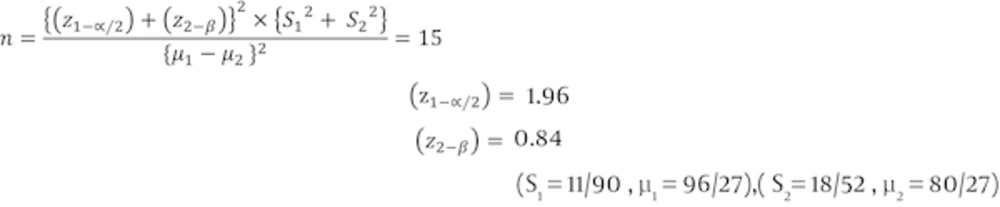
Figure 1.
The Sample Size Calculation Formula
A researcher-made questionnaire was used to assess JS and its domains. This questionnaire was developed deductively using standardized JS questionnaires such as the Herzberg questionnaire as well as Persian questionnaires developed qualitatively. The generated questionnaire consisted of items on nurses’ demographic characteristics and JS. The JS part included 62 items in four main domains including management and supervision (14 items), organizational culture (14 items), psychosocial (14 items) and relationships and welfare (20 items). The items were rated on a six-point Likert-type scale. The six points of the scale were “very satisfied”, “satisfied”, “mildly satisfied”, “dissatisfied”, “very dissatisfied” and “neutral” scored from 6 to 1, respectively. Thus, the total score of the JS questionnaire could range from 62 to 372. The content validity of the questionnaire was assessed by ten faculty members affiliated to Birjand University of Medical Sciences, Birjand, Iran. The Cronbach’s alpha values of the questionnaire and its management and supervision, organizational culture, psychosocial and relationships and welfare domains were 0.95, 0.87, 0.89, 0.86, 0.89, and 0.83, respectively.
The study intervention was implemented by the first author as follows. Initially, the researcher introduced herself to the participants, explained the aim and the methods of the study to them, and obtained their written consent. They were ensured that they could voluntarily withdraw from the study. Moreover, the questionnaires were anonymized and labeled by numerical codes. The confidentiality of their data was also guaranteed. Then, all nurses in both study groups were asked to complete the study questionnaire. Thereafter, the EI training intervention was implemented for the nurses in the experimental group while the nurses in the control group received no EI intervention.
The training protocol was developed based on the Bradberry and Greaves program which consists of four EI skills including self-awareness, self-management, social awareness and relationship management. The intervention was implemented in ten 90-minute weekly sessions held using the collaborative learning and the question-and-answer teaching methods. Finally, the training materials were embedded in a booklet and provided to the nurses in the experimental group. To minimize the likelihood of errors in program implementation, promote nurses’ learning, and ensure nurses’ complete understanding of the training materials, all nurses in the experimental group were allocated to a single group and the training sessions were held in the amphitheater of Valiasr hospital. Moreover, the sessions were held on a weekly basis to allow nurses exercise the learned skills in their daily lives. The contents of each training session were as follows.
3.1. Session 1
The trainer introduced herself to the participants and they were also asked to introduce themselves. Then, the participants were provided with the information about the aim and the methods of the study and the contents of the next sessions. This session lasted 45 minutes.
3.2. Sessions 2 and 3
The main topic of these two sessions was emotional self-awareness. Therefore, explanations were provided to the participants about self-awareness and its definitions, self-esteem and strategies to boost it, recognition and control of feelings, and different types of self-including parameters such as physical, actual, ideal, social, and spiritual. Moreover, in the printed booklet of these two sessions, activities were included to inform nurses about training materials and encourage their active collaboration. For instance, they were asked to express their current feelings and their causes (such as unhappiness and its causes) for other participants. In another activity, they were asked to admit their own negative feelings and attempt to find their origins. Moreover, they were invited to write their abilities and strengths on one side of a blank paper in their booklets as well as their weaknesses and limitations on the other side. Thereafter, they were asked to admit such weaknesses and strengths as their own characteristics and attempt to reinforce the strengths and overcome the weaknesses. It was also tried to improve nurses’ emotional self-awareness through giving them practical exercises. Each of these two sessions lasted 90 minutes.
3.3. Sessions 4 and 5
The contents of these sessions included social skills, the communication model, the key elements of communication, barriers to effective communication and recommendations to increase the effectiveness of verbal communications, management of conflicts in communications, and sympathy and strategies to improve it. Practical exercises were also given to the participants to improve their communication skills. Each of these two sessions lasted 90 minutes.
3.4. Sessions 6 and 7
These two sessions were on the types of emotions, components, nature, reasons and consequences of anger, anger management strategies, problem solving and its phases and self-control and its steps. In these 90-minute sessions, it was attempted to enhance nurses’ anger management skills through giving them practical exercises.
3.5. Sessions 8 and 9
The contents of these sessions were stress and its definitions, flexibility and stress endurance, causes and effects of stress, coping with stress, stress management strategies in workplace and skills to cope with negative mood. Practical exercises were used to enhance nurses’ skills to manage stress and cope with negative mood. Each of these two sessions also lasted 90 minutes.
3.6. Session 10
The contents of previous sessions were reviewed in this session and the nurses were reminded of the time of taking the posttest.
In all phases of the study, it was attempted to protect the participants’ privacy and dignity. One week after the last training session, posttest was given to all nurses in both groups. During the intervention, two nurses withdrew from the study due to rotational shifts and family conflicts and hence, the final data analysis was performed on the data retrieved from sixteen nurses in the experimental and eighteen nurses in the control groups. The collected data were transferred into the SPSS ver. 18.0. Descriptive statistics measures were used to describe and present the data while the paired- and the independent-samples T tests were employed to analyze the data at significance level of 0.05.
4. Results
Most of the nurses in the experimental and control groups were female (14 and 10 nurses, respectively). The Chi-square test revealed no significant difference between the groups regarding the nurses’ gender (P = 0.1). Moreover, the means of nurses’ age in the experimental and the control groups were 35.6 ± 3.7 and 33.1 ± 3.8 years, respectively. This difference between the groups was not statistically significant (P = 0.06). The Chi-square test also showed no significant difference between the groups concerning the nurses’ working ward (P = 0.7; Table 1).
Table 1.Comparing the Study Groups in Terms of the Nurses’ Demographic Characteristics
| Variable | Group | P Value | |
|---|---|---|---|
| Control, No. (%) | Experimental, No. (%) | ||
| Marital status | 0.36 | ||
| Single | 4 (25) | 2 (12.5) | |
| Married | 12 (75) | 14 (87.5) | |
| Gender | 0.1 | ||
| Female | 10 (62.5) | 14 (87.5) | |
| Male | 6 (37.5) | 2 (12.5) | |
| Working ward | 0.7 | ||
| General | 5 (31.2) | 6 (37.5) | |
| Critical care | 11 (68.8) | 10 (62.5) | |
The paired-samples T-test revealed significant differences between the pretest and posttest values of JS and its domains in the experimental group. However, in the control group, these differences were not statistically significant (Table 2).
Table 2.Comparing Pretest and Posttest Scores of Job Satisfaction and its Domains in the Study Groups
| Variable | Group | |||||
|---|---|---|---|---|---|---|
| Control | P Value | Experimental | P Value | |||
| Before Mean ± SD | After Mean ± SD | Before Mean ± SD | After Mean ± SD | |||
| Total JS score | 255.5 ± 35.0 | 258.7± 31.9 | 0.54 | 241.2 ± 32.4 | 286.7± 23.8 | < 0.001 |
| Organizational culture | 57.9 ± 10.2 | 60.3 ± 7.3 | 0.15 | 54.3 ± 9.0 | 65.7 ± 7.0 | < 0.001 |
| Psychosocial | 57.4 ± 9.8 | 58.1 ± 9.8 | 0.68 | 56 ± 7.3 | 64.5 ± 5.8 | < 0.001 |
| Relationships | 47.4 ± 6.2 | 47.4± 5.5 | 0.98 | 42.7 ± 10.0 | 52.7 ± 5.7 | 0.001 |
| Facility | 31.5 ± 6.3 | 31.5 ± 6.3 | 0.98 | 31.4 ± 6.3 | 37.7± 6.2 | 0.004 |
The results of the independent-samples T-test revealed no significant difference between the groups in terms of the pretest JS scores and its three domains including organizational culture, psychosocial and relationships and welfare. However, after the study intervention, the differences between the groups regarding JS and all its domains were statistically significant. The same test also showed that the difference between the groups regarding the mean score of the management domain of JS was not statistically significant neither before (P = 0.16) nor after the study intervention (P = 0.09; Table 3).
Table 3.Comparing the Study Groups in Terms of the Pretest and Posttest Scores of Job Satisfaction and its Domains
| Variable | Measurement Time Point | |||||
|---|---|---|---|---|---|---|
| Before | P Value | After | P Value | |||
| Experimental, Group Mean ± SD | Control Group Mean ± SD | Experimental, Group Mean ± SD | Control Group Mean ± SD | |||
| Total JS score | 241.2 ± 32.4 | 255.5± 35.0 | 0.23 | 286.7± 23.8 | 258.7± 31.9 | 0.008 |
| Organizational culture | 54.3 ± 9.0 | 57.9 ± 10.2 | 0.3 | 65.7 ± 7.0 | 60.3± 7.3 | 0.04 |
| Psychosocial | 56 ± 7.3 | 57.4± 9.8 | 0.64 | 64.5 ± 5.8 | 58.1 ± 9.8 | 0.03 |
| Relationships | 42.7± 10.0 | 47.4 ± 6.2 | 0.12 | 52.7± 5.7 | 47.4 ± 5.5 | 0.01 |
| Facility | 31.4± 6.3 | 31.5 ± 6.3 | 0.96 | 37.7 ± 6.2 | 31.5 ± 6.3 | 0.009 |
The independent-samples T-test also showed that in the experimental group, the pretest-posttest mean difference values of JS and its domains were significantly higher than the corresponding values in the control group (Table 4).
Table 4.Comparing the Study Groups in terms of the Pretest-Posttest Mean Difference Scores of Job Satisfaction and its Domains
| Variable | Group | P Value | |
|---|---|---|---|
| Experimental, Mean ± SD | Control, Mean ± SD | ||
| Total JS score | 3.1 ± 20.2 | 45.6 ± 33.8 | < 0.001 |
| Organizational culture | 2.4 ± 6.5 | 11.4 ± 9.3 | 0.004 |
| Psychosocial | 0.8 ± 7.6 | 8.6 ± 7.6 | 0.007 |
| Relationships | 0.0 ± 5.2 | 10.1 ± 9.3 | 0.001 |
| Facility | -0.0 ± 5.5 | 6.3 ± 7.2 | 0.01 |
5. Discussion
The current study was conducted in two teaching hospitals located in Birjand, Iran, to examine the effects of training EI skills on different aspects of nurses’ JS. The EI training programs significantly enhanced nurses’ JS (P = 0.008). This finding was in line with the findings reported by Naderi et al. They found that training intrapersonal and interpersonal EI skills to the male employees of an oil production company significantly improved their JS (18). However, Zahraee found that EI training was not effective to enhance JS among the employees of the Iranian offshore engineering and construction company (19). These conflicting findings can be attributed to differences in the job descriptions, work conditions, and personal characteristics of the participants of these studies. The current study findings were also congruent with the findings of correlational studies which reported a significant correlation between EI and JS (15, 16).
It was also found that EI skills training significantly improved the score of the psychosocial domain of JS (P = 0.03). Nooryan et al. also reported that EI training significantly affected nurses’ ability to cope with job-related stress and anxiety (20). Moreover, Karimi et al. noted that EI skills alleviate nurses’ job stress and significantly affected their well-being (21).
During the current study EI training program, the subjects learned skills such as emotional regulation, considering the level of self-motivation, having functional rather than dysfunctional thoughts once analyzing daily affairs and self-control and positive feedback when facing anger-provoking situations. Therefore, it can be declared that EI training indirectly affected nurses’ JS through improving their psychosocial skills.
The study findings also revealed that EI training significantly increased the score of the relationship domain of nurses’ JS (P = 0.01). This finding denoted the effectiveness of training EI skills in strengthening relationships. Fletcher et al. also found that holding EI training workshops improved medical students’ communication skills and satisfaction with profession (22). Such an effect is produced through getting familiar with interpersonal communication skills, verbal and non-verbal components of communication and the characteristics of good communication. Although this finding was not directly in line with scientific theories, it was congruent with the human relations model which holds that human relations can have a profound effect on JS. Human relations are among the topics which surround the communication skills and the social awareness (sympathy) components of EI (10). Nurses were more successful to establish personal and interpersonal relationships due to learning EI skills such as listening and sympathizing. These skills helped nurses to directly affect their audience, increased their acceptability, strengthened their relationships and enhanced their JS (23).
The study findings also revealed a significant increase in the score of the organizational culture domain of JS (P = 0.04). It was congruent with the findings of a study by Nader et al.; they reported that teaching intrapersonal and interpersonal EI skills was effective to improve male workers’ affective commitment and JS (18). Moreover, Zhu et al. found EI as a strong predictor of nurses’ work engagement (24).
It was also found that training EI skills improved nurses’ facility-related JS (P = 0.009). Fata et al. found that the self-respect and the flexibility domains of EI explained 8.3% of females` satisfaction with salaries while the emotional self-awareness and the reality testing domains of EI explained 8.8% of males` satisfaction with salaries. Therefore, they reported that irrespective of salary level or actual work quality, the self-regard, self-respect and flexibility domains of EI were the predictors of satisfaction with salary and work (25). In the current study, JS consisted of factors such as satisfaction with salary level and monetary rewards. Therefore, training EI skills to nurses and enhancing the level of their emotional self-awareness and flexibility can indirectly improve their facility-related JS.
5.1. Conclusion
The findings of the current study indicated that training EI skills can enhance nurses’ JS. Moreover, EI skills can indirectly enhance nurses’ JS through promoting their psychological health, social skills, decision-making ability, communication and sympathy skills (which are the components of psychosocial, organizational culture and relationship domains of JS), optimism, flexibility, self-esteem and self-respect (i e, the facility domain of JS). As this interventional study confirmed the findings of previous correlational studies, EI skills training is recommended to hospital managers to enhance nurses’ JS.


