
1. Background
The phenomenon of fertility constitutes a pivotal variable in demographic shifts (1, 2), serving as a principal driver of population augmentation. As a fundamental biological process, fertility exerts a substantial influence on population expansion, thereby motivating national governments to implement pro-natalist policies (3). The incidence of childbearing and associated fertility rates are critical components within the domain of population dynamics, with profound ramifications for societal advancement. Effective management of these parameters can modulate socioeconomic development, labor force composition, sustainable resource utilization, and national security considerations (4, 5).
The pronounced reduction in fertility rates has emerged as a paramount demographic challenge globally over the preceding three decades (6). The confluence of diminished fertility and an increasingly aged populace precipitates a spectrum of economic and public health adversities (7). A prevalent trend of delayed childbearing, observed across diverse global populations, harbors the potential to induce a sustained decrement in desired fertility, protracted population contraction, and consequential impediments to sustainable developmental trajectories. Furthermore, a discernible augmentation in the proportion of individuals electing childlessness has been documented (8). These demographic shifts have collectively contributed to the erosion of fertility rates across numerous geographical regions, notably within developing nations, thereby fostering an aging demographic profile, elevated rates of retirement, labor force deficits, and a concomitant attenuation of economic expansion and productivity (9).
An investigation delineated salient determinants of fecundity within developing nations. Findings indicated that maternal age constitutes a primary prognosticator of reproductive outcomes in these locales. Moreover, elevated educational attainment among both marital partners, and specifically among women, demonstrated an inverse correlation with age-specific fertility rates. Notably, a non-intuitive variable impacting reproductive conduct was identified as the national per capita healthcare expenditure. Augmentations in per capita healthcare costs were observed to culminate in a reduction of fertility rates. The reproductive choices of families are contingent upon a multifaceted array of determinants, encompassing socio-cultural conventions, prevailing economic climates, culturally embedded ideologies, individual axiologies, religious affiliations, spousal attributes, education level, and economic instabilities, including unemployment rates, occupational opportunities, occupational strain, deferred marital unions, housing insecurity, and analogous adversities (10, 11). A comprehensive analysis of the factors influencing fertility and family planning intentions can yield crucial insights for the formulation of policies and strategies aimed at fostering a greater inclination among households to engage in childbearing (12).
Commencing in 2019, the emergence of the coronavirus disease 2019 (COVID-19) pandemic inaugurated a novel epoch in human history, precipitating a global crisis of substantial magnitude (13). Mortality data indicate that, within the period spanning January 1, 2020, to December 31, 2021, the virus resulted in over five million fatalities globally. Furthermore, the cumulative death toll attributable to the pandemic is estimated to be approximately eighteen million individuals. While the global ramifications of the pandemic extend significantly beyond the documented mortality figures (14), contemporary research elucidates that the inherent molecular characteristics of testicular and ovarian tissues may facilitate viral accumulation. This observation suggests a potential for COVID-19 to exert adverse effects on the reproductive systems of both male and female individuals (15).
The COVID-19 pandemic has exerted a substantial influence on both gestational experiences and reproductive intentions. Gravid individuals exhibit a heightened susceptibility to severe morbidity and unfavorable prognoses when infected with COVID-19, as evidenced by elevated rates of inpatient care and mortality (16). Apprehensions regarding vertical transmission and the potential sequelae of viral exposure for both maternal and fetal health have engendered anxiety and a diminished inclination toward pregnancy throughout the pandemic period (17). The implementation of domestic isolation protocols, coupled with the enforcement of social distancing guidelines and the augmentation of prenatal healthcare consultations, has demonstrably impacted reproductive intentions. Specifically, a subset of women has elected to postpone or forgo conception, driven by apprehensions regarding viral transmission and the prevailing climate of ambiguity. In summation, the COVID-19 pandemic has introduced multifaceted deliberations and obstacles for gravid individuals and those contemplating gestation, thereby significantly modulating decisional frameworks and attitudinal stances concerning parturition and familial demographic planning (18).
Over the course of the past three decades, the Islamic Republic of Iran has undergone a substantial demographic transition characterized by a pronounced reduction in fertility rates (19). Specifically, a 70% decrease in fertility has been observed, positioning Iran within the cohort of nations exhibiting sub-replacement fertility levels (20). Projections disseminated by the World Bank indicate that the continuation of this downward trend will result in a population growth rate of less than 1% by the year 2025, accompanied by a demographic shift towards an aged population structure (21). This demographic phenomenon has consistently been a subject of governmental concern. In spite of the implementation of policies designed to incentivize increased fertility, Iranian families have demonstrated a diminished inclination for larger family sizes, culminating in a stagnation of population growth and a further erosion of fertility rates (22).
2. Objectives
This research endeavor, centered on the domains of pregnancy-related prevention, diagnosis, and treatment, was undertaken to assess the degree of reproductive intent, specifically the inclination or disinclination toward childbearing, among women during the COVID-19 pandemic. This investigation was necessitated by the paucity of extant data regarding the pandemic's effects on pregnancy, and further aimed to identify the determinants influencing such reproductive decisions.
3. Methods
3.1. Design
A cross-sectional study design was employed to assess the influence of the COVID-19 virus on women's reproductive intentions, specifically their inclination or disinclination toward childbearing, within healthcare centers affiliated to Abadan University of Medical Sciences.
3.2. Participants
Inclusion criteria for this study encompassed voluntary participation, female subjects aged 18 to 45 years without medical contraindications to pregnancy, and attendance at healthcare centers affiliated to Abadan University of Medical Sciences between 2023 and 2024.
Exclusion criteria encompassed both a refusal to participate in the research and the submission of incomplete questionnaires. Employing the methodology outlined by Tavousi et al. (23), which reported a childbearing desire rate (p) of 0.318, and utilizing a precision (d) of 0.2p, a minimum sample size of 245 participants was determined, assuming a 95% confidence level. This calculation was performed using MedCalc software. To account for a projected 20% attrition rate, the final sample size was adjusted using the following formula:
3.3. The Questionnaire
Data collection in this investigation employed a survey instrument originally designed by Tavousi et al. (23). The questionnaire comprised three distinct segments, with the initial section dedicated to the elicitation of socio-demographic variables. These variables included, but were not limited to, dyadic age, education level, parity, occupational status, household income, housing tenure, age at first marriage, marital duration, spousal age disparity, maternal age at first birth, and offspring gender. The second part of the questionnaire, dedicated to assessing inclination toward childbearing, consisted of 15 items. Conversely, the third section, focusing on disinclination toward childbearing, contained 18 items. Item development for both sections was achieved through a comprehensive literature review, culminating in the compilation of a broad spectrum of factors influencing childbearing decisions. These factors were then translated into discrete questionnaire items, refined through consensus among the research team and expert consultation. Subsequent to the primary data collection, a questionnaire was administered to elucidate the factors influencing women's decisions regarding childbearing. The instrument's validity was established through expert review, and its reliability was confirmed with a Cronbach's alpha coefficient of 0.80.
3.4. Data Collection
A multi-stage cluster sampling technique was employed. Initially, the healthcare centers affiliated to Abadan University of Medical Sciences were stratified into five distinct geographical clusters. Subsequently, two health centers were randomly selected from each cluster, yielding a total of 10 participating centers. Within each selected center, data were collected from 25 eligible female participants, chosen via simple random sampling, following informed consent and a detailed explanation of the study objectives.
3.5. Data Analysis
The study employed descriptive statistics, presenting data as frequencies, percentages, means, and standard deviations. Inferential statistical analyses, specifically Pearson's correlation coefficient and logistic regression, were utilized to assess relationships between variables. Furthermore, to control for potential confounding effects, stratified regression analyses were performed across relevant covariates. Statistical significance was determined at a threshold of P < 0.05. All statistical analyses were conducted using SPSS version 26.
4. Results
A cohort of 245 women of reproductive age, free from medical contraindications to pregnancy, attending healthcare centers affiliated to Abadan University of Medical Sciences, participated in the study by providing responses regarding their pregnancy intentions during the COVID-19 pandemic.
Results presented in Table 1 indicate that among the 245 survey participants who responded to questions regarding inclination toward childbearing, the most frequently cited reasons for strong agreement were “the desire to establish a large family” (25.7%) and “the inclination to reinforce familial foundations” (25.7%). Furthermore, the predominant motivations endorsed with complete concurrence were “the aspiration for parenthood” (56.7%) and “a pronounced inclination toward childbearing” (45.7%). Conversely, factors such as “uncertainty regarding the existing number of offspring” (28.6%) and “religious considerations” (31.8%) elicited the highest frequencies of neutral responses among the participants. The primary sources of discord were identified as “childlessness” (54.3%) and “the aspiration for additional progeny following remarriage” (52.2%). Conversely, instances of absolute disagreement were predominantly attributed to “the antecedent loss of a child” (48.2%) and “the pursuit of benefits associated with incentivized policies” (45.7%).
Table 1.
Frequency and Percentage of Responses to the Questionnaire on Reasons for Inclination Toward Childbearing a
| Items | Frequency of Responses (%) | ||||
|---|---|---|---|---|---|
| Completely Agree | Agree | No Idea | Disagree | Completely Disagree | |
| Because I love children very much. | 55 (22.4) | 112 (45.7) | 33 (13.5) | 18 (18.4) | 0 (0.0) |
| Because I love being a mother. | 30 (12.2) | 139 (56.7) | 46 (18.8) | 30 (12.3) | 0 (0.0) |
| Due to the encouragement/insistence of those around | 13 (5.3) | 58 (23.7) | 39 (15.9) | 107 (43.7) | 28 (11.4) |
| Because I like to have a large family. | 63 (25.75) | 41 (16.7) | 53 (21.6) | 67 (27.4) | 21 (8.6) |
| Because my wife insists that we have children. | 2 (0.8) | 70 (28.7) | 38 (15.5) | 98 (40.0) | 37 (15.1) |
| Because the number of my current children is not enough. | 50 (20.4) | 72 (29.4) | 70 (28.6) | 37 (15.1) | 16 (6.5) |
| Because my means are enough to have more children. | 24 (9.8) | 64 (26.1) | 35 (14.3) | 77 (31.4) | 45 (18.4) |
| Because I want my next child to be a girl/boy. | 9 (3.7) | 43 (17.6) | 60 (24.5) | 110 (44.9) | 23 (9.3) |
| Because my wife is at the right age to have children and we want to use this opportunity to have healthy children. | 28 (11.4) | 97 (39.6) | 41 (16.8) | 73 (29.8) | 6 (2.4) |
| Because my child has died. | 0 (0.0) | 2 (0.8) | 0 (0.0) | 125 (51.0) | 118 (48.2) |
| Due to reinforcing familial foundations | 63 (25.7) | 41 (16.7) | 53 (21.7) | 67 (27.3) | 21 (8.6) |
| For religious considerations | 22 (9.0) | 77 (31.4) | 78 (31.9) | 66 (26.9) | 2 (0.8) |
| To benefit from incentive policies | 0 (0.0) | 14 (5.7) | 0 (0.0) | 119 (48.6) | 112 (45.7) |
| Because I have no children. | 37 (15.1) | 8 (3.3) | 0 (0.0) | 133 (54.3) | 67 (27.3) |
| Because I want to have additional children following remarriage. | 2 (0.8) | 4 (1.6) | 0 (0.0) | 128 (52.3) | 111 (45.3) |
a Values are expressed as No. (%).
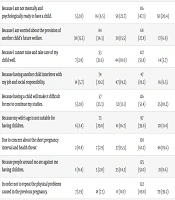
Based on the data presented in Table 2, a survey of 245 individuals regarding factors contributing to their disinclination toward childbearing revealed that “insufficient income” and “heightened economic burdens associated with raising a child” were each endorsed with complete agreement by 18.4% of respondents. Furthermore, “lack of adequate housing” (42.9%) and “anxiety concerning the child's future welfare” (34.3%) were the most frequently cited reasons. Conversely, “lack of psychological and emotional preparedness for parenthood” was the most prevalent factor for which respondents indicated a neutral stance, with 23.7% expressing no definitive opinion. The primary justifications for maternal opposition to subsequent pregnancies encompassed “maternal substance use” (0.69%) and “brief inter-pregnancy intervals and the resulting risks to the spouse's health” (61.2%). Additionally, the most prevalent factors associated with complete maternal dissent were “a familial history of congenital anomalies” (50.2%) and “intrafamilial discord” (0.49%).
Table 2.
Frequency and Percentage of Responses to the Questionnaire on Reasons for Disinclination Toward Childbearing a
| Items | Frequency of Responses (%) | ||||
|---|---|---|---|---|---|
| Completely Agree | Agree | No Idea | Disagree | Completely Disagree | |
| Because I do not have enough income to have another child. | 45 (18.4) | 77 (31.4) | 35 (14.3) | 64 (26.1) | 24 (9.8) |
| Because I do not have a suitable place to bring another child. | 30 (12.2) | 105 (42.9) | 54 (22.0) | 40 (16.3) | 16 (6.5) |
| Because having another child increases my economic problems. | 45 (18.4) | 77 (31.4) | 35 (14.3) | 64 (26.1) | 24 (9.8) |
| Because I am not mentally and psychologically ready to have a child. | 5 (2.0) | 16 (6.5) | 58 (23.7) | 116 (47.3) | 50 (20.4) |
| Because I am worried about the provision of another child’s future welfare. | 38 (15.5) | 84 (34.3) | 38 (15.5) | 68 (27.8) | 17 (6.9) |
| Because I cannot raise and take care of my child well. | 7 (2.9) | 53 (21.6) | 44 (18.0) | 127 (51.8) | 14 (5.7) |
| Because having another child interferes with my job and social responsibility. | 14 (5.7) | 74 (30.2) | 47 (19.2) | 47 (19.2) | 16 (6.5) |
| Because having a child will make it difficult for me to continue my studies. | 5 (2.0) | 57 (23.3) | 32 (13.1) | 126 (51.4) | 25 (10.2) |
| Because my wife's age is not suitable for having children. | 6 (2.4) | 73 (29.8) | 41 (16.7) | 97 (39.6) | 28 (11.4) |
| Due to concern about the short pregnancy interval and health threat | 2 (0.8) | 7 (2.9) | 37 (15.5) | 150 (61.2) | 48 (19.6) |
| Because people around me are against me having children. | 1 (0.4) | 5 (2.0) | 35 (14.3) | 125 (51.0) | 21 (8.6) |
| In order not to repeat the physical problems caused in the previous pregnancy. | 7 (2.9) | 18 (7.3) | 0 (0.0) | 122 (49.8) | 79 (39.2) |
| Because I want to keep the proper age gap between my children. | 9 (3.7) | 12 (4.9) | 0 (0.0) | 120 (49.0) | 98 (40.0) |
| Due to my wife's disinclination | 5 (2.0) | 9 (3.7) | 34 (13.9) | 133 (54.3) | 75 (30.6) |
| Because having a child due to family differences increases my problems. | 0 (0.0) | 5 (2.0) | 0 (0.0) | 128 (52.2) | 120 (49.0) |
| Because I do not have enough income to have another child. | 9 (3.7) | 12 (4.9) | 0 (0.0) | 111 (45.3) | 113 (46.1) |
| Because I do not have a suitable place to bring another child. | 3 (1.2) | 25 (10.2) | 0 (0.0) | 169 (69.0) | 48 (19.6) |
| Because having another child increases my economic problems. | 0 (0.0) | 0 (0.0) | 0 (0.0) | 122 (49.8) | 123 (50.2) |
a Values are expressed as No. (%).
Table 3 presents data concerning maternal pregnancy intentions during COVID-19. As illustrated in this table, 175 mothers expressed an inclination whereas 70 indicated a disinclination toward childbearing. The table serves as an analytical tool to examine the influence of diverse factors on maternal pregnancy inclinations within the COVID-19 pandemic. The mean age of women reporting a lack of desire for pregnancy was significantly higher (29.33 ± 6.88 years) when compared to those expressing a desire for pregnancy (26.08 ± 6.37 years). This disparity suggests an inverse relationship between age and maternal inclination, wherein younger women exhibit a greater inclination toward motherhood. Advancing maternal age demonstrated a statistically significant positive correlation with a decreased inclination for pregnancy. Furthermore, a constellation of factors, including higher number of previous children, prior COVID-19 infections, higher education levels, lower income levels, pre-existing comorbidities, and a history of high-risk pregnancies, were identified as significant determinants in women's reproductive decision-making during the pandemic, resulting in a reduced inclination toward childbearing. Conversely, neither employment status nor COVID-19 vaccination status exhibited a statistically significant effect on women's inclination to become pregnant during COVID-19.
Table 3.
Comparison of Variables Based on Inclination and Disinclination Toward Childbearing a
| Items | Total | Disinclination | Inclination | P-Value b | OR |
|---|---|---|---|---|---|
| Age (y) c | |||||
| Mean ± standard deviation | 28.14 ± 7.28 | 33.29 ± 6.88 | 26.08 ± 6.37 | <0.001 | 0.745 |
| Age of marriage (y) c | |||||
| Mean ± standard deviation | 19.01 ± 2.80 | 18.16 ± 2.89 | 19.35 ± 2.7 | 0.002 | 1.209 |
| Number of children | |||||
| 0 | 45 (18.4) | 3 (6.7) | 42 (93.3) | < 0.001 | 0.537 |
| 1 | 73 (29.8) | 9 (12.3) | 64 (87.7) | < 0.001 | 0.276 |
| 2 | 87 (31.8) | 29 (37.2) | 49 (62.8) | < 0.001 | 0.178 |
| 3 | 36 (14.7) | 22 (61.1) | 14 (39.8) | < 0.001 | 0.245 |
| 4 | 12 (4.9) | 6 (50.0) | 6 (50.0) | < 0.001 | 0.153 |
| 5 | 1 (0.4) | 1 (100.0) | 0 (0.0) | - | 1 (ref) |
| History of COVID-19 | |||||
| 0 | 35 (14.3) | 6 (17.1) | 29 (82.9) | 0.052 | 1.34 |
| 1 | 175 (71.4) | 49 (28.0) | 126 (72.0) | 0.423 | 1.64 |
| 2 | 29 (11.8) | 11 (37.9) | 18 (62.1) | 0.325 | 1.55 |
| 3 | 4 (1.6) | 2 (50.0) | 2 (50.0) | 0.073 | 1.32 |
| 4 | 2 (0.8) | 2 (100.0) | 0 (0.0) | - | 1 (ref) |
| Education level c | |||||
| Middle school | 42 (17.1) | 9 (21.4) | 33 (78.5) | < 0.001 | 0.136 |
| diploma | 138 (56.3) | 32 (23.2) | 106 (76.8) | < 0.001 | 0.15 |
| Associate degree | 10 (4.1) | 3 (30.0) | 7 (70.0) | < 0.001 | 0.214 |
| Bachelor's degree | 52 (21.2) | 17 (32.6) | 35 (67.3) | < 0.001 | 0.24 |
| Master's degree | 3 (1.2) | 2 (66.6) | 1 (33.3) | - | 1 (ref) |
| Employment status | |||||
| housewife | 187 (76.3) | 58 (31.0) | 129 (69.0) | 0.0128 | 1.72 |
| Employed | 58 (23.7) | 12 (20.7) | 46 (79.3) | - | 1 (ref) |
| Income level* | |||||
| weak | 122 (49.8) | 54 (44.3) | 68 (55.7) | < 0.001 | 3.06 |
| medium | 86 (36.3) | 9 (10.1) | 80 (89.9) | < 0.001 | 0.43 |
| Good | 34 (13.9) | 7 (20.6) | 27 (79.4) | - | 1 (ref) |
| Comorbidities c | |||||
| does not have | 191 (78.0) | 44 (23.0) | 147 (77.0) | < 0.001 | 3.89 |
| diabetes | 13 (5.3) | 11 (84.6) | 2 (15.4) | < 0.001 | 71.5 |
| blood pressure | 17 (6.9) | 11 (64.7) | 6 (35.3) | < 0.001 | 4.27 |
| Hypothyroidism | 10 (4.1) | 3 (30.0) | 7 (70.0) | < 0.001 | 5.57 |
| Anemia | 14 (5.7) | 1 (7.1) | 13 (92.9) | - | 1 (ref) |
| COVID-19 vaccination | |||||
| Sinopharm | 155 (63.3) | 43 (27.7) | 112 (72.3) | 0.599 | 1.53 |
| Barekat | 75 (30.6) | 24 (32.0) | 51 (68.0) | 0.445 | 1.88 |
| Astrazanka | 15 (6.1) | 3 (20.0) | 12 (80.0) | - | 1 (ref) |
| History of high-risk pregnancy c | |||||
| Have not | 220 (89.8) | 51 (23.2) | 169 (76.8) | < 0.001 | 3.7 |
| Has | 25 (10.2) | 9 (76.0) | 6 (24.0) | - | 1 (ref) |
Abbreviation: OR, odds ratio; SD, standard deviation; COVID-19, coronavirus disease 2019.
a Values are expressed as mean ± SD or No. (%).
b Univariate logistic regression test.
c Statistically significant variable.
5. Discussion
Prior research studies have documented a prevalent belief among individuals that the introduction of one or two offspring serves to consolidate marital bonds and augment spousal intimacy (24). Reproduction is acknowledged as a significant and intrinsically valued human experience, contributing to parental affective states characterized by love and joy, as well as fostering both physical and psychological well-being. Furthermore, it is perceived as a longitudinal investment, yielding enhanced parental life satisfaction (25). Within the cohort of 245 female participants, the predominant motivations exhibiting unanimous agreement were the desire to establish a large family and the inclination to reinforce familial foundations. Additionally, a consensus was observed among the participants concerning their parental proclivity and a robust desire for procreation. The primary drivers influencing maternal inclination toward pregnancy were identified as both a perceived deficit in the number of existing offspring and the prevalence of religious considerations. In these instances, mothers typically held well-defined and explicit perspectives. Conversely, the etiologies underlying their dissent frequently encompassed childlessness at the time of survey completion and the aspiration for additional progeny following remarriage. Furthermore, the rationales with which they exhibited marked disagreement were the antecedent the antecedent loss of a child and the pursuit of benefits associated with incentivized policies, aligning with extant scholarly findings. A consensus emerged among the study participants regarding the primary deterrents to childbearing. Specifically, financial exigencies, encompassing both inadequate income and the amplified economic burdens inherent in childcare, were consistently cited. Furthermore, the participants exhibited agreement on the inhibitory influence of lack of adequate housing and anxiety concerning the child's future welfare. A deficiency in psychological and emotional preparedness for parental responsibilities constituted a factor regarding which mothers typically expressed a lack of articulated viewpoints. Conversely, maternal substance use, along with apprehensions concerning brief inter-pregnancy intervals and the resulting risks to the spouse's health, were frequently cited as reasons for maternal dissent. Additionally, maternal dissent was most pronounced regarding a familial history of congenital anomalies and intrafamilial discord. Prior research corroborates these findings, identifying apprehensions concerning the prospective financial security of additional offspring, the exacerbation of economic strain due to increased family size, and a sense of fulfillment with the existing number of children as primary determinants of childbearing reluctance (23-25). This research undertakes a thorough examination of the multifaceted determinants affecting female reproductive intentions amidst the COVID-19 pandemic. A salient finding is the significant influence of age, with a discernible inverse correlation between age and the inclination for 187 pregnancy. Specifically, older women demonstrate a reduced inclination towards motherhood 188 relative to younger women, thereby underscoring age as a critical predictive variable. A demonstrable inverse correlation exists between parity and maternal pregnancy inclination. Specifically, women with higher number of children exhibit diminished desires for subsequent pregnancies, whereas those expressing a desire for pregnancy typically present with nulliparity or fewer than two children. Furthermore, consistent with extant literature, another study (26) reported an age-related decline in fertility, as evidenced by lower parities among older women compared to their younger counterparts. Maternal preference for early-age pregnancy is primarily driven by anxieties regarding the perceived age disparity between mother and offspring. This concern predominantly centers on the establishment of robust interpersonal connections and the cultivation of a close, amicable relationship with the child (27). Consistent with prior research, this investigation demonstrates an inverse relationship between female education level and the inclination for pregnancy. During the COVID-19 pandemic, maternal employment status and the specific type of COVID-19 vaccination received did not yield statistically significant differences in pregnancy inclination. Conversely, a significant positive correlation was observed between family income level and pregnancy desire, with women from households possessing average or high incomes exhibiting a greater likelihood of intending to conceive. The exigencies of the COVID-19 pandemic, characterized by widespread corporate and institutional closures, precipitated workforce reductions. This resulted in familial financial instability, subsequently contributing to the postponement of childbearing. The pandemic's prevalence induced a significant alteration in women's reproductive intentions, with many opting to defer pregnancy until post-crisis or to limit their family size due to the adversities encountered during this period. During the pandemic, a diminished inclination for pregnancy was observed among mothers with pre-existing medical conditions, underscoring the salient role of health status in reproductive decision-making. Furthermore, individuals with a prior history of high-risk pregnancies exhibited a reduced inclination towards conception during the same period, thereby elucidating a correlation between antecedent high-risk obstetric events and a subsequent disinclination toward fertility. Contemporary demographic analysis reveals a sustained reduction in fertility rates, attributable to a confluence of factors. These include, but are not limited to, evolving fertility patterns, inadequate support mechanisms for young couples, escalating expenditures associated with childrearing, elevated housing costs, and heightened anxieties regarding access to appropriate healthcare infrastructure, particularly in the context of pandemic related disruptions. Furthermore, despite potential perceptions of enhanced reproductive outcomes associated with earlier maternal age, women frequently postpone childbearing. This deferral is attributed to a confluence of factors, including the pursuit of higher education, precarious employment conditions, inadequate financial resources, housing insecurity, and a lack of intrinsic motivation or inclination toward motherhood. Concurrently, childcare represents a significant concern for women across both employed and non-employed demographics. The data suggest a resistance among women to prioritize competing desires, specifically indicating a reluctance to suppress their maternal aspirations for alternative pursuits. Furthermore, a pervasive perception of role conflict is evident, with the vast majority of employed women acknowledging a contradiction between their maternal responsibilities and professional obligations. Notably, concerns regarding employment stability are prevalent, as many working women express apprehension about potential job termination due to pregnancy and perceive childbearing as a potential impediment to career retention and advancement. Furthermore, a subset of employed women perceives current institutional support mechanisms, including the stipulated maternity leave period, as inadequate and express dissatisfaction with the quality and accessibility of childcare services. Drawing upon Becker's economic framework, contemporary familial reproductive decisions are predicated upon a cost-benefit analysis, wherein the determination of family size is contingent upon the balance between financial expenditures and income levels, reflecting the household's overall economic stability. From a socio-economic perspective, couples deliberate on the prospective quality of life for their offspring, which encompasses considerations of future health outcomes, employment opportunities, and education level. In Becker's framework, the notion of child quality of life serves as a pivotal element, illustrating an inverse relationship between parental income and the number of children. Specifically, child quality, as defined by investment in each child's well-being, is positively correlated with income levels, while the sheer quantity of offspring is not. Consequently, increased income may result in a reduction of the desired number of children, a phenomenon attributed to the potential for the marginal cost per child to outpace income growth (28-31).
5.1. Conclusions
This research investigates the etiologies and determinants that modulate individuals' inclination toward childbearing during COVID-19. The motivational drivers reported by mothers inclined toward pregnancy encompassed the desire to establish a large family, the inclination to reinforce familial foundations, and the aspiration for parenthood. These findings are congruent with prior scholarly investigations that have underscored the significant influence of offspring on familial structures and parental eudemonic states. Conversely, the principal impediments to pregnancy were identified as financial limitations, housing instability, and anxiety concerning the child's future welfare. Maternal reproductive preferences were predominantly modulated by age, previous children, education level, and income level. Prior exposure to COVID-19 infection exhibited no statistically significant influence on the decision to conceive. However, pre-existing medical comorbidities and a history of high-risk pregnancies served as significant deterrents to conception. The results presented herein illustrate the intricate and mutually influential effects of health-related socio-economic and demographic determinants on maternal decision-making amidst the pandemic, thereby offering significant data for both policy formulation and healthcare service delivery. It is universally acknowledged that shifts in fertility patterns within any nation precipitate consequential alterations across a spectrum of interconnected domains, necessitating focused attention from policymakers. In the event that COVID-19 precipitates a substantial decline in long term fertility intentions and impedes couples' decisions regarding childbearing, a consequential augmentation of the elderly demographic is inevitable. Consequently, policymakers will be compelled to reassess and formulate novel policy frameworks designed to incentivize individuals to pursue additional procreation. A decline in fertility intentions has the potential to alter familial configurations within developing nations, where offspring are frequently perceived as sources of future economic security or as contributors to domestic labor. Consequently, it is imperative to conduct research that examines the pandemic's impact on fertility dynamics through contextually specific, country-level analyses. Given the variability of family planning programs and population policies across nations, a more systematic and in-depth analysis is imperative, particularly for monitoring fluctuations in fertility rates. Such an investigation would facilitate the evaluation of policy efficacy during periods of acute crisis, thereby enabling the identification of areas necessitating policy revision or reformulation. It is imperative that policymakers implement measures to broaden the availability of family planning resources, encompassing contraceptive options, thereby enabling individuals to exercise informed reproductive autonomy, particularly during periods of instability. Furthermore, we advocate for the development and financial support of diverse initiatives aimed at providing assistance to couples facing pandemic-related infertility.
5.2. Limitations
Given the limitations imposed by the restricted sample size and abbreviated study duration, additional investigations are warranted to comprehensively evaluate the safety and health outcomes for both pregnant individuals and their fetuses during the COVID-19 pandemic. It is recommended that subsequent research endeavors further scrutinize these determinants and formulate tailored interventions to effectively address the heterogeneous requirements of maternal populations amidst public health emergencies.