
Fertility Gynecology Andrology

Image Credit:Fertility Gynecology Andrology

Nulliparous Women’s Attitudes Toward Fertility and Childbearing in COVID-19 Pandemic

Author(s):
Malihe  FakehiMalihe Fakehi1, Mohammad Mehdi HashemnejadMohammad Mehdi Hashemnejad1, Saghar GhanbariSaghar Ghanbari1, Neda HashemiNeda Hashemi1, Roghayeh Saadati ShamirRoghayeh Saadati Shamir2, Zohreh HeidaryZohreh Heidary3, Marjan GhaemiMarjan GhaemiMarjan Ghaemi ORCID3,*
1Shahid Akbarabadi Hospital, Iran University of Medical Sciences, Tehran, Iran
2North Khorasan University of Medical Sciences, Bojnord, Iran
3Vali-E-Asr Reproductive Health Research Center, Tehran University of Medical Sciences, Tehran, Iran

Fertility, Gynecology and Andrology:Vol. 1, issue 1; e123477
Published online:Mar 13, 2022
Article type:Letter
Received:Feb 16, 2022
Accepted:Feb 19, 2022
How to Cite:Fakehi M, Hashemnejad MM, Ghanbari S, Hashemi N, Saadati Shamir R, et al. Nulliparous Women’s Attitudes Toward Fertility and Childbearing in COVID-19 Pandemic. Fertil Gynecol Androl. 2021;1(1):e123477. doi: https://doi.org/10.5812/fga.123477

Dear Editor,
Delayed childbearing is one of the common patterns of reproductive behavior in today’s world (1). The consequences of the couple’s age might need more assisted conception and have effects on pregnancy outcome (2). Low fertility is considered a big challenge for the government, although most families believe that the fertility below replacement is in favor of higher standards of living (3).
On the other hand, the coronavirus disease 2019 (COVID-19) pandemic affects the physical, mental, economic, or social health and wellbeing of pregnant women (4). It has disrupted maternal health and prenatal care worldwide, causing tight restrictions for pregnancy (5). The global economic downturn and the loss of numerous occupations might also affect maternal health.
The authors would like to present this study entitled “Nulliparous Women’s Attitudes toward Fertility and Childbearing in COVID-19 Pandemic”. The current study aimed to determine Iranian women’s attitudes toward fertility and childbearing. The study was conducted on nulliparous women who attended the outpatient clinics of two referral centers affiliated with Iran University of Medical Sciences, Tehran, Iran, within April to July 2021. The inclusion criteria were the age range of 18 - 40 years, no history of pregnancy, and ability to write and read in Persian. The cases of male or female infertility were excluded from the study.
The attitude to childbearing was evaluated by the attitude toward fertility and childbearing (ATFC) questionnaire that was introduced by Soderberg et al. (6), translated to Persian and validated with Cronbach’s alpha equal to 0.88 (7). This questionnaire contains 21 items that were answered on a 5-point Likert scale (strongly disagree: 1 to strongly agree: 5). The minimum and maximum scores were 21 and 105, respectively. A higher score indicated a more positive attitude toward fertility and childbearing. The data collection time for each questionnaire was about 15 minutes.
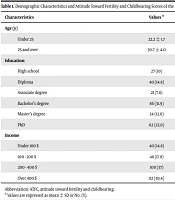
The data were collected by an online questionnaire provided by the researcher that was sent to the participants by SMS and analyzed by SPSS software (version 20). The Chi-square test was used to examine the relationship between the qualitative variables. Analysis of variance was used to compare more than two means, and analysis of covariance was used to determine the relationship between them. In case of abnormal data distribution, the nonparametric equivalent of the tests was used. A level of 0.05 was considered statistically significant. Totally, 270 female subjects were recruited in the study. Table 1 shows the demographic characteristics of the participants.
Table 1.Demographic Characteristics and Attitude Toward Fertility and Childbearing Scores of the Participants
CharacteristicsValues aATFC Score aP Value
Age (y)0.937
Under 2522.2 ± 1.771.47 ± 15.33
25 and over30.7 ± 4.071.66 ± 16.67
Education< 0.000
High school27 (10)81.44 ± 14.09
Diploma40 (14.8)79.12 ± 13.85
Associate degree21 (7.8)71.42 ± 17.68
Bachelor’s degree86 (31.9)70.67 ± 17.06
Master’s degree34 (12.6)69.39 ± 13.69
PhD62 (23.0)65.01 ± 15.20
Income< 0.000
Under 100 $40 (14.8)77.9 ± 15.05
100 - 200 $48 (17.8)73.56 ± 15.95
200 - 400 $100 (37)70.94 ± 15.47
Over 400 $82 (30.4)68.50 ± 17.29

Abbreviation: ATFC, attitude toward fertility and childbearing.

a Values are expressed as mean ± SD or No. (%).

The tendency of the women for childbearing had decreased significantly with increasing their level of education and economic status. Otherwise, age was not a significant factor for childbearing. Based on the analysis of age, educational level, income level, and each of the ATFC scales in the subjects, it was shown that as the participants’ education and income levels increased, the importance of the child in the future and the resulting social identity decreased; on the other hand, the child was more considered a barrier in the present time. On the other hand, with increasing maternal age, fewer women see the child as an obstacle in the present.
As previously mentioned, women in today’s society are less inclined to have children. Additionally, considering the economic situation of Iran and job insecurity, especially in the COVID-19 pandemic, having a child is considered a significant risk, and the only way to address the couple’s economic and social concerns about childbearing is by providing stable conditions and support programs for the family institution by governments (8).
This study was conducted during the COVID-19 pandemic; therefore, there were high levels of fear of mother-to-fetus transmission, unemployment due to the pandemic, increased couple involvement in quarantine times, and stress (9). Furthermore, it seems that one of the reasons for the decrease in the number of women willing to have children is the COVID-19 pandemic, which can be reduced by providing appropriate counseling and economic services.
In conclusion, women in better economic status with higher educational levels had a lower tendency to have children. Appropriate governmental policies should be based on providing job security for women in case of pregnancy and economic stability to give a sense of security for couples to have children and planning support programs.
Footnotes

References

  • 1.
    Sobotka T. Post-Transitional Fertility: The Role of Childbearing Postponement in Fuelling the Shift to Low and Unstable Fertility Levels. J Biosoc Sci. 2017;49(S1):S20-45. [PubMed ID: 29160188]. https://doi.org/10.1017/S0021932017000323.
  • 2.
    Balasch J, Gratacos E. Delayed childbearing: effects on fertility and the outcome of pregnancy. Curr Opin Obstet Gynecol. 2012;24(3):187-93. [PubMed ID: 22450043]. https://doi.org/10.1097/GCO.0b013e3283517908.
  • 3.
    Lee R, Mason A, members of the N. Is low fertility really a problem? Population aging, dependency, and consumption. Science. 2014;346(6206):229-34. [PubMed ID: 25301626]. [PubMed Central ID: PMC4545628]. https://doi.org/10.1126/science.1250542.
  • 4.
    Kotlar B, Gerson E, Petrillo S, Langer A, Tiemeier H. The impact of the COVID-19 pandemic on maternal and perinatal health: a scoping review. Reprod Health. 2021;18(1):10. [PubMed ID: 33461593]. [PubMed Central ID: PMC7812564]. https://doi.org/10.1186/s12978-021-01070-6.
  • 5.
    Ajayi KV, Harvey IS, Panjwani S, Uwak I, Garney W, Page RL. Narrative Analysis of Childbearing Experiences During the COVID-19 Pandemic. MCN Am J Matern Child Nurs. 2021;46(5):284-92. [PubMed ID: 34162794]. [PubMed Central ID: PMC8373388]. https://doi.org/10.1097/NMC.0000000000000742.
  • 6.
    Soderberg M, Lundgren I, Christensson K, Hildingsson I. Attitudes toward fertility and childbearing scale: an assessment of a new instrument for women who are not yet mothers in Sweden. BMC Pregnancy Childbirth. 2013;13:197. [PubMed ID: 24165014]. [PubMed Central ID: PMC4231394]. https://doi.org/10.1186/1471-2393-13-197.
  • 7.
    Kordzanganeh J, Mohamadian H. Psychometric assessment of the validity of the Iranian version of attitude toward fertility and childbearing inventory in women without a history of pregnancy in the South of Iran. J School Public Health Inst Public Health Res. 2019;17(1).
  • 8.
    Miller AR. The effects of motherhood timing on career path. J Populat Econom. 2009;24(3):1071-100. https://doi.org/10.1007/s00148-009-0296-x.
  • 9.
    Banaei M, Ghasemi V, Saei Ghare Naz M, Kiani Z, Rashidi-Fakari F, Banaei S, et al. Obstetrics and Neonatal Outcomes in Pregnant Women with COVID-19: A Systematic Review. Iran J Public Health. 2020;49(Suppl 1):38-47. [PubMed ID: 34268204]. [PubMed Central ID: PMC8266025]. https://doi.org/10.18502/ijph.v49iS1.3668.

Similar Articles

22
Jul
2025
Arch Pediatr Infect Dis

Investigating the Impact of Coronavirus Disease 2019 on Women's Inclination or Disinclination Toward Childbearing

Arghavan Afra,
Elham Senisel bachari,
Mehdi Khedmati,
Shima Seneysel Bachari,
Naser Kamyari

Afra A, Senisel bachari E, Khedmati M, Seneysel Bachari S, Kamyari N. Investigating the Impact of Coronavirus Disease 2019 on Women's Inclination or Disinclination Toward Childbearing. Arch Pediatr Infect Dis. 2026;14(1):e159400. doi: https://doi.org/10.5812/apid-159400

10
Nov
2024
J Nurs Midwifery Sci

The Role of Spirituality, Marital Satisfaction and Socio-Economic Status on Attitudes Toward Childbearing Among Married Women Without the Intention and History of Pregnancy: A Cross-Sectional Study

Parisa Sarsharbeidokhti,
Rahim Bagherzadeh Ledari,
Maedeh Bagheri

Sarsharbeidokhti P, Bagherzadeh Ledari R, Bagheri M. The Role of Spirituality, Marital Satisfaction and Socio-Economic Status on Attitudes Toward Childbearing Among Married Women Without the Intention and History of Pregnancy: A Cross-Sectional Study. J Nurs Midwifery Sci. 2024;11(4):e154615. doi: https://doi.org/10.5812/jnms-154615

19
Jan
2025
koomesh

Attitude Towards Having Children in Women at the Threshold of Marriage in the Southwestern Region of Khuzestan

Mohammad Mahboubi,
Bagher Pahlavanzadeh,
Abolhassan Afkar,
Hamideh Khovaitarizadeh

Mahboubi M, Pahlavanzadeh B, Afkar A, Khovaitarizadeh H. Attitude Towards Having Children in Women at the Threshold of Marriage in the Southwestern Region of Khuzestan. koomesh. 2024;26(5):e153402. doi: https://doi.org/10.69107/koomesh-153402

30
Jun
2000

Contraceptive methods and attitude of women seeking termination of unwanted pregnancies toward subsequent childbirth

M Hassanabadi,
S. Kaheni,
HR. Kamiyare,
AR. Saadtjoo

Hassanabadi M, Kaheni S, Kamiyare H, Saadtjoo A. Contraceptive methods and attitude of women seeking termination of unwanted pregnancies toward subsequent childbirth. J Inflamm Dis. 2024;4(1):e154695. doi:

19
Mar
2012

Women’s experiences of unwanted pregnancy

Forough Mortazavi,
Maryam Damghanian,
Zahra Mottaghi,
Mohammad Shariati

Mortazavi F, Damghanian M, Mottaghi Z, Shariati M. Women’s experiences of unwanted pregnancy. J Kermanshah Univ Med Sci. 2012;15(6):e78904. doi:


Crossmark
Crossmark
Checking
Share on
Cited by
Metrics

Ordering Reprints

Articles are published under the Creative Commons license stated on each article. No permission or royalty fee is required for uses permitted by that license. CCC handles optional bulk and customized reprint orders. Any quotation covers production and delivery services only, not copyright permission. > Request Reprints from CCC 

Search Relations

Author(s):

Related Articles