
1. Background
Several molecular tests have been widely developed for the severe acute respiratory syndrome coronavirus 2 (SARS-CoV-2) detection during the emergence of the coronavirus disease 2019 (COVID-19) pandemic (1). Among commercially available molecular detection assays, a real-time quantitative reverse transcription-polymerase chain reaction (RT-qPCR) targeting one or multiple regions of the SARS-CoV-2 ribonucleic acid (RNA) genome is used as a gold standard method to identify infected cases (1). This assay is highly sensitive and specific and has a limit of detection within the range of 5 - 500 copies of viral RNA per reaction (2).
Although genome-based detection offers a powerful means of COVID-19 diagnosis, the positive result might not always infer the active stage of the virus in transmission. Previous studies have indicated that the prolonged detection of SARS-CoV-2 RNA for weeks or months has been reported in some cases after symptom onset or following the recovery of clinical illness (3-5). Rodríguez-Grande et al. (6) reported the longest period of positive RT-PCR COVID-19 case at 101 days after first diagnosis. Persistent test positivity more likely represents a nonviable remnant of the virus due to its slow degradation of inactivated RNA virus (7). However, a prolonged viable SARS-CoV-2 viral shedding can be detected in certain patients, such as immunocompromised cases, among whom infectious SARS-CoV-2 can be detected in viral culture for several months (8-10). Additionally, a retesting positive RT-PCR after recovering the symptoms with a negative RT-PCR result has been reported suggesting reinfection or recurrent infection (11-13).
Due to the rising uncertainty of the meaning of persistent or retested positive RT-PCR results, it is necessary to distinguish between a viable transmissible virus and a nonviable one. To date, the presence of replicating-competent SARS-CoV-2 virus can be confirmed using viral culture as a reference method. However, significant limitations of low sensitivity and not being practical to perform in routine clinical laboratories have precluded this approach from being widely used (14). Considerable efforts have been made to evaluate new techniques based on molecular viability markers to selectively detect the infectious virus (15-17), from which the detection of SARS-CoV-2 subgenomic RNAs (sgRNAs) is one of the alternative strategies. Viral sgRNA intermediates are synthesized through a discontinuous transcription process. Each sgRNA contains the common 5’-leader sequence, the transcriptional regulatory sequence, the target subgenomic genes, and the remaining 3’-genome end (18). Because sgRNAs will be transcribed following host cell infection and are poorly packed into mature virions, the presence of these intermediates is expected to correlate with actively replicating viruses (19). However, studies on the evaluation of sgRNAs as infectious markers have shown controversial results (6, 16, 17, 20, 21).
2. Objectives
For the clarification of the controversy, this study aimed to primarily evaluate the detection of two sgRNA types, N and E sgRNA, by comparing the results with the traditional total or genomic RNA (gRNA) detection and viral culture from in vitro experiment and confirmed COVID-19 nasopharyngeal swabbing (NPS) samples. This study provides diagnostic parameter data that might be utilized as a combined method with a standard approach to indicate the existence of viable replicating SARS-CoV-2.
3. Methods
3.1. Study Site, Safety, and Ethics
The experiment that involved infectious SARS-CoV-2 was performed in a biosafety level (BSL) 3 laboratory at Mahidol University in Thailand using procedures approved by the Mahidol University Biosafety Committee (approval No. MU 2021-012). The extracted RNA from infectious SARS-CoV-2 samples was sent to conduct a molecular test in a BSL-1 laboratory at Thammasat University in Thailand using procedures approved by the Thammasat University Institutional Biosafety Committee (063/2564). With permission, the leftover viral transport medium (VTM) of confirmed COVID-19 NPS samples derived from a previously approved research project by the Siriraj Institutional Review Board (COA no.: Si 324/2020) was used in this study. Therefore, this work was considered and approved as exempt research by the Human Research Ethics Committee of Thammasat University (panel on scientific research) (COE no.: 006/2564).
3.2. Severe Acute Respiratory Syndrome Coronavirus 2 Propagation
A clinical isolate of SARS-CoV-2/01/human/Jan2020/Thailand was used in this study. It represents the original Wuhan strain isolated from a confirmed COVID-19 patient at Bamrasnaradura Infectious Diseases Institute, Nonthaburi, Thailand. The SARS-CoV-2 was propagated in Vero E6 cells (CRL-1586, ATCC) in minimum essential medium (MEM, Corning) supplemented with 2% fetal bovine serum (FBS) at 37°C with 5% CO2 for 2 - 5 days. The virus was collected and centrifuged to remove cell debris. Virus stocks were aliquoted and kept at -80°C.
Virus stock was quantitated by the plaque assay. Briefly, a density of 2.3 × 10⁵ Vero E6 cells/well was plated in 24-well plates. The next day, the supernatants were discarded, and the cells were infected with 100 μL of 10-fold serial dilutions of virus stock for an hour at 37°C with 5% CO2. Subsequently, the virus inoculums were removed, and the cells were overlaid with 1.56% microcrystalline cellulose (Avicel, RC-591) in 2% FBS-MEM. The infected cells were further incubated at 37°C with 5% CO2 for 3 days. After that, the overlaid medium was discarded, and the cells were fixed with 10% (v/v) formalin in phosphate-buffered saline for 2 hours. The fixed cells were washed with tap water and stained with 1% (w/v) crystal violet in 20% (v/v) ethanol for 15 minutes. Excess dyes were removed by washing them in tap water. The viral titers were measured by counting plaque number and were calculated in plaque-forming units per ml (PFU/ml).
3.3. Surrogate of Replicating and Nonreplicating Severe Acute Respiratory Syndrome Coronavirus 2 from In Vitro Experiment
Before the day of infection, Vero E6 cells were grown in 6-well plates at a density of 5.5 × 10⁵ cells/well in a growth medium. Prior to performing the experiment, culture media was removed. The surrogate of replicating SARS-CoV-2 was performed by the infection of the virus into Vero E6 cells at the multiplicity of infection (MOI) of 0.001 and 0.01. For the surrogate of nonreplicating SARS-CoV-2, the virus was treated with combined reproposing antiviral drugs between niclosamide and ivermectin at the most effective concentrations showing 99.77% of inhibition (22, 23). In brief, the cells were pretreated with final concentrations of 0.04 μM niclosamide and 2.4 μM ivermectin for an hour. Then, SARS-CoV-2 at the indicated MOI was added to the pretreated cells for an hour at 37°C with 5% CO2. Afterward, the virus inoculum was discarded, and the cells were further cultured in 2% FBS-MEM for 2 days.
After 2 days of incubation, the presence or absence of cytopathic effect was detected under a light microscope. Culture supernatant quantified virus titers by plaque assay as described above and reported as PFU/mL. Additionally, the infected cells and supernatant were taken to extract RNA using TRIzol or TRIzol LS for gRNAs and sgRNAs detection. The experiments were performed in duplicate, and mock control (i.e., untreated cells) was also included.
3.4. Clinical Samples and Selection Criterion
Leftover NPS in VTM samples were kindly obtained with permission from a previous research project. In the aforementioned prospective cohort study, admitted patients at Siriraj Hospital or Golden Jubilee Medical Center, Thailand, who were over 18 years of age with positive RT-PCR SARS-CoV-2 detection were recruited to enroll with given informed consent within July 12, 2020, and April 7, 2021. The NPS samples were collected at different time points, including before (i.e., the first time of enrollment) and after treatment with antiviral drugs. The VTM was taken to determine the viral infectivity under cell culture. Moreover, gRNAs were detected in the extracted RNA by Allplex 2019-nCoV Assay (Seegene, Korea) using the primers targeting N, RNA-dependent RNA polymerase, and E genes.
A total of 40 nonidentifiable leftover specimens were selected to enroll in this study derived from 28 patients collected at different time points, 11 samples of which were from the same individuals. The selection criterion was based on the different patterns of agreement between the viral culture and gRNAs detection.
3.5. Ribonucleic Acid Extraction and Quantitative Reverse Transcription-Polymerase Chain Reaction Assay for Severe Acute Respiratory Syndrome Coronavirus 2 RNA Detection
The total RNA was extracted from SARS-CoV-2 infected Vero E6 cells and culture supernatant using TRIzolTM/TRIzolTM LS (Invitrogen, USA)-chloroform method according to manufacturer’s guidelines. The RNA was resuspended in 20 - 40 μL of nuclease-free water. For NPS, the residual VTM was centrifuged at 2,000 rpm for 10 minutes, and 200 μL of the sample was used to extract RNA using PureLink Viral RNA/DNA Mini Kit (Cat no.: 12280050, Invitrogen, USA) according to the manufacturer’s instructions and eluted in 50 μL of elution buffer. The concentration of the purified RNA was measured, and the RNA was then stored at -80°C.
The SARS-CoV-2 gRNA and sgRNA targeting N and E genes were detected using a Luna® Universal One-Step RT-qPCR Kit (New England Biolabs, USA). The primers used for this study were previously designed, as shown in Table 1. The final reaction mixture included 1X one-step reaction mix, 1X WarmStart RT enzyme mix, 200 nM of each primer, 50 ng of the RNA template, and nuclease-free water used for volume adjustment equal to 20 μL. The positive control of extracted RNA from SARS-CoV-2 infected cells and negative control of nuclease-free water were performed in each run. The amplification reaction was carried out using the CFX-96 real-time PCR detection system (Bio-Rad, USA). The conditions were reverse transcription for 10 minutes at 55°C, initial denaturation for 1 minute at 95°C, 40 cycles of denaturation for 10 seconds at 95°C, and extension for 30 seconds at 60°C, followed by melt curve analysis.
Table 1.
Primers for SYBR Green One-Step Quantitative Reverse Transcription-Polymerase Chain Reaction
| Gene and Primer | Sequence 5’ to 3’ | Tm (°C) | References |
|---|---|---|---|
| Envelope (gRNA E) | 80 | Corman et al. (24) | |
| E_Sarbeco Fw | ACAGGTACGTTAATAGTTAATAGCGT | ||
| E_Sarbeco Rw | ATATTGCAGCAGTACGCACACA | ||
| Nucleocapsid (gRNA N) | 83.5 | Centers for Disease Control and Prevention (25) | |
| CCDC-N Fw | GGGGAACTTCTCCTGCTAGAAT | ||
| CCDC-N Rw | CAGACATTTTGCTCTCAAGCTG | ||
| sgRNA E | 76.5 | Zollo et al. (26) | |
| Forward | CAAACCAACCAACTTTCGATCTCTTGTA | ||
| Reverse | AGAAGTACGCTATTAACTATT | ||
| sgRNA N | 80.5 | Zollo et al. (26) | |
| Forward | CAAACCAACCAACTTTCGATCTCTTGTA | ||
| Reverse | TCTGGTTACTGCCAGTTGAATC |
Abbreviations: gRNA, genomic ribonucleic acid; sgRNA, subgenomic ribonucleic acid.
3.6. Statistical Analyses
The data are expressed as the mean ± standard deviation. A two-by-two table was used to calculate diagnostic parameters together with the 95% confidence interval, including sensitivity, specificity, positive predictive value (PPV), negative predictive value (NPV), and accuracy. Additionally, the Cohen’s Kappa index was used to evaluate the correlation level between RT-qPCR targeting gene assay and viral culture.
4. Results
4.1. Comparison of Detection of Genomic RNAs and Subgenomic RNAs with Viral Culture from In Vitro Experiment
The two repurposed drugs did not directly inhibit viral RNA replication. As a result, they had less effect on the abundance of viral RNA than the level of replication-competent virus. As shown in Table 2, the results of viral culture confirmed the difference between infectious untreated SARS-CoV-2-infected Vero E6 cells and noninfectious treated SARS-CoV-2-infected cells with combined repurposed drugs at both viral inoculum doses (MOI: 0.001 and 0.01). When comparing the cycle threshold (Ct) value and the difference of Ct from cell and supernatant, gRNAs were detected at higher levels than sgRNAs, and N sgRNA was detected at higher levels than E sgRNA.
Table 2.
Comparison of Detection Methods Between Viral Culture and Quantitative Reverse Transcription-Polymerase Chain Reaction Targeting Genomic Ribonucleic Acids and Subgenomic Ribonucleic Acids in Surrogate In Vitro Study
| Samples | Culture (Plaque-Forming Units/mL) | RNA Source | Average Cycle Threshold Value | Difference of Cycle Threshold | ||||||
|---|---|---|---|---|---|---|---|---|---|---|
| N | sgN | E | sgE | E-N | sgN-N | sgE-E | sgE-sgN | |||
| SARS-CoV-2-infected cells (MOI: 0.001) | 2.5 × 10⁶ | Cell | 5.60 | 7.24 | 6.7 | 19.20 | 1.1 | 1.64 | 12.5 | 11.96 |
| S/N | 18.98 | 27.24 | 18.06 | 35.92 | -0.92 | 8.26 | 17.86 | 8.68 | ||
| Drug-treated SARS-CoV-2-infected cells (MOI: 0.001) | ND | Cell | 9.26 | 10.34 | 10.50 | 23.06 | 1.24 | 1.08 | 12.56 | 12.72 |
| S/N | 25.20 | 32.02 | 24.51 | ND | -0.69 | 6.82 | - | - | ||
| SARS-CoV-2-infected cells (MOI: 0.01) | 2.05 × 10⁵ | Cell | 6.70 | 8.07 | 7.53 | 20.29 | 0.83 | 1.37 | 12.76 | 12.22 |
| S/N | 17.92 | 25.05 | 17.00 | 33.55 | -0.92 | 7.13 | 16.55 | 8.5 | ||
| Drug-treated SARS-CoV-2-infected cells (MOI: 0.01) | ND | Cell | 7.51 | 8.65 | 8.63 | 20.79 | 1.12 | 1.14 | 12.16 | 12.14 |
| S/N | 22.99 | 28.79 | 22.31 | ND | -0.68 | 5.8 | - | - | ||
| Mean ± SD | Cell | 1.07 ± 0.17 | 1.31 ± 0.25 | 12.50 ± 0.25 | 12.26 ± 0.33 | |||||
| S/N | -0.80 ± 0.17 | 7.00 ± 1.01 | 17.21 ± 0.93 | 8.59 ± 0.13 | ||||||
Abbreviations: RNA, ribonucleic acid; SARS-CoV-2; severe acute respiratory syndrome coronavirus 2; MOI, multiplicity of infection; S/N, culture supernatant; sg, subgenomic; ND, not detected; SD, standard deviation.
All types of target genes were detected from cellular-isolated RNA of both untreated and treated cells with comparable Ct levels. Despite being unable to differentiate between viable and nonviable viruses with these target genes from cellular RNA, E sgRNA detection in sampled supernatant RNA showed a consistent result with viral culture; however, others did not show a consistent result with viral culture. This finding might suggest that the time after 2 days of antiviral treatment was too early to observe the decline of viral RNA in infected cells. Therefore, molecular tests targeting E sgRNA in an extracellular system provided accurate information on replicating SARS-CoV-2.
4.2. Evaluation of Subgenomic RNAs Detection in Confirmed Coronavirus Disease 2019 Clinical Samples
A total of 40 nonidentifiable leftover NPS samples in the VTM of confirmed COVID-19 patients were selected to enroll in this study, as shown in Table 3. These samples were collected at different time points before and after antiviral treatment, and then a probe-based RT-qPCR targeting gRNAs and viral culture were performed. In this study, an SYBR green one-step RT-qPCR targeting N and E sgRNAs was performed, and the results were compared with viral culture.
Table 3.
Detection of Two Subgenomic Ribonucleic Acids Types and Comparison with the Test Report of Clinical Samples Used in This Study
| No. | Sample ID | Days a | Culture | Cycle Threshold Value | |||||||
|---|---|---|---|---|---|---|---|---|---|---|---|
| N | sgN | E | sgE | E-N | sgN-N | sgE-E | sgE-sgN | ||||
| 1 | IDRA004 | 7 | Negative | 30.91 | 31.35 | 28.49 | ND | 2.42 | 0.44 | - | - |
| 2 | IDRA005 | 6 | Negative | 36.73 | ND | 34.33 | ND | 2.4 | - | - | - |
| 3 | IDRA006 | 6 | Negative | ND | ND | ND | ND | - | - | - | - |
| 4 | IDRA007 | 0 | Positive | 18.38 | 20.95 | 14.99 | 30.09 | 3.39 | 2.57 | 15.1 | 9.14 |
| 5 | IDRA007 | 12 | Negative | ND | ND | ND | ND | - | - | - | - |
| 6 | IDRA008 | 11 | Negative | 31.9 | 32.01 | 30.56 | ND | 1.34 | 0.11 | - | - |
| 7 | IDRA009 | 30 | Negative | ND | ND | ND | ND | - | - | - | - |
| 8 | IDRA013 | 12 | Negative | ND | ND | ND | ND | - | - | - | - |
| 9 | IDRA013 | 31 | Negative | ND | ND | ND | ND | - | - | - | - |
| 10 | IDRA014 | 11 | Negative | ND | ND | ND | ND | - | - | - | - |
| 11 | IDRA016 | 30 | Negative | ND | ND | ND | ND | - | - | - | - |
| 12 | IDRA018 | 12 | Negative | ND | ND | ND | ND | - | - | - | - |
| 13 | IDRA018 | 21 | Negative | ND | ND | ND | ND | - | - | - | - |
| 14 | IDRA019 | 28 | Negative | ND | ND | ND | ND | - | - | - | - |
| 15 | IDRA043 | 0 | Positive | 24.05 | 21.09 | 21.3 | 30.88 | 2.75 | -2.96 | 9.58 | 9.79 |
| 16 | IDRA043 | 9 | Negative | 35.64 | ND | 32.8 | ND | 2.84 | - | - | - |
| 17 | IDRA061 | 0 | Positive | 21.68 | 23.42 | 19.09 | 32.98 | 2.59 | 1.74 | 13.89 | 9.56 |
| 18 | IDRA061 | 5 | Negative | 24.28 | 24.05 | 21.26 | 32.93 | 3.02 | -0.23 | 11.67 | 8.88 |
| 19 | IDRA065 | 0 | Negative | ND | ND | ND | ND | -0.21 | - | - | - |
| 20 | IDRA065 | 5 | Positive | 18.94 | 19.48 | 15.87 | 28.67 | 3.07 | 0.54 | 12.8 | 9.19 |
| 21 | IDRA065 | 7 | Positive | 20.5 | 21.2 | 17.9 | 30.83 | 2.6 | 0.7 | 12.93 | 9.63 |
| 22 | IDRA095 | 0 | Positive | 27.77 | 27.98 | 24.69 | 38.21 | 3.08 | 0.21 | 13.52 | 10.23 |
| 23 | IDRA097 | 8 | Negative | 34.41 | 33.88 | 31.84 | ND | 2.57 | -0.53 | - | - |
| 24 | IDRA100 | 0 | Positive | 19.08 | 18.71 | 16.09 | 33.74 | 2.99 | -0.37 | 17.65 | 15.03 |
| 25 | IDRA105 | 4 | Negative | 19.27 | 20 | 16.47 | 34.49 | 2.8 | 0.73 | 18.02 | 14.49 |
| 26 | IDRA106 | 4 | Negative | 18.38 | 16.99 | 16.32 | 30.66 | 2.06 | -1.39 | 14.34 | 13.67 |
| 27 | IDRA106 | 8 | Negative | 28.75 | 27.46 | 26.08 | ND | 2.67 | -1.29 | - | - |
| 28 | IDRA107 | 5 | Negative | 21.83 | 20.23 | 18.5 | 32.09 | 3.33 | -1.6 | 13.59 | 11.86 |
| 29 | IDRA108 | 5 | Negative | 29.74 | 34.04 | 26.72 | ND | 3.02 | 4.3 | - | - |
| 30 | IDRA109 | 0 | Positive | 18.36 | 22.68 | 14.15 | 36.57 | 4.21 | 4.32 | 22.42 | 13.89 |
| 31 | IDRA109 | 7 | Negative | 26.27 | 32.45 | 24.52 | ND | 1.75 | 6.18 | - | - |
| 32 | IDRA111 | 0 | Positive | 24.6 | 18.36 | 21.33 | 29.01 | 3.27 | -6.24 | 7.68 | 10.65 |
| 33 | IDRA111 | 5 | Negative | 29.03 | 25.19 | 25.44 | ND | 3.59 | -3.84 | - | - |
| 34 | IDRA112 | 0 | Positive | 17.15 | 22.46 | 13.65 | 33.53 | 3.5 | 5.31 | 19.88 | 11.07 |
| 35 | IDRA113 | 0 | Positive | 22.37 | 24.58 | 20.92 | 35.99 | 1.45 | 2.21 | 15.07 | 11.41 |
| 36 | IDRA113 | 5 | Negative | 24.58 | 22.35 | 21.77 | 35.35 | 2.81 | -2.23 | 13.58 | 13 |
| 37 | IDRA114 | 0 | Negative | 27.3 | 30.45 | 25.19 | ND | 2.11 | 3.15 | - | - |
| 38 | IDRA115 | 0 | Negative | 14.25 | 16.52 | 12.95 | 26.77 | 1.3 | 2.27 | 13.82 | 10.25 |
| 39 | IDRA116 | 0 | Positive | 21.16 | 18.77 | 17.18 | 28.92 | 3.98 | -2.39 | 11.74 | 10.15 |
| 40 | IDRA116 | 5 | Negative | 26.33 | 26.35 | 23.64 | ND | 2.69 | 0.02 | - | - |
| Mean ± SD | 24.61 ± 5.87 | 24.19 ± 5.33 | 21.86 ± 6.03 | 30.62 ± 8.00 | 2.65 ± 0.89 | 0.43 ± 2.84 | 14.29 ± 3.51 | 11.22 ± 1.98 | |||
Abbreviations: sg, subgenomic; ND, not detected; SD, standard deviation.
a Duration of antiviral treatment.
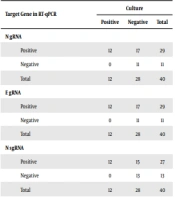
The correlation between molecular assay targeting gRNAs and sgRNAs and viral culture as the reference method was compared and presented in the 2 × 2 table (Table 4), and the diagnostic parameters and Cohen’s Kappa index were analyzed (Table 5). Based on the obtained data, E sgRNA detection indicated the best result in all diagnostic parameters, including sensitivity, specificity, PPV, NPV, and accuracy, and presented a good agreement result with virus recovery; nevertheless, others showed only a fair agreement.
Table 4.
Correlation Between Viral Culture and Quantitative Reverse Transcription-Polymerase Chain Reaction Based-Assay Targeting Genomic Ribonucleic Acids and Subgenomic Ribonucleic Acids
| Target Gene in RT-qPCR | Culture | ||
|---|---|---|---|
| Positive | Negative | Total | |
| N gRNA | |||
| Positive | 12 | 17 | 29 |
| Negative | 0 | 11 | 11 |
| Total | 12 | 28 | 40 |
| E gRNA | |||
| Positive | 12 | 17 | 29 |
| Negative | 0 | 11 | 11 |
| Total | 12 | 28 | 40 |
| N sgRNA | |||
| Positive | 12 | 15 | 27 |
| Negative | 0 | 13 | 13 |
| Total | 12 | 28 | 40 |
| E sgRNA | |||
| Positive | 12 | 6 | 18 |
| Negative | 0 | 22 | 22 |
| Total | 12 | 28 | 40 |
Abbreviations: RT-qPCR, quantitative reverse transcription-polymerase chain reaction; gRNA, genomic ribonucleic acid; sgRNA, subgenomic ribonucleic acid.
Table 5.
Assessment of Diagnostic Parameters and Cohen’s Kappa Index from Severe Acute Respiratory Syndrome Coronavirus 2 Quantitative Reverse Transcription-Polymerase Chain Reaction Based-Assay Targeting Genomic Ribonucleic Acids and Subgenomic Ribonucleic Acids
| Target Gene | Percentage of Diagnostic Parameters (95% CI) | Cohen’s Kappa | |||||
|---|---|---|---|---|---|---|---|
| Sensitivity | Specificity | PPV | NPV | Accuracy | Index Value | Interpretation a | |
| N gRNA | 100.00% (73.54 - 100) | 39.29% (21.50 - 59.42) | 41.38% (34.38 - 48.74) | 100.00% | 57.50% (40.89 - 72.96) | 0.28 | Fair agreement |
| E gRNA | 100.00% (73.54 - 100) | 39.29% (21.50 - 59.42) | 41.38% (34.38 - 48.74) | 100.00% | 57.50% (40.89 - 72.96) | 0.28 | Fair agreement |
| N sgRNA | 100.00% (73.54 - 100) | 46.43% (27.51 - 66.13) | 44.44% (36.17 - 53.04) | 100.00% | 62.50% (45.80 - 77.27) | 0.34 | Fair agreement |
| E sgRNA | 100.00% (73.54 - 100) | 78.57% (59.0 - 91.70) | 66.67% (49.60 - 80.26) | 100.00% | 85.00% (70.16 - 94.29) | 0.69 | Good agreement |
Abbreviations: PPV, positive predictive value; NPV, negative predictive value; gRNA, genomic ribonucleic acid; sgRNA, subgenomic ribonucleic acid.
a Henry et al. (27)
As expected, most cases of NPS samples collected before antiviral treatment or at the first time of enrollment exhibited a concordant positive result between viral culture and sgE detection, indicating the presence of replication-competent SARS-CoV-2. However, the negative result of culture alone or together with sgE negative was observed in a few cases. These different negative result patterns might be due to a lower sensitivity of the culture method, improper sample collection, or good anti-SARS-CoV-2 immunity in certain patients. After treatment with antiviral drugs for > 5 days, likewise, most cases of collected NPS showed the agreement of negative results between viral culture and sgE detection, suggesting the absence of the active virus. However, some samples collected after treatment within 4 - 5 days presented inconsistent results indicating that the positive RT-qPCR for sgE assay was still observed; however, viral cultivation became undetectable. A persistent positive result after antiviral treatment was observed in numerous cases detected by RT-qPCR targeting N, E, and sgN, which was believed to be the remnant viral RNA. The sgE can become undetectably correlated with negative for culture, although gRNA detection was still positive at a low Ct value within the range of 23.64 to 26.33 (Table 3).
Based on the obtained results, the present study suggested that RT-qPCR for sgE detection might be used as an optional assay to determine the presence/absence of infectious SARS-COV-2 in clinical samples. However, quantitative analysis by sgE assay should be avoided since an average positive Ct value of E sgRNA was higher than others that correlated with the lower rate of gene expression.
5. Discussion
In the present in vitro study, the active replicating SARS-CoV-2 experiment setting could be detected by both viral culture and molecular assay targeting all genes. Although sgRNAs are transcribed within infected cells, positive sgRNA detection could be observed in cell supernatant, presumably due to sloughing infected cells or leakage of sgRNA after virus release. The experiment setting of nonactive replicating SARS-CoV-2 by antiviral treatment for 2 days showed unculturable results. The positive RT-qPCR result in each of the target genes was shown from cellular RNA at a comparable level with untreated antiviral drug conditions. It was probably because the used antiviral drugs did not disrupt the synthesis process of all gRNAs and sgRNAs after virus entry, or the detection time might be too early to observe viral genome degradation.
A reduction of viral RNA expression from degradation might be observed if the sample was collected in a prolonged experiment; unfortunately, the current cell-based study impeded that process. Notably, undetectable RT-qPCR result was only observed from sgE gene detection in supernatant; however, other genes were still presented even at a lower level than the untreated condition. The plausible explanation of false positives might occur through the remaining trace amount of intact SARS-CoV-2 after the absorption process. Additionally, although N sgRNA should not be detected in this case, a previous study reported that trace amounts of N sgRNA can be packaged into virions (28). Therefore, the initial evaluation previously carried out by the same researchers exhibited a promising role of sgE RNA as a surrogate marker for replication-competent SARS-CoV-2.
Then, the researchers performed a pilot study by testing an SYBR green one-step RT-qPCR targeting N and E sgRNAs from 40 leftover NPS samples of 28 volunteers diagnosed with COVID-19 positive. The samples were collected at different time points, before and after receiving antiviral drugs, to perform viral culture and probe-based one-step RT-qPCR targeting N and E gRNAs. Significantly, the E sgRNA detection assay indicated a good agreement with the viral culture that was better than other compared genes. The highest sensitivity of E sgRNA for unculturable virus identification was shown at the Ct value of other gRNAs and N sgRNA within the range of 23-26. Furthermore, E sgRNA distinguished noncultivable SARS-CoV-2 from the prolonged persistent positive of other genes detected in the sample collected on the 11th day after treatment.
Due to the limited sensitivity of the culture method that requires a minimum active viral load or sometimes needs several blind subpassages for viral recovery, negative viral culture results with positive sgRNA should be carefully interpreted by the assessment of the clinical data or the time of virus exposure (14). In symptomatic patients, it should not be assumed as they are no longer infectious. On the other hand, for asymptomatic patients, when patients were likely exposed to the virus was a key decision to determine how much is the risk of ongoing transmission or the suitable time for ending the quarantine.
The conflicting conclusions on the assessment of SARS-CoV-2 infectivity using sgRNA marker from previous studies were probably resulted from the difference in the types of sgRNA (6, 16, 20, 21, 29). Studies that evaluated sgRNAs expressing near the 3' end of the genome, such as sgN or sgOrf7, showed a high correlation with gRNA detection; therefore, using these markers could not apply as viability markers (20, 29). Prolonged persistent RT-PCR positive in sgN or sgOrf7 might be due to a higher-level expression when compared to other sgRNAs, such as sgE, that is far from 3’ end; therefore, it might take a longer time to degrade (16). Additionally, it has been postulated that viral RNA intermediate transcription might be protected from nuclease by convoluted membranes and cellular double-membrane vesicles (20). On the other hand, the E sgRNA detection assay in this study and recent studies (6, 30) assisted in the identification of the existence of replication-competent SARS-CoV-2 in clinical samples collected from the beginning of symptom onset and persistent gRNA-positive cases. Bruce et al. (30) reported that using specific testing for sgE can serve as an effective rule-out test for viral infectivity.
Therefore, the findings of the present study suggested the detection of E sgRNA as an alternative approach to indicate the presence of infectious SARS-CoV-2. This could help distinguish individuals who still have an active viral infection from those who are no longer contagious, especially in persistently RT-PCR positive cases in whom a prolonged active infection was observed in some immunocompromised hosts. Positive sgE detection might be more accurate if it was assessed with patient clinical symptoms, the duration time after virus exposure, or SARS-CoV-2 immune response status.