
1. Background
The coronavirus disease 2019 (COVID-19) pandemic appeared as a result of an expeditious spread of the severe acute respiratory syndrome coronavirus 2 (SARS-CoV-2), leading to abysmal effects on the lives of people worldwide (1). The clinical course of COVID-19 varies from a symptomless infection to multisystem organ damage and death (2). The COVID-19 pandemic led to a drastic death toll, reducing overall life expectancy by 1.5 years in 2020 (3). Despite the production of several vaccines and medications, the mortality rate in patients affected by COVID-19 infection remains high, indicating the need to develop more effective therapeutic strategies (4).
Reports worldwide suggest that certain supplements could be potential candidates for adjuvant therapy. However, the efficacy of these supplements has not been thoroughly evaluated (5). Since lower levels of circulating trace elements were detected in COVID-19 patients, questions were raised about the possible advantages of these minerals in treating COVID-19 infection. Trace elements contribute to various processes, which modulate immune responses and also perform as cofactors for several antioxidant molecules. Deficient concentrations of these elements can influence innate and adaptive immune functions, predisposing individuals to severe infectious diseases (6). In critically ill patients, mineral deficiencies are accompanied by an elevation in free radical production and an attenuation in the systemic inflammatory processes, thereby directly participating in cell death and a higher mortality risk (7).
Previous studies have investigated the role of different trace elements in treating COVID-19 infection. However, a systematic review reported that up to 2022, no trial had assessed selenium's prophylactic or therapeutic effects in COVID-19 patients (8). As an antioxidant and anti-inflammatory agent, selenium is influentially involved in the glutathione peroxidase system (9). Before the current pandemic, several clinical trials had studied the impact of this element on the clinical outcomes of individuals suffering from critical conditions. However, the results appeared to be controversial. In a meta-analysis conducted by Allingstrup and Afshari (10) in 2015, selenium supplements appeared to reduce mortality in critically ill patients. Nevertheless, a year later, Manzanares et al. (11) observed that selenium supplementation neither lowered the mortality rate nor improved the clinical outcomes of critically ill patients.
2. Objectives
Given the known antioxidant and anti-inflammatory properties of selenium and the lack of clinical trials on the effects of selenium supplementation on the course of COVID-19, we conducted this study to monitor the efficacy and safety of selenium supplementation in COVID-19 patients. We hypothesized that selenium supplementation could improve the clinical outcomes of individuals affected by COVID-19.
3. Methods
3.1. Study Design and Participants
This open-label randomized controlled trial was conducted at Shahid Mostafa Khomeini Hospital in Ilam, Iran, in 2021. The inclusion criteria were as follows: Hospitalized patients aged 18 to 65 years who were diagnosed with COVID-19 infection based on a positive RT-PCR test, clinical and para-clinical evidence, including a respiratory rate of ≥ 30 per minute, arterial oxygen saturation lower than 90%, and arterial oxygen partial pressure to fractional inspired oxygen (PaO2/FiO2) ratio < 300 mmHg (12). The exclusion criteria were as follows: Acute renal failure, chronic kidney disease, pregnancy or breastfeeding, history of allergic reaction to selenium, pneumonia due to viral, bacterial, and fungi microorganisms or noninfectious causes, cirrhosis, a prior history of active or latent forms of tuberculosis, and acquired immunodeficiency syndrome. The sample size was calculated based on the formula below, considering the confidence interval of 95%, a type 1 error of 5%, a type 2 error of 20%, and a power of 80%. As this research needed follow-up, we considered the possibility of dropping samples; hence, there were five additional participants in each group, and the total sample size was 100 (13).
Figure 1 illustrates the studied population's CONSORT 2010 flow diagram (14). A total of 100 subjects who met the inclusion criteria were recruited. Participants were randomized and divided at a 1:1 ratio into two groups utilizing a simple permuted block randomization method. Participants in the control group were treated according to the hospital’s protocol for the treatment of COVID-19, which consisted of 400 mg of hydroxychloroquine twice daily on day one, thenceforth 200 mg twice daily. The intervention group received a selenium capsule in a daily dose of 200 micrograms in addition to 400 mg of hydroxychloroquine twice daily on day one, thenceforth 200 mg twice daily.
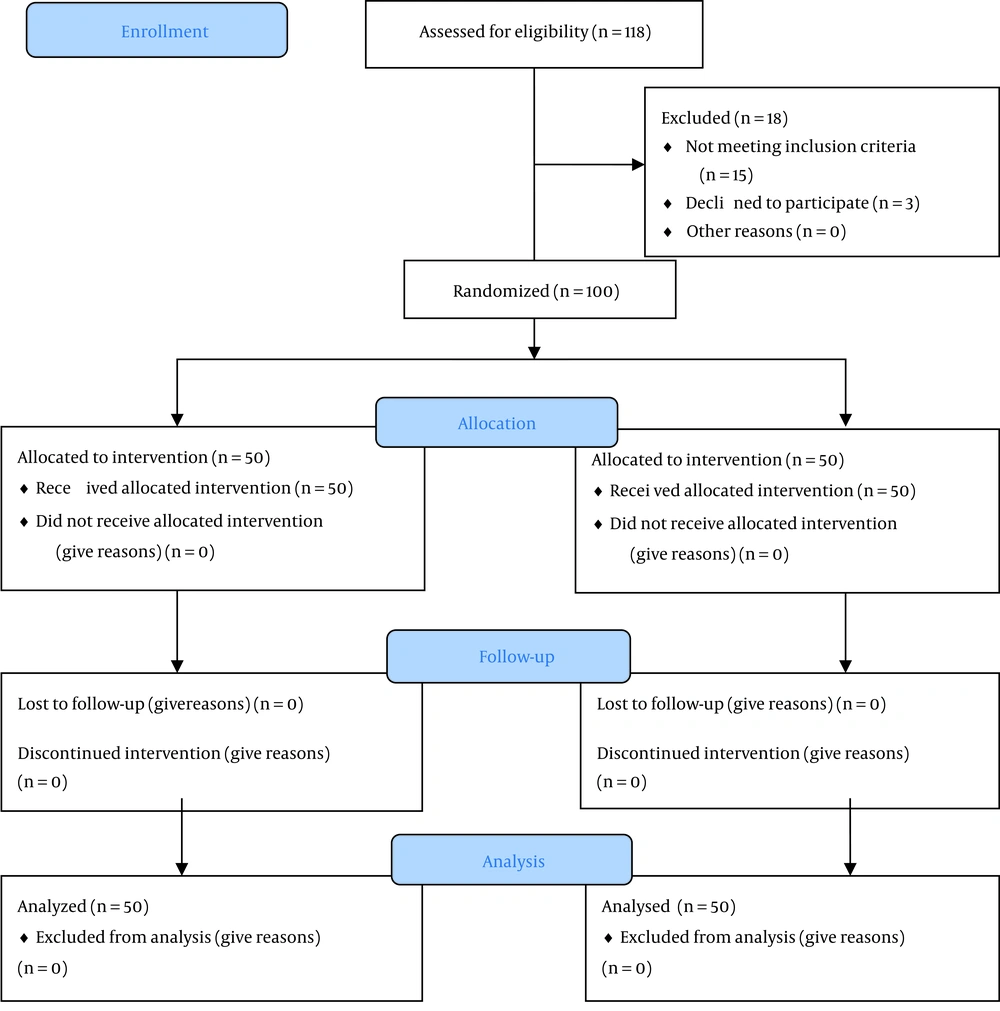
Figure 1.
CONSORT 2010 flow diagram (14) for the studied population
3.2. Data Collection
Data related to age, gender, duration of hospitalization, period of mechanical ventilation dependency, and laboratory tests, including white blood count (WBC), hemoglobin, platelet, ferritin, erythrocyte sedimentation rate (ESR), and c-reactive protein (CRP) values of patients diagnosed with COVID-19 were collected and recorded in the follow-up form on the 1st and 14th day. Laboratory tests and length of stay were considered the study outcomes.
3.3. Statistical Analysis
Quantitative variables were described as mean and standard deviation (SD). The independent samples t-test and the repeated measures ANOVA were used to compare the mean of quantitative variables in different groups. The statistical analyses were conducted in STATA software version 12 at a 0.05 significance level.
3.4. Ethical Considerations
The study was approved by the Research Ethics Committee of Ilam University of Medical Sciences with the ethical code IR.MEDILAM.REC.1399.010. Written, informed, and voluntary consent was obtained from all participants in the study. The patients were assured that non-participation in the survey would not prevent them from receiving routine treatments. Hence, the principles of the Declaration of Helsinki were observed.
3.5. Study Protocol Registration
This trial was registered at the Iranian Registry of Clinical Trials with the identifier IRCT20190418043307N1.
4. Results
4.1. Demographic Data
Data related to gender, age, and BMI are listed in Table 1. The mean age in the selenium and control groups were 56.54 ± 17.91 and 57.14 ± 18.31 years, respectively.
Table 1.
Characteristics of the Patients Hospitalized for COVID-19 in the Selenium and Control Groups
| Characteristics | Control Group | Selenium Group |
|---|---|---|
| Age (y) | 57.14 ± 18.31 | 56.54 ± 17.91 |
| Weight (kg) | 66.00 ± 13.3 | 69.2 ± 14.4 |
| BMI (kg/m2) | 27.1 ± 5.0 | 28.3 ± 5.7 |
4.2. Laboratory Findings
On the 14th day after intervention, platelets, WBC, and hemoglobin increased significantly in the selenium group compared to their pre-treatment levels (P < 0.05). At the same time, a considerable drop was detected in ESR, CRP, and ferritin (P < 0.05). Please refer to Table 2 for additional data.
Table 2.
Distribution of Pre- and Post-intervention Laboratory Values in the Selenium and Control Groups
| Groups | Before Intervention | 14th Day | P-Value |
|---|---|---|---|
| WBC | 0.05 | ||
| Selenium | 9.49 ± 4.62 | 12.26 ± 2.33 | |
| Control | 8.80 ± 4.81 | 9.34 ± 3.11 | |
| Platelet count (1000/µL) | 0.04 | ||
| Selenium | 228 ± 71 | 243 ± 75 | |
| Control | 230 ± 83 | 239 ± 68 | |
| ESR (mm/hour) | 0.02 | ||
| Selenium | 71.6 ± 28.8 | 39.4 ± 36.5 | |
| Control | 68.9 ± 27.3 | 35.5 ± 34.2 | |
| CRP (mg/dL) | < 0.001 | ||
| Selenium | 4.6 ± 1.3 | 0.98 ± 0.5 | |
| Control | 3.9 ± 0.2 | 2.2 ± 0.1 | |
| Ferritin (mg/dL) | < 0.001 | ||
| Selenium | 275.4 ± 11.1 | 259 ± 9.6 | |
| Control | 279.0 ± 12.3 | 273 ± 10.9 | |
| Hemoglobin (g/dL) | 0.04 | ||
| Selenium | 12.9 ± 1.9 | 15.2 ± 1.2 | |
| Control | 12.1 ± 0.1 | 13.9 ± 0.5 |
Abbreviations: WBC, white blood count; ESR, erythrocyte sedimentation rate; CRP, c-reactive protein.
4.3. Clinical Outcomes
The mean hospital stay duration in the selenium and control groups were 9.27 ± 13.50 and 11.45 ± 14.33 days, respectively (P = 0.401). The mean mechanical ventilation dependency days in the selenium and control groups were 9.65 ± 11.71 and 7.45 ± 4.93, respectively, which showed no statistically significant difference (P = 0.307). Table 3 tabulates further information.
Table 3.
Comparison of Clinical Outcomes of Patients in Control and Intervention Groups
| Characteristics | Selenium Group | Control Group | P-Value |
|---|---|---|---|
| Hospitalization time (days) | 9.27 ± 13.50 | 11.45 ± 14.33 | 0.401 |
| Mechanical ventilation dependency (days) | 7.45 ± 4.93 | 9.65 ± 11.71 | 0.307 |
5. Discussion
This study investigated the effects of selenium supplementation on clinical and paraclinical outcomes in COVID-19 patients. Selenium supplementation led to an increase in platelets, WBC, and hemoglobin and a reduction in ESR, CRP, and ferritin levels.
Direct indications that selenium could affect the COVID-19 course and the outcome of patients are limited and from observational studies. Nevertheless, based on prior experience with selenium adjuvant therapy for SARS and other viral infections, we highlight evidence suggesting dietary supplements' roles in promoting host resistance against viral infections. Selenium supplementation seems to be a beneficial add-on treatment for critically ill patients; however, there are some discrepancies in previous findings. Several studies have shown that this trace element can boost the proliferation of T lymphocytes and natural killer (NK) cells and the activities of the innate immune system (15, 16). The results of a previous work demonstrated that selenium supplementation in a dose of 200 µg/d boosted the cytotoxicity of CD8+ T cells, the lytic activity of NK cells, and the number of lymphocyte populations in human peripheral blood (16). Besides, Sakr et al. (17) reported that plasma selenium concentrations reversely correlated with inflammatory markers, including interleukin 6, CRP, and leucocyte count.
Concerning COVID-19 infection, the data on selenium supplementation are mostly restricted to observational findings. Selenium has been proposed as a micronutrient influential in the immune and inflammatory systems, which can aid in recognizing patients at a higher risk (18). In this regard, Im et al. (19) showed that selenium shortage in COVID-19 patients attenuated the immune responses and resulted in accelerated disease progression. A study conducted by Majeed et al. (20) in the Indian population revealed that plasma selenium concentrations were lower in COVID-19 patients than in the healthy control group.
In a prospective analysis performed by Razeghi Jahromi et al., although a drop in CRP levels accompanied elevated selenium levels, no remarkable association was found between disease severity and selenium levels (21). As reported in a retrospective study, arginine combined with other micronutrients, including selenium, shortened the length of stay and duration of ventilation in COVID-19 cases (22). On the contrary, the findings of Ramezaninejad et al. demonstrated that regarding the survival rate and need for ventilation, recipients of vitamin C, D, and selenium were not fundamentally different from patients who did not receive these supplements (23). It should be noted that in their study, only eight subjects received selenium, which might be insufficient to provide conclusive evidence.
The available data on the implication of selenium in COVID-19 are primarily observational, while randomized controlled trials are the only reliable methodology to verify the efficacy and safety of such interventions. A review article recommended that clinical studies with large sample sizes be conducted to confirm the potential benefits of selenium for reducing the incidence or severity of COVID-19 (24). Although our findings indicated that selenium supplementation reduced some inflammatory markers, this evidence may be insufficient to justify routine selenium supplementation to treat COVID-19 patients.
Overall, the results of the present work provided evidence that may benefit future research. However, due to possible limitations that might affect the generalizability of the findings, the results of this study should be treated with caution.
5.1. Limitations
This was an open-label trial, and the control group did not receive a placebo. Due to the study's novelty, we couldn't analyze some variables, such as lung involvement extent, recovery rates, and impact of other treatments.
5.2. Conclusions
Fulfilling the body's nutritional requirements is crucial for optimal immune system performance, improving COVID-19 patient survival rates. In this study, we focused on the importance of selenium in strengthening the immune system. The present study showed that after the intervention, the inflammatory markers decreased in the majority of patients. Since COVID-19 patients have reportedly low levels of several trace elements, it would be feasible to assume that nutritional deficiencies can influence the onset and progression of COVID-19. Hence, repeated measurements of blood parameters could help determine the prognosis of COVID-19 patients and monitor the efficacy of treatment.