Cover image of the article: The Impact of Hemoperfusion on Clinical Outcomes in Severe COVID-19 Patients: A Retrospective Propensity Score-Matched Study

Image Credit:Arch Clin Infect Dis

The Impact of Hemoperfusion on Clinical Outcomes in Severe COVID-19 Patients: A Retrospective Propensity Score-Matched Study

Authors

Meysam Safi KeykalehMeysam Safi Keykaleh ORCID1, Komeil Malmir2, Ehsan Movahedi -Tabar2, Akbar Rahnama2, Mohamad Reza Tavakoli3,*
1Nahavand School of Medical Sciences, Hamadan University of Medical Sciences, Hamadan, Iran
2Department of Critical Care Nursing, Dr. Gharazi Hospital, Hamadan, Iran
3Internal Medicine Specialist of Dr. Gharazi Hospital, Hamadan, Iran
*Corresponding Author: Internal Medicine Specialist of Dr. Gharazi Hospital, Hamadan, Iran. Email: meysam.safikeykaleh27@gmail.com

Archives of Clinical Infectious Diseases:Vol. 21, issue 2; e171705
Published online:Apr 30, 2026
Article type:Brief Report
Received:Mar 05, 2026
Accepted:Apr 17, 2026
How to Cite:Safi Keykaleh M, Malmir K, Movahedi -Tabar E, Rahnama A, Tavakoli MR. The Impact of Hemoperfusion on Clinical Outcomes in Severe COVID-19 Patients: A Retrospective Propensity Score-Matched Study. Arch Clin Infect Dis. 2026;21(2):e171705. doi: https://doi.org/10.5812/archcid-171705

Abstract

Background:

Severe COVID-19 is frequently complicated by hyperinflammation and is associated with a high mortality rate.

Objectives:

Adjunctive hemoperfusion (HP) aims to remove inflammatory mediators; however, its clinical benefits remain controversial.

Methods:

This retrospective 1:1 propensity score-matched case-control study included 70 patients with severe COVID-19 who were admitted to the intensive care unit (ICU) at Dr. Gharazi Hospital, Malayer, Iran, from March 2020 to September 2022. Patients received adjunctive HP using Jafron cartridges plus standard care (n = 35) or standard care alone (n = 35).

Results:

After matching, baseline characteristics were well balanced. Adjunctive hemoperfusion was associated with a significantly greater reduction in C-reactive protein (46% ± 14% vs. 18% ± 9%; P < 0.001), a greater improvement in peripheral oxygen saturation (SpO2; +7% ± 2% vs. +2% ± 1%; P = 0.01), a shorter ICU length of stay (11.2 ± 4.1 vs. 16.5 ± 5.8 days; P = 0.03), and a lower need for mechanical ventilation (40.0% vs. 62.9%; P = 0.04). In-ICU mortality was numerically lower in the HP group (20.0% vs. 34.3%; P = 0.08) but did not reach statistical significance. No procedure-related deaths occurred.

Conclusions:

In this propensity-matched cohort, adjunctive hemoperfusion was associated with attenuated systemic inflammation, improved oxygenation, a reduced need for mechanical ventilation, and a shorter ICU stay. These findings should be interpreted cautiously given the retrospective design.

1. Background

A dysregulated hyperinflammatory response (cytokine storm) is common in severe COVID-19 and can result in endothelial dysfunction, acute respiratory distress syndrome, multiorgan failure, and high mortality (1-3). Despite the use of corticosteroid and antiviral therapies in some patients, those with refractory hyperinflammation generally have a poor prognosis (4, 5).
Extracorporeal blood purification, particularly hemoperfusion (HP), has been adopted as a supportive therapy to remove circulating inflammatory mediators. Several studies and meta-analyses have shown reductions in inflammatory markers with HP; however, its effects on clinical outcomes, including mortality and mechanical ventilation, have been inconsistent (6, 7). Previous studies have been conducted mainly in high-resource settings, and data from resource-limited environments remain limited.

2. Objectives

This retrospective, propensity score-matched study was designed to evaluate the associations between adjunctive hemoperfusion and inflammation, oxygenation, mechanical ventilation, intensive care unit (ICU) length of stay, and mortality among patients with severe COVID-19 in a resource-limited ICU in Iran.

3. Methods

3.1. Study Design and Setting

This retrospective, 1:1 propensity score-matched case-control study was conducted in the ICU of Dr. Gharazi Hospital, Malayer, Iran, from March 2020 to September 2022. The study was approved by the Ethics Committee of Hamadan University of Medical Sciences (IR.UMSHA.REC.1400.865), and informed consent was waived because of the retrospective design and the use of deidentified data.

3.2. Participants and Eligibility

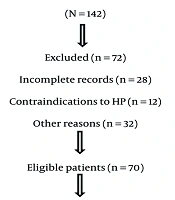
A total of 142 patients with severe COVID-19 were screened. The inclusion criteria were age ≥ 18 years, a positive severe acute respiratory syndrome coronavirus 2 polymerase chain reaction result, compatible chest imaging findings, and severe disease (respiratory rate > 25/min, SpO2 < 90% on room air, or PaO2/FiO2 < 200). The exclusion criteria were coagulopathy contraindicating extracorporeal therapy, hypersensitivity to cartridge materials, or substantially incomplete records. Finally, 70 patients were included after 1:1 propensity score matching (Figure 1).
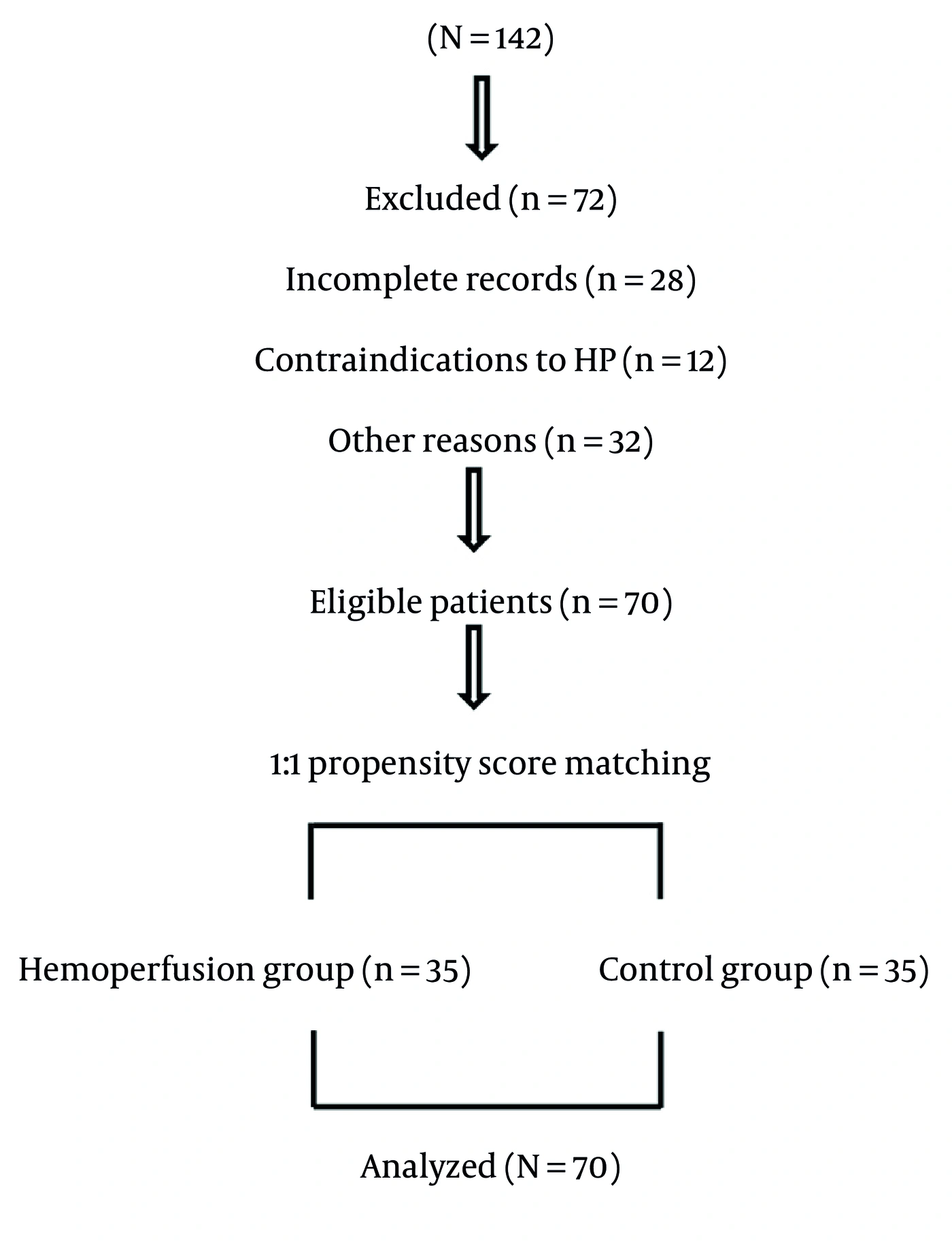
Flow diagram of the study participants
Figure 1.
Flow diagram of the study participants

3.3. Intervention

Patients in the hemoperfusion group received a median of 2 HP sessions (IQR, 1 - 3) per patient. Each session was performed on a Fresenius platform using Jafron cartridges and lasted 3 - 6 hours. The median interval from ICU admission to the first session was 38 hours (IQR, 24 - 52). Blood flow ranged from 150 to 200 mL/min, and unfractionated heparin was used for anticoagulation. Hemoperfusion was initiated when the C-reactive protein (CRP) level was > 80 mg/L or the PaO2/FiO2 ratio was < 150 mm Hg after routine treatment. Co-interventions were similar between the 2 groups (Table S1 in the Supplementary File).

3.4. Propensity Score Matching and Statistical Analysis

Propensity score matching was performed to balance age, sex, diabetes, hypertension, and the baseline PaO2/FiO2 ratio. A 1:1 nearest-neighbor matching approach with a caliper of 0.1 was used. All standardized mean differences after matching were < 0.10. Given the matched design, paired statistical tests were applied as appropriate, including the paired t test, Wilcoxon signed-rank test, and McNemar test. Logistic regression was used to obtain adjusted odds ratios. All data were analyzed using SPSS, version 26. A P value < 0.05 was considered statistically significant.

4. Results

After 1:1 propensity score matching, 35 patients were included in each group, for a total of 70 patients with severe COVID-19. Demographic and clinical characteristics were evenly distributed between the hemoperfusion and control groups (Table 1).
Table 1.
Demographic and Baseline Clinical Characteristics of the Study Participants a
VariablesHP Group (n = 35)Control Group (n = 35)P-Value
Age (y)63.4 ± 11.262.9 ± 10.80.81
Gender0.79
Male21 (60)22 (63)
Female14 (40)13 (37.1)
Diabetes14 (40)15 (43)0.84
Hypertension16 (46)17 (49)0.77
Initial PaO2/FiO2 (mm Hg)138 ± 42141 ± 390.72
a Values are expressed as mean ± SD or No. (%).
Adjunctive hemoperfusion was associated with a significantly greater reduction in CRP (46% ± 14% vs. 18% ± 9%; P < 0.001) and a greater improvement in SpO2 (+7% ± 2% vs. +2% ± 1%; P = 0.01) at 48 hours (Table 2).
Table 2.
Changes in Inflammatory and Oxygenation Parameters Before and After the Intervention
ParametersHP GroupControl GroupP-Value
CRP reduction a46 ± 1418 ± 9< 0.001
Preintervention CRP (mg/L) b82.4 ± 12.179.8 ± 13.50.52
Postintervention CRP (mg/L) b43.2 ± 8.765.5 ± 11.9< 0.001
SpO2 improvement a7 ± 22 ± 10.01
a Values are expressed as % ± SD.
b Values are expressed as mean ± SD.
ICU length of stay (11.2 ± 4.1 vs. 16.5 ± 5.8 days, respectively; P = 0.03) and the use of invasive mechanical ventilation (40.0% vs. 62.9%, respectively; P = 0.04) were significantly lower in the hemoperfusion group. In-ICU mortality was numerically lower in the hemoperfusion group (20.0% vs. 34.3%; P = 0.08) but did not reach statistical significance (Table 3).
Table 3.
Primary Clinical Outcomes in the Hemoperfusion and Control Groups a
OutcomeHP GroupControl GroupP-Value
Mortality7 (20)12 (34.3)0.08
ICU length of stay (d)11.2 ± 4.116.5 ± 5.80.03
Need for mechanical ventilation14 (40)22 (62.9)0.04
a Values are expressed as No. (%) or mean ± SD.
Adjusted odds ratios are presented in Table 4. The most frequent adverse events in the hemoperfusion group were transient hypotension (22.9%), electrolyte imbalance (14.3%), and chills or low-grade fever (8.6%). All events were managed with supportive care, and no procedure-related deaths occurred.
Table 4.
Adjusted Odds Ratios for the Main Binary Clinical Outcomes
OutcomeAdjusted OR95% CIP-Value
Need for mechanical ventilation0.390.16 - 0.940.036
In-ICU mortality0.470.19 - 1.220.119

5. Discussion

This study showed that adjunctive hemoperfusion was associated with a significantly greater reduction in systemic inflammation, improved oxygenation, a shorter ICU stay, and a reduced need for mechanical ventilation among patients with critical COVID-19. In-ICU mortality was numerically lower in the hemoperfusion group than in the control group (20.0% vs. 34.3%; P = 0.08).
These results are consistent with previous studies and meta-analyses demonstrating beneficial effects of hemoperfusion on inflammatory markers and certain physiological parameters, although its effect on survival remains unclear (6, 8, 9). The timing of hemoperfusion initiation may be relevant. In this study, early administration of HP within 48 hours of ICU admission was associated with improved outcomes. This finding aligns with previous reports indicating that early intervention may be more effective before irreversible organ damage occurs (10).
Patients with COVID-19 may have comorbid conditions that contribute to mortality. Other adjunctive therapies, such as statins, have also been investigated, with inconsistent effects on outcomes (11, 12). In small hospitals and clinics with limited resources, hemoperfusion may represent a useful treatment option because more sophisticated treatment modalities are often unavailable.
Hemoperfusion may act by adsorbing circulating cytokines, including interleukin 6, tumor necrosis factor α, and interleukin 1β, thereby attenuating the cytokine storm; this mechanism is biologically plausible (13). However, the benefit may be short-lived because of cytokine rebound and cartridge variability.

5.1. Limitations

This study has several limitations. First, its single-center retrospective design may have introduced selection and information bias despite the use of propensity score matching. Second, the sample size (n = 70) was small and did not provide sufficient statistical power to detect differences in mortality. Third, cytokines such as interleukin 6 and tumor necrosis factor α were not measured serially because doing so was not logistically feasible in this resource-limited setting. Fourth, follow-up data after ICU discharge were not assessed. Finally, the number of hemoperfusion sessions was not uniform and was left to the physician's discretion. These limitations highlight the need for larger, multicenter prospective studies to validate these findings.

5.2. Conclusions

Adjunctive hemoperfusion was associated with improved intermediate clinical outcomes, including reduced systemic inflammation, improved oxygenation, a reduced need for mechanical ventilation, and a shorter ICU stay. In-ICU mortality was also numerically lower in the hemoperfusion group (20.0% vs. 34.3%), but the difference was not statistically significant (P = 0.08).
Hemoperfusion may be considered an adjunctive treatment in resource-limited settings, particularly when initiated early. Larger multicenter trials are needed to confirm these observations and determine its effect on survival.
Acknowledgments

Footnotes

  • AI Use Disclosure:The authors declare that no generative AI tools were used in the creation of this article.

  • Authors' Contribution:M. S. K. and M. R. T. conceived and designed the study and supervised the work; K. M., E. M-T., and A. R. collected the clinical data; M. S. K. and M. R. T. performed the statistical analysis; M. S. K. drafted the manuscript. All authors critically revised and approved the final manuscript and agreed to be accountable for the accuracy and integrity of the work.

  • Conflict of Interests Statement:The authors declare no conflicts of interest. The hemoperfusion cartridges were provided as part of routine clinical care and not sponsored by the manufacturer.

  • Data Availability:The data presented in this study are uploaded during submission as a supplementary file and are openly available for readers upon request.

  • Ethical Approval:The study was approved by the Institutional Ethics Committee of Hamadan University of Medical Sciences, Hamadan, Iran (approval code: IR.UMSHA.REC.1400.865).

  • Funding/Support:The Vice-Chancellor for Research at Hamadan University of Medical Sciences has approved financial support for this project in 2025 (Grant agreement: No. 140102061880).

References

  • 1.
    Huang C, Wang Y, Li X, Ren L, Zhao J, Hu Y, et al. Clinical features of patients infected with 2019 novel coronavirus in Wuhan, China. The Lancet. 2020;395(10223):497-506. [PubMed ID: 31986264]. [PubMed Central ID: PMC7159299]. https://doi.org/10.1016/S0140-6736(20)30183-5.
  • 2.
    Zhou F, Yu T, Du R, Fan G, Liu Y, Liu Z, et al. Clinical course and risk factors for mortality of adult inpatients with COVID-19 in Wuhan, China: a retrospective cohort study. The Lancet. 2020;395(10229):1054-62. [PubMed ID: 32171076]. [PubMed Central ID: PMC7270627]. https://doi.org/10.1016/S0140-6736(20)30566-3.
  • 3.
    Mehta P, McAuley DF, Brown M, Sanchez E, Tattersall RS, Manson JJ. COVID-19: consider cytokine storm syndromes and immunosuppression. The Lancet. 2020;395(10229):1033-4. [PubMed ID: 32192578]. [PubMed Central ID: PMC7270045]. https://doi.org/10.1016/S0140-6736(20)30628-0.
  • 4.
    Fajgenbaum DC, June CH. Cytokine storm. New England journal of medicine. 2020;383(23):2255-73. [PubMed ID: 33264547]. [PubMed Central ID: PMC7727315]. https://doi.org/10.1056/NEJMra2026131.
  • 5.
    Siddiqi HK, Mehra MR. COVID-19 illness in native and immunosuppressed states: A clinical–therapeutic staging proposal. The Journal of Heart and Lung Transplantation. 2020;39(5):405-7. [PubMed ID: 32362390]. [PubMed Central ID: PMC7118652]. https://doi.org/10.1016/j.healun.2020.03.012.
  • 6.
    Shang S, Zhang B, Wu B, Dou Y, Zhang L, Sun W. The efficacy of hemoperfusion in severe COVID-19 patients: a systematic review and meta-analysis. Blood Purif. 2025;54(7):384-403. [PubMed ID: 40367933]. https://doi.org/10.1159/000546256.
  • 7.
    Ronco C, Bagshaw SM, Bellomo R, Clark WR, Husain-Syed F, Kellum JA, et al. Extracorporeal blood purification and organ support in the critically ill patient during COVID-19 pandemic: expert review and recommendation. Blood purification. 2021;50(1):17-27. [PubMed ID: 32454500]. [PubMed Central ID: PMC7270067]. https://doi.org/10.1159/000508125.
  • 8.
    Soleimani A, Taba SMM, Hasibi Taheri S, Loghman AH, Shayestehpour M. The effect of hemoperfusion on the outcome, clinical and laboratory findings of patients with severe COVID-19: a retrospective study. New Microbes and New Infections. 2021;44. 100937. [PubMed ID: 34490065]. [PubMed Central ID: PMC8410636]. https://doi.org/10.1016/j.nmni.2021.100937.
  • 9.
    Kusirisin P, Noppakun K, Trongtrakul K, Vongsanim S, Suteeka Y, Ophascharoensuk V, et al. Efficacy of the cytokine adsorption therapy in patients with severe COVID-19-associated pneumonia: lesson learned from a prospective observational study. Blood Purification. 2024;53(1):10-22. [PubMed ID: 37918373]. [PubMed Central ID: PMC11251652]. https://doi.org/10.1159/000534914.
  • 10.
    Hashemian SM, Jafari A, Khoundabi B, Jamaati H, Rahimi P. Hemoperfusion Combined With Continuous Renal Replacement Therapy in the Management of ARDS COVID‐19 Patients: A Quasi‐Experimental Study. Health Science Reports. 2025;8(4). e70571. [PubMed ID: 40177411]. [PubMed Central ID: PMC11961550]. https://doi.org/10.1002/hsr2.70571.
  • 11.
    Nilav A, Karimi Rouzbahani A, Mahmoudvand G, Zavari T. Evaluation of the Effect of Underlying Diseases on Mortality of COVID-19 Patients: A Study of 19,985 Cases. Jundishapur Journal of Microbiology. 2022;15(11). https://doi.org/10.5812/jjm-133603.
  • 12.
    Bahadori R, Dodangeh S, Nabavi SA, Allami A. Effect of Statin Treatment on COVID-19 Patients', Outcomes: A Randomized Double-blind Controlled Clinical Trial. J Inflammatory Dis. 2022;26(2). https://doi.org/10.32598/JID.26.2.8.
  • 13.
    Peng JY, Li L, Zhao X, Ding F, Hou X, Peng Z. Hemoperfusion with CytoSorb® in critically ill COVID-19 patients. Blood purification. 2022;51(5):410-6. [PubMed ID: 34407530]. [PubMed Central ID: PMC8450818]. https://doi.org/10.1159/000517721.

Copyright

Copyright © 2026, Safi Keykaleh et al. This open-access article is available under the Creative Commons Attribution 4.0 (CC BY 4.0) International License (https://creativecommons.org/licenses/by/4.0/), which allows for unrestricted use, distribution, and reproduction in any medium, provided that the original work is properly cited.

Similar Articles

26
Aug
2023
The Efficacy of High-Dose Pulse Therapy vs. Low-Dose Intravenous Methylprednisolone on Severe to Critical COVID-19 Clinical Outcomes: A Randomized Clinical Trial

The Efficacy of High-Dose Pulse Therapy vs. Low-Dose Intravenous Methylprednisolone on Severe to Critical COVID-19 Clinical Outcomes: A Randomized Clinical Trial

Zahra Sahraei,
Parnaz Panahi,
Kouroush Solhjoukhah,
Maryam Mesbah,
Siamak Afaghi,
Mahdi Amirdosara
,et al.

Sahraei Z, Panahi P, Solhjoukhah K, Mesbah M, Afaghi S, et al. The Efficacy of High-Dose Pulse Therapy vs. Low-Dose Intravenous Methylprednisolone on Severe to Critical COVID-19 Clinical Outcomes: A Randomized Clinical Trial. Iran J Pharm Res. 2023;22(1):e137838. doi: https://doi.org/10.5812/ijpr-137838

11
Sep
2022
Efficacy of Dexamethasone and Methylprednisolone in Hospitalization Outcomes of COVID-19 Patients: A Comparative Retrospective Study

Efficacy of Dexamethasone and Methylprednisolone in Hospitalization Outcomes of COVID-19 Patients: A Comparative Retrospective Study

Mohammad Amin Abbasi,
Amir Ziaee,
Alireza Hejrati,
Seyyed Alireza Hosseini,
Lina Hejrati,
Shahin Keshtkar Rajabi

Abbasi MA, Ziaee A, Hejrati A, Hosseini SA, Hejrati L, et al. Efficacy of Dexamethasone and Methylprednisolone in Hospitalization Outcomes of COVID-19 Patients: A Comparative Retrospective Study. Arch Clin Infect Dis. 2022;17(2):e129727. doi: https://doi.org/10.5812/archcid-129727

7
Aug
2021
Comparison of the Eight Different Treatment Regimens for the Hospitalized Patients with COVID-19: A Retrospective Cohort Study

Comparison of the Eight Different Treatment Regimens for the Hospitalized Patients with COVID-19: A Retrospective Cohort Study

Mohammad Haji Aghajani,
Elham Porheidar,
Omid Moradi,
asma Pourhosseingoli,
Nilofar Taherpour,
Armineh Barootkoob
,et al.

Haji Aghajani M, Porheidar E, Moradi O, Pourhosseingoli A, Taherpour N, et al. Comparison of the Eight Different Treatment Regimens for the Hospitalized Patients with COVID-19: A Retrospective Cohort Study. J Cell Mol Anesth. 2021;6(4):e151632. doi: https://doi.org/10.22037/jcma.v6i4.35553

15
Feb
2024
Effect of High-Dose Vitamin D on Mortality and Hospital Length of Stay in ICU Patients with COVID-19: A Randomized Clinical Trial

Effect of High-Dose Vitamin D on Mortality and Hospital Length of Stay in ICU Patients with COVID-19: A Randomized Clinical Trial

MohammadHosein Zamanian,
Zohreh Javadfar,
Yahay Salimi,
Mehr Ali Rahimi,
Elham Rabieenia,
Akram Rahimi

Zamanian M, Javadfar Z, Salimi Y, Rahimi MA, Rabieenia E, et al. Effect of High-Dose Vitamin D on Mortality and Hospital Length of Stay in ICU Patients with COVID-19: A Randomized Clinical Trial. J Kermanshah Univ Med Sci. 2024;28(1):e140510. doi: https://doi.org/10.5812/jkums-140510

30
Jan
2024
Investigation of the Effectiveness of Tocilizumab on COVID-19 Patients: A Retrospective Study

Investigation of the Effectiveness of Tocilizumab on COVID-19 Patients: A Retrospective Study

Behnaz Khodabakhshi,
Romina Masoumifar,
Mahdi Mazandarani,
Narges Lashkarbolouk,
Gholamreza Roshandel

Khodabakhshi B, Masoumifar R, Mazandarani M, Lashkarbolouk N, Roshandel G. Investigation of the Effectiveness of Tocilizumab on COVID-19 Patients: A Retrospective Study. Compr Health Biomed Stud. 2024;2(3):e151051. doi: https://doi.org/10.5812/chbs-151051

More by these authors

Meysam Safi KeykalehPubMedScholar
Komeil MalmirPubMedScholar
Ehsan Movahedi -TabarPubMedScholar
Akbar RahnamaPubMedScholar
Mohamad Reza TavakoliPubMedScholar
Share
Cited by
Metrics