
1. Background
Dengue remains one of the most important mosquito-borne viral infections worldwide, particularly in tropical and subtropical regions where Aedes aegypti and Aedes albopictus are widely distributed (1). Recent global estimates indicate a continuing increase in the dengue burden over recent decades, with transmission expanding in many endemic and emerging settings (2). Southeast Asia continues to account for a substantial share of this burden, with recurrent outbreaks placing pressure on households, schools, local health systems, and disease-control programs (3). Thailand is among the countries where dengue remains endemic, and prevention continues to rely heavily on vector control, early recognition of risk, and sustained community participation (4).
Although clinical management is essential for reducing severe outcomes and mortality, dengue prevention largely occurs outside clinical settings. Household practices, such as eliminating mosquito breeding sites, covering water containers, using repellents or protective barriers, and maintaining clean domestic environments, remain central to dengue control (5). Evidence from recent reviews suggests that technical vector-control strategies alone are often insufficient unless they are supported by community engagement, health education, and locally acceptable behavioral interventions (6, 7). For families with young children, these behaviors are particularly important because preschool children have limited ability to protect themselves from mosquito exposure and depend on parents or caregivers for daily prevention.
Parental dengue prevention behavior is shaped by several interacting factors. Individual perceptions, such as perceived risk, perceived severity, perceived benefits of prevention, and self-efficacy, may influence whether parents consistently implement preventive practices. At the same time, enabling factors, including access to preventive resources, and reinforcing factors, such as advice from health personnel, community health volunteers, schools, and the media, may strengthen or weaken preventive actions. Recent studies on dengue prevention have increasingly emphasized that behavior change requires more than knowledge alone; it requires repeated communication, social support, school-community collaboration, and interventions adapted to the local context (8-10).
2. Objectives
This study aimed to assess the levels of predisposing, enabling, and reinforcing factors and to identify the factors associated with dengue prevention behaviors among parents of preschool children in a dengue-endemic province of Thailand.
3. Methods
3.1. Study Design and Setting
A cross-sectional study was conducted to examine factors associated with dengue prevention behaviors among parents of preschool children attending private schools in Samut Songkhram Province, Thailand. The study was conducted in five private schools under the Ministry of Education in Mueang Samut Songkhram District: Darunanukul School, Prakob Wittaya School, Kong Li Jian Min School, Sarasas Witaed Samut Songkhram School, and Lomrak Maeklong School. Samut Songkhram is a dengue-endemic province with environmental conditions that may support Aedes mosquito breeding, including residential areas, water storage practices, and a humid climate.
3.2. Participants and Sampling
The study population comprised parents of preschool children from five private schools in Samut Songkhram Province. In this study, the term "parents" refers to parents or primary caregivers responsible for the child’s daily care. Based on school records, the total population was 862 parents, with one parent representing each child. The sample size was calculated using the Krejcie and Morgan formula (11), with a 95% confidence level, a 5% margin of error, and a population proportion of 0.50. The minimum required sample size was 266 participants. After adding 20% to account for potential nonresponse or incomplete questionnaires, the target sample was 320 parents.
Stratified random sampling was used to obtain proportional representation from each school. The target sample was allocated across schools according to the number of preschool children enrolled in each school: Darunanukul School, 93; Prakob Wittaya School, 17; Kong Li Jian Min School, 34; Sarasas Witaed Samut Songkhram School, 49; and Lomrak Maeklong School, 127. After proportional allocation, simple random sampling was used to select eligible parents within each school.
In total, 320 parents were invited to participate. Of these, 267 returned complete questionnaires and were included in the final analysis, yielding a completion rate of 83.4%. Questionnaires with incomplete responses were excluded before analysis. Respondent and nonrespondent characteristics could not be compared because no personal data were collected from nonrespondents.
3.3. Research Instrument
Data were collected using a structured, self-administered questionnaire developed from the literature on dengue prevention behaviors, the Health Belief Model, community-based dengue control, and school- and household-level prevention practices (1, 6, 12-14). The questionnaire assessed parental perceptions, enabling resources, reinforcing support, and dengue prevention behaviors and comprised five sections.
Section 1 assessed demographic characteristics, including sex, age, religion, education level, occupation, duration of residence, and reported awareness of dengue illness among family members. This section included seven categorical items.
Section 2 assessed predisposing factors related to dengue prevention and was developed based on Health Belief Model constructs used in dengue prevention studies (1, 12, 13). It included four domains: perceived susceptibility to dengue infection, 10 items; perceived severity of dengue, 12 items; perceived benefits of dengue prevention, 8 items; and perceived self-efficacy in dengue prevention, 12 items. The first three domains were rated on a five-point Likert scale from 1 = strongly disagree to 5 = strongly agree. The self-efficacy domain was rated from 1 = definitely cannot do to 5 = definitely can do. Higher scores indicated stronger perceptions and greater confidence in dengue prevention. The Cronbach’s alpha coefficient for this section was 0.92.
Section 3 assessed enabling factors, specifically resource adequacy, based on the household dengue prevention and vector-control literature (6, 14). It included five items related to the availability of materials or resources for preventing mosquito breeding and mosquito bites. Each item was scored as 1 = adequate and 0 = inadequate. The total enabling-factor score ranged from 0 to 5, with higher scores indicating greater resource availability. For descriptive reporting, the score was categorized as inadequate or adequate; for regression analysis, the continuous enabling-factor score was used. The Cronbach’s alpha coefficient for this section was 0.90.
Section 4 assessed reinforcing factors, based on literature emphasizing health personnel, community health volunteers, school-community collaboration, and risk communication in dengue prevention (6, 14, 15). It included three domains: advice from health personnel, 12 items; advice from village health volunteers, 12 items; and dengue-related information from other sources, 9 items. Items were rated on a three-point scale from 1 = never to 3 = often. Higher scores indicated greater reinforcing support. The Cronbach’s alpha coefficient for this section was 0.82.
Section 5 assessed dengue prevention behaviors using 14 items covering mosquito-breeding-site elimination, mosquito-bite prevention, household environmental management, and participation in dengue prevention activities (6, 13, 14). Items were rated on a five-point scale from 1 = never practice to 5 = always practice. The total possible score ranged from 14 to 70, and the mean score was used for interpretation and regression analysis. Higher scores indicated more frequent dengue prevention behaviors. The Cronbach’s alpha coefficient for this section was 0.90.
For five-point scales, mean scores were interpreted as low, 1.00 - 2.33; moderate, 2.34 - 3.66; and high, 3.67 - 5.00. For three-point scales, mean scores were interpreted as low, 1.00 - 1.67; moderate, 1.68 - 2.35; and high, 2.36 - 3.00.
3.4. Data Collection
Data were collected between January and March 2026 after ethical approval was obtained. The researchers coordinated with school administrators to identify eligible parents and explain the study procedures. Participants received information regarding the study purpose, voluntary participation, confidentiality, and the right to withdraw at any time. Written informed consent was obtained before data collection. Questionnaires were distributed in paper-based or online formats according to participant convenience and required approximately 20 - 30 minutes to complete. Returned questionnaires were checked for completeness before data entry. Only complete questionnaires were included in the final analysis.
3.5. Statistical Analysis
Data were analyzed using IBM SPSS Statistics version 29.0. Descriptive statistics were used to summarize participant characteristics and study variables. Frequencies and percentages were used for categorical variables, whereas means and standard deviations were used for continuous variables. Multiple linear regression analysis was performed to identify factors associated with dengue prevention behaviors. Predisposing factors, enabling factors, and reinforcing factors were entered as independent variables, and the dengue prevention behavior mean score was entered as the dependent variable. The enabling factor was entered as a continuous score rather than the adequate/inadequate classification.
Regression assumptions were assessed before model interpretation. Linearity and homoscedasticity were examined using residual plots. Normality of residuals was assessed using a histogram and a normal probability plot. Multicollinearity was assessed using variance inflation factor and tolerance values. Influential observations were examined using standardized residuals and Cook’s distance. Demographic variables were described but were not included as covariates in the main model because the study aimed to examine associations of predisposing, enabling, and reinforcing factors with dengue prevention behaviors. Therefore, the findings were interpreted as unadjusted cross-sectional associations. Statistical significance was set at P < 0.05.
4. Results
4.1. Participant Characteristics
A total of 320 parents were invited to participate, and 267 completed questionnaires were included in the final analysis, yielding a completion rate of 83.4%. Most participants were female (75.3%), aged 31 - 40 years (41.6%), and Buddhist (97.8%). Table 1 summarizes the demographic characteristics of the participants.
Table 1.
Participant Characteristics of Parents of Preschool Children (N = 267) a
| Characteristics | No. (%) |
|---|---|
| Gender | |
| Female | 201 (75.3) |
| Male | 66 (24.7) |
| Age, y | |
| 20 - 30 | 91 (34.1) |
| 31 - 40 | 111 (41.6) |
| 41 - 50 | 50 (18.7) |
| 51 - 60 | 15 (5.6) |
| Religion | |
| Buddhist | 261 (97.8) |
| Islam | 2 (0.7) |
| Christian | 4 (1.5) |
| Education level | |
| No formal education | 2 (0.7) |
| Primary education | 21 (7.9) |
| Secondary education | 106 (39.7) |
| Bachelor’s degree | 126 (47.2) |
| Higher than bachelor’s degree | 12 (4.5) |
| Occupation | |
| Government officer/state enterprise employee | 45 (16.9) |
| General employee | 55 (20.6) |
| Farmer | 6 (2.2) |
| Trading/private business | 98 (36.7) |
| Unemployed | 33 (12.4) |
| Other | 30 (11.2) |
| Duration of residence, y | |
| Less than 1 | 7 (2.6) |
| 1 - 2 | 29 (10.9) |
| 3 - 5 | 52 (19.5) |
| More than 5 | 179 (67.0) |
| Awareness of dengue illness among family members | |
| Yes | 170 (63.7) |
| No | 97 (36.3) |
a Percentages may not total 100.0 because of rounding.
4.2. Levels of Predisposing, Enabling, and Reinforcing Factors
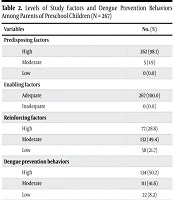
Most participants were classified as having high overall predisposing-factor scores related to dengue prevention (98.1%), whereas 1.9% were classified as having moderate scores. For enabling factors, all participants were classified as having adequate dengue prevention resources. However, this classification was based on the categorized resource score; the continuous enabling-factor score was retained for regression analysis. Reinforcing factors were predominantly at a moderate level (49.4%), followed by high (28.8%) and low levels (21.7%) (Table 2).
Table 2.
Levels of Study Factors and Dengue Prevention Behaviors Among Parents of Preschool Children (N = 267)
| Variables | No. (%) |
|---|---|
| Predisposing factors | |
| High | 262 (98.1) |
| Moderate | 5 (1.9) |
| Low | 0 (0.0) |
| Enabling factors | |
| Adequate | 267 (100.0) |
| Inadequate | 0 (0.0) |
| Reinforcing factors | |
| High | 77 (28.8) |
| Moderate | 132 (49.4) |
| Low | 58 (21.7) |
| Dengue prevention behaviors | |
| High | 134 (50.2) |
| Moderate | 111 (41.6) |
| Low | 22 (8.2) |
Although most participants were classified as having high overall predisposing-factor scores, the domain-level mean scores were in the moderate range. This difference reflects the use of different summary approaches: Table 2 presents categorical classifications, whereas Table 3 presents mean domain scores.
Table 3.
Mean Scores of Predisposing and Reinforcing Factors Related to Dengue Prevention (N = 267) a
| Variables | Mean ± SD | Interpretation |
|---|---|---|
| Predisposing factors | ||
| Perceived susceptibility to dengue | 2.97 ± 0.16 | Moderate |
| Perceived severity of dengue | 2.86 ± 0.34 | Moderate |
| Perceived benefits of dengue prevention | 2.95 ± 0.19 | Moderate |
| Perceived self-efficacy in dengue prevention | 2.95 ± 0.21 | Moderate |
| Overall predisposing factors | 2.93 ± 0.23 | Moderate |
| Reinforcing factors | ||
| Advice from health personnel | 2.04 ± 0.64 | Moderate |
| Advice from village health volunteers | 2.03 ± 0.65 | Moderate |
| Dengue-related information from other sources | 2.03 ± 0.62 | Moderate |
| Overall reinforcing factors | 2.03 ± 0.63 | Moderate |
a Abbreviation: SD, standard deviation.
4.3. Dengue Prevention Behaviors
Overall, 50.2% of parents reported a high level of dengue prevention behavior, 41.6% reported a moderate level, and 8.2% reported a low level. The dengue prevention behavior scale consisted of 14 items rated on a five-point scale, with a possible total score ranging from 14 to 70. The mean behavior score was used as the outcome variable in the regression analysis (Table 3).
4.4. Factors Associated with Dengue Prevention Behaviors
Multiple linear regression showed that predisposing, enabling, and reinforcing factors were significantly associated with dengue prevention behaviors. The model was significant and explained 28.1% of the variance (R2 = 0.281, adjusted R2 = 0.274, F = 34.39, P < 0.001). Reinforcing factors showed the strongest association (β = 0.39, P < 0.001), followed by enabling factors (β = 0.16, P < 0.01) and predisposing factors (β = 0.15, P < 0.01) (Table 4).
Table 4.
Multiple Linear Regression Analysis of Factors Associated with Dengue Prevention Behaviors Among Parents of Preschool Children (N = 267) a
| Predictors | B | SE | β | t | P-Value |
|---|---|---|---|---|---|
| Constant | -0.67 | 0.74 | - | -0.90 | 0.36 |
| Predisposing factors | 0.72 | 0.25 | 0.15 | 2.88 | < 0.01 |
| Enabling factors | 0.28 | 0.10 | 0.16 | 2.66 | < 0.01 |
| Reinforcing factors | 0.35 | 0.05 | 0.39 | 6.62 | < 0.001 |
a The dependent variable was the dengue prevention behavior mean score. The enabling factor was entered as a continuous score. Model summary: R2 = 0.281, adjusted R2 = 0.274, F = 34.39, P < 0.001. Abbreviations: B, unstandardized coefficient; SE, standard error; β, standardized coefficient; R2, coefficient of determination.
Regression diagnostics indicated that the assumptions of linearity, normality of residuals, and homoscedasticity were acceptable. Multicollinearity was not evident based on variance inflation factor and tolerance values. No influential observations were identified based on standardized residuals and Cook’s distance.
5. Discussion
This study found that approximately half of the parents of preschool children reported high levels of dengue prevention behavior, whereas a considerable proportion reported moderate or low levels. This finding is important because dengue prevention continues to depend heavily on sustained household and community practices, particularly the removal of mosquito breeding sites, the prevention of mosquito bites, and environmental management around homes and schools (2, 3, 16). Although dengue control increasingly includes newer strategies such as improved surveillance, vaccination, Wolbachia-based approaches, and spatial repellents, routine family-level prevention remains essential in endemic settings where Aedes mosquitoes breed close to human dwellings (5, 7, 17). The present findings suggest that parents of preschool children may already engage in several preventive behaviors; however, the proportion with only moderate practices indicates that prevention may not be consistent or sufficiently sustained. This is particularly relevant for preschool children, who depend on parents and caregivers for protection from mosquito exposure and may be less able to recognize or avoid risk environments independently (18-20).
Predisposing factors were significantly associated with dengue prevention behaviors, supporting previous evidence that perceived susceptibility, perceived severity, perceived benefits, and self-efficacy are important determinants of dengue-related preventive action (12, 13, 21). However, the domain-level results showed that parental perceptions were generally moderate, with perceived severity scoring lower than the other domains. This may indicate that some parents practice prevention because of routine school or community expectations rather than a strong internal perception of dengue severity. Similar findings have been reported in studies using the Health Belief Model, in which knowledge alone was not always sufficient to sustain dengue prevention unless accompanied by perceived risk, perceived benefits, and confidence in performing preventive behaviors (12, 22, 23). In infectious disease prevention, this gap is important because dengue may be perceived as familiar or seasonal, which can reduce urgency even when outbreaks recur. Therefore, risk communication should not only provide general information about dengue but also help parents understand why severe dengue can occur, why young children require protection, and how simple household actions can reduce risk (4).
The finding that all participants were classified as having adequate enabling resources should be interpreted carefully. This descriptive result indicates that, after categorization, all participants met the threshold for adequate resources. However, variation remained in the continuous enabling-factor score used in the regression analysis. Therefore, the significant association between enabling factors and dengue prevention behaviors reflects differences in the degree of resource availability rather than differences between adequate and inadequate groups. This finding suggests that even when basic resources are available, greater availability or more consistent access to prevention materials may still support better dengue prevention behaviors.
The strongest association with dengue prevention behavior in this study was with reinforcing factors, including advice from health personnel, village health volunteers, and dengue-related information sources. This finding highlights the importance of social reinforcement and repeated communication in dengue control. Previous studies and reviews have shown that community participation, school-based health education, and locally adapted interventions can improve dengue knowledge, attitudes, and practices, especially when messages are reinforced through trusted community networks (6, 8, 9). In Thailand and other Southeast Asian settings, village health volunteers and school personnel can serve as practical links between public health agencies and families. However, reinforcing factors in this study were mostly moderate, suggesting that existing communication may not be frequent, specific, or continuous enough to support long-term behavior change. Strengthening school–family–health sector collaboration may therefore be a useful strategy, particularly through parent education, regular mosquito-breeding-site checks, digital reminders, and coordinated campaigns before and during dengue transmission seasons (24, 25).
Because this study used a cross-sectional design, the observed associations should not be interpreted as evidence of causality or intervention effectiveness. Predisposing, enabling, and reinforcing factors were measured at the same time as dengue prevention behaviors; therefore, temporality cannot be established. The findings should be interpreted as identifying factors associated with prevention behaviors and as informing future intervention design, rather than demonstrating that changes in these factors will directly improve prevention behaviors.
This study has several strengths. It focused on parents of preschool children, a group highly relevant to dengue prevention but less frequently examined than general adult populations or school-aged children. The study also used a structured framework that included predisposing, enabling, and reinforcing factors, allowing a broader understanding of parental prevention behavior beyond knowledge alone. In addition, stratified random sampling across five private schools improved representation within the study setting.
Several limitations should also be acknowledged. First, the cross-sectional design limits causal interpretation and precludes conclusions about temporal relationships between predictors and prevention behaviors. Second, dengue prevention behaviors were self-reported and may have been affected by recall or social desirability bias. Third, the study was conducted among parents from private schools in one province, which may limit generalizability to public schools, rural communities, or households with different socioeconomic backgrounds. Fourth, characteristics of nonrespondents were not available; therefore, potential nonresponse bias could not be fully assessed. Finally, the regression model was unadjusted for demographic covariates and explained 28.1% of the variance in dengue prevention behaviors, indicating that other factors, such as household structure, environmental conditions, previous dengue experience, school policy, local outbreak intensity, and access to public health campaigns, should be explored in future studies.
5.1. Conclusions
Dengue prevention behaviors among parents of preschool children were significantly associated with predisposing, enabling, and reinforcing factors. Reinforcing factors, including advice from health personnel, village health volunteers, and dengue-related information sources, showed the strongest association with prevention behaviors. Because of the cross-sectional design, these findings should be interpreted as associations rather than causal effects. School-based dengue prevention programs should therefore use these findings to guide future intervention planning, with an emphasis on continuous communication, parental self-efficacy, and coordinated support among families, schools, and community health services.